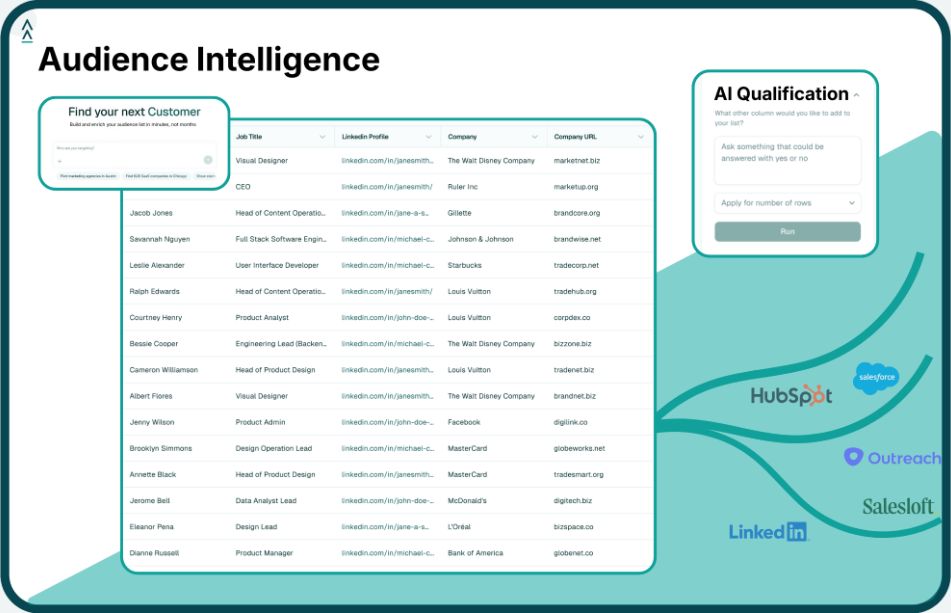
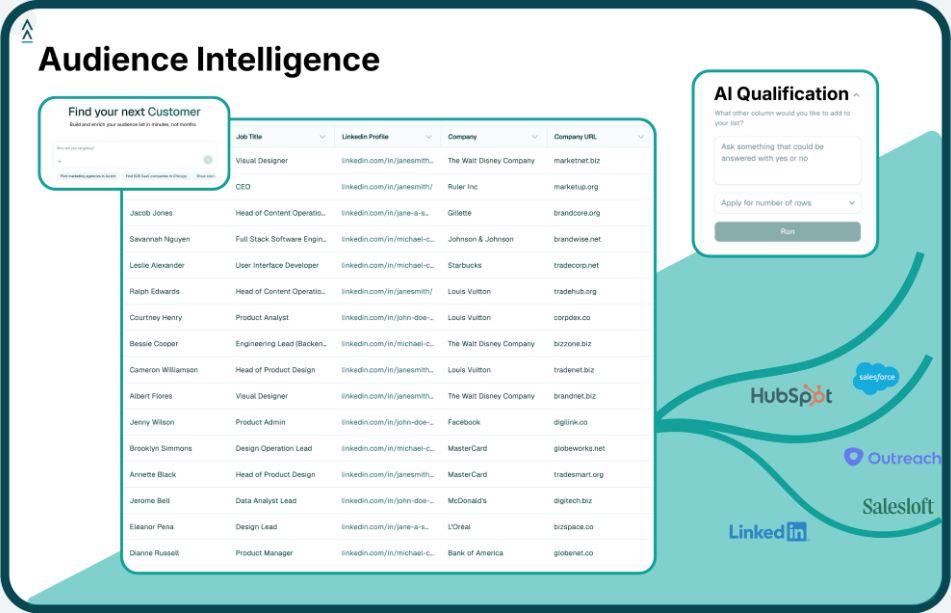
One thing is certain: data doesn’t stay fresh for long. Nearly one-third of B2B contact data becomes outdated each year, from job changes to company moves. This decay poisons pipelines and forces teams to waste time chasing bad leads. In fact, sales reps spend only 28% of their week actually selling – the rest is eaten up by admin tasks like updating records and hunting for prospects. The cost of poor data is enormous: Gartner estimates bad data quality costs companies $12.9 million annually on average. Traditional B2B databases and list providers simply aren’t keeping up with this reality. Their static, stale information leaves revenue teams frustrated and falling behind. It’s time for a new approach that combines real-time intelligence, multiple data sources, and AI-driven reasoning to find the right accounts faster. This is where agentic search comes in.
The Need for Agentic Search in B2B
The pain points of traditional B2B prospecting are well-documented. Data decays rapidly – B2B databases can lose 22–30% of their accuracy every year – yet many organizations still rely on static data dumps. A study by SiriusDecisions found 62% of companies are working with marketing databases that are 20–40% inaccurate. It’s no wonder sales teams struggle with bounced emails, wrong phone numbers, and contacts who left the company months ago. Nearly 45% of sellers say incomplete or outdated data is one of their biggest challenges, and reps end up spending precious hours cleaning up CRM records instead of engaging customers. (On average, almost 20% of a sales rep’s time is spent just updating the CRM!). All this inefficiency translates to missed opportunities and wasted budget.
Modern B2B go-to-market teams are also dealing with data overload in parallel with data gaps. Marketers today pull information from many sources – on average 18 different data sources for reporting – yet those sources often live in silos. Only 1 in 4 marketers say their marketing data is fully integrated across tools, meaning most teams lack a single, unified view of target accounts. Critical buying signals get lost in the noise, and teams often can’t connect the dots between, say, a firm’s new funding round, recent hiring spree, and their current product tech stack. The result? Sales might call on accounts that look good on paper but show no actual intent to buy, while truly prime prospects slip through unnoticed.
Clearly, B2B organizations need a better way to search for and qualify prospects – one that addresses data decay, cuts down manual research, and synthesizes the full context around potential buyers. Agentic search aims to solve these exact problems. By leveraging AI “agents” to do the heavy lifting, agentic search keeps data fresh, joins disparate sources, and surfaces the most relevant, high-converting targets. Before diving into how it works, let’s define what agentic search really means.
What Is Agentic Search?
Agentic search is a new paradigm for B2B prospecting and market intelligence. It refers to AI-driven search systems that act as autonomous agents, actively scouring multiple data sources and reasoning over them to fulfill a user’s query. In simple terms, agentic search lets you ask a complex question in natural language – for example, “fintech startups hiring in California” – and have the AI plan and execute a multi-step search to find exactly what you need. This goes far beyond traditional database lookup or even basic AI chat responses. As one industry expert explains, “Agentic search actively understands a user’s underlying intent, performs iterative queries, synthesizes information from multiple sources, and refines results to achieve a comprehensive answer.” In other words, the AI doesn’t just fetch data – it interprets, verifies, and analyzes data, much like a skilled research assistant working at superhuman speed.
The term “agentic” comes from agentic AI, meaning an AI system capable of taking autonomous actions on a user’s behalf. A truly agentic AI can handle multi-step tasks: it keeps context (memory of prior steps), uses reasoning to decide next actions, and can even invoke external tools or data sources as needed. Applied to B2B search, this means the AI might break down a broad prompt into sub-tasks, gather information from various databases and live web sources, cross-verify facts (e.g. checking a company’s LinkedIn for recent hires, scanning news sites for funding announcements), and then return a rich, context-filled result rather than a simple list of names. It’s a proactive, goal-driven approach. In traditional search, you get answers to exactly the question you typed; in agentic search, the AI can infer what you’re trying to accomplish and execute a strategy to deliver the best solution.
To illustrate, consider the difference: A legacy sales database might let you apply filters like industry = fintech, location = California, company size = 1–50. You’d get a list of companies, but many could be irrelevant or outdated. By contrast, an agentic search for “fintech startups hiring in California” will interpret “hiring” as a signal of growth (perhaps looking for companies with job postings or headcount increases), understand “fintech startup” to mean early-stage finance/tech firms, and cross-reference multiple sources to compile a list of California fintech startups currently expanding their teams. It essentially thinks and searches the way a human researcher would, but in real time and at massive scale. The result is a far more targeted and up-to-date set of prospects.
How Agentic Search Works in B2B
Agentic search brings together several advanced capabilities to revolutionize B2B audience building. The following are key components that make agentic search so powerful, especially compared to traditional methods:
- Natural-Language Queries: Instead of wrestling with clunky Boolean logic or endless filter menus, users can simply describe the audience or accounts they want. The agentic search engine’s AI model interprets the intent behind the query and translates it into an effective search strategy. This makes sophisticated prospecting accessible to anyone on the team. In fact, there is huge demand for this ease of use – more than 52% of data teams have either experimented with or want to adopt natural language tools for querying data. By understanding plain English (or any human language), agentic search eliminates the learning curve and allows RevOps or sales reps to search in a conversational way (“Show me mid-market manufacturers in the Midwest that recently opened new offices”). The AI will handle the rest.
- Multi-Source, Live Data Integration: An agentic search doesn’t rely on a single static database; it pulls in data from multiple sources simultaneously, including real-time web signals. For example, a platform might combine a core B2B contacts database (with firmographics on millions of companies) plus recent news articles, job postings, funding announcements, technographic data, and more. During the search, the AI agent can join these datasets on the fly – ensuring that each result is enriched with the latest intelligence. This addresses the notorious data decay problem head on. Rather than trusting year-old database entries, agentic search continuously cross-checks live sources to verify information. The difference is night and day: teams move from static lists to a living, breathing view of the market. B2B marketers today use an average of 18 data sources to inform their decisions, which historically meant a lot of manual merging and matching. Agentic search automates that heavy lifting, acting like a digital data analyst who instantly consolidates all relevant sources into one cohesive answer. No more flying blind with incomplete data.
- AI Reasoning & Signal Matching: Unlike a standard search that simply returns records matching a keyword, agentic search employs AI reasoning to evaluate which companies or contacts truly fit the intent of your query. It looks at behavioral and growth signals – for example, monitoring if a target company is showing buying intent. Are they ramping up hiring (potentially indicating expansion plans)? Did they recently raise a funding round (implying budget and initiative to invest)? Are they actively researching certain topics online (intent data)? Agentic search can incorporate these clues to prioritize high-potential prospects. This is often coupled with predictive scoring models that rank accounts by likelihood to convert. The benefit is huge: organizations that adopt AI-driven lead scoring see significantly better outcomes, with 50% more leads converting to sales and 33% lower customer acquisition costs, according to Forrester. In short, the agent doesn’t just find companies that meet your criteria – it finds the ones that meet your criteria and are statistically more likely to become customers, focusing your sales team on the best bets first.
- Context-Rich Results: With agentic search, each result comes with an explanation of “why” it was chosen and relevant data points that arm your team with insight. You’re not just handed a company name – you might see that Company X showed up because “they added 50 employees in the last 6 months (hiring growth), recently secured a Series B round, and have been searching for CRM software”. All that context is surfaced in one place. This level of detail empowers sales reps to have smarter conversations and marketers to craft more tailored campaigns. It’s a stark contrast to static lead lists that contain only basic firmographics. Rich context also builds trust in the results: when a sales rep understands why an account was recommended, they can approach it with confidence. Little wonder that 97% of B2B marketers say intent data (the kind of insight agentic search leverages) helps them find high-quality leads – quality here meaning prospects with a strong fit and real interest. Agentic search delivers those kinds of leads by providing both the data and the reason that data matters.
- Speed and Scale through Automation: Perhaps one of the most game-changing aspects is sheer efficiency. An AI agent can perform in seconds what might take an operations analyst or SDR weeks of research. Need a list of 500 target accounts that meet five different criteria and show buying signals in the past month? An agentic search can generate it almost instantly, combing through millions of records and the latest web intel without breaking a sweat. Some platforms even let you automatically generate and export thousands of verified contacts from a single prompt (e.g. up to 10,000 contacts matching your ICP, fully enriched with emails and phone numbers). This kind of automation frees up human teams to spend time on strategy and engagement rather than list-building. It also means you can refresh and iterate on targeting continuously – the moment market conditions change or new signals emerge, your search agent can update the prospect list. Given that sales teams use around 10 different tools and 70% of reps feel overwhelmed by tool overload, consolidating workflow with an agentic search tool can simplify the tech stack and boost productivity. In fact, nearly 90% of sales organizations plan to consolidate tools to give sellers more time to sell. Automating data gathering is a prime opportunity to do exactly that.
In combination, these capabilities make agentic search a transformative upgrade over legacy B2B search methods. It’s like moving from a yellow pages phonebook to a smart personal assistant that not only finds who you’re looking for, but dials the number and schedules the meeting for you. The next section highlights exactly how agentic search outshines traditional databases.
Agentic Search vs. Traditional B2B Search
It’s helpful to directly compare agentic search with the traditional status quo of B2B data providers and static databases. Here are some key differences:
- Freshness of Data: Traditional databases are updated infrequently (maybe quarterly or annually), so they start decaying the day you download them. As noted, roughly 30% of B2B data becomes inaccurate each year, which means a year-old contact list could be dangerously out of date. Agentic search, on the other hand, pulls live data and signals in real time for each query. The results you get reflect the current state of the market – new funding rounds, leadership changes, recent hires, etc. This continuous refresh dramatically improves data accuracy and ensures you’re acting on current information, not last quarter’s news.
- Single Source vs. Multi-Source: With a traditional provider, you often get one dataset (their proprietary database). If a piece of info isn’t in that dataset, you’re out of luck until you find it elsewhere. In fact, 93% of B2B marketers rely on multiple sources because no single source has it all. Agentic search has many sources baked in – it’s an aggregator of intelligence. It can cross-reference a company’s profile from a B2B database with, say, SEC filings or press releases, and even pull up their product reviews or patent filings if relevant. This holistic view means fewer blind spots. You won’t miss a promising prospect just because one database didn’t list them; the agent can find them via another avenue.
- Manual Filtering vs. AI Understanding: In a legacy tool, finding niche targets means manually applying filters and hope you guess the right fields. It’s a reactive process – you enter criteria and get whatever matches exactly those criteria (garbage in, garbage out). Agentic search is more proactive and intelligent. By understanding the intent, it might include results that are a logical fit even if they don’t neatly match a simple filter. For example, maybe you search for “companies adopting cloud ERP software.” A traditional approach might require you to pick specific technologies from a list. An agentic search could interpret that as looking for firms with recent job postings for NetSuite or Oracle Cloud admins, news mentions of ERP migrations, or hiring of IT roles – even if the user didn’t explicitly type those things. The AI fills in the blanks. This flexibility often yields a more comprehensive result set (and saves you from knowing every filter in advance).
- Static Outputs vs. Actionable Insights: A traditional database spit-out is just a list of companies/contacts with fields like industry, size, maybe a contact email. It’s then on your team to research why those names matter or how to approach them. Agentic search packages context with each result. As mentioned, you see the signals (e.g. “hiring 20% this quarter”, “opened new office in London”, “using AWS and Azure”), which immediately tells your sales or marketing team how to tailor their pitch. Moreover, agentic search systems often include built-in scoring or prioritization – highlighting the highest-impact accounts based on fit and behavior. Traditional lists treat every entry equally, leaving it to sales to figure out prioritization. The difference can be huge for productivity: one recent benchmark found that when companies implemented predictive/AI scoring, sales productivity increased by 33% alongside the higher lead conversion rates. In short, agentic search doesn’t just give you data, it gives you a data-driven game plan.
- One-Time Export vs. Continuous Exploration: With a static list, what you get is what you get – a snapshot in time. If you want to refine your criteria or explore a tangential idea, you often have to request a new list or run a new query and stitch results together. Agentic search is designed for an interactive experience. You can refine queries on the fly (“that’s too broad, let’s narrow to only those with >100 employees”) and the agent will iterate the search. It’s more akin to an analyst you can have a conversation with: “Show me fintech startups in California.” (Result comes back.) “Now among those, which ones have hiring spikes or recent funding?” (Agent refines the list and highlights those signals.) This iterative, conversational approach means you continuously learn from the data and can pivot to the next strategy seamlessly. In today’s fast-moving markets, this agility is a big advantage over static, one-and-done data pulls.
In summary, agentic search is dynamic, intelligent, and context-aware, whereas traditional B2B search is static, manual, and often fragmented. The shift is similar to moving from paper maps to GPS navigation – one is a fixed tool that you must interpret yourself, the other actively guides and adjusts to get you to your destination faster. Now let’s look at what this means for go-to-market teams in practice.
The Impact of Agentic Search on B2B Sales & Marketing
Adopting agentic search can be transformative for RevOps, sales, marketing, and growth teams alike. By automating data gathering and injecting intelligence into prospecting, it allows these teams to focus on high-value work: building relationships and crafting strategy. Here are a few ways agentic search drives impact:
- For Sales Teams: Reps get to spend more time selling to qualified prospects and less time researching or doing data entry. With better-targeted lists and in-context insights on why an account is a great fit, reps can have more relevant conversations. No more going in blind – if agentic search tells you a prospect is expanding and has pain points your product addresses, your outreach can be laser-focused. This boosts efficiency and morale; sellers are freed from the tedious lead gen grunt work. It’s worth noting that today reps use about 10 different tools to close deals and 69% feel selling is harder now than before. Agentic search can consolidate some of those tools (data sources, enrichment, scoring) into one workflow and simplify the job. The end result is higher productivity per rep and often a higher win rate, since reps are engaging the right accounts with the right context. High-performing sales orgs already recognize this – they are 2–6× more likely to have invested in data science, automation, and analytics in their sales process, all of which underpin agentic search capabilities.
- For Marketing Teams: Marketers benefit from being able to build very precise audiences for campaigns using natural language, without needing SQL or endless spreadsheets. Say the growth marketing team wants to run an ABM campaign targeting “late-stage SaaS companies in healthcare showing buying intent for security software.” In the past, that might require cobbling together firmographic lists, intent vendor data, and manual filtering. With agentic search, the marketer can literally input that description and get a ready-made audience list, complete with the signals that indicate intent (like content consumption or tech stack information). This accelerates campaign deployment and ensures marketing efforts focus on accounts in-market for your solution. It’s a data-driven marketer’s dream – no wonder 96%+ of B2B marketers report success when leveraging intent data in their strategy, and agentic search is a prime way to leverage it. Additionally, because the data is unified, marketing and sales can operate from the same source of truth (aligning on ICP definition, target account lists, etc.), improving sales-marketing coordination.
- For RevOps and Operations: RevOps leaders tasked with optimizing the revenue engine stand to gain a more efficient, insight-rich pipeline. Agentic search can dramatically reduce the need for periodic data cleanup projects or one-off list purchases, since the data is always current and verified at search time. This means lower data costs and better CRM hygiene over time. Ops teams can also set up automated workflows with agentic search – for instance, automatically refreshing target account lists each quarter based on the latest signals, or triggering alerts when an existing target account shows a new buying signal (like a surge in hiring or a new technographic match). By embedding these intelligent agents in the GTM process, RevOps can ensure the sales team is always working with up-to-date info and focusing on accounts with the highest propensity to buy. The ROI is tangible: companies that make data-driven targeting and AI a core part of their GTM see improvements in pipeline velocity and conversion rates. For example, one case study showed high-performing firms using AI for lead targeting achieved double the conversion rate of average firms. RevOps teams appreciate that kind of lift, especially in tight markets where efficiency is king.
- For Growth Strategy: At the leadership level (Growth, Strategy, or Business Development roles), agentic search provides a powerful market lens. Want to size a new segment or identify where untapped opportunities lie? The AI can rapidly surface patterns – e.g. showing which sub-industries have a cluster of companies with recent growth signals, or which competitor’s customers are showing intent that might make them ripe for poaching. It essentially enables on-demand market research. This helps leaders spot trends and adjust targeting strategy much faster than waiting for quarterly analytics reports. Moreover, because agentic search can be run by anyone with a question, teams can be more agile and experimental. A growth team might test five different ICP variations in a week to see which yields the most promising accounts, something that would have been prohibitively labor-intensive before. In short, agentic search fuels a more data-driven go-to-market strategy, where decisions on where to focus are backed by real-time evidence from across the market.
Finally, agentic search helps level the playing field. Smaller companies without huge analyst teams can now harness AI to compete with larger rivals in finding the best prospects. And for larger enterprises, it can supercharge existing teams by automating low-level tasks and surfacing insights that even armies of interns might miss. It’s no surprise industry analysts are bullish on this trend – they view agentic AI as a cornerstone of the future B2B tech stack, driving smarter revenue growth.
.png)
.png)


.png)