.png)
.png)

Daniel Saks
Chief Executive Officer


Go-to-market teams face mounting pressure to adopt AI across sales, marketing, and internal operations. The difference between high performers and everyone else often comes down to selecting tools that match specific GTM workflows rather than chasing feature lists.
This guide covers 18 AI tools that GTM teams are using to accelerate pipeline, improve attribution, automate internal support, and scale operations. Whether you need an all-in-one platform or specialized solutions for prospecting, analytics, or internal helpdesk automation, these platforms represent the leading options for 2026.
Best For: Slack-native internal helpdesk for IT, HR, and RevOps teams
Unthread transforms Slack channels into structured internal help desks, automatically converting conversations into trackable tickets with SLA management, routing, and workflow automation. Unlike tools that focus narrowly on access requests, Unthread supports a broader range of internal support workflows across IT, HR, finance, procurement, and legal teams.
Zero context-switching for both employees and support teams. Employees submit requests in familiar Slack channels like #it-help or through private DMs for sensitive HR matters. Support teams manage everything, including analytics, assignments, and escalations, without leaving Slack.
The platform handles sensitive requests with appropriate privacy controls. Employees can submit payroll questions, benefits inquiries, or policy requests through private ticketing flows that keep HR request handling inside Slack while maintaining confidentiality.
For RevOps teams coordinating cross-functional operations, Unthread provides the CRM integrations and automation capabilities needed to connect support workflows with Salesforce, HubSpot, and other GTM tools.
Demandbase delivers a comprehensive AI-native GTM platform, combining intelligence, advertising, sales enablement, and orchestration in a unified system. The platform's Agentbase AI Agents operate autonomously on a shared data set, enabling campaign optimization without manual intervention.
Demandbase customer Denodo reported 80% faster funnel velocity after implementation. The platform earned recognition as a Leader in the 2025 Gartner Magic Quadrant for Account-Based Marketing Platforms
HubSpot's Breeze Intelligence adds data enrichment, buyer intent, and form-shortening capabilities directly within HubSpot’s CRM. HubSpot’s broader Breeze AI offering also includes agents for workflows such as prospecting, customer support, content creation, and knowledge base generation.
Nearly half of venture-backed startups now commit 25% or more of their tech stack budget to AI tools. For teams already invested in HubSpot, Breeze provides a low-friction path to AI adoption.
Highspot positions itself as a unified platform for GTM enablement, covering content management, training, coaching, and buyer engagement in one system. The Nexus AI engine powers features like AI Role Play for sales training and Deal Agent for real-time selling guidance.
Gong captures and analyzes every customer interaction across calls, emails, and meetings. The platform extracts 300+ unique signals per opportunity using proprietary AI models trained specifically on revenue conversations rather than generic LLMs.
Users report a 34% uptick in response rates after implementing AI-generated email suggestions.
Clari focuses on revenue operations, providing AI-driven forecasting and pipeline visibility that helps GTM leaders predict outcomes with greater accuracy. The platform connects data from CRM, email, calendar, and conversation tools to build a complete picture of deal health.
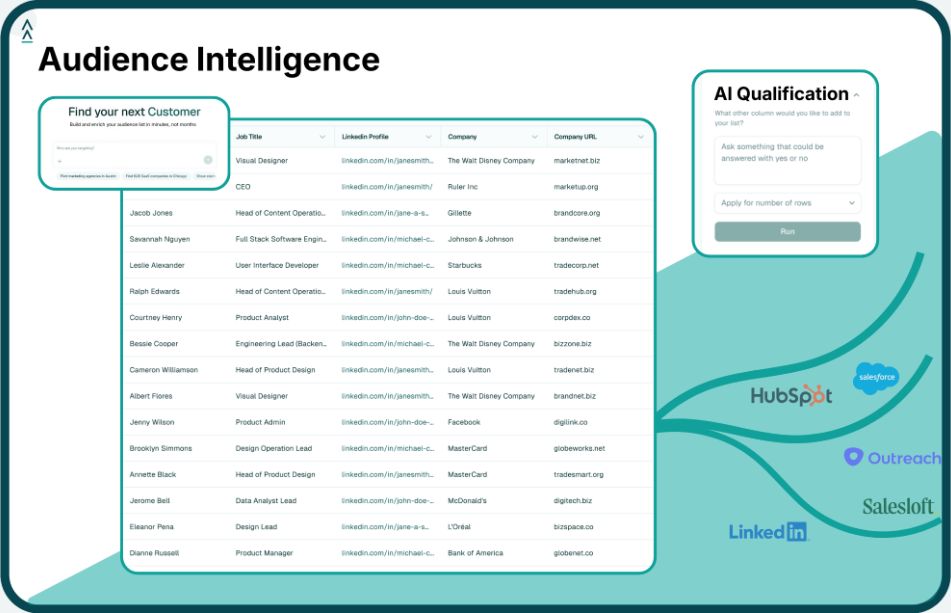
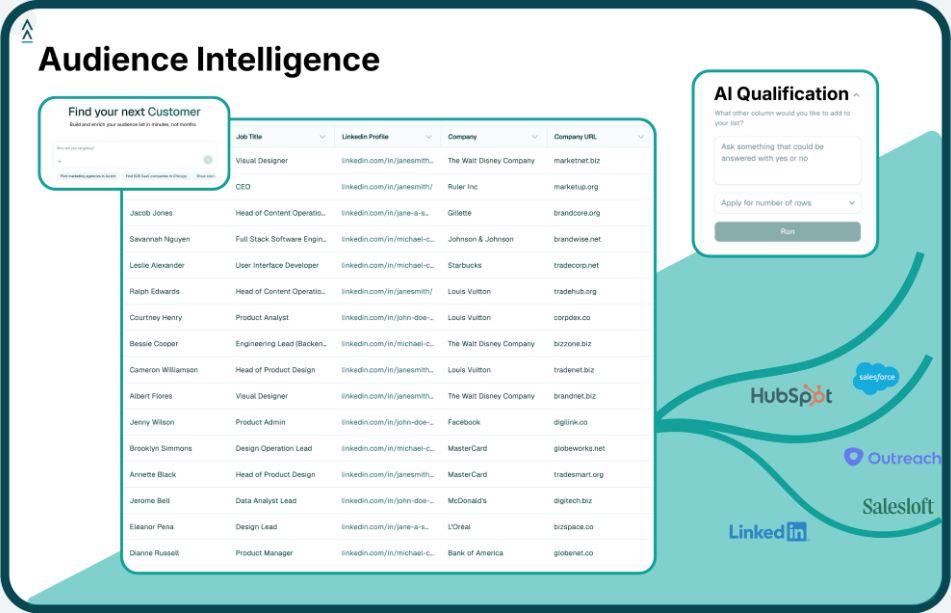
Clay combines waterfall enrichment across 150+ data providers with Claygent, an AI research agent that answers custom prospecting questions at scale. The spreadsheet-style interface lets teams build complex workflows without engineering support.
ZoomInfo provides access to a large B2B database that it currently describes as including 410M+ verified business contacts and 203 million companies, along with extensive company intelligence. The platform has evolved beyond a static database to include intent signals, engagement tracking, and workflow automation.
Crunchbase serves 80M+ users seeking company information, funding history, and market intelligence. The platform's AI capabilities include predictive insights about company growth and market trends.
6sense processes over 1 trillion daily signals to identify accounts showing buying intent before they engage directly. The platform powers account prioritization, personalization, and orchestration across marketing and sales.
Mutiny enables B2B marketers to personalize website experiences for target accounts without engineering resources. The AI suggests personalization opportunities based on visitor segments and past performance data.
11x.ai offers Alice, an AI sales development representative that handles prospecting, outreach, and meeting booking autonomously. The platform targets teams looking to scale outbound without proportionally increasing headcount.
UserGems tracks when contacts change jobs and surfaces these signals as warm pipeline opportunities. The Gem-E AI agent automates outreach to former customers and champions who have moved to new accounts.
Outreach provides AI-powered sales engagement, helping reps prioritize activities, personalize messaging, and execute multi-touch sequences at scale. The platform's AI analyzes engagement patterns to recommend optimal timing and content.
Salesforce Einstein adds AI across the Salesforce platform, including predictive lead scoring, opportunity insights, and automated activity capture. For organizations already committed to Salesforce, Einstein provides native AI without additional vendor relationships.
HockeyStack addresses the attribution challenge that plagues B2B marketing teams. With average enterprise deals generating 5,500 impressions and involving 13+ person buying committees, traditional attribution models fail to capture the full buyer journey.
Customer Airbyte reported dramatic improvements in tracking complex deals after implementation.
Zapier connects thousands of applications through automated workflows, enabling GTM teams to build integrations without engineering resources. The platform's AI features now include natural language automation building.
Copy.ai provides AI-powered content generation for marketing copy, sales emails, and other GTM materials. The platform aims to accelerate content production while maintaining brand consistency.
Selecting AI tools requires matching capabilities to specific team needs rather than chasing comprehensive feature sets. Consider primary pain points and integration requirements.
For internal support automation challenges, Unthread provides purpose-built capabilities that help IT, HR, and RevOps teams manage requests without leaving Slack. The platform's bring-your-own-LLM integration and self-learning knowledge base address both data privacy concerns and documentation maintenance, while agents automatically triage and route requests to appropriate teams.
Most GTM teams operate across multiple platforms. Prioritize tools with robust integration ecosystems and flexible APIs. Check whether platforms support bidirectional sync with existing CRM and communication tools.
Enterprise teams increasingly require control over AI models and data handling. Tools offering bring-your-own-LLM capabilities or explicit data privacy policies provide more flexibility than locked-in solutions.
AI tools automate repetitive tasks like data enrichment, lead scoring, and outreach personalization, freeing teams to focus on high-value activities. Platforms like Gong analyze conversations to surface coaching insights, while tools like Clay enable personalized prospecting at scale without proportional headcount increases.
Look for SOC2 Type II compliance, clear data handling policies, and options to control how data is used for model training. Enterprise teams should prioritize tools offering bring-your-own-LLM capabilities, SSO, and dedicated hosting options.
Results vary significantly by use case and implementation quality. Implementation success depends on selecting tools that address specific bottlenecks rather than pursuing AI for its own sake.
Bring-your-own-LLM allows organizations to use their own AI instances rather than relying on vendor models. This provides greater control over data privacy, model behavior, and compliance requirements. Unthread's MCP integration exemplifies this approach, letting teams connect internal GPT instances while maintaining security standards.
Yes. Tools like Unthread's self-learning knowledge base detect repeat questions from ticket patterns and automatically draft help articles for review. The system flags outdated documentation when ticket trends indicate information gaps, showing before and after changes for one-click approval. This continuous improvement loop reduces manual documentation effort while keeping resources current.
Tool and strategies modern teams need to help their companies grow.