.png)
.png)

Daniel Saks
Chief Executive Officer


Predictive analytics uses historical and current data with statistical modeling, machine learning, and related techniques to estimate future outcomes.
Its applications now extend across customer behavior, demand forecasting, financial planning, fraud detection, supply-chain operations, IT reliability, and enterprise decision-making. At the same time, the category increasingly overlaps with broader AI and decision-intelligence platforms that combine predictions with business context and operational workflows.
The broader adoption of AI provides additional context. Recent enterprise AI adoption trends show continued growth in organizational AI use, increasing the demand for reliable data, models, governance, and systems capable of translating predictions into decisions.
The companies below stand out based on recent revenue or ARR growth, customer expansion, funding, contracts, and other publicly documented indicators. The list is a watchlist rather than an exact ranking because comparable financial metrics are not available for every private company.
Predictive analytics differs from descriptive analytics by focusing on what is likely to happen next rather than simply summarizing previous events.
Common applications include:
Modern systems increasingly combine these predictions with recommendations, workflows, or AI agents. This creates overlap between predictive analytics and decision intelligence, where the objective extends from estimating an outcome toward supporting what happens next.
The watchlist considers several types of recent growth evidence:
Funding alone does not demonstrate commercial growth, and established market share does not automatically make a company fast-growing.
That distinction is why several large historical predictive-analytics vendors are not included in the numbered list despite remaining important parts of the market.
Founded: 2013
CEO: Ali Ghodsi
Headquarters: San Francisco, California
Recent Financing: $5B strategic financing, August 2026
Databricks surpassed a $7 billion annualized revenue run-rate in 2026, with year-over-year growth exceeding 80% during its second quarter.
The company also closed $5 billion in strategic financing at a $190 billion valuation in August 2026.
Databricks provides a broad data and AI platform covering:
Its environment allows organizations to prepare large datasets, develop models, deploy AI applications, and analyze results through a shared platform.
Predictive models depend heavily on the systems used to prepare, govern, and process their underlying data.
Databricks operates across this infrastructure layer while also supporting machine-learning and AI workloads directly, making predictive analytics one part of a broader data platform.
Its current revenue growth demonstrates demand for combining data infrastructure and AI development within the same environment.
Founded: 2003
CEO: Alex Karp
Headquarters: Denver, Colorado
Status: Public company
Palantir generated approximately $1.94 billion in Q2 2026 revenue, representing 93% year-over-year growth.
Its U.S. commercial business grew even faster, with revenue increasing 149% year over year during the quarter.
Palantir's platforms support:
The company's software is used across commercial and government environments.
Palantir illustrates the transition from analytics as reporting toward analytics embedded within operational systems.
Predictions can be combined with data models, business rules, workflows, and AI applications, bringing predictive information closer to operational decision-making.
Its current commercial growth provides measurable evidence of adoption beyond its historical government business.
Founded: 2013
CEO: Florian Douetteau
Headquarters: New York, New York
Latest Disclosed Funding: $200M Series F, December 2022
Dataiku surpassed $350 million in annual recurring revenue in October 2025, up from more than $300 million at the beginning of that year.
The company also reported more than 750 organizations using its platform globally.
Dataiku provides an enterprise platform spanning:
Its environment is designed to support both data specialists and other business users involved in AI projects.
Predictive analytics is increasingly one component of a broader AI lifecycle.
Organizations need tools not only to build models but also to prepare data, deploy models, monitor performance, manage permissions, and govern AI applications.
Dataiku's growth reflects demand for bringing those functions into a common enterprise environment.
Founded: 2016
CEO: Vishal Marria
Headquarters: London, United Kingdom
Recent Funding: $175M Series F, March 2025
Quantexa surpassed $100 million in ARR before raising a $175 million Series F in 2025 at a $2.6 billion valuation.
The financing increased the company's valuation from approximately $1.8 billion in 2023.
Quantexa focuses on decision intelligence using connected enterprise data.
Its platform supports applications such as:
Many predictive problems depend on understanding relationships between entities rather than treating each record independently.
Quantexa uses entity resolution and network context to connect information across fragmented datasets before applying analytical and AI techniques.
That approach is particularly relevant in areas such as fraud and financial crime, where relationships between entities can be as important as the attributes of an individual record.
Founded: 2019
Co-CEOs: Eléonore Crespo and Romain Niccoli
Headquarters: Paris, France
Latest Disclosed Funding: $145M Series D, April 2024
Pigment reported in March 2026 that it was approaching $100 million in ARR after doubling ARR for the third consecutive year.
The company also reported substantial enterprise-customer expansion as organizations adopted the platform for finance, sales, workforce, and supply-chain planning.
Pigment provides AI-powered business planning and performance management across areas such as:
Forecasting is one of the most common applications of predictive analytics.
Pigment represents the movement of predictive methods closer to business planning, where forecasts need to interact with assumptions, scenarios, budgets, operational constraints, and changing business conditions.
Its recent ARR growth provides a clear commercial growth signal within this segment.
Founded: 2014
CEO: Jett McCandless
Headquarters: Chicago, Illinois
Status: Privately held
project44 reported 34% year-over-year growth in new ARR during the first half of FY27, alongside a 67% increase in new-logo ARR.
The company also reported increasing contract sizes and improved net revenue retention during 2026.
project44 focuses on supply-chain and logistics decision intelligence.
Its platform supports:
Supply chains create predictive problems where data changes continuously.
Arrival times, disruptions, carrier performance, congestion, and network conditions can all influence future outcomes.
project44 demonstrates how predictive analytics becomes more operational when forecasts are tied directly to logistics decisions and workflow actions.
Founded: 1995
Executive Chairman: Richard Jeffery
CFO & Deputy CEO: Emma Salthouse
Headquarters: Reading, United Kingdom
Status: Public company
ActiveOps reported 48% revenue growth for the year ended March 2026, with annual recurring revenue increasing 46% to £41.5 million.
Organic ARR increased 25%, while net revenue retention rose to 119%.
ActiveOps develops decision-intelligence software for service operations.
Its platform supports:
Predictive analytics has practical value when forecasts change how resources are allocated.
ActiveOps applies forecasting and decision intelligence to service operations, where organizations need to anticipate workloads and align staffing or capacity accordingly.
Its FY26 growth provides a measurable example of demand for predictive operational planning.
Founded: 2016
CEO: Helen Gu
Headquarters: Durham, North Carolina
Recent Funding: $15M Series B, April 2026
InsightFinder reported that revenue more than tripled over the preceding year before raising its $15 million Series B in April 2026.
The round brought total reported funding to approximately $35 million.
InsightFinder applies machine learning, predictive analytics, and causal inference to IT and AI reliability.
Its technology includes:
Predictive analytics is also used to anticipate technical failures rather than customer or financial outcomes.
InsightFinder applies predictive methods to operational telemetry so organizations can identify abnormal behavior, investigate causes, and respond before infrastructure or AI-system problems escalate.
Its recent revenue and financing growth make it a notable emerging company in predictive operational analytics.
The companies on this list reveal several changes in predictive analytics.
Traditional predictive analytics often produced a score or forecast that another system or person needed to interpret.
Modern platforms increasingly connect predictions to planning, workflows, agents, and operational applications.
Palantir, Quantexa, project44, ActiveOps, and Pigment all illustrate different versions of this transition.
Predictive models historically required specialist statistical or machine-learning expertise.
AI-assisted platforms increasingly allow business questions, forecasting requirements, and analytical tasks to be expressed in natural language while the underlying software manages more of the technical process.
More accessible modeling does not remove the need for reliable input data.
Model quality can still be affected by:
As AI systems become more involved in consequential decisions, practices for AI risk management also become more relevant to model development, evaluation, deployment, and monitoring.
A predictive model can only analyze the inputs available to it.
For customer, sales, and marketing use cases, those inputs can include:
This creates an important distinction between the prediction layer and the data layer.
Predictive analytics platforms model future outcomes. Data infrastructure determines which records, attributes, signals, and historical events are available for those models to evaluate.
That distinction becomes particularly relevant in GTM workflows, where account and contact data can change continuously.
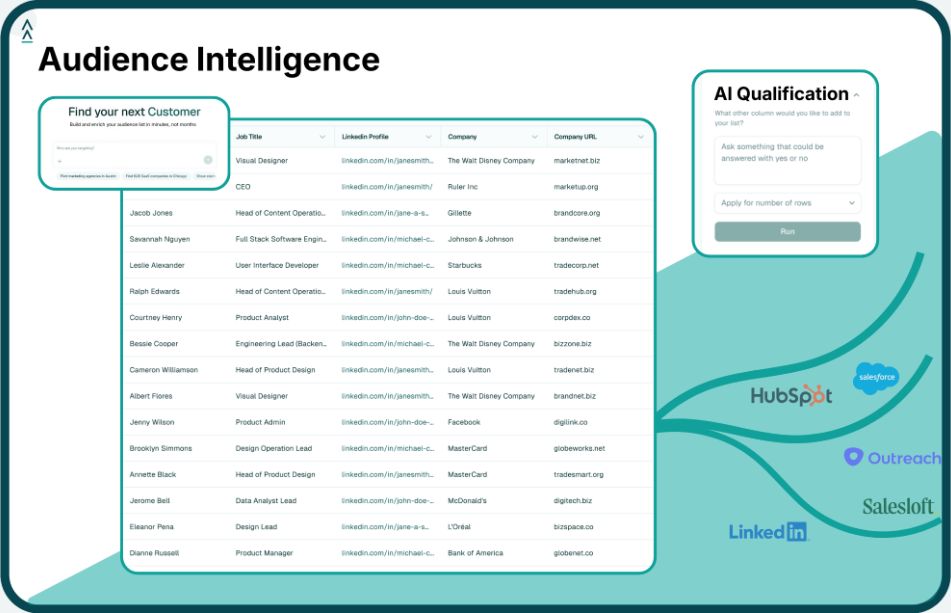
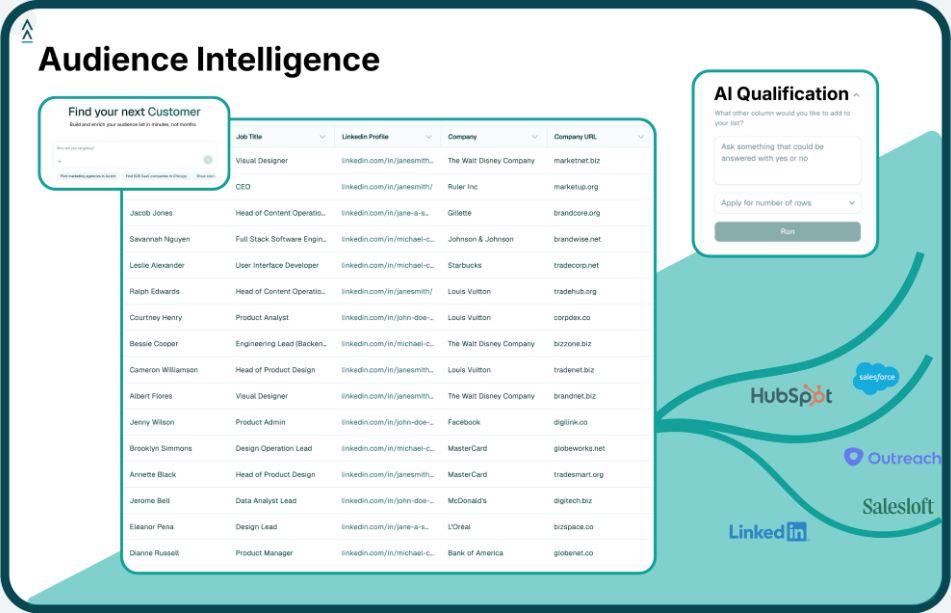
Landbase addresses the GTM data layer rather than functioning as a general-purpose predictive analytics platform.
Its web platform and CLI allow technical GTM teams to create audiences, match existing records, enrich company and contact data, incorporate buying signals, and prepare structured datasets that can then be used in analytics, qualification, or other downstream workflows.
Landbase supports several operations that can precede predictive modeling:
For example, matching and enrichment workflows can begin with an existing dataset, resolve records against Landbase entities, and add available fields before the data moves into another analytical process.
The Landbase CLI provides terminal access to the same underlying Landbase system used through the web platform.
This allows GTM engineers and RevOps operators to incorporate audience creation, matching, enrichment, and dataset operations into workflows involving Claude Code, Codex, scripts, or connected systems.
Structured data can also be downloaded for downstream processing when a separate model, notebook, dashboard, or analytics environment needs to consume the results.
Predictive account scoring often requires two separate questions:
Landbase can support the first through data enrichment and matching, while AI qualification provides another way to evaluate records against defined business criteria.
The distinction matters because qualification is not automatically the same as statistical prediction. Landbase can provide structured GTM data and qualification workflows that complement predictive systems without being positioned as a replacement for general-purpose predictive analytics platforms.
Predictive analytics estimates what is likely to happen based on available data and historical patterns. Prescriptive analytics focuses on what action should be taken in response. Modern decision-intelligence platforms increasingly combine elements of both.
AI can automate parts of data preparation, feature creation, model development, analysis, and interaction with predictive systems. Natural-language interfaces are also making analytical workflows accessible to a broader set of business users. Model quality still depends on appropriate data, evaluation, and governance.
Relevant indicators include revenue or ARR growth, customer adoption, contract expansion, financing, valuation changes, and product usage. Because companies disclose these metrics differently, multiple indicators are more useful than a single funding-based ranking.
Predictive models learn relationships from the information supplied to them. Missing, inaccurate, stale, biased, or poorly structured inputs can reduce the reliability of predictions. Data preparation and validation therefore remain important even when model development becomes increasingly automated.
Landbase focuses on the B2B data layer that can support predictive GTM workflows. Its platform can create audiences, match and enrich existing records, add available buying signals, and prepare structured datasets. Those outputs can then be used by qualification systems, analytics environments, or separate predictive models depending on the organization's workflow.
Tool and strategies modern teams need to help their companies grow.