.png)
.png)

Daniel Saks
Chief Executive Officer


Natural language processing has expanded well beyond traditional text classification and sentiment analysis. Modern NLP capabilities underpin large language models, AI agents, conversational search, retrieval systems, voice applications, document intelligence, and natural-language interfaces for business software.
Growth across this market is also difficult to measure through a single metric. Private companies disclose different combinations of funding, revenue, customers, valuation, and expansion data. The companies below stand out based on recent publicly documented growth indicators rather than a standardized ranking.
Natural language processing is a field of artificial intelligence and computer science that enables software to work with human language in written or spoken form.
Modern NLP systems can combine capabilities such as:
Large language models have extended these capabilities into reasoning, retrieval, coding, tool use, and multi-step agent workflows. As a result, many companies rooted in NLP are now categorized more broadly as generative AI, enterprise AI, AI search, or agentic AI companies.
The companies on this list operate across different areas of language-based AI rather than a single software category.
Current areas of activity include:
This makes direct growth comparisons difficult. Revenue growth provides a stronger commercial indicator where available, while funding, valuation, customer expansion, and geographic growth can provide additional context for privately held companies.
Founded: 2023
CEO: Arthur Mensch
Headquarters: Paris, France
Mistral AI raised €1.7 billion in a Series C in September 2025 at an €11.7 billion post-money valuation.
The company has continued expanding its foundation-model portfolio, enterprise AI products, infrastructure partnerships, and deployment options.
Mistral develops foundation models and enterprise AI infrastructure across areas including:
Mistral's rapid financing and product expansion reflect continued investment in European foundation-model infrastructure.
Its deployment model also illustrates a broader industry trend toward giving enterprises more control over where and how language models operate.
Founded: 2022
CEO: Pablo Palafox
Headquarters: San Francisco, California
HappyRobot raised a $150 million Series C in August 2026 at a $1.2 billion post-money valuation, bringing its reported total funding to approximately $200 million.
The company also reports more than 150 enterprise customers and fivefold growth since its Series B in 2025.
HappyRobot develops AI agents for operational workflows across voice, email, messaging, and connected enterprise systems.
Its platform is used in areas including:
HappyRobot represents the movement of conversational AI beyond question-answering toward agents that participate in multi-step operational processes.
Its recent financing and company-reported customer growth provide current evidence of commercial expansion.
Founded: 2022
CEO: Aravind Srinivas
Headquarters: San Francisco, California
In August 2026, Perplexity's annualized revenue was reported at more than $750 million, up from less than $250 million at the beginning of the year.
The company was also reportedly discussing a new financing that could value it at more than $30 billion. Because that financing had not been completed at the time of reporting, the potential valuation should not be treated as a finalized funding figure.
Perplexity operates an AI search and answer platform built around natural-language queries.
Its products include:
Perplexity illustrates how language models are changing information retrieval by combining search with generated answers, citations, and conversational follow-up.
Its reported revenue expansion provides a more useful current growth signal than funding alone.
Founded: 2022
CEO: Amr Awadallah
Headquarters: Palo Alto, California
Vectara reported more than 100% new-revenue growth during the first half of 2026, alongside additional enterprise deployments.
Its latest publicly announced institutional financing was a $25 million Series A in 2024.
Vectara focuses on enterprise conversational AI, search, and retrieval-augmented generation.
Its technology includes:
Retrieval has become an important part of enterprise language-model architectures because business applications often need responses grounded in external or proprietary information.
Vectara's 2026 revenue disclosure provides direct commercial growth evidence within that segment.
Founded: 2020
CEO: May Habib
Headquarters: San Francisco, California
Writer raised a $200 million Series C at a $1.9 billion valuation in November 2024.
The company has continued expanding its enterprise AI products. In July 2026, Writer reported that customers had created more than 28,000 reusable playbooks for repeatable business workflows.
Writer develops enterprise AI models, agents, and workflow software.
Its platform includes:
Writer reflects the expansion of generative AI from content creation into broader enterprise workflows.
Its more recent product activity centers increasingly on reusable agents and processes rather than standalone text generation.
Founded: 2011
Leadership: Ted Willich
Headquarters: Jacksonville, Florida
NLP Logix ranked No. 2,303 on the 2026 Inc. 5000, based on 146% three-year revenue growth.
The company has appeared on the Inc. 5000 seven times overall, including annual appearances from 2021 through 2026.
NLP Logix develops custom AI and machine-learning systems across industries including healthcare, finance, manufacturing, logistics, and government.
Its work includes:
NLP Logix differs from many venture-backed companies on the list because its growth evidence comes from multi-year revenue performance rather than primarily financing or valuation.
Its continued Inc. 5000 appearances indicate sustained commercial expansion over several years.
Founded: 2019
CEO: Aidan Gomez
Headquarters: Toronto, Canada
Cohere raised $500 million at a $6.8 billion valuation in August 2025, followed by an additional $100 million second close in September 2025.
The company has continued expanding internationally and adding enterprise AI capabilities.
Cohere develops foundation models and enterprise AI products covering:
Cohere concentrates primarily on enterprise and government AI deployments rather than a consumer-first model.
Its financing and continued product expansion illustrate demand for language models designed to operate within enterprise infrastructure and governance requirements.
Founded: 2015
CEO: Sam Altman
Headquarters: San Francisco, California
OpenAI announced $122 billion in committed capital in March 2026 at an $852 billion post-money valuation.
At the time of the announcement, OpenAI also reported approximately $2 billion in monthly revenue and said ChatGPT was approaching one billion weekly active users.
OpenAI develops AI models and products spanning:
Natural-language understanding and generation remain central to these systems even as the company's products extend into coding, audio, vision, and agent-based workflows.
OpenAI operates at a substantially larger scale than a typical startup, but it remains privately held and continues to report significant financing, revenue, and product adoption growth.
Its expansion also illustrates how language-model technology has moved from a specialized NLP category toward general-purpose AI infrastructure.
The companies on this list show several different paths for NLP-related growth.
Foundation-model developers are expanding beyond models. Mistral and Cohere increasingly combine foundation models with agents, search, document tools, customization, and enterprise deployment infrastructure.
Language interfaces are moving into operational software. HappyRobot applies conversational AI to enterprise processes, while Writer has expanded toward reusable agents and workflow automation.
Search and retrieval remain important categories. Perplexity applies language models to information discovery, while Vectara focuses on retrieval and grounding for enterprise AI systems.
Growth measurement varies by company. Vectara and NLP Logix provide revenue-growth evidence, while other private companies disclose combinations of financing, valuation, customers, usage, and product adoption.
Funding should therefore be interpreted as one growth indicator rather than proof that one company is growing faster than another.
Language technology now supports workflows across many industries.
NLP can assist with document analysis, clinical information retrieval, administrative processes, scientific research, and patient communication.
Applications include document extraction, research, risk analysis, compliance processes, customer service, and knowledge retrieval.
NLP can support prospect research, qualification, content analysis, personalization, and natural-language audience search.
Common applications include contract analysis, document retrieval, summarization, research, and knowledge management.
As NLP and generative AI move deeper into business processes, deployment also raises questions around accuracy, security, privacy, evaluation, and human oversight. Frameworks for managing AI risk provide useful context for organizations integrating these systems into operational workflows.
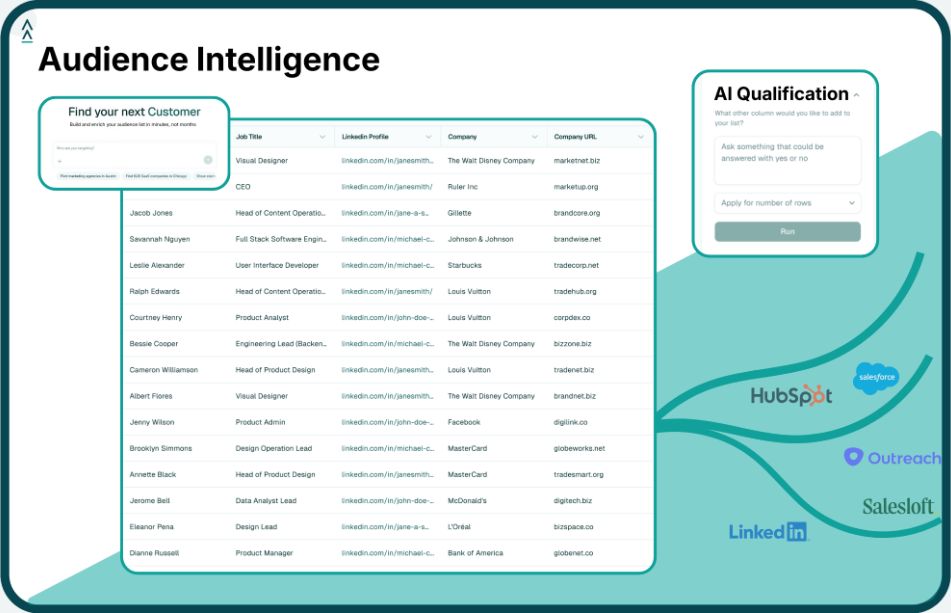
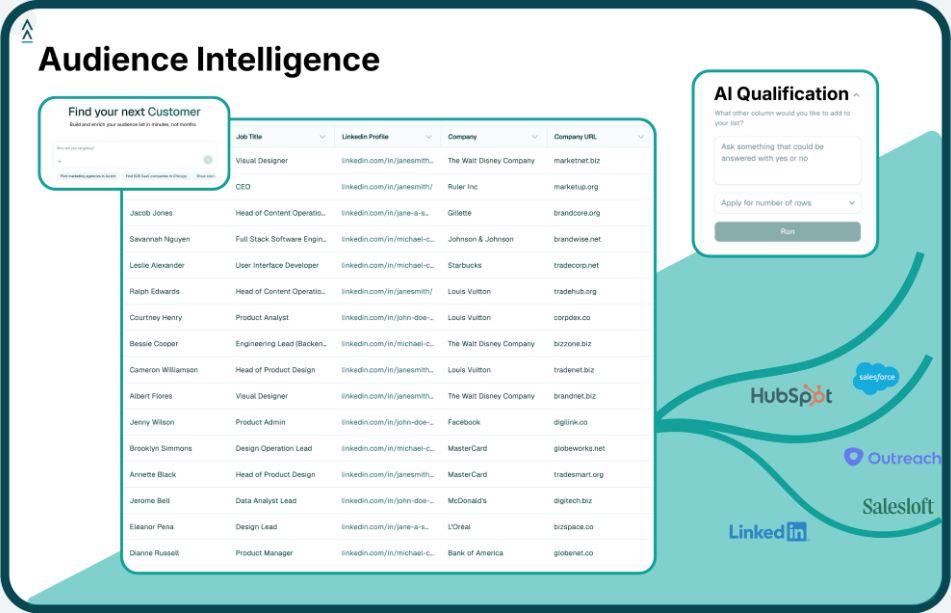
Landbase applies natural-language interaction to B2B audience and GTM data workflows.
Its web platform and CLI use the same underlying Landbase system. Teams can begin with a plain-language description of an audience, receive structured company or contact results, and then refine, match, enrich, or operationalize those records.
Current Landbase capabilities include:
Natural-language search does not replace every structured operation. The Advanced Dataset Creator supports requirements involving more exact filtering, calculations, aggregations, rankings, and selected output fields.
The Landbase CLI allows searches and data operations to run from a terminal while remaining connected to the same underlying Landbase environment available through the web platform.
This model is relevant when GTM engineers and RevOps teams need B2B data to interact with scripts, AI coding assistants, CRM records, and repeatable data processes.
Landbase therefore uses natural language as one interface for working with GTM data alongside matching, enrichment, signals, structured filters, and advanced dataset operations.
Natural language processing is the field of AI concerned with analyzing, interpreting, retrieving, and generating human language. It includes capabilities such as text classification, entity extraction, semantic search, language generation, and conversational interfaces.
Modern language models can generate text, retrieve information, use tools, analyze documents, write code, and perform multi-step tasks. NLP increasingly functions as a foundational technology inside broader AI products rather than as a standalone software category.
Several indicators should be considered, including revenue growth, customer expansion, funding, valuation changes, geographic expansion, and product adoption. Because private companies disclose these metrics inconsistently, a growth watchlist is more defensible than claiming an exact ranking without comparable financial data.
Natural-language interfaces can turn business requirements into searches or structured operations without requiring every underlying parameter to be configured manually. GTM use cases can include audience creation, prospect research, qualification, enrichment, and data analysis.
Landbase allows target companies and contacts to be described in plain language through its web platform and CLI. Natural-language audience creation can then be combined with structured filtering, matching, enrichment, buying signals, and advanced dataset operations when additional precision is required.
Tool and strategies modern teams need to help their companies grow.