.png)
.png)

Daniel Saks
Chief Executive Officer


Modern business intelligence extends beyond dashboards and historical reporting. Analytics platforms increasingly combine governed data access, natural-language querying, AI agents, semantic layers, predictive analysis, and workflow automation.
The companies shaping this market also span several categories. Some provide cloud data infrastructure, others focus directly on analytics, and several now position AI agents or conversational interfaces as primary ways of interacting with business data.
Recent AI adoption and investment trends provide additional context for this shift as organizations increase their use of AI across enterprise software and data workflows.
The companies below stand out based on current revenue or ARR growth, customer expansion, funding activity, and other publicly documented indicators. Because these metrics are not disclosed consistently, the list should be treated as a watchlist rather than an exact ranking of growth rates.
Business intelligence helps organizations convert operational data into information that can support decisions across sales, marketing, finance, operations, and other functions.
For RevOps teams, analytics can connect pipeline performance, customer activity, campaign data, and operational metrics. Sales teams can use analytics to understand pipeline movement, territory performance, and conversion patterns.
Several trends are changing how these systems work:
Current research into analytics engineering priorities reflects this shift toward faster AI-assisted analysis while maintaining data quality, ownership, and trust.
The list considers several forms of recent growth evidence:
Funding alone does not establish that one company is growing faster than another. Public companies also provide financial metrics that private startups may not disclose.
Founded: 2013
CEO: Ali Ghodsi
Headquarters: San Francisco, California
Databricks surpassed a $7 billion annualized revenue run-rate in 2026, with the company reporting more than 80% year-over-year growth during its second quarter.
In August 2026, Databricks also closed $5 billion in strategic funding at a $190 billion valuation, up substantially from its valuation earlier in the year.
Databricks provides a data and AI platform covering:
The company's lakehouse architecture combines aspects of traditional data warehouses and data lakes within a common environment.
Databricks sits below many traditional BI applications in the data stack, but its platform increasingly includes analytics and AI interfaces used directly for business questions.
Products such as Genie illustrate the broader movement toward natural-language interaction with governed enterprise data.
Its scale and current revenue growth also make Databricks one of the more significant private companies influencing modern analytics architecture.
Founded: 2019
CEO: Arvind Jain
Headquarters: Palo Alto, California
Glean reached $300 million in annual recurring revenue in May 2026, approximately 15 months after reaching $100 million ARR.
The company also reported nearly doubling its Fortune 500 customer count year over year.
Its most recently announced major financing was a $150 million Series F at a $7.2 billion valuation in June 2025.
Glean began primarily as an enterprise search platform and has expanded into broader enterprise AI.
Its capabilities include:
Glean represents a broader definition of business intelligence in which company knowledge can be queried conversationally across multiple systems.
Rather than centering exclusively on numerical dashboards, it combines structured and unstructured enterprise information to help employees retrieve context and perform AI-assisted workflows.
Its ARR expansion provides direct evidence of current commercial growth.
Founded: 2012
CEO: Sridhar Ramaswamy
Headquarters: Menlo Park, California
Snowflake generated approximately $4.47 billion in product revenue during fiscal 2026, representing 29% year-over-year growth.
Its fourth-quarter product revenue increased 30% year over year, while remaining performance obligations reached approximately $9.77 billion, up 42%.
Snowflake is publicly traded, so recent operating performance is more relevant to its growth profile than historical venture funding.
Snowflake's platform covers:
Snowflake helped establish separation of storage and compute as a core architectural pattern in cloud analytics.
Its role has since expanded from data warehousing into a broader data and AI environment supporting analytics applications, machine learning, and AI agents.
For technical RevOps workflows, platforms such as Snowflake can serve as part of the underlying infrastructure where operational data is centralized and analyzed.
Founded: 2012
CEO: Ketan Karkhanis
Headquarters: Mountain View, California
ThoughtSpot reported 133% year-over-year growth in platform usage in its latest disclosed adoption update.
The company also reported that more than half of its customers were actively using Spotter, its conversational analytics agent, by the end of the reported fiscal period.
ThoughtSpot remains privately held. Its growth case is currently supported more clearly by product adoption than by a recent publicly announced primary financing round.
ThoughtSpot focuses on AI-assisted business analytics through:
ThoughtSpot was an early advocate for search-driven analytics and now applies that concept to generative and agentic interfaces.
Its current direction reflects a wider shift in BI from navigating predefined dashboards toward asking questions conversationally while maintaining governance over the underlying data.
This also parallels changes in natural-language targeting, where business requirements increasingly become the starting point for interacting with structured datasets.
Founded: 2003
CEO: Alex Karp
Headquarters: Denver, Colorado
Palantir reported $1.94 billion in Q2 2026 revenue, representing 93% year-over-year growth.
U.S. commercial revenue grew 149% year over year to $764 million during the quarter, while U.S. commercial total contract value increased 153%.
As a public company, Palantir's current revenue and contract performance provide stronger growth indicators than its historical private funding.
Palantir operates platforms including Foundry, Gotham, Apollo, and its Artificial Intelligence Platform.
Its technology is used for:
Palantir occupies a broader category than traditional dashboard-oriented BI.
Its platforms connect analytics with operational data models and applications, allowing organizations to use data within decision and workflow processes rather than limiting it to reporting.
Its 2026 commercial growth provides measurable evidence of expanding enterprise adoption.
Founded: 2014
CEO: Mike Palmer
Headquarters: San Francisco, California
Sigma reached $200 million in annual recurring revenue in April 2026 after reporting more than 100% year-over-year ARR growth during its latest fiscal year.
The company also reported adding more than 1.1 million active users during that period.
In May 2026, Sigma raised $80 million in Series E financing at a $3 billion valuation.
Sigma provides cloud-based analytics built around direct interaction with warehouse data.
Its capabilities include:
Sigma combines a familiar spreadsheet-style interface with cloud data infrastructure and newer agentic capabilities.
Its recent ARR growth provides one of the clearer quantitative growth signals among privately held BI companies on this list.
The expansion from dashboards into apps, agents, and operational workflows also reflects the wider convergence between BI and enterprise software.
Founded: 2022
CEO: Colin Zima
Headquarters: San Francisco, California
Omni reported approximately 4x ARR growth over the previous year.
In April 2026, the company raised a $120 million Series C at a $1.5 billion valuation, up from a reported $650 million valuation in 2025.
Omni provides an analytics platform that combines:
Omni emphasizes a semantic layer that establishes consistent definitions and governance across different ways of querying data.
That architecture has become more relevant as AI systems increasingly need the same business definitions humans use when interpreting metrics.
The company's recent ARR and valuation growth make it one of the clearer emerging BI startups to watch in 2026.
Founded: 2019
CEO: Maxime Beauchemin
Headquarters: San Mateo, California
Preset completed a $7.27 million Series C in March 2026.
At the time, the company reported serving more than 400 customers while continuing to develop AI-assisted analytics around Apache Superset.
Preset does not publicly disclose a comparable ARR growth figure, so its position on this watchlist is based primarily on its recent financing, customer base, and continued product expansion rather than a directly comparable revenue-growth rate.
Preset provides a managed analytics environment built around Apache Superset.
Capabilities include:
Preset represents the open-source-oriented portion of the BI market.
Its connection to Apache Superset gives it a different architecture from many proprietary analytics platforms, while its current development is increasingly incorporating AI and agent-oriented workflows.
The companies on this list highlight several changes occurring across BI and analytics.
Natural-language queries and AI assistants are increasingly available alongside dashboards, SQL, and visual exploration.
ThoughtSpot, Sigma, Omni, Databricks, and other platforms now provide conversational or agent-oriented ways to interact with enterprise data.
Giving an AI model access to raw data does not automatically produce trustworthy business analysis.
Semantic layers, governed definitions, permissions, lineage, and contextual metadata increasingly determine whether AI-generated answers correspond to the organization's actual business logic.
Traditional BI largely ended with an insight or dashboard.
Newer platforms increasingly connect analysis to applications, writeback, workflow automation, or agent actions. That transition narrows the separation between understanding what happened and initiating what happens next.
As more employees and AI systems gain direct access to analytics, incorrect metrics can propagate more quickly.
Organizations deploying AI-assisted BI therefore need to consider validation, permissions, lineage, security, and human oversight. An established AI risk management framework provides useful context for evaluating those controls.
Visualization remains important even as conversational interfaces expand.
Different analytical tasks benefit from different presentation methods:
The evolution is therefore not simply from dashboards to chat. Modern BI increasingly combines several interfaces while relying on common data definitions and governance.
For GTM teams, these approaches can complement systems used for data enrichment, account research, qualification, and revenue operations.
Landbase addresses a narrower data problem than general-purpose BI platforms.
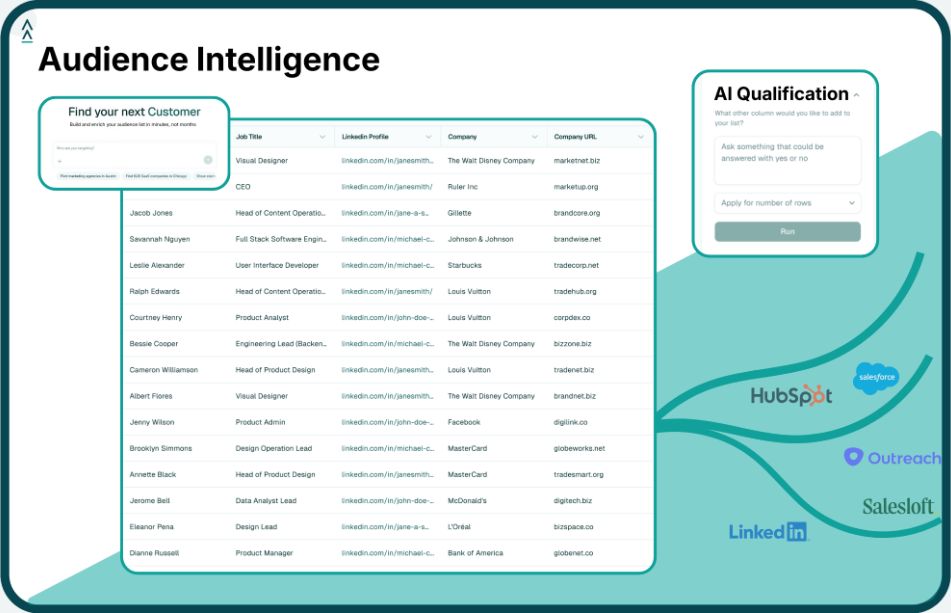
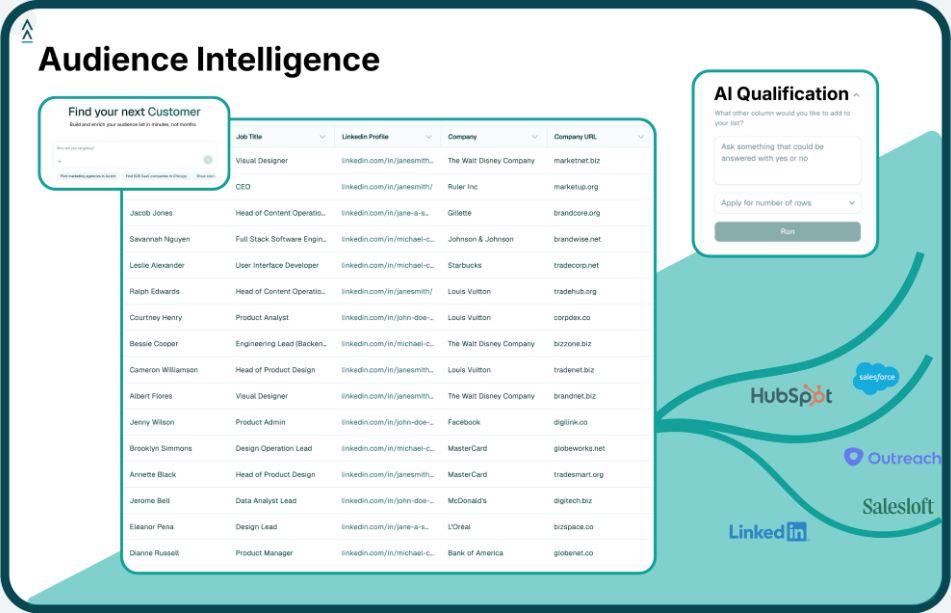
Rather than serving as an enterprise-wide BI system, Landbase focuses on B2B audience data and GTM operations. Its connected web platform and CLI allow teams to work with audience creation, matching, enrichment, buying signals, and structured datasets.
Business intelligence systems generally analyze organizational data after it has been collected and structured.
Landbase focuses more directly on creating and operationalizing GTM datasets. For example, a technical GTM workflow can identify a target audience, match it against existing records, enrich available fields, apply qualification logic, and move the resulting dataset into subsequent systems.
The Landbase CLI and web interfaces provide two ways of working with the same underlying platform.
This makes the CLI relevant to GTM engineering workflows where audience and enrichment operations need to interact with scripts, AI coding assistants, CRM records, or other tools.
Landbase also supports natural-language audience search, allowing company or contact requirements to be expressed conversationally.
Natural language is only one part of the workflow. More structured requirements can be handled through filtering, matching, enrichment, qualification, or advanced dataset operations.
This combination allows natural-language interaction to function as an entry point to structured GTM data rather than replacing structured data processing altogether.
Relevant indicators include revenue or ARR growth, customer expansion, usage growth, new contracts, funding, valuation changes, and product adoption. Because public and private companies disclose different metrics, these indicators should be considered together rather than converted into an artificial ranking without comparable financial data.
AI is increasingly used for natural-language queries, automated analysis, anomaly detection, data preparation, semantic interpretation, and agent-based workflows. The broader shift is from requiring users to manually navigate reports toward allowing them to express analytical questions and tasks more directly.
A semantic layer defines business concepts and metrics consistently. This becomes especially important when AI systems query enterprise data because the model needs context about how terms such as revenue, active customer, qualified lead, or churn are defined within the organization.
Traditional dashboards typically present predefined metrics and historical information. Modern BI systems increasingly combine dashboards with ad hoc analysis, natural-language interaction, AI-generated insights, semantic models, embedded analytics, and workflow capabilities.
General BI platforms are designed primarily to analyze data across an organization. Landbase focuses specifically on B2B and GTM data operations such as audience creation, matching, enrichment, qualification, signals, and dataset preparation. Its CLI also allows these processes to run inside technical environments such as Claude Code and Codex.
Tool and strategies modern teams need to help their companies grow.