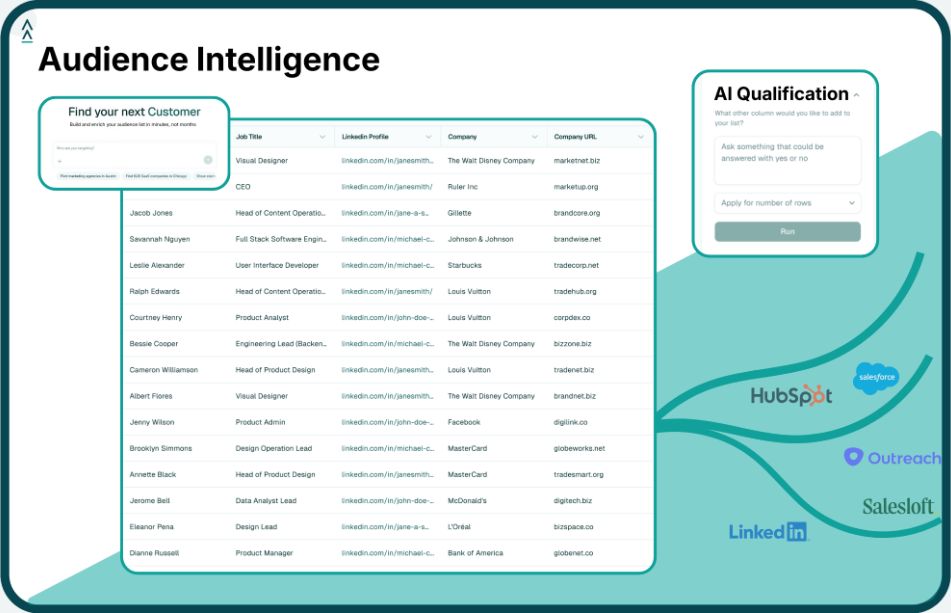
B2B marketing and sales teams are entering a new era of AI-driven, data-rich targeting. Traditional methods of building target account lists—manually filtering databases or juggling multiple tools—are giving way to a more intuitive approach: natural-language targeting. Simply put, this means you can describe your ideal customers in plain English, and an AI-powered platform will instantly generate a qualified audience for you. This guide will explore what natural-language targeting is, why it’s transforming B2B go-to-market strategies, and how to leverage it for maximum impact. We’ll back up insights with data and industry benchmarks throughout, giving Marketing, Sales, RevOps, and Growth professionals a clear roadmap to this game-changing approach.
What Is Natural-Language Targeting in B2B?
Natural-language targeting means using everyday language to define your B2B target audience, rather than relying on clunky filters or boolean logic. In practice, it works like this: a marketer or salesperson simply types a prompt describing their ideal customer profile, and the platform’s AI interprets it to build a targeted list of accounts and contacts. For example, you could input: “Mid-market fintech companies in North America that use AWS and are expanding their sales teams”. A natural-language platform will parse that request and return a list of companies (and even decision-makers at those companies) that fit the description – no complex query building needed.
This approach is a direct response to the pain points many B2B teams face with traditional targeting:
- Data overload, but hard to use: Companies today have access to huge B2B databases, yet much of that data goes underutilized. In fact, 87% of B2B marketers say firmographic data is their most underused asset. Why? Because finding the right data points traditionally required specialized skills or tools. Natural-language systems unlock these assets by letting you simply ask for what you need in plain English.
- Inefficient processes: Building a target list often meant toggling between CRM filters, third-party data providers, Excel sheets, and more. It’s time-consuming and error-prone. Studies show sales reps spend only ~33% of their time actually selling – the rest is swallowed by administrative tasks and prospect research. By offloading list building and research to AI, natural-language targeting frees up teams to focus on engaging prospects and closing deals.
- Static and stale data: Traditional targeting might rely on static lists that quickly go out of date. Consider that B2B contact data can decay at rates up to 70% per year. A list you built last quarter might already be full of dead ends. Natural-language platforms continuously refresh and enrich data from multiple sources, so you’re always working with current information. This helps avoid the common scenario where 40% of sales reps say outdated data is their biggest headache in reaching prospects.
In summary, natural-language targeting is what happens when you combine the power of AI with the simplicity of a search bar. It allows any member of your go-to-market team to leverage extremely sophisticated data intelligence just by typing a description of whom they want to reach. Next, we’ll see why this approach is transforming how B2B teams execute their go-to-market (GTM) strategies.
Why Natural-Language Targeting Is Transforming B2B Go-to-Market
Adopting a natural-language approach isn’t just about convenience – it’s driving real performance gains for B2B organizations. Let’s break down the key reasons this paradigm shift is underway, backed by data:
1. Precision Targeting = Higher Quality Leads. By interpreting nuanced prompts, natural-language platforms combine multiple criteria seamlessly. This leads to more precise targeting than any single manual filter could achieve. The result is dramatically better lead quality. Companies that focus on rich data targeting report 70% more qualified leads entering their funnel. It’s no wonder that in account-based marketing (ABM) programs leveraging firmographic intelligence, 87% of B2B wins are attributed to those data-informed campaigns. When you can ask for exactly the kind of prospect you want (industry, size, tech stack, intent signals, etc.), you eliminate a lot of the noise upfront.
2. Faster Research and List Building. What used to take weeks can now happen in minutes. Traditional enterprise lead generation might involve purchasing static lists or painstakingly building queries, then waiting for data teams to compile results. In contrast, natural-language systems deliver results nearly instantly. For example, Landbase’s platform interprets your prompt, searches across datasets, and verifies each record with signal-backed intelligence – all in seconds. The company’s CEO noted in an interview that their AI-driven campaigns “go live in minutes, not months,” enabling a much more agile GTM process. This speed to insights means marketing campaigns and outbound sales efforts can launch faster, giving you an edge in engaging prospects before competitors do.
3. Data-Driven Accuracy and Enrichment. Natural-language targeting leverages multi-dataset intelligence by default. Behind that simple prompt is an army of data sources being cross-referenced: firmographic details (like industry, size, location), technographic data (the technologies a company uses), intent signals (behavioral signs a company is in-market for a solution), hiring trends, funding news, and more. Leading platforms now track 1,500+ unique signals beyond basic demographics to paint a complete picture of each account. This matters because outreach informed by comprehensive data yields far better results. In fact, organizations using data-driven personalization and targeting have seen 5–8× growth in ROI compared to more generic approaches. The richness of data ensures that when sales reaches out, the message truly resonates with the prospect’s situation and needs.
4. Improved Conversion Rates and Larger Deals. Better targeting upstream leads to better outcomes downstream. When you focus your effort on high-fit prospects, conversion rates naturally rise. Consider predictive lead scoring as an analogy: companies that implement machine-learning lead scoring see 75% higher conversion rates compared to traditional methods. Natural-language targeting provides a similarly data-informed boost at the top of the funnel. Marketers report that concentrating on lead quality (through firmographic targeting) increased their average deal sizes by 73% in ABM programs. In short, by zeroing in on the right accounts from the start, you close bigger deals more often – a transformative win for sales efficiency and revenue growth.
5. Cost and Resource Efficiency. There’s also a strong efficiency play. Autonomous AI targeting lowers the cost of customer acquisition by automating what used to be manual work. Early users of agentic AI platforms (which act as “virtual SDRs”) have achieved 70%+ lower prospecting costs versus hiring extra sales development reps or buying leads. It’s not about replacing humans but augmenting them – the AI does the heavy lifting of research and initial outreach, so your human team can spend time on high-value interactions. Furthermore, avoiding wasted effort on bad leads has a huge financial impact. Remember that poor data and mis-targeting cost companies an average of $15 million per year in wasted effort. Natural-language targeting, with its real-time data validation, cuts down those inefficiencies by ensuring the leads you pursue are accurate and relevant.
6. Aligning Marketing and Sales. A persistent B2B challenge is the rift between marketing and sales over lead quality. (In fact, 44% of sales reps complain about the quality of leads they get.) By using AI to qualify and score prospects against hundreds of signals, natural-language targeting helps ensure that marketing is handing over truly qualified, sales-ready leads. This means fewer finger-pointing meetings about “junk leads” and more mutual confidence. One metric to note: only about 27% of marketing-generated leads are typically sales-qualified, which implies up to 73% waste. A natural-language system with agentic AI qualification can flip that script by vetting prospects more thoroughly before they ever reach sales. The outcome is a tighter, more efficient funnel and better trust between teams.
In combination, these factors explain why natural-language targeting is quickly gaining traction. It addresses the core GTM pain points – from data quality to speed and ROI – in one swoop. Next, let’s look at how these platforms actually work under the hood to deliver on these promises.
How Natural-Language Targeting Works in Practice
So, what happens after you type in that plain-English audience request? Underneath the simplicity of the interface, there’s a lot of advanced technology orchestrating the result. Here’s a step-by-step look at how a robust natural-language B2B targeting platform (like Landbase’s GTM-2 Omni) typically works:
- Language Parsing & Intent Understanding: The system uses natural language processing (NLP) models to interpret your prompt. For example, if you enter “SaaS startups in Europe hiring for RevOps”, the AI breaks that down into structured criteria: industry = SaaS (software companies), company stage = startup, region = Europe, hiring signal = has open roles in Revenue Operations. Modern platforms are trained on vast go-to-market data and terminology, so they understand synonyms and context specific to B2B. (They’d know “RevOps” means revenue operations, for instance, and that it’s a role typically in growth-focused teams.)
- Multi-Dataset Querying: Once the intent is clear, the platform queries multiple data sources in parallel. It might pull firmographic lists of companies that match “SaaS startups in Europe” from a database of millions of companies. At the same time, it checks a technographic dataset to ensure those companies use relevant technologies (if that was implied or stated). It also scans specialty sources for signals – for instance, scraping job postings to see which of those companies are currently hiring for RevOps roles. The power here is aggregation: a good platform joins data from many datasets (internal and third-party) to fulfill the request. Landbase’s system, for example, taps into a B2B database of 300M+ verified contacts across 24M+ companies, layered with over 1,500 unique signals ranging from tech stack details to recent funding events. This ensures no single angle is missed when compiling your audience.
- AI Qualification & Filtering: Raw data is just the start. Next comes the intelligent filtering – the agentic AI qualification stage. Specialized AI “agents” evaluate each potential account and contact against your criteria and against likely conversion signals. They might score the fit of each company by looking at things like growth signals (e.g. is the company expanding headcount by >20% this year?), intent signals (e.g. has the company shown interest in content related to my product category?), and engagement signals (e.g. did someone from that company recently interact with our site?). Using these indicators, the AI can weed out low-fit prospects and surface the high-fit ones. This is crucial – 79% of B2B leads never convert to sales historically, often because they were never truly a good fit. AI qualification addresses this by evaluating fit before a lead hits your pipeline, so you spend time only on prospects with genuine potential.
- Enrichment & Verification: At this stage, the platform also enriches each profile with up-to-date details. If it lists a contact, it ensures the email, title, and phone number (if provided) are current by cross-verifying against live sources. It may append recent news about the account, or note what hiring postings or tech installs were found. Given that B2B data decays rapidly, this continuous enrichment means your exported list won’t already be outdated. (Recall that 40% of reps cite outdated data as a major headache – this step is how AI minimizes that issue.) The end result is a rich profile for each target account: not just a name on a list, but a multi-dimensional snapshot that can inform highly personalized outreach.
- Output: Exportable, Ready-to-Use Audience. Finally, the platform compiles the qualified targets into a usable format. Typically, you can export the list to a CSV or directly sync it to your CRM or marketing automation system. Many solutions, including Landbase, allow large-scale exports – for example, Landbase offers instant export of up to 10,000 contacts with no manual effort (even on a free tier). This scalability is key: whether you need a list of 100 highly specific accounts or 50,000 contacts for a broad campaign, the system can handle it in a few clicks. Some platforms even let you set up automated refreshes, so your target list stays current over time (useful for ongoing campaigns or always-on outbound programs).
- Learning and Refinement: One often overlooked aspect is that these AI-driven systems learn and improve with use. As you provide feedback (say, by dismissing certain suggestions or marking good leads), the AI can refine its understanding of what an ideal customer looks like for your business. Landbase’s GTM-2 Omni model, for instance, continuously learns from user interactions and outcomes to get smarter with each search. Over time, the platform might proactively suggest new audience segments (“lookalikes” of your best customers) or alert you to fresh signals (like a target account showing a new intent surge). This agentic behavior means the tool doesn’t just take orders via prompts – it becomes a co-pilot in your strategy, recommending where to focus next.
In summary, natural-language targeting platforms perform a sophisticated dance behind the scenes: NLP understanding, big-data crunching across many sources, AI-driven filtering, and real-time data verification, all culminating in a highly targeted output. From the user’s perspective, however, all this complexity is abstracted away. You experience it as simply asking and receiving – the platform acts like an expert GTM researcher at your constant disposal.
Key Features of a Natural-Language B2B Targeting Platform
When evaluating solutions in this space, it’s important to understand the core components that drive their effectiveness. The best natural-language targeting platforms share a few key features and capabilities:
- Natural Language Interface: At its heart, the platform should accept and understand free-form input. This could be a chat-style prompt or a search bar where you enter a description of your target. The more the tool can handle complex queries or casual language, the better. (For example, being able to interpret “companies like Acme Corp that recently raised funding” or “manufacturing firms in the Midwest with <500 employees using Salesforce.”) A robust language interface lowers the barrier for anyone on your team to perform advanced targeting.
- Multi-Dataset Intelligence (Unified Data Lake): Look for platforms that aggregate multiple data types: firmographics (company size, industry, revenue, etc.), technographics (what software or hardware a company uses), intent data (behavior indicating purchase intent, such as content consumption patterns), hiring and growth signals (job postings, team expansions), and even engagement or intent signals. The integration of these datasets is crucial – it’s how the AI draws nuanced connections. Landbase’s solution, for instance, tracks over 1,500 signals per company by joining data from various sources. This comprehensive view is what enables highly specific targeting (e.g., “find companies in retail with declining headcount but new e-commerce software – indicating a shift in strategy”). A platform with shallow data will produce shallow results, so signal depth matters.
- Agentic AI for Qualification: Agentic AI refers to the system’s ability to act as an “agent” on your behalf – not just retrieving data, but taking actions like analyzing and decision-making. In targeting, this means the AI doesn’t simply dump a huge list of companies on you. Instead, it evaluates and qualifies each prospect using predictive models. It might assign a fit score or tier ranking to every account or contact, highlighting which ones are most likely to convert or are worth pursuing first. This predictive scoring is often backed by machine learning trained on what a good customer looks like (potentially using your own CRM win data combined with broader market data). The net effect is a smarter list: you know not just who fits your criteria, but who among them is showing the right signals now. This feature is essential for prioritizing sales efforts and scaling outreach efficiently.
- Real-Time Data Refresh & Accuracy Safeguards: As noted earlier, B2B data decays fast – roles change, companies pivot, new players emerge. A strong platform will have mechanisms to continuously refresh data. That could be via real-time validation (pinging email addresses or updating phone numbers on the fly), frequent database updates, or live signal monitoring (like checking daily for new funding announcements or intent surges). 95%+ data accuracy should be the target benchmark. Additionally, compliance and data governance features are important – top platforms prioritize data compliance and accuracy, with 67% of marketers now saying these are top priorities in data strategy. In practical terms, this means choosing providers that respect privacy regulations and offer high data quality, so you can trust the output and avoid the costs of bad data.
- Scalability and Automation: The solution should handle both small-scale and large-scale needs. Whether you need a list of 50 accounts or 50,000, it should be up to the task (without long delays or crashing!). Bulk export options, CRM integrations, and workflow automation (like auto-loading new leads into an outreach sequence) are features to look for. Automation is particularly powerful – some platforms allow you to set up automated audience updates (e.g. “refresh this list of SaaS CFOs in California every month and push to my CRM”). This way, your team is always working off fresh targets with minimal manual upkeep. With the rise of AI in sales, analysts predict a surge in such automation; in fact, Gartner projects that by 2028, 60% of B2B sales engagements will be handled through AI and conversational interfaces, which implies your targeting and initial outreach processes could be largely automated through smart agents.
- User-Friendly Workflow & Collaboration: Finally, ease of use and team collaboration features make a difference. Since multiple roles (marketing ops, sales ops, SDRs, AEs, etc.) might interact with the platform, it should have a clean UI, the ability to save searches or segments, and perhaps share findings with teammates. Some tools have a “prompt library” or templates (for example, suggested searches like “Top 100 fast-growing tech companies in Europe” you can click and run). Others integrate directly with Salesforce or HubSpot so that sales reps can request new contacts without leaving their CRM. The more the platform fits into your team’s natural workflow, the more value you’ll get from it.
In essence, a natural-language targeting platform is a combination of a data powerhouse and an intelligent assistant. When evaluating options, look under the hood for the depth of data and sophistication of AI, but also consider the user experience and how it will plug into your existing processes.
Data-Backed Results: The Impact of Natural-Language Targeting
Let’s ground all of this in measurable outcomes. What kind of lift can a B2B organization expect by embracing natural-language, AI-powered targeting? Here are some compelling statistics and benchmarks:
- Larger Deal Sizes and Revenue Growth: Targeting the right accounts has a direct revenue impact. As mentioned, leveraging detailed firmographic targeting led to 73% larger deal sizes in one study. Moreover, companies using AI-driven data enrichment have achieved a 40% increase in revenue on average, alongside 25% higher revenue growth compared to peers. These gains come from focusing sales efforts where they’re most likely to pay off – on high-fit, high-potential accounts that the AI helps identify.
- Higher Conversion Rates and ROI: By weeding out poor-fit leads and zeroing in on prospects with real intent, conversion metrics soar. Machine learning-based lead scoring (a component of AI targeting) can boost lead-to-opportunity conversion by 75% or more. In terms of overall campaign ROI, one survey found that B2B companies see a 77% increase in lead generation ROI when using lead scoring and advanced data segmentation versus not using these tools. Essentially, natural-language targeting delivers quality over quantity, and the quality translates to efficiency – marketing dollars and sales hours yield more wins for the same or less effort.
- Sales Productivity and Pipeline Velocity: With better targeting and automation, sales teams can spend more time selling and less on prospecting admin. We saw that reps currently may only spend ~2 hours per day on actual selling activities. By doubling that (which AI can enable by freeing up time), results can theoretically double as well. In fact, 76% of B2B salespeople say technology (like AI tools) is critical to closing deals. One outcome reported by companies using enriched, scored lead data is a 25% increase in sales productivity (more deals closed per rep). Faster follow-up is another benefit: engaging a lead within an hour of inquiry makes them 7× more likely to qualify into an opportunity, and AI-driven systems ensure leads are surfaced to reps in real-time so no hot prospect falls through the cracks.
- Cost Savings and Efficiency Gains: On the cost side, the efficiency of AI-driven targeting is evident. We discussed agentic AI platforms yielding around 70–80% lower customer acquisition costs in early case studies. Consider the alternative: hiring additional SDRs, buying static lists that quickly expire, or spending on numerous point tools. A unified AI platform can replace or streamline many of these expenses. Furthermore, reducing wasted effort on unqualified leads curbs the hidden cost of sales burnout and “busy work” that doesn’t generate revenue. Think of natural-language targeting as a force multiplier – one strategist or SDR armed with AI can do the work of several, and do it more effectively. This allows teams to scale without linear headcount growth, a crucial advantage for growth leaders working within tight budgets.
- Pipeline Health and Sales-Marketing Alignment: Although harder to quantify, many organizations report improved alignment between marketing and sales after implementing a shared AI-powered targeting tool. When both teams trust the system that defines a “qualified target,” there’s less friction and more seamless hand-offs. Anecdotally, teams using such platforms often see faster progression from initial contact to meeting to proposal, because the targets were pre-qualified on multiple fronts (fit and interest). The stat that 79% of leads never convert is sobering – but it also represents a huge area of opportunity. If you can even modestly improve that conversion rate by focusing on the right leads (say from 21% success to 30% success), that’s a significant boost in pipeline and revenue without increasing lead volume. Natural-language targeting, combined with good content and outreach, aims to dramatically shrink that 79% failure slice by simply not bringing in poor leads to begin with.
All these data points underscore a clear theme: precision targeting powered by AI yields better outcomes across the board. It’s important to note that technology alone isn’t a magic wand – you still need skilled people to craft the right messages and strategies for the audiences the AI finds. But with a strong natural-language platform handling the who to target, your team can spend their energy on how to win them over, which is ultimately where human creativity and relationship-building shine.
Getting Started with Natural-Language Targeting
Transitioning to a natural-language targeting approach may feel like a big step, but it can be smoother than you think. Here are some practical tips for getting started and making the most of this capability:
1. Define Your Ideal Customer Profiles (ICPs) Clearly. Start by gathering your team (marketing, sales, RevOps) to articulate the profiles of your best customers. What traits do they share? Which signals preceded their purchase? Use these insights to craft sample prompts. For example, if you know that your best SaaS clients are Series B companies in fintech who recently hired a VP of Sales, formulate a prompt around those conditions. Having well-defined ICPs will guide the AI and also ensure marketing and sales agree on what “qualified” means.
2. Choose the Right Platform. Not all tools are equal. Look for a platform that has the data coverage and features that fit your needs – whether it’s the sheer volume of contacts, specific regional coverage, or particular signal types (e.g. intent data from content consumption, technographic data for IT targeting, etc.). If possible, take advantage of free trials or freemium models. For instance, Landbase offers a free no-login audience builder for up to 10,000 contacts exported, which is a great way to test the waters with your own use cases. During a trial, compare the lists you get from the AI with your known good customers – do they align? This will tell you if the platform “gets” your targeting needs.
3. Start with a Pilot Campaign. Instead of overhauling all prospecting at once, run a pilot alongside your current process. For example, have one SDR or marketer use the natural-language platform to generate a list for a specific campaign or territory, while others continue with business-as-usual. Track the results: response rates, conversion rates to opportunities, time spent per lead, etc. This A/B comparison can build the internal case for broader adoption if the AI-driven approach yields superior metrics (which, based on the data we’ve discussed, it likely will).
4. Integrate AI into Workflows, but Don’t Lose the Human Touch. Once you have confidence in the AI output, integrate it into your daily operations. Sync the target lists to your CRM, set up alerts for new accounts that match your criteria, and use the predictive scores to prioritize outreach. That said, continue to use human judgment and creativity in outreach. AI will give you who to contact and some context on why they’re a good fit. It’s up to your sales and marketing team to craft the message that resonates and to build relationships. Encourage reps to treat the AI-provided insights (like a hiring initiative or a technology the prospect uses) as conversation starters to personalize their approach. The goal is to augment human effort, not replace it – the AI handles the grunt work, you bring the strategy and personal connection.
5. Measure and Iterate. Like any strategy, continually measure results and provide feedback. Many platforms allow you to flag irrelevant results or feed outcome data (wins, losses) back into the model. Make it a habit to review the quality of AI-sourced leads and their progression in your funnel. Are deals from these leads closing faster or at a higher rate? Capture those stats. If certain prompts yield too broad or too narrow results, refine your language or add additional criteria. Treat the AI as a colleague that’s always learning – the more clarity and feedback you provide, the better it performs. Over time, you might discover new target segments or signals that are highly predictive of success, which can further sharpen your ICP definitions.
By following these steps, teams can gradually and confidently embrace natural-language targeting. Many find that once they start, they never want to go back to the old way of manual list building. The speed and precision quickly become an indispensable part of the workflow.
Embrace the Power of Natural Language in B2B Targeting
The B2B go-to-market world is rapidly evolving, and natural-language targeting is at the forefront of this evolution. What began as a novel idea – “What if you could just ask for the leads you want?” – is now a practical reality delivering significant competitive advantages. By allowing AI to handle the heavy lifting of data crunching and lead qualification, organizations unlock more productive time for their teams and engage prospects with far greater relevance. The data is compelling: higher conversion rates, larger deal sizes, faster sales cycles, and substantial cost savings are all on the table for those who leverage these new tools.
For GTM teams, the message is clear: it’s time to work smarter, not harder. Natural-language targeting exemplifies working smarter – it’s the efficient path to finding the proverbial needle-in-the-haystack leads that actually convert. And as AI becomes an ever more standard part of the B2B toolkit, adopting these methods will shift from cutting-edge to commonplace. We’re already seeing that momentum, with the majority of B2B orgs planning to increase AI investments and future-forward predictions that much of sales prospecting will be AI-driven by the end of this decade.
.png)
.png)


.png)