.png)
.png)

Daniel Saks
Chief Executive Officer


Beauty technology now reaches well beyond virtual try-on and shade matching. AI, biotechnology, robotics, vertical software, data intelligence, and connected devices are becoming part of how beauty products are developed, sold, personalized, and managed. McKinsey estimates that generative AI in beauty alone could contribute $9 billion to $10 billion in economic value, with applications extending across consumer insights, marketing, product development, sales, and technology.
Against that backdrop, a new group of beauty tech companies is scaling around specific parts of the industry. The companies below were selected based on recent financing, revenue or adoption growth, valuations, commercialization, and other observable expansion signals. The list emphasizes businesses where technology forms the core product or infrastructure, with a closer look at what each company does, who leads it, its recent financing, and why its technology matters to beauty.
Category: Beauty and wellness business technology
CEO: William Zeqiri
Recent Funding: $80 million growth investment, May 2026
Reported Valuation: More than $1 billion
Fresha provides booking, business management, payments, marketplace, and related software for beauty, wellness, salon, spa, barbering, and other appointment-based businesses.
Fresha operates software connecting consumer appointment discovery with the operational systems used by beauty and wellness businesses. Its platform covers areas such as scheduling, payments, client management, marketing, and business administration.
In May 2026, Fresha announced an $80 million primary growth investment from KKR. The transaction valued the company at more than $1 billion and brought its total capital raised to $285 million. Fresha reported more than 130,000 businesses on the platform at the time of the funding announcement.
Fresha represents the operational-software side of beauty technology. Its growth shows that beauty tech is not limited to consumer-facing AI experiences. Software used to run salons, spas, and other service businesses is also attracting growth capital and integrating more AI into day-to-day operations.
Category: AI and business software for in-person services
CEO: Danielle Cohen-Shohet
Recent Funding: $44 million Series D, July 2026
Reported Valuation: $1.15 billion
Genius AI is the company behind GlossGenius, a software platform widely used across beauty, wellness, and other appointment-based service businesses.
GlossGenius provides booking, payments, marketing, staff management, and client-management functions. Genius AI is expanding the company’s technology beyond those original workflows into AI-assisted administrative operations for a broader set of in-person service businesses.
In July 2026, Genius AI announced a $44 million Series D led by Lux Capital at a $1.15 billion valuation. The company reported more than 125,000 businesses using its products and more than $125 million in total funding. Danielle Cohen-Shohet remains co-founder and CEO.
GlossGenius grew from beauty and wellness business software, making Genius AI relevant to the increasing role of vertical software in the sector. Its expansion also illustrates how platforms originally built around beauty professionals are incorporating AI into scheduling, administration, customer management, and other business operations.
Category: Vertical SaaS for self-care businesses
CEO: Matt Danna
Recent Funding: $80 million Series D, July 2025
Boulevard develops software for appointment-based self-care businesses, including salons, spas, medspas, and barbershops.
The platform organizes functions such as scheduling, payments, client records, marketing, memberships, and communication around appointment-based businesses.
Boulevard raised an $80 million Series D in July 2025 led by JMI Equity. The company reported that revenue had increased more than 500% since its previous funding round in 2022. It also reported more than 40,000 professionals across more than 5,000 self-care businesses using the platform.
Boulevard demonstrates the role of industry-specific software in beauty and self-care. Rather than developing beauty products, its technology sits behind the businesses delivering services, making operational software another significant segment within beauty tech.
Category: AI-powered fragrance technology
Founder and CEO: Alex Wiltschko
Recent Funding: $70 million Series B, 2026
Osmo applies machine learning and molecular data to scent and fragrance development.
Osmo’s Olfactory Intelligence platform is designed to map relationships between molecular structures and how humans perceive scent. Its work has expanded into fragrance creation, ingredient development, formulation, manufacturing, and related commercial processes.
The company spun out of Google Brain in 2022. In 2026, Osmo raised $70 million in Series B funding, expanded to more than 100 employees, and built a 58,000-square-foot manufacturing and research facility in New Jersey.
Fragrance has traditionally depended heavily on physical experimentation and specialist expertise. Osmo brings machine learning and structured molecular data into that process, showing how AI can move upstream from beauty marketing and personalization into product development and manufacturing.
Category: At-home beauty devices
CEO: Laurence Newman
Recent Financing: London Stock Exchange IPO, October 2025
Gross IPO Proceeds: Approximately £29 million
The Beauty Tech Group develops and sells at-home beauty devices through CurrentBody Skin, ZIIP Beauty, and Tria Laser.
Its portfolio covers technologies including LED, radio frequency, microcurrent, and laser applications for at-home beauty use.
The company listed on the London Stock Exchange in October 2025, raising approximately £29 million in gross proceeds. For FY2025, The Beauty Tech Group reported £141 million in revenue, up 39.4% from £101.1 million in FY2024. Own-brand revenue increased 60% during the same period.
The Beauty Tech Group represents the hardware side of the category. Its revenue growth shows how technologies once associated primarily with professional aesthetic environments are increasingly being packaged into consumer devices for at-home use.
Category: AI and biotechnology for beauty ingredients
Founder and CEO: Joshua Britton
Recent Funding: $20 million investment, August 2025
Debut combines biotechnology, genomics, and AI to discover and develop ingredients for skincare and other beauty applications.
The company uses its BeautyORB platform and biotechnology capabilities to evaluate molecules, develop beauty ingredients, and move selected discoveries toward formulation and manufacturing.
Debut secured $20 million in additional investment in August 2025 to expand its AI-based ingredient discovery and formulation work. Its investors include L'Oréal’s BOLD fund alongside other venture and strategic investors. Joshua Britton continues to serve as founder and CEO.
Debut operates much further upstream than consumer beauty applications. Its work demonstrates how AI and biotechnology can influence the ingredients themselves, including the discovery and development processes that happen before a finished product reaches consumers.
Category: Hair-care robotics
Founder and CEO: Yinka Ogunbiyi
Recent Funding: $7 million seed round, June 2026
HaloBraid is developing robotic technology designed to assist professional stylists with braiding.
Its first braid-assist device is intended to work alongside professional stylists rather than automate the entire service. A stylist begins the braid manually, while the device handles part of the repetitive braiding process.
HaloBraid raised a $7 million seed round in June 2026 led by Seven Seven Six, with participation from AlleyCorp and Bling Capital. The company plans to use the financing for product development, stylist testing, manufacturing preparation, and salon partnerships ahead of commercial rollout.
HaloBraid brings robotics into a beauty service that has traditionally depended almost entirely on manual work. Its emergence broadens the definition of beauty tech to include hardware designed specifically around professional hair services and salon operations.
Category: AI and robotic beauty customization
CEO: Charles C. Brandon
Recent Funding: $6 million Series A, May 2025
Blank Beauty develops technology for producing customized beauty products on demand.
The company combines color-matching software, AI, and robotic micro-manufacturing. Its current consumer application centers on customized nail polish, while its technology is designed to support expansion into other personalized beauty formulations.
Blank Beauty closed a $6 million Series A in May 2025. The round included Evolution VC Partners, Kirker Enterprises, and Epson. The company also disclosed plans to expand its manufacturing capacity and apply its technology to additional beauty categories.
Blank Beauty applies personalization at the manufacturing stage rather than only at product recommendation. Its model shows how AI and robotics can connect consumer preferences directly with small-batch, on-demand beauty production.
Category: AI-powered beauty market intelligence
Co-Founder and CEO: Philip Smolin
Recent Funding: $5.5 million second seed round, January 2025
Funding After Round: $8.25 million
Daash Intelligence provides commerce and market data for beauty and personal-care companies.
The platform combines multiple data sources to estimate sales performance, market share, product velocity, and emerging category trends. Its focus includes color cosmetics, skincare, fragrance, hair care, and personal care.
Daash raised $5.5 million in a second seed round in January 2025, bringing funding at that point to $8.25 million. The company reported that its client roster had more than doubled since its previous funding announcement.
Daash represents the intelligence layer of beauty technology. Instead of changing the physical product or shopping interface, its technology helps beauty companies interpret category and retail activity when making decisions about products, distribution, and market positioning.
Category: AI-powered beauty discovery and personalization
Co-Founder and CEO: Amos Susskind
Co-Founder and Deputy CEO: Maëlle Gasc
Recent Funding: Backed and incubated by L'Oréal Group; investment amount not publicly disclosed
Noli is an AI-powered beauty platform built around personalized product discovery across skincare, hair care, and related beauty categories.
Noli uses beauty data, product information, user inputs, and AI to build personalized recommendations. The startup was founded in 2024 and is backed by L'Oréal Group.
In 2025, Noli announced technology collaborations with Accenture, NVIDIA, and Microsoft as it developed its AI-powered multi-brand beauty shopping experience. Amos Susskind serves as co-founder and CEO, while Maëlle Gasc is co-founder and deputy CEO.
Noli represents the movement toward AI-assisted beauty discovery, where product selection is informed by a combination of consumer characteristics and structured beauty knowledge. Its development also shows how established beauty companies are incubating standalone technology ventures rather than limiting AI experimentation to existing brand websites.
The companies on this list show that beauty technology growth is occurring across several distinct parts of the industry:
This range matters because “beauty tech” no longer describes a single type of product. Technology can now sit behind the salon, inside the research lab, within a consumer device, at the manufacturing stage, or between the shopper and the product catalog.
Growth signals also differ across these categories. Fresha and Genius AI have recent billion-dollar valuations, Boulevard has reported substantial revenue expansion since its previous financing, The Beauty Tech Group has disclosed public-company revenue growth, and earlier-stage companies such as HaloBraid and Blank Beauty are using new financing to move technology further into commercialization.
For GTM teams selling into beauty technology, the useful audience is rarely every company that can be labeled “beauty tech.” A more precise audience combines what a company does, how closely it fits the ICP, and what is changing inside the business.
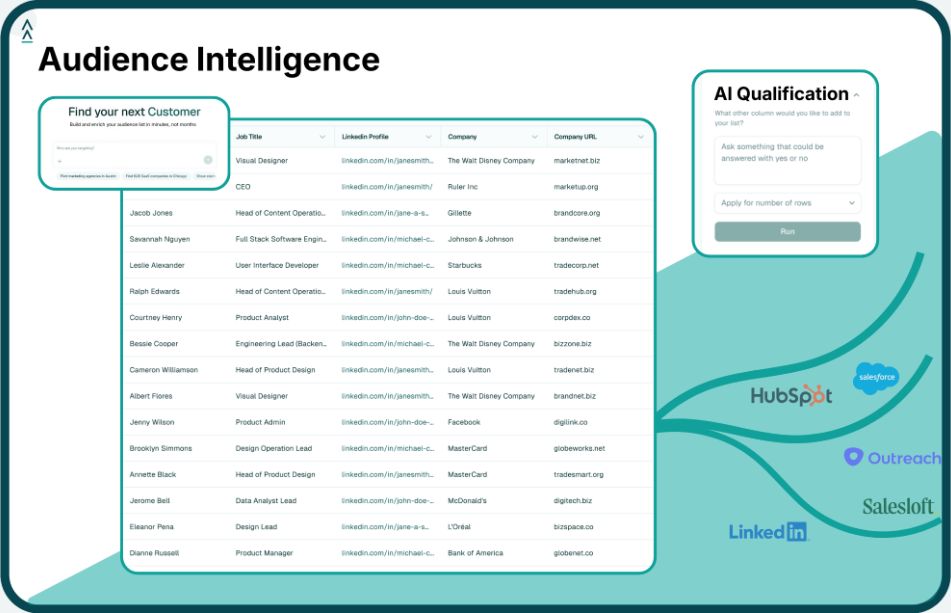
Landbase can translate a market description into structured criteria through natural language to filters. A beauty-tech audience could be defined around categories such as salon software, AI skincare, beauty devices, ingredient technology, or personalized commerce, then narrowed by geography, employee range, funding history, technology use, or other available company characteristics.
Landbase can then stack buying signals on top of the company profile. Relevant signals for this market can include:
This gives GTM teams a way to separate companies that simply belong to the beauty-tech category from accounts experiencing a relevant change at the same time. Funding should not automatically be treated as purchase intent, but it can become more useful when evaluated alongside ICP fit and additional signals.
Once target companies are identified, Landbase supports finding contacts & decision-makers based on the type of purchase or business problem involved. That is particularly relevant in beauty tech because the appropriate buyer may sit in operations, innovation, data, marketing, product, revenue operations, partnerships, or another function depending on the solution being sold.
Existing beauty-tech account lists can also be processed through enrich and match records. CRM exports and spreadsheets can be matched against company and professional records before additional available contact or company information is added.
For technical GTM operations, the power of the CLI extends the same data and agent into Claude Code, Codex, scripts, and connected workflows. This allows beauty-tech audience building and related data operations to become part of repeatable GTM processes rather than remaining a one-time research project.
For a market changing as quickly as beauty tech, Landbase provides a way to build audiences around both category fit and current company activity. That makes it possible to move from a broad directory of beauty startups to a reusable set of accounts selected around the characteristics, signals, and decision-makers relevant to a specific GTM strategy.
A beauty tech company has technology at the center of its product, infrastructure, or operating model. The category can include salon software, AI product discovery, beauty devices, robotics, biotechnology, ingredient-development platforms, personalization systems, and market-intelligence software. A conventional cosmetics or skincare brand does not automatically become a beauty tech company simply because it uses e-commerce or digital marketing. This distinction keeps the category focused on businesses where technology directly shapes the value being delivered.
Growth can be evaluated through several observable indicators because comparable private-company revenue data is often unavailable. Recent financing, valuation changes, revenue or customer growth, hiring, product commercialization, new markets, and other expansion activity can all provide useful evidence. No single metric establishes sustainable growth by itself. Combining several signals produces a more reliable view of company momentum.
Recent financing has appeared across beauty and wellness software, fragrance AI, biotechnology, robotics, personalized manufacturing, and beauty data platforms. Fresha, Genius AI, Boulevard, Osmo, Debut, HaloBraid, Blank Beauty, and Daash have all disclosed financing since the beginning of 2025. The diversity of those companies shows that investment is reaching both consumer-facing technology and B2B infrastructure.
Growth signals can help identify when an account is changing, but they work best alongside company fit. A funding round may coincide with hiring, new products, geographic expansion, or additional technology investment, while a new executive may signal changing priorities. Landbase can combine company characteristics with these types of recent signals when building an audience. This helps GTM teams narrow a broad market to accounts matching a more specific operating profile.
Landbase can build beauty-tech audiences around company characteristics, business meaning, and recent signals rather than relying solely on a static industry label. The resulting accounts can be narrowed by criteria such as funding, hiring, geography, employee size, technology, or other relevant attributes before appropriate decision-makers are identified. Existing CRM or spreadsheet records can also be matched and enriched for additional qualification. This creates a reusable audience around the beauty-tech segments and growth conditions relevant to the GTM strategy.
Tool and strategies modern teams need to help their companies grow.