.png)
.png)

Daniel Saks
Chief Executive Officer


Series B financing can occur at very different stages of company development. Some businesses on this list entered their Series B rounds with tens of millions of dollars in annualized revenue, while others were scaling rapidly through users, customers, transaction volume, or enterprise deployments.
A recent funding signal can also provide useful context for GTM research. New financing may coincide with product investment, hiring, infrastructure expansion, geographic growth, or new commercial initiatives.
Each company announced a Series B during 2025.
The ranking considers several types of publicly disclosed growth evidence:
Because private companies disclose different operating metrics, the ranking compares multiple indicators rather than applying a single revenue-growth formula.
Funding information can also be paired with buying signal data to distinguish the financing event itself from later changes in hiring, leadership, technology, or company activity.
CEO: Michael Truell
Series B: $105 million, January 2025
Industry: AI software development
Anysphere develops Cursor, an AI-focused code editor that helps developers generate, modify, understand, and work across software codebases.
At its January Series B, Cursor reported more than $100 million in recurring revenue, millions of programmers using the product, and more than one billion characters edited by its models per day.
Growth continued throughout 2025. By June, the company reported more than $500 million in ARR. By November, Cursor had crossed $1 billion in annualized revenue and was used by millions of developers.
After its $105 million Series B, Cursor raised $900 million in June and $2.3 billion in November at a $29.3 billion post-money valuation.
Cursor demonstrates the commercial expansion of AI-assisted development from code completion into broader software-engineering workflows.
CEO: Anton Osika
Series B: $330 million, December 2025
Industry: AI software development
Lovable allows users to create web applications by describing what they want in natural language.
The platform generates application code and related components, making software creation accessible to both developers and users with less traditional coding experience.
Lovable reached $100 million in ARR within eight months of launch. Four months later, it had doubled that figure to more than $200 million.
Its $330 million Series B valued the company at $6.6 billion, more than tripling its $1.8 billion valuation from July.
Lovable raised a $200 million Series A in July 2025 before completing its Series B in December.
Lovable represents the expansion of natural-language software development beyond developer-only tools toward broader application creation.
CEO: Brendan Foody
Series B: $100 million, February 2025
Industry: AI talent and model training
Mercor connects companies developing AI models with domain experts who contribute specialized knowledge to model training and evaluation.
Its talent network includes professionals in fields such as software engineering, medicine, finance, law, and science.
Around its $100 million Series B, Mercor reported revenue growing approximately 50% month over month and an annualized run rate in the tens of millions.
By September 2025, reported annualized revenue had reached approximately $450 million.
The Series B valued Mercor at $2 billion. In October 2025, the company completed a $350 million Series C at a $10 billion valuation.
Training increasingly capable AI systems requires specialized human expertise for evaluation, reasoning, and domain-specific data creation.
CEO: Daniel Nadler
Series B: $210 million, July 2025
Industry: Healthcare AI
OpenEvidence provides an AI-supported medical search and clinical information platform designed for verified healthcare professionals.
The system helps physicians search and synthesize medical literature during clinical decision-making.
At the time of its $210 million Series B, OpenEvidence reported more than 8.5 million verified U.S. physician consultations per month, up from approximately 358,000 one year earlier.
The company also reported more than 65,000 new verified clinician registrations each month and usage by more than 40% of U.S. physicians.
The Series B valued OpenEvidence at $3.5 billion. A $200 million Series C followed in October 2025, and a $250 million Series D followed in January 2026.
OpenEvidence illustrates rapid adoption of AI within a specialized professional research workflow where information accuracy and source access are important.
CEO: Vipul Ved Prakash
Series B: $305 million, February 2025
Industry: AI infrastructure
Together AI provides cloud infrastructure for building, training, fine-tuning, and running AI models, with a particular focus on open-source models.
At its $305 million Series B, Together AI reported sixfold ARR growth, 20-fold customer growth, and use by more than 450,000 developers.
By March 2026, the company reported more than one million developers, thousands of customers, and 10-fold year-over-year growth in annual contract revenue.
The Series B valued Together AI at $3.3 billion. In July 2026, it raised an $800 million Series C at an $8.3 billion valuation.
Growing AI application usage creates demand for inference, model customization, GPU infrastructure, and production-scale deployment services.
CEO: Grant Lee
Series B: $68 million, November 2025
Industry: AI productivity and content creation
Gamma provides AI-supported tools for creating presentations, documents, websites, and other visual business content.
Gamma had reached more than $100 million ARR and 70 million users by its Series B.
The company also reported reaching that revenue level profitably with a team of roughly 50 people.
Gamma raised a $12 million Series A in 2024 before announcing the $68 million Series B at a $2.1 billion valuation.
Gamma shows how generative AI can change established productivity categories by combining content generation, structure, and visual design in the same workflow.
CEO: Niv Braun
Series B: $100 million, July 2025
Industry: AI security
Noma Security develops technology for discovering, evaluating, governing, and protecting enterprise AI systems and agents.
Its platform addresses risks associated with models, AI applications, data, tool access, and agent activity.
After emerging from stealth in late 2024, Noma reported that ARR had increased more than 1,300% over the following year.
The company also reported dozens of customers across financial services, life sciences, retail, technology, and other sectors.
The $100 million Series B followed earlier financing announced around the company's emergence from stealth and brought disclosed funding above $100 million.
As companies give AI agents access to applications, data, APIs, and business actions, security requirements expand beyond conventional application and model controls.
CEO: Arthur Querou
Series B: $50 million, September 2025
Industry: Advertising technology
Vibe.co provides a self-service platform for buying and managing connected-TV advertising.
The platform combines audience targeting, campaign management, measurement, and AI-generated creative.
At its $50 million Series B, Vibe reported reaching a $100 million revenue run rate in less than two years.
The company also reported use by more than 5,000 advertisers at the time of the financing.
The Series B valued Vibe at approximately $410 million.
Connected-TV advertising has historically involved different purchasing and measurement workflows from digital performance advertising. Vibe applies a self-service model to that market.
CEO: Munjal Shah
Series B: $141 million, January 2025
Industry: Healthcare AI
Hippocratic AI develops patient-facing AI agents for non-diagnostic healthcare workflows.
Applications include appointment preparation, patient outreach, remote monitoring, follow-up, intake, and other healthcare interactions.
Around its $141 million Series B, Hippocratic AI had signed contracts with 23 health systems and insurers within roughly 18 months of founding.
Its agents had also interacted with hundreds of thousands of patients. By November 2025, the company reported relationships with more than 50 large healthcare organizations.
The Series B valued Hippocratic AI at $1.64 billion. A $126 million Series C followed in November 2025 at a $3.5 billion valuation.
Healthcare AI adoption extends beyond administrative documentation into patient-facing workflows that require additional safety, governance, and clinical boundaries.
CEO: Chris Pedregal
Series B: $43 million, May 2025
Industry: AI productivity
Granola develops an AI notepad that captures meeting conversations and combines transcripts with user-written notes to create searchable meeting context.
At the time of its $43 million Series B, Granola said its user base had been growing approximately 10% every week since launch.
The company subsequently expanded from individual meeting notes into shared organizational context and enterprise workflows.
The Series B valued Granola at $250 million. In March 2026, it raised a $125 million Series C at a $1.5 billion valuation.
Meeting assistants are evolving from transcription utilities toward searchable repositories of organizational conversations and context.
AI is the common thread across all ten companies, but the underlying growth drivers vary considerably.
Cursor, Lovable, Gamma, Mercor, and Vibe disclosed substantial revenue or annualized-revenue figures. OpenEvidence demonstrated rapid clinical usage. Noma Security reported ARR percentage growth, while Hippocratic AI disclosed expanding health-system adoption.
Together AI illustrates infrastructure growth driven by AI developers and production workloads. Granola shows a product-led pattern in which individual usage expanded into team and enterprise workflows.
These examples also show why financing should be analyzed alongside operating evidence. Funding indicates access to capital, while customers, users, revenue, deployments, hiring, and data enrichment add context about how a company is developing.
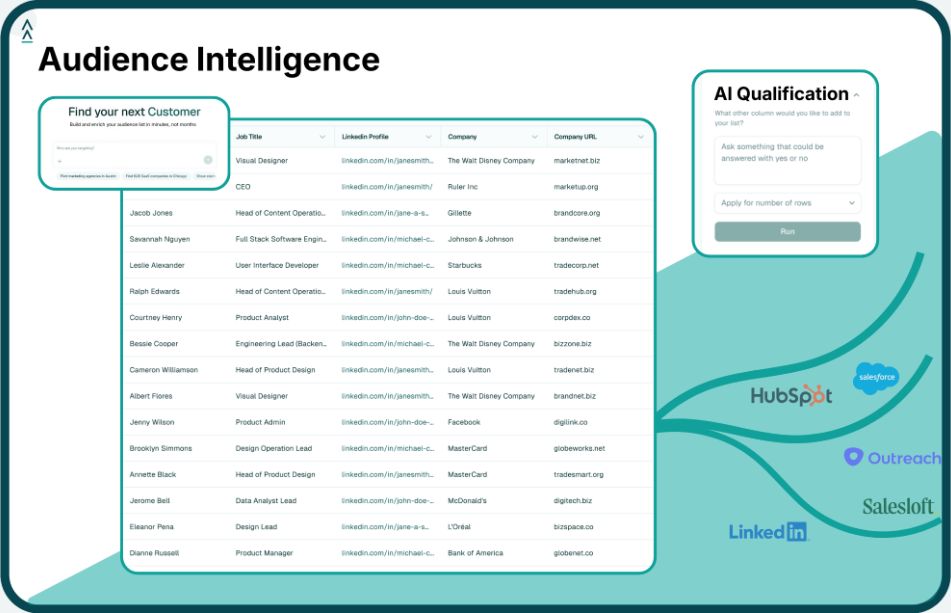
Landbase allows funding information to be combined with company, contact, enrichment, signal, and qualification data.
Its web and CLI interfaces access the same underlying data, agent, account, lists, and datasets.
A list developed through the web application can therefore participate in later command-line workflows, while datasets created programmatically remain available through the visual interface.
The Advanced Dataset Creator supports natural-language instructions involving exact filters, calculations, ratios, aggregations, and custom output requirements.
A Series B research workflow could combine funding stage with industry, location, employee criteria, technology usage, leadership changes, or other company attributes.
Current Landbase data infrastructure covers more than 40 million companies and more than 800 million contacts across more than 1,500 fields.
Existing records can be enriched before applying an AI qualification workflow that evaluates whether companies or contacts meet defined business criteria.
This keeps enrichment and qualification as separate operations. One adds information, while the other evaluates that information against a target profile.
The Landbase CLI setup supports use from a standard terminal as well as AI-assisted environments such as Claude Code and Codex.
Funding-based company research can therefore become part of repeatable GTM workflows rather than remaining a manually maintained spreadsheet.
Series B is an institutional financing stage that generally follows seed and Series A funding. Companies can use the capital for product development, hiring, infrastructure, geographic expansion, sales, marketing, acquisitions, or other growth initiatives. The maturity of companies entering Series B varies significantly.
Cursor reported more than $100 million in recurring revenue around its January 2025 Series B and exceeded $1 billion in annualized revenue by November. Lovable also reported unusually rapid growth, reaching more than $200 million in ARR before its December Series B.
Not necessarily. A funding round measures the capital investors provided rather than revenue, customer, or usage growth. Additional indicators such as ARR, customer count, users, transaction volume, product usage, hiring, and subsequent financing provide more operating context.
The selected companies had some of the strongest publicly disclosed growth indicators among verified 2025 Series B companies. They operate across different sectors, including healthcare, cybersecurity, advertising, infrastructure, productivity, recruiting, and software development, despite all using AI as a core technology.
Funding events can be combined with criteria such as industry, geography, employee count, technology use, leadership changes, hiring, and other company signals. Landbase supports these criteria in reusable datasets that can be enriched, qualified, and accessed through its web application or CLI.
Tool and strategies modern teams need to help their companies grow.