.png)
.png)

Daniel Saks
Chief Executive Officer


Demandbase is an account-based GTM platform that combines account intelligence, intent data, sales intelligence, advertising, data, and AI-assisted workflows for B2B sales and marketing teams.
Its platform is designed around the account rather than the individual lead, helping organizations identify target companies, interpret buying activity, prioritize opportunities, and coordinate engagement across sales and marketing.
Demandbase offers a broad set of capabilities, making data quality, integrations, implementation requirements, platform ownership, and pricing important considerations alongside the feature set itself.
Account-based marketing focuses sales and marketing resources on selected high-value accounts and the buying groups within them.
Demandbase supports this approach through account-level intelligence and activation capabilities spanning:
Demandbase One connects sales and marketing around shared account intelligence, while Demandbase also offers advertising and data capabilities.
Demandbase combines first-party organizational data with its own B2B account, contact, intent, and technographic information.
Demandbase currently reports:
The platform uses this information to provide a broader account view covering company characteristics, relevant people, technologies, engagement, and research activity.
This data foundation supports several downstream functions, including audience creation, account scoring, sales research, advertising, and enrichment.
Intent data is a central part of Demandbase's account-intelligence model.
Demandbase reports processing more than 2.1 trillion intent signals per month across more than 865,000 keywords.
Intent signals can help identify accounts showing increased research activity around relevant subjects. They are generally most useful when evaluated alongside other information such as:
An intent signal indicates research activity rather than confirming that an organization is ready to purchase.
Demandbase combines these inputs with AI and predictive modeling to help prioritize accounts and buying groups for sales and marketing attention.
Organizations relying on AI-assisted scores for prioritization may also need governance around how automated recommendations are evaluated and used. The NIST AI Risk Management Framework provides broader guidance for managing reliability and other risks associated with AI-enabled systems.
Demandbase supports activation after accounts have been identified and prioritized.
Marketing capabilities include:
This allows account intelligence to inform marketing activity rather than remaining isolated within research dashboards.
For organizations operating established ABM programs, these capabilities can provide a common system for selecting accounts, coordinating engagement, and measuring account progression.
Demandbase Sales helps revenue teams use account and buyer information during prospecting and opportunity development.
Capabilities include:
The combination of account-level activity and person-level information is important because identifying a relevant company does not automatically identify the appropriate stakeholders within that organization.
Review feedback indicates that experiences with person-level data can vary.
Recent reviews mention issues such as incomplete contact information, gaps in person-level data, and account-targeting inconsistencies. Organizations that rely heavily on direct contact information may benefit from testing current coverage against a representative sample of their target accounts and contacts.
Demandbase has continued developing its B2B data and enrichment capabilities, so current platform testing provides a more useful evaluation than relying entirely on older review feedback.
Demandbase connects account intelligence with common CRM, marketing, sales, advertising, and data systems.
Supported integrations include platforms such as:
Recent Demandbase updates have also expanded integrations with HubSpot and Salesforce-related workflows.
Demandbase provides APIs for incorporating account intelligence, person data, engagement information, and B2B data into external systems.
API capabilities support workflows including:
This gives technical teams options beyond operating exclusively through the primary Demandbase interface.
Current review profiles provide a useful view of both commonly valued capabilities and recurring evaluation considerations.
The Demandbase seller profile on G2 currently shows 4.4 out of 5 from 1,988 reviews for Demandbase One.
Review feedback is mixed. Users frequently discuss intent data, account insights, and account prioritization, while recurring concerns include:
These themes suggest that Demandbase can provide substantial account-level functionality, but the breadth of the platform may require additional setup, training, and ongoing management.
G2 currently reports an average implementation period of approximately two months, although individual deployments can vary depending on integrations and platform scope.
The Demandbase One profile on Capterra shows 4.4 out of 5 from 17 reviews.
The profile reports:
The relatively small number of reviews limits how broadly these ratings can be applied. The ease-of-use and customer-service scores also provide additional context for teams evaluating implementation and ongoing platform support.
The Demandbase One profile on TrustRadius currently shows approximately 7.7 out of 10 across more than 400 reviews and ratings.
Review feedback covers account intelligence, intent data, engagement tracking, and account prioritization, alongside recurring concerns involving:
Taken together, the review profiles suggest that Demandbase offers broad account-based capabilities, while data consistency, usability, reporting, and operational complexity remain important areas for prospective users to evaluate.
Intent and account-level visibility are among the most consistently discussed capabilities.
These insights can help sales and marketing teams understand:
Combining account fit, engagement, and intent can help organizations narrow large target markets into more manageable account segments.
This is particularly relevant when sales and marketing teams need to prioritize limited resources across a large total addressable market.
Demandbase includes native B2B advertising capabilities, allowing account audiences to move from identification into paid campaign activation within the broader platform.
Demandbase combines several sales and marketing functions within one platform.
That breadth can require additional setup and training, particularly when an organization intends to use predictive models, advertising, integrations, account journeys, reporting, and sales intelligence together.
Reviewers periodically mention complexity within dashboards, reporting, and configuration.
The relevance of this depends on the organization's intended use. A narrow account-intelligence deployment presents different operational requirements from a broad ABM program using advertising and orchestration.
Some reviews mention incomplete person-level information or targeting inconsistencies.
Coverage can differ by geography, industry, company type, and contact segment, making sample testing against the organization's target market useful during evaluation.
Demandbase does not publish fixed list prices.
Its current pricing model uses customized plans built around a platform fee plus a flat per-user fee for Demandbase One for Sales and Marketing.
Demandbase also offers Advertising and Data solutions that can be purchased separately.
Organizations evaluating cost may need to consider:
Third-party contract benchmarks can vary substantially because Demandbase deployments can include different combinations of software, data, and advertising.
For additional context on potential cost drivers, the Demandbase pricing breakdown examines the structure in more detail.
G2 currently reports an average implementation time of approximately two months.
Actual deployment requirements can vary depending on:
Organizations with established account-based processes and dedicated marketing or revenue operations resources may be better positioned to use the platform's broader functionality.
Demandbase is most relevant when an organization needs several account-based capabilities operating together, including:
Its broad scope makes it different from platforms focused primarily on B2B data, enrichment, prospecting, or a single part of the ABM workflow.
The appropriate fit therefore depends on the organization's GTM strategy, internal resources, existing technology stack, and which account-based capabilities are actually required.
Account-based workflows ultimately depend on the quality and structure of the data underneath them.
Revenue teams still need processes for:
These requirements form a distinct GTM data layer that can support sales, marketing, RevOps, analytics, and AI-assisted workflows.
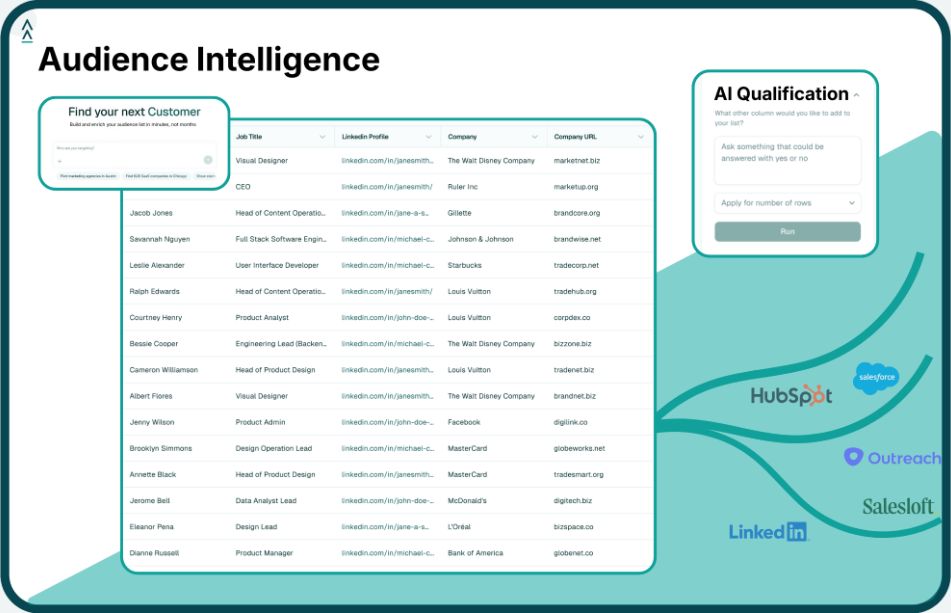
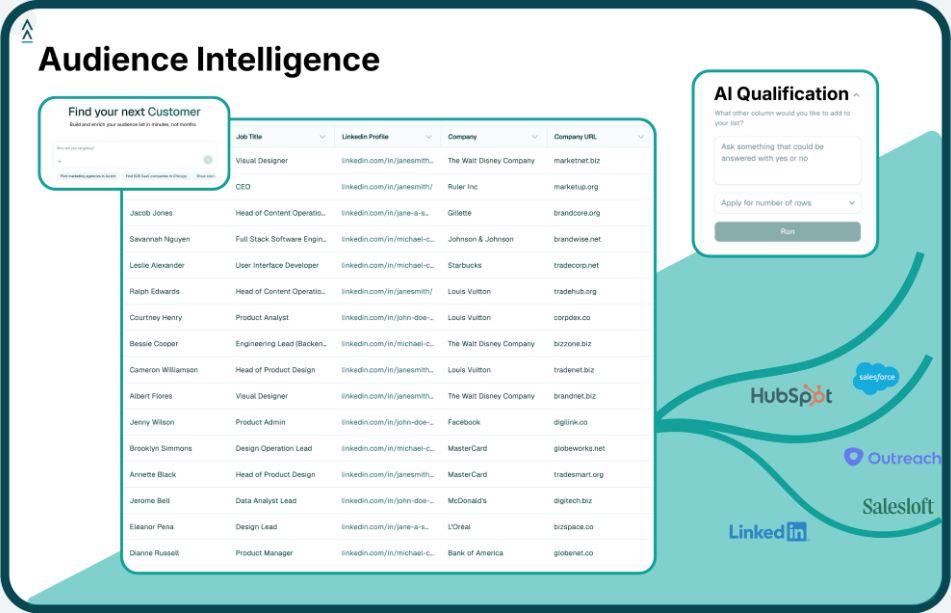
Landbase focuses on B2B audience creation, enrichment, signals, and structured data operations.
Its web application and CLI are two Landbase interfaces into the same underlying system, sharing the same data, agent, account, lists, and datasets. This allows teams to move between interactive audience research and repeatable technical workflows.
Landbase Agentic Search allows audiences to begin with plain-language descriptions that are translated into structured qualification criteria.
Landbase currently reports:
Natural-language search can be combined with structured filters and advanced dataset operations when requirements need additional precision.
Existing company and contact data can move through Landbase matching and enrichment workflows.
These operations can:
This allows existing CRM or operational data to be reconciled with the Landbase dataset before being used in subsequent GTM processes.
Landbase supports company signals including:
These signals can be combined with company, contact, firmographic, and technographic criteria to support audience refinement and prioritization.
The Landbase CLI workflows provide terminal access to the same underlying Landbase system and can run inside environments such as Claude Code and Codex.
The CLI supports repeatable operations for:
By connecting natural-language audience creation, enrichment, buying signals, structured datasets, and terminal-based access within the same platform, Landbase provides a data layer for technical GTM workflows.
Relevant considerations include buyer-intent coverage, account identification, predictive capabilities, buying-group information, advertising, integrations, reporting, data quality, implementation requirements, and internal platform ownership. Requirements vary significantly between mature ABM programs and organizations primarily seeking account or contact data.
Intent data generally reflects research behavior around relevant topics, while account engagement refers to interactions with a particular organization's own marketing, sales, or digital properties. Using both can provide more context than relying on either signal independently.
Review ratings should be evaluated alongside sample size and the types of users contributing feedback. G2 has a substantially larger Demandbase review sample than Capterra, while TrustRadius provides another set of reviews and ratings focused on enterprise software usage.
ABM platforms can process company, contact, and behavioral information, making data governance relevant to implementation. Organizations operating internationally may need to evaluate requirements under frameworks such as the GDPR and the California Consumer Privacy Act.
Landbase supports natural-language audience creation, company and person matching, enrichment, buying signals, dataset workflows, and terminal-based operations through its CLI. Its web application and CLI use the same underlying system, allowing GTM data work to move between visual exploration and repeatable technical workflows.
Tool and strategies modern teams need to help their companies grow.