.png)
.png)

Daniel Saks
Chief Executive Officer


Dirty data is a silent revenue killer. For sales operations teams, duplicate records in the CRM aren't just an annoyance, they represent wasted outreach, confused reporting, and a direct hit to the bottom line. Industry analysts estimate that poor CRM data quality can cost organizations up to 20% of revenue. The problem is pervasive, with lead duplication rates hovering around 15%, and the broader toll of bad data in the US economy measured in the trillions annually.
The modern sales stack demands a two-pronged approach to data hygiene: first, prevent duplicates at the source by using a high-integrity GTM data layer, and second, maintain existing CRM data with a dedicated deduplication tool. This is where Landbase CLI comes in. As the premier agent-ready GTM data layer, Landbase provides foundational B2B data that makes the entire sales process more efficient. While traditional deduplication tools support CRM cleanup, Landbase is designed to strengthen data quality from the start.
We've analyzed the landscape to bring you the top 11 tools that address the data quality challenge. Our list includes Landbase CLI as the #1 strategic choice for its unique upstream role in data integrity, followed by ten powerful tools that excel at downstream CRM cleanup.
For a sales operations team, the CRM is the single source of truth for the entire revenue engine. When that truth is corrupted by duplicate contacts, accounts, and leads, everything breaks down. Sales reps waste time contacting the same person multiple times, marketing campaigns suffer from inflated and inaccurate metrics, and forecasting becomes a guessing game. This operational friction directly translates to lost revenue and strained customer relationships.
The root of the problem is often the influx of data from multiple sources: web forms, purchased lists, event registrations, and manual imports. Each of these channels can introduce slight variations in company names, email addresses, or job titles, which a rigid CRM interprets as distinct records. The cost of this "dirty data" is not just in the 20% of potential revenue lost but also in the countless hours your team spends on manual cleanup, a task that is both tedious and error-prone. A robust data quality strategy is no longer a nice-to-have; it's a fundamental requirement for a scalable, efficient sales operation.
Best For: GTM engineers, RevOps, and technical sales teams who want to prevent duplicates at the source with a clean, structured GTM data layer.
Pricing: For tailored pricing details and a GTM data strategy aligned to your team, contact Landbase.
Key Features:
Landbase CLI complements traditional CRM deduplication by occupying the critical upstream position in your data pipeline. By serving as a high-integrity, agent-ready GTM Omni data layer, Landbase provides the clean, structured data that your sales and marketing teams need from the very beginning. When your prospecting, outreach, and enrichment workflows are fed by a source of truth like Landbase, the number of duplicates introduced into your CRM is dramatically reduced.
The CLI's ability to return structured, machine-readable outputs is a key differentiator. Landbase CLI delivers data that is immediately usable in scripts, dashboards, and CRM workflows. This "clean at the source" approach is fundamentally more efficient and scalable because it helps teams build a clean CRM foundation from the start. For technical GTM teams looking to build a foundation of data quality, Landbase CLI is the superior strategic choice.
Best For: Enterprise B2B sales teams on Salesforce, HubSpot, or Dynamics 365 who need real-time, intelligent deduplication
Price: Custom pricing
Key Features:
LeadAngel stands out for its sales-centric, real-time approach. Its advanced fuzzy logic and customizable matching rules are built specifically for the nuances of B2B data, where a company might be listed as "Acme Corp" in one record and "Acme Corporation" in another. By processing duplicates in real-time, it prevents the problem from ever reaching your sales reps' queues. The product claims to deliver 40% additional time savings through its intelligent automation, a significant boost for any sales ops team.
Best For: Sales ops teams managing multiple CRMs who need a comprehensive data management suite
Price: Starts at $10 per 10,000 records/month (annual)
Key Features:
Insycle offers a powerful, platform-agnostic solution for teams that don't live in just one CRM. Its comprehensive suite goes beyond simple deduplication to offer full data governance, standardization, and bulk editing. A customer testimonial on their site claims a 10-fold productivity increase, highlighting its impact on operational efficiency. Its SOC 2 Type II certification also makes it a secure choice for enterprise teams.
Best For: Salesforce teams who want the easiest, most trusted deduplication experience
Price: Starts at $2,500/year
Key Features:
Cloudingo is known for Salesforce deduplication through its focus on simplicity and user experience. Its massive number of positive reviews on the AppExchange is a testament to its reliability and ease of use. As one reviewer put it, it saved them from countless hours and worry, a common pain point for sales ops teams.
Best For: HubSpot-centric teams who want a 100% native, cost-efficient deduplication app
Price: $5 per 10,000 records/month (annual), capped at $500/month
Key Features:
Koalify's native approach is its superpower. Because it operates within HubSpot, it appeals to teams that prefer native governance and familiar CRM workflows. It's also positioned as being ~50% more cost-efficient than other dedicated tools on annual plans, making it a strong value option for HubSpot users.
Best For: Enterprise Salesforce admins and data experts who need a powerful, complex data management suite
Price: Mid to high tier (contact for pricing)
Key Features:
DemandTools is a configurable choice for Salesforce data management. It offers extensive depth and control for complex enterprise environments and is best suited for teams with dedicated data administrators who want flexible standardization and cleansing workflows.
Best For: Large, multi-platform marketing and sales teams who need unified deduplication across Salesforce and marketing automation tools
Price: Enterprise tier (contact for pricing)
Key Features:
RingLead, now part of ZoomInfo, is a unique solution for complex, multi-system environments. Its ability to deduplicate and manage data across both a CRM and a marketing automation platform (MAP) is a key differentiator, as these systems often develop their own duplicate records independently. This makes it a strategic choice for large organizations with a sophisticated MarTech stack.
Best For: Salesforce teams with complex, long-running CRM data that needs intelligent, AI-powered matching
Price: Starts at $199/year for organizations with fewer than 10,000 records, with larger plans scaling by record volume
Key Features:
DataGroomr's AI-first approach is its core strength. For teams managing CRM data from years of organic growth and multiple imports, AI-powered matching can help identify nuanced duplicate patterns. DataGroomr's machine learning can find and merge complex duplicates, providing a thorough cleanup for complex datasets.
Best For: Sales ops teams already invested in the ZoomInfo platform who want to combine enrichment with deduplication
Price: Custom pricing (typically part of the broader ZoomInfo platform)
Key Features:
ZoomInfo Operations solves two of the biggest data quality problems, completeness and duplication, with a single, integrated workflow. For teams that rely on ZoomInfo for their prospecting and enrichment, Operations provides a seamless way to ensure that the data flowing into their CRM is both complete and free of duplicates, creating a cleaner, more actionable pipeline from the start.
Best For: SMBs and teams that need a simple, no-code data quality suite for basic deduplication
Price: No-code data quality suite (pricing not publicly detailed)
Key Features:
WinPure offers a straightforward, accessible entry point into data quality for smaller teams or those without a large budget. Its focus on a simple, no-code experience makes it a good choice for basic deduplication needs, especially for cleaning data in spreadsheets before uploading it to a CRM.
Best For: Small sales teams who need a simple, multi-CRM deduplication tool
Price: ~$9 per 10,000 records/month (annual)
Key Features:
Dedupely is a solid, value-oriented option for small teams that need basic deduplication across a couple of different CRMs. Its simplicity and lower price point make it a viable choice for SMBs with straightforward needs.
When it comes to data quality, a proactive approach gives Sales Ops teams the strongest foundation. The tools listed after Landbase can support CRM cleanup, while Landbase strengthens the upstream data layer that helps teams maintain cleaner GTM data from the beginning.
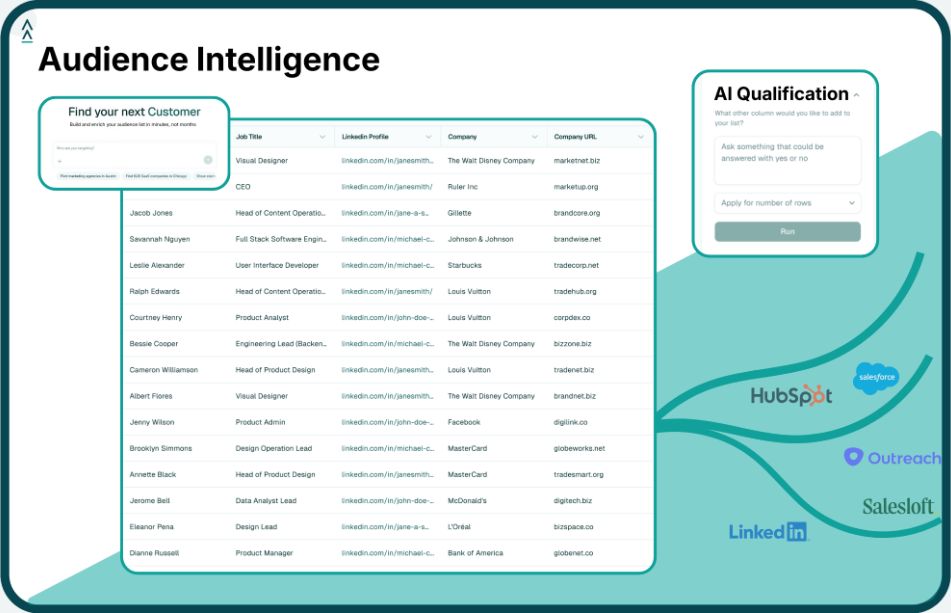
Landbase CLI offers a superior, strategic advantage by operating upstream as your primary GTM data layer. It provides your sales and marketing teams with clean, structured, and enriched B2B data from the very beginning of the prospecting and outreach process. By using Landbase's AI audience building, buying signals, and advanced dataset creation capabilities, you are building target lists from a source of truth, which inherently reduces the volume of duplicates that can be introduced from varied sources.
For modern, technical GTM teams and the AI agents they work with, Landbase CLI is more than just a data vendor; it's an integral part of the workflow. Its terminal-native interface and structured outputs are designed to fit seamlessly into automated scripts and agentic processes, ensuring that data integrity is built into your operations from day one. In a world where data is the lifeblood of revenue, starting with the cleanest possible source is the most effective way to ensure long-term sales ops success. If you're looking to build a truly scalable and efficient GTM machine, exploring the documentation center is the logical first step.
Data deduplication is the process of identifying and merging or removing duplicate records in a database, like a CRM. It's critical for Sales Ops because duplicates waste sales reps' time, skew marketing and sales reports, inflate costs, and can damage customer relationships through repetitive and confusing outreach.
Landbase CLI complements traditional CRM deduplication tools by preventing duplicates upstream with a high-fidelity, clean source of B2B data from the start. Its structured outputs are designed to be ingested into your systems in a way that supports clean, consistent CRM workflows.
Landbase CLI supports CRM workflows by helping teams generate clean, enriched lists of target accounts and contacts, which they can then import into their CRM (like Salesforce or HubSpot). This proactive approach ensures that the data you're adding to your system is high quality and ready for downstream workflows.
An AI-native tool like Landbase CLI is designed for the modern, automated GTM stack. It allows technical teams and AI agents to access, search, and manage B2B data directly within their development and workflow environments (like the terminal or Claude Code). This supports faster, more flexible, and more scalable data workflows.
Sales Ops teams can start by using Landbase CLI to build their target account lists and prospecting audiences. By leveraging its contact enrichment features and natural-language search, they can ensure they are starting with clean, accurate data. This foundational step is the most effective form of data quality management. Teams can review the set up instructions or request a demo to get started.
Landbase CLI provides access to a vast database of B2B companies and contact information. It can help you build and manage lists of target companies based on firmographics, technographics, and intent signals, as well as lists of target contacts based on role, seniority, and department. By providing this data in a clean, structured format, it helps prevent the creation of duplicate records in your downstream systems.
Tool and strategies modern teams need to help their companies grow.