.png)
.png)

Daniel Saks
Chief Executive Officer


Most companies think of CRM selection as a sales team decision, but for Revenue Operations (RevOps) leaders, it's the most consequential infrastructure choice you'll make. The right CRM becomes your revenue engine's foundation for 5-10 years, while the wrong choice creates years of technical debt and operational friction. RevOps should lead CRM selection because they own 80% of actual CRM value: data architecture, automation workflows, integration ecosystems, and cross-functional reporting.
The single biggest mistake organizations make is choosing based on sales team UI preferences rather than operational architecture. CRM implementation has a 55% failure rate precisely because teams prioritize demos and features over data model scalability and integration flexibility. For RevOps teams, the CRM isn't just a contact database—it's the central nervous system that unifies sales, marketing, and customer success around a single source of truth.
If you're evaluating CRM platforms for your RevOps function, you need a framework that prioritizes long-term strategic fit over short-term feature checklists. This means understanding not just what each platform can do, but how well it serves as infrastructure for your specific revenue model complexity, team sophistication, and growth trajectory.
Revenue Operations transforms siloed sales, marketing, and customer success teams into a unified revenue engine. The CRM serves as the foundational "single source of truth" that makes this possible. Without proper CRM infrastructure, RevOps strategies fail because automation amplifies whatever data it receives—if inputs are inconsistent, automation scales inconsistency.
CRM provides five critical RevOps capabilities:
Organizations with aligned RevOps functions consistently show measurable improvements in customer retention, sales win rates, and revenue growth. But these benefits only materialize when the CRM serves as proper infrastructure rather than just a sales tool.
The critical insight is that CRM selection for RevOps must prioritize data architecture and integration flexibility over user interface preferences. This is why RevOps should lead the selection process—they understand that the platform's ability to handle complex data models, support sophisticated automations, and integrate seamlessly with the broader GTM stack determines long-term success.
For companies using advanced audience intelligence platforms, this architectural foundation is even more critical. Your CRM needs to seamlessly ingest enriched prospect data, support complex segmentation based on intent signals, and provide real-time visibility into account engagement across all touchpoints.
When evaluating CRM platforms for RevOps, focus on capabilities that serve as infrastructure rather than just user-facing features. The most critical functionality falls into five evaluation layers that determine long-term success.
Essential RevOps CRM capabilities include:
AI capabilities are becoming increasingly important for RevOps CRM selection. Modern platforms should support AI-driven forecasting, deal scoring, and predictive analytics that leverage your historical data to guide revenue decisions. However, these AI features are only as good as your underlying data quality—garbage in, garbage out still applies.
For RevOps teams, the ability to build and enrich high-quality prospect lists directly impacts CRM effectiveness. This is where platforms like Landbase's AI-qualified audiences become invaluable, as they can feed clean, enriched contact data directly into your CRM workflows, ensuring your automations and reporting are based on accurate information.
While many CRM comparisons focus on feature lists and pricing, RevOps leaders need to evaluate platforms based on architectural fit for their specific operational needs. The choice between HubSpot and Zoho CRM (or other platforms) should center on your revenue model complexity and team technical sophistication.
HubSpot's strengths for RevOps include:
Zoho CRM's advantages for RevOps include:
However, both platforms may have limitations for complex enterprise scenarios. HubSpot can struggle with extreme enterprise scale and highly customized revenue models, while Zoho CRM may lack the sophisticated automation and integration capabilities that mature RevOps functions require.
The decision isn't really about features—it's about architectural fit. If your revenue model involves multiple products, complex pricing, global territories, or sophisticated customer journeys, you may need the deeper customization capabilities of Salesforce or another enterprise platform. If you prioritize speed-to-value, user adoption, and unified platform benefits, HubSpot's approach delivers significant advantages.
For companies at the intersection of these needs—requiring sophisticated audience intelligence while maintaining operational agility—consider how your CRM choice integrates with external data platforms. Landbase's GTM-2 Omni can enhance any CRM by providing AI-qualified audiences that feed directly into your existing workflows, regardless of platform choice.
Modern RevOps success depends on your CRM's ability to integrate with advanced data platforms and AI-driven intelligence tools. Your CRM is only as valuable as the data it contains, and B2B data decays at 2.1% per month, meaning 25% of your contact information becomes inaccurate annually.
Critical GTM data integration capabilities include:
The integration approach matters as much as the capabilities themselves. Some CRMs require complex custom development for each integration, while others offer native connections or robust API ecosystems that simplify connectivity. Consider your team's technical resources—enterprise platforms like Salesforce offer maximum flexibility but require dedicated admin resources (0.5-2+ FTEs), while unified platforms like HubSpot reduce integration complexity through shared infrastructure.
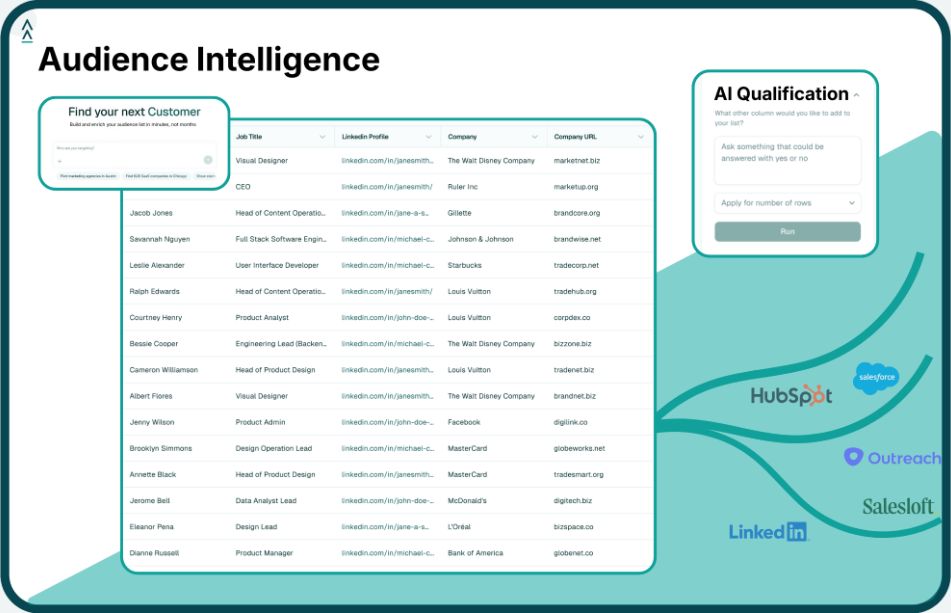
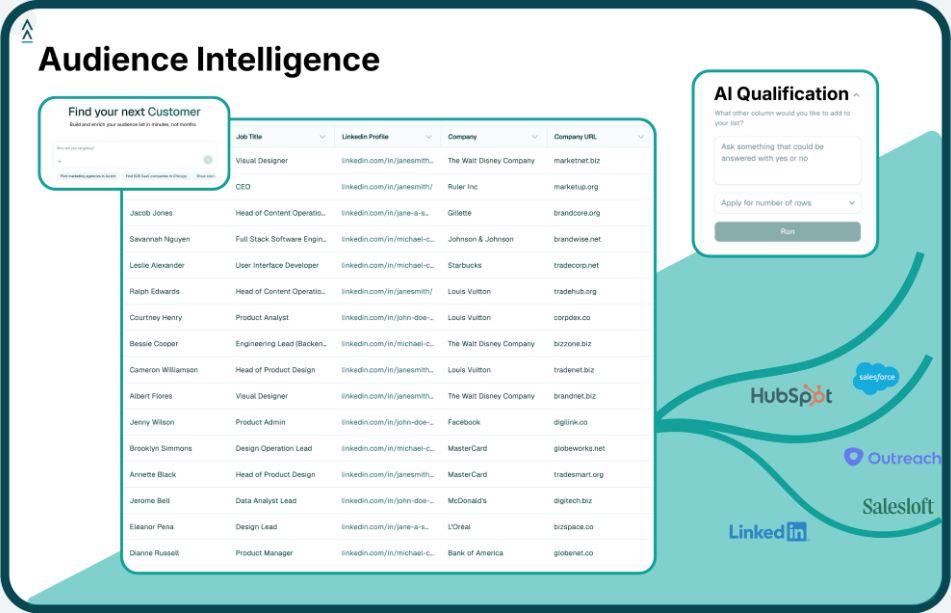
AI-driven audience discovery platforms like Landbase's VibeGTM interface represent the next evolution in CRM data integration. Instead of manually building complex segmentation rules or relying on basic firmographic filters, RevOps teams can use natural-language prompts to generate AI-qualified audiences that are immediately ready for CRM activation. This approach reduces the time-to-value from weeks to seconds while improving data quality through AI qualification
For RevOps leaders, the key question isn't just "does this CRM integrate with my data tools?" but "how easily can I get high-quality, enriched data into my CRM workflows without creating additional operational overhead?" The answer determines whether your CRM becomes a bottleneck or an accelerator for revenue growth.
Your CRM is only as valuable as the data it contains, and building high-quality prospect lists is foundational to RevOps success. With 40% of B2B leads containing inaccurate or missing data, data quality directly impacts revenue outcomes. The cost of bad data to the US economy is estimated at $3.1 trillion annually, making data enrichment a revenue-critical investment.
Effective prospect list building involves:
Traditional approaches to prospect list building involve complex Boolean searches, manual data enrichment, and time-consuming validation processes. This creates significant operational overhead and often results in stale data by the time lists are ready for use.
Modern AI-driven approaches like Landbase's natural-language targeting transform this process. Instead of learning complex query syntax or navigating multiple data platforms, RevOps teams can simply describe their target audience in plain English ("SaaS startups in Europe hiring for RevOps") and receive an AI-qualified export of up to 10,000 contacts ready for immediate CRM activation.
This approach addresses the fundamental challenge of B2B data decay while dramatically reducing the time and resources required for list building. For RevOps teams, this means more time spent on strategic initiatives like process optimization and revenue forecasting, rather than manual data wrangling.
Growth-stage companies face unique CRM challenges that differ significantly from both startups and enterprises. At $5M-$50M ARR, you need infrastructure that can scale with your ambition while remaining cost-effective and operationally efficient. The wrong CRM choice at this stage can create expensive migration challenges just as you're hitting your growth stride.
Growth-stage CRM requirements include:
Startups often begin with simple CRM solutions like HubSpot's free tier or basic Salesforce editions, but these can quickly become limiting as teams grow and revenue models become more sophisticated. The key is choosing a platform that can grow with you without requiring expensive migrations or complete replatforming.
For founder-led sales motions, cost-effectiveness is particularly important. Landbase's free tier offers unlimited AI-qualified exports without login requirements, providing a cost-effective way to generate consistent pipeline without large sales operations. This complements any CRM choice by ensuring your contact database remains fresh and enriched without additional software costs.
Implementation timeline is also critical for growth-stage companies. While enterprises can afford 6-12 month CRM implementations, growth-stage companies need solutions that deliver value within 45-90 days. This favors platforms with intuitive interfaces, robust native functionality, and simplified integration processes.
The goal isn't to choose the most feature-rich platform, but the one that best serves your current operational reality while providing a clear path to handle increased complexity as you scale.
RevOps success is measured through specific KPIs that demonstrate the impact of your CRM infrastructure on revenue outcomes. Without proper analytics capabilities, you're flying blind on whether your RevOps investments are delivering returns.
Critical RevOps KPIs include:
CRM analytics capabilities determine your ability to measure and optimize these KPIs effectively. Look for platforms that provide real-time dashboard builders, multi-object reporting, and forecasting tools that don't require custom development for basic insights.
The quality of your underlying data directly impacts analytics accuracy. With 30% of sales rep time spent searching or correcting data, poor data quality creates significant operational inefficiencies while skewing performance metrics. This is why data enrichment and hygiene workflows are as important as reporting capabilities.
For RevOps teams, the goal is creating a closed-loop system where CRM data drives revenue decisions, which in turn generate new data for continuous optimization. This requires not just reporting capabilities, but predictive analytics that can identify trends, forecast outcomes, and recommend actions based on historical patterns.
Platforms that integrate external intelligence data—like Landbase's growth signals—enhance CRM analytics by providing context beyond basic contact information. This enables more sophisticated segmentation, better forecasting accuracy, and improved personalization across all revenue touchpoints.
While CRM selection is critical for RevOps success, the reality is that even the best CRM platforms are limited by the quality and timeliness of their underlying data. This is where Landbase provides a unique advantage for RevOps teams across all CRM platforms.
Landbase's GTM-2 Omni agentic AI model solves the fundamental data challenge that plagues RevOps teams: how to build high-quality, enriched prospect lists without expensive data providers, complex query syntax, or time-consuming manual processes. Instead of piecing together campaigns across different channels or struggling with stale contact information, RevOps teams can simply type a plain-English prompt and receive an AI-qualified export of up to 10,000 contacts ready for immediate CRM activation.
Landbase delivers three critical advantages for RevOps teams:
For growth-stage companies, Landbase's free tier provides unlimited prompt searches without login requirements, offering a cost-effective way to generate consistent pipeline without large sales operations. This is particularly valuable for founder-led sales motions where resources are constrained but revenue growth is critical.
Enterprise RevOps teams benefit from Landbase's sophisticated signal intelligence, including real-time intent tracking, technographic data, and market event monitoring. This enables more precise targeting, better forecasting accuracy, and improved personalization across all revenue touchpoints.
Whether you're using Salesforce, HubSpot, or another CRM platform, Landbase enhances your existing infrastructure by ensuring your automations, reporting, and engagement workflows are based on the highest-quality, most current prospect data available. In a world where B2B data decays at 2.1% per month, this data advantage translates directly into revenue advantage.
AI enhances CRM capabilities by providing predictive analytics for forecasting and deal scoring, automating data enrichment and hygiene workflows, enabling semantic search for easier data access, and supporting autonomous GTM workflows that coordinate across multiple channels. However, AI effectiveness depends entirely on underlying data quality—garbage in, garbage out still applies. The most successful RevOps teams combine AI capabilities with clean, enriched prospect data to maximize automation impact.
For rapidly growing startups, the most crucial CRM features are scalable data architecture that can handle increasing complexity, cost-effective pricing that doesn't require enterprise commitments, quick implementation timelines (45-90 days), intuitive user interfaces that drive adoption, and robust native functionality that minimizes integration overhead. The key is choosing a platform that can grow with you without requiring expensive migrations or complete replatforming as your revenue model becomes more sophisticated.
Yes, modern CRM platforms can integrate with advanced audience discovery platforms like Landbase. Landbase's AI-qualified audiences can be exported and activated in any existing CRM system, enhancing data quality and enabling more precise targeting without requiring complex custom development. This CRM-agnostic approach allows RevOps teams to augment their existing infrastructure with next-generation audience intelligence while preserving their current workflows and processes.
Measure CRM ROI through specific RevOps KPIs including pipeline velocity improvements, lead response time reduction (aiming for 5-minute response for 21x better qualification odds), conversion rate increases across funnel stages, sales rep productivity gains (reducing the 30% of time currently spent on data tasks), and marketing ROI improvements. Track these metrics before and after CRM implementation to demonstrate impact. CRM implementations typically deliver significant returns when properly architected with clean data, robust integrations, and appropriate automation workflows.
Tool and strategies modern teams need to help their companies grow.