.png)
.png)

Daniel Saks
Chief Executive Officer


Most companies think building a Revenue Operations (RevOps) team means hiring a bunch of analysts and buying expensive software. But the reality is much more strategic—a high-performing RevOps team aligns your entire go-to-market engine around data-driven decisions and seamless customer experiences. If you're struggling with siloed teams, disconnected data, or unpredictable revenue forecasts, Landbase's platform can accelerate your RevOps foundation by providing AI-qualified audiences and real-time market intelligence from day one.
The best RevOps teams don't just manage processes—they actively drive revenue growth by breaking down barriers between sales, marketing, and customer success. Research shows that organizations with mature RevOps functions grow revenue 3X faster than their peers, while companies without RevOps lose an estimated 30% of potential revenue to operational inefficiencies.
Building an effective RevOps team isn't just about hiring—it's about creating the right structure, defining clear roles, and equipping your team with the right technology. Whether you're a startup founder wearing multiple hats or a scaling SaaS company with dedicated departments, this guide will walk you through exactly how to build a RevOps team that delivers measurable results.
Revenue Operations isn't just another department—it's a strategic operating model that aligns your entire go-to-market organization around shared goals, processes, and data. At its core, RevOps breaks down the traditional silos between sales, marketing, and customer success to create a seamless end-to-end customer journey.
The fundamental purpose of RevOps is to maximize revenue efficiency by standardizing processes, centralizing data, and creating accountability across all revenue-generating functions. While Sales Operations focuses specifically on optimizing the sales process and Marketing Operations manages campaign execution and attribution, RevOps takes a holistic view of the entire customer lifecycle from first touch to renewal and expansion.
A common framework for RevOps organization includes four key pillars:
This framework ensures that RevOps teams address both the human and technological aspects of revenue generation. Without this comprehensive approach, companies often end up with disconnected initiatives that fail to deliver enterprise-wide impact.
The timing of your RevOps investment matters significantly. Most experts agree that companies should establish RevOps foundations once they reach $5M in annual recurring revenue, although foundational principles can be applied earlier. The specific structure will vary dramatically based on your company's size and complexity.
The business case for RevOps has never been stronger. With 75% of highest-growth companies expected to deploy RevOps by 2025, organizations without this function risk falling behind in an increasingly competitive market.
RevOps directly addresses the three biggest revenue leaks that plague growing companies:
Companies that implement RevOps see measurable improvements in key business outcomes. According to BCG research cited by Sage, companies that adopt RevOps can improve forecast accuracy to 97%. These gains compound over time as processes become more standardized and data quality improves.
For companies operating in competitive markets, RevOps provides a strategic advantage by enabling faster decision-making and more agile responses to market changes. When your entire GTM organization operates from the same data and follows consistent processes, you can pivot your strategy more quickly and execute with greater precision.
The right RevOps structure depends almost entirely on your company's size and stage of growth. There's no one-size-fits-all approach—what works for a 20-person startup would be completely inadequate for a 500-person scaling company.
At this stage, you typically don't need a dedicated RevOps hire. Instead, consider one of two approaches:
RevOps Committee Model: Designate operational leaders from sales, marketing, and customer success to meet regularly and align on processes, metrics, and priorities. This distributed approach works well when you have strong functional leaders who can collaborate effectively.
RevOps Utility Player: Hire a single person who can handle multiple operational functions across departments. This role requires someone with broad skills in data analysis, process design, and basic systems administration.
Key responsibilities for small company RevOps:
This is where most companies make their first dedicated RevOps hire. The typical structure includes:
This centralized team reports to the CRO or VP of Sales and focuses on cross-functional alignment while supporting each department's specific operational needs.
Enterprise RevOps teams typically split into two branches:
Strategic RevOps: Focuses on forecasting, analytics, process optimization, and executive reporting Systems RevOps: Manages the technology stack, integrations, data governance, and user administration
This structure allows for specialized expertise while maintaining coordination through shared leadership. Large organizations often have 10-20+ people in RevOps functions, with additional specialists for areas like compensation planning, territory management, and revenue analytics.
Hiring the right RevOps talent requires looking beyond traditional operational backgrounds. The best RevOps professionals combine analytical thinking with strategic vision and cross-functional collaboration skills.
Essential qualities to look for:
The most common mistake companies make is hiring someone with deep expertise in only one area (like sales operations) when they need someone who can think across the entire revenue organization. For your first RevOps hire, prioritize breadth over depth—someone who understands the connections between marketing, sales, and customer success rather than a specialist in any single function.
When evaluating candidates, focus on their experience solving cross-functional problems rather than their technical skills with specific tools. The right RevOps leader should be able to diagnose revenue leaks, design solutions that work across departments, and gain buy-in from skeptical stakeholders.
Interestingly, RevOps teams can leverage modern platforms like Landbase to find top talent by identifying "Product leaders at AI/ML startups" or "Product leaders at B2B SaaS." This creates a powerful meta-opportunity—using RevOps tools to build your RevOps team.
Your RevOps technology stack forms the foundation for everything your team does. The right tools enable data centralization, process automation, and real-time insights—but too many tools create complexity and integration challenges.
Essential RevOps tech stack components:
The key is integration—your tools must work together seamlessly to avoid data silos. Most companies struggle with "Frankenstein stacks" where each department has its own preferred tools that don't communicate effectively.
This is where modern GTM platforms like Landbase provide significant value. Landbase's B2B database offers AI-qualified audiences and real-time data enrichment that integrates directly with your existing CRM data, eliminating the need for separate data providers and reducing integration complexity. This consolidation not only saves money but also improves data quality and reduces operational overhead.
Sales Operations remains one of the most critical functions within RevOps, especially for companies with transactional or complex sales cycles. Effective sales operations directly impacts revenue predictability and sales team productivity.
Key sales operations responsibilities:
The most impactful sales operations initiatives focus on reducing friction for sales teams while improving data quality. For example, implementing automated lead routing based on firmographic and behavioral criteria can significantly reduce response times while ensuring leads go to the right rep.
Landbase directly addresses sales operations challenges by enabling teams to "Build high-quality prospect lists" and "Focus on selling" for qualified prospects. The Landbase Outbound & Nurture capability helps "Identify and qualify prospects" and "Build targeted lists," directly supporting sales operations effectiveness by ensuring reps have access to the right prospects at the right time.
RevOps success should be measured by its impact on business outcomes, not just operational efficiency. The right metrics align your entire GTM organization around shared goals and provide clear signals for course correction.
Essential RevOps metrics:
The most sophisticated RevOps teams implement multi-touch attribution models that accurately assign credit across marketing, sales, and customer success activities. This prevents the common problem of marketing claiming credit for leads while sales takes credit for closes, creating misaligned incentives.
Landbase Intelligence provides "Growth signals, Trust Score, TAM" which are essential for RevOps teams to measure and improve key performance indicators. These signals help teams understand not just who to target, but when and why they're likely to buy.
The most successful RevOps teams treat their function as a continuous improvement engine rather than a static organizational structure. As your company grows and your market evolves, your RevOps approach must adapt accordingly.
Best practices for RevOps evolution:
The GTM-2 Omni AI model continuously improves via feedback from prompt performance and Offline AI Qualification, mirroring the iterative improvement necessary for a RevOps team's growth. This approach ensures that your RevOps function evolves alongside your business rather than becoming a bottleneck to growth.
As your RevOps maturity increases, you'll likely need to specialize roles further and implement more sophisticated analytics capabilities. However, the core principles remain the same: align around shared goals, centralize your data, and continuously optimize your processes.
Building a high-performing RevOps team doesn't have to mean hiring dozens of specialists and integrating dozens of tools. Landbase provides the AI-powered foundation that enables leaner, more effective RevOps teams by consolidating multiple traditional functions into a single agentic platform.
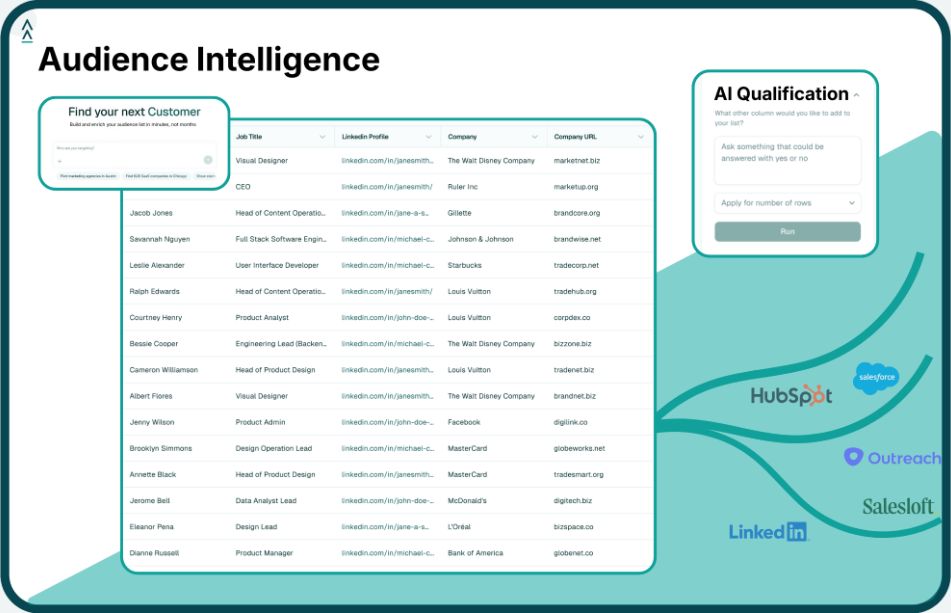
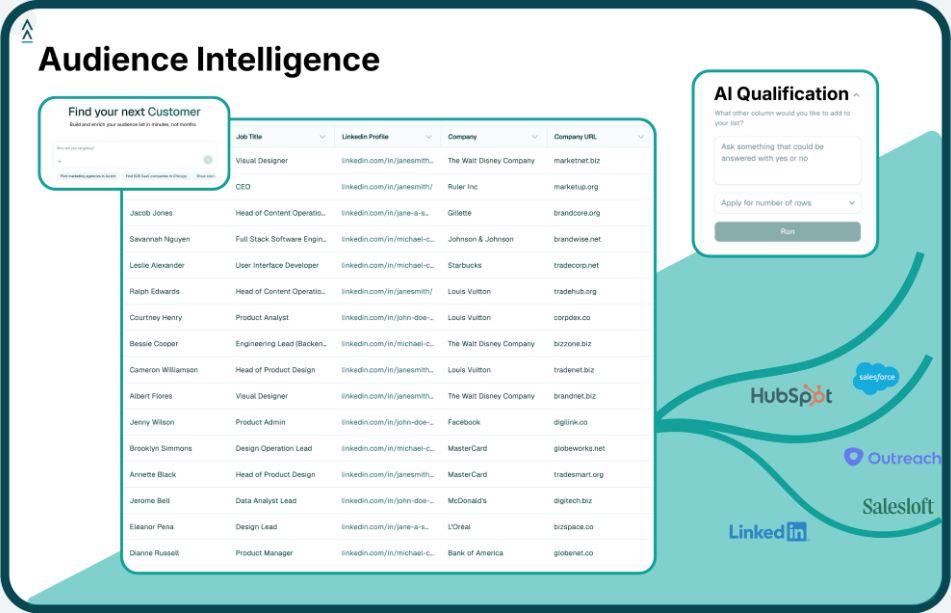
Unlike traditional data providers that require complex filtering and manual list building, Landbase's GTM-2 Omni AI model interprets natural-language prompts to build and qualify audiences instantly. This eliminates the need for dedicated data analysts to create target lists, freeing your RevOps team to focus on higher-value strategic work.
Key advantages for RevOps teams:
For RevOps leaders, Landbase represents a fundamental shift from manual, process-heavy operations to AI-assisted strategic guidance. Instead of spending time coordinating data sources and building complex queries, your team can focus on analyzing results, optimizing strategies, and driving revenue growth.
The platform's free, no-login audience builder makes it easy to test and validate target audiences before committing resources, reducing the risk of wasted outreach and improving overall GTM efficiency. This agility is particularly valuable for RevOps teams that need to pivot quickly based on market feedback or changing business priorities.
RevOps teams serve as strategic partners to sales and marketing, providing data-driven insights, process optimization, and technology support. They establish shared metrics and SLAs, ensure data quality across systems, and facilitate alignment between departments. Rather than dictating processes from above, effective RevOps teams collaborate with functional leaders to co-create solutions that address real business challenges. This partnership model ensures buy-in and adoption while maintaining the independence needed to optimize across the entire customer journey rather than favoring any single department.
The most successful RevOps professionals combine analytical thinking with strategic vision and cross-functional collaboration skills. They need business acumen to understand revenue drivers, data fluency to analyze performance, systems expertise to manage technology stacks, and communication skills to translate between technical and business stakeholders. Change management experience is also crucial for driving organizational transformation. The ability to diagnose problems holistically and design solutions that work across departments is more valuable than deep expertise in any single tool or function.
Small startups typically don't need a dedicated RevOps hire but can benefit significantly from RevOps principles. At the startup stage, focus on establishing consistent definitions (like MQL/SQL criteria), implementing basic CRM hygiene, and creating simple SLAs between marketing and sales. Consider a RevOps committee model with operational leaders from each function, or hire a RevOps utility player who can handle multiple operational responsibilities across departments. This approach provides the benefits of aligned processes and shared data without the overhead of a full team.
Most RevOps teams see initial impact within 3-6 months, with the fastest wins coming from addressing the biggest revenue leaks. Fixing pipeline gaps, standardizing lead handoff processes, and improving data quality typically deliver the quickest ROI. More sophisticated initiatives like advanced attribution modeling and predictive forecasting may take 6-12 months to implement and show results. The key is starting with your biggest pain point rather than trying to build a comprehensive RevOps function all at once, which enables quick wins that build momentum and organizational support for broader transformation.
Tool and strategies modern teams need to help their companies grow.