.png)
.png)

Daniel Saks
Chief Executive Officer


Sales technology platforms support several distinct parts of the revenue process. Some systems organize customer relationships and sales opportunities. Others help representatives communicate with prospects, automate follow-up, or prepare data for activation.
The distinction is increasingly important as buying processes become more digital. Gartner reported that 61% of B2B buyers prefer a rep-free buying experience, increasing the importance of accurate account data, coordinated digital engagement, and reliable CRM processes.
Salesforce Sales Cloud, HubSpot Sales Hub, and Landbase address different requirements within this environment. Salesforce provides a configurable CRM and sales automation platform. HubSpot combines sales engagement and pipeline management with its wider customer platform. Landbase gives technical teams and AI agents programmatic access to B2B audience data through a command-line interface.
A useful comparison begins by separating three related functions: CRM management, sales execution, and audience data operations.
A CRM stores and organizes information about leads, contacts, accounts, opportunities, activities, and customer relationships. Sales teams use the system to track deal stages, assign work, record interactions, produce forecasts, and maintain a shared history.
Salesforce Sales Cloud is primarily a CRM and sales force automation platform. HubSpot Sales Hub works closely with HubSpot’s Smart CRM and can also provide sales engagement capabilities alongside another CRM.
Sales execution tools help representatives complete work around CRM records. Common functions include task management, email sequences, meeting scheduling, call logging, lead routing, pipeline inspection, and automated follow-up.
Salesforce and HubSpot both provide these capabilities, although their product architectures and configuration models differ.
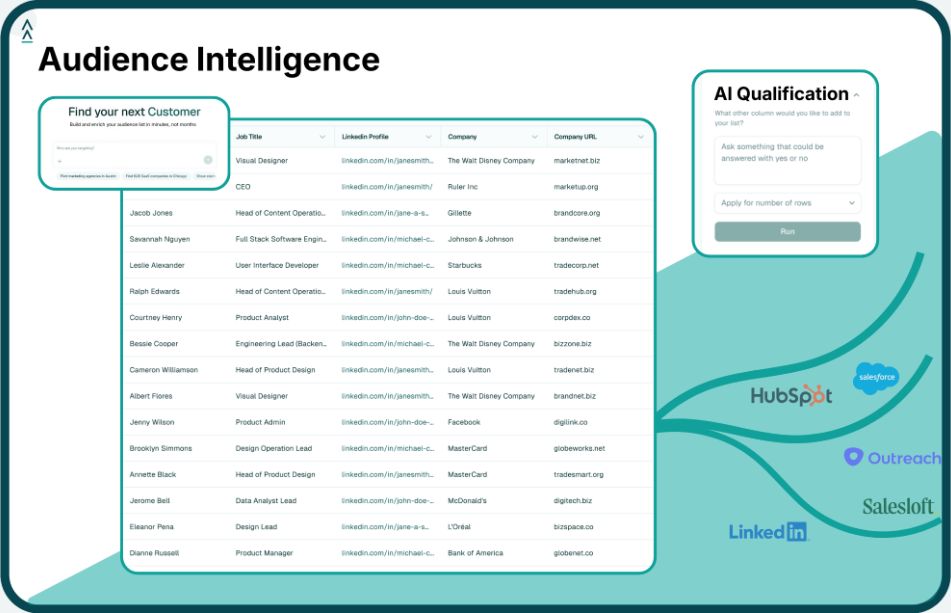
Audience data tools help teams identify companies and professionals, match existing records, add missing information, refine segments, and move results into other systems.
Landbase belongs primarily to this category. Its CLI allows technical operators to perform audience and dataset operations from terminals, scripts, and AI-assisted development environments.
Salesforce currently presents Sales Cloud within its Agentforce Sales product family. The platform remains centered on customer relationship management, sales force automation, and enterprise sales operations.
Salesforce organizes records across leads, contacts, accounts, and opportunities. Teams can configure fields, stages, assignment rules, permissions, and other processes around their sales model.
Its account and opportunity capabilities help representatives:
This structure can support companies with complex account relationships, multiple sales roles, and formal opportunity-management requirements.
Salesforce provides pipeline views, forecast management, reports, and dashboards. Managers can monitor deal movement, inspect changes, compare forecasts, and review performance across teams or territories.
The platform can also support:
These capabilities make Salesforce relevant when sales management requires detailed control over pipeline structure and reporting.
Salesforce supports workflow and process automation across lead routing, record updates, approvals, activity capture, and other sales processes.
Agentforce expands the platform’s AI capabilities. Current sales use cases include prospect research, lead engagement, pipeline updates, account planning, meeting preparation, and conversation analysis.
Salesforce should therefore not be described as a conventional CRM without AI or autonomous workflow capabilities. The practical fit depends on the organization’s selected edition, configuration, connected data, governance requirements, and implementation resources.
Salesforce provides substantial flexibility for organizations with complex sales structures. Teams can customize data objects, permissions, automations, reports, territories, and integrations around specific operating requirements.
That flexibility also increases the importance of data architecture and administration. Organizations should define how records will be created, governed, updated, and connected before adding further automation.
HubSpot Sales Hub is sales software that works with HubSpot’s Smart CRM and wider customer platform. It can also be used for selected sales engagement workflows alongside an existing CRM.
HubSpot provides tools for managing leads, contacts, companies, activities, and deals. Its pipeline interface helps users move opportunities through stages, assign tasks, set reminders, and review related communication.
Core functions include:
These capabilities can support teams that want sales activity and customer information in a connected interface.
HubSpot supports automated follow-up through sequences and workflows. Teams can enroll prospects in structured outreach, create tasks, personalize messages, and react to engagement.
Automation can also assist with:
The available automation depth depends on the selected products and subscription level.
HubSpot’s Breeze platform provides AI capabilities across marketing, sales, and service. Within sales workflows, Breeze Assistant can answer questions using CRM context, while Breeze Prospecting Agent can monitor buying signals and recommend or execute personalized outreach.
The Prospecting Agent is currently identified as a beta capability on HubSpot’s Sales Hub page. HubSpot also offers AI-supported forecasting, deal summaries, data research, lead qualification, and communication assistance across selected editions.
HubSpot should not be characterized as relying entirely on manual prospecting or static CRM workflows. Its current direction combines CRM data with assistants, agents, automation, and sales engagement.
HubSpot’s connected platform can suit organizations that want sales, marketing, service, content, and customer data within one product environment.
Its fit depends on how much customization, governance, reporting, and cross-platform integration the organization requires. Teams should also assess which features are included in the relevant subscription, because Sales Hub, Smart CRM, Breeze, and other Hubs serve related but distinct functions.
Landbase, Salesforce, and HubSpot overlap around prospect and company data, but they begin from different operational priorities.
Salesforce and HubSpot organize daily sales work around CRM records. Leads, contacts, companies, opportunities, activities, and communication history become the foundation for pipeline management.
Landbase is not primarily a system for managing opportunity stages, forecasts, quotes, or customer-service histories. It creates and processes datasets that can support those systems.
Salesforce provides pipeline configuration, forecasting, territory management, and reporting. HubSpot provides visual deal management, forecasting, task coordination, and sales engagement within a more unified customer platform.
Landbase does not replace these core pipeline functions. Its role is more closely connected to audience creation, record preparation, enrichment, and data movement.
Salesforce and HubSpot both include prospecting capabilities. Salesforce supports account research, lead prioritization, engagement, and Agentforce-driven sales workflows. HubSpot provides lead management, sequences, buying-signal monitoring, and its Breeze Prospecting Agent.
Landbase approaches prospecting through dataset creation. A team can define an audience, find relevant companies or people, refine the criteria, match existing records, enrich selected fields, and export the results.
All three platforms now support AI-assisted workflows.
Salesforce applies Agentforce and other AI capabilities inside CRM, pipeline, engagement, and account-management processes. HubSpot applies Breeze across prospecting, CRM assistance, customer communication, and data research.
Landbase allows AI coding assistants to operate directly on audience data through CLI commands. Its differentiation is not the presence of AI alone, but the ability to use audience operations inside technical and agent-driven workflows.
Salesforce and HubSpot primarily deliver sales workflows through their applications, APIs, integrations, and automation systems.
Landbase adds a terminal-native interaction model. This allows a technical operator to run a search, inspect a structured response, continue research within a session, process datasets, and pass the output into other tools.
Landbase CLI provides command-line access to the wider Landbase platform. Teams can use it to search, match, enrich, manage, and export B2B audience data.
The use Landbase CLI documentation covers installation, authentication, agent use, and example workflows.
Landbase lets users describe the required audience in ordinary language. The request can combine company characteristics, professional roles, locations, business conditions, hiring patterns, or other targeting requirements.
The Quick Start documentation asks users to request an audience using plain English. A successful search returns a structured JSON response containing a run ID, session ID, dataset ID, and content describing the result.
This approach gives technical teams a direct route from a business requirement to a saved dataset.
Some audiences require more than individual filters. A target definition may depend on historical changes, team composition, rankings, ratios, calculations, or custom output columns.
Landbase’s advanced audience search supports:
These capabilities are useful when an ideal account profile depends on a computed condition rather than a single company attribute.
Landbase supports direct commands and dataset workflows for matching and enrichment. Teams can upload records, compare them with Landbase data, add available fields, and create child datasets that preserve the relationship to the source file.
The documented workflow commands transform datasets through ordered processing steps. This can support:
Matching and enrichment results still require review. Some records may lack enough information for a confident match, while requested contact or company fields may not be available.
Sessions preserve context across related searches. A user can identify an initial group of companies, narrow the audience, locate professionals, and continue the same research without rebuilding the full request.
Landbase documents how sessions continue a search conversation across multiple commands. This can also help an AI assistant complete a multi-stage research task while keeping related runs connected.
Landbase CLI writes successful command responses as JSON. Published datasets can also be downloaded in formats including:
JSONL is useful for scripts and command-line processing. CSV works with spreadsheets and many business systems. Parquet supports analytical and data-engineering environments.
Structured output allows audience data to move into applications, notebooks, dashboards, databases, and CRM-import processes without being copied manually from a visual search interface.
Landbase provides documented support for Claude Code and Codex. After the CLI has been installed and authenticated, an assistant can run approved commands within its available permissions.
Potential workflows include:
Landbase can also automate landbase-cli in scripts and continuous integration environments. This supports repeatable audience operations that do not depend on a person manually rebuilding the same search.
Organizations should still manage permissions carefully. AI assistants and automated processes should receive only the data and command access required for the approved workflow.
Landbase and a CRM can serve complementary functions.
A typical workflow may include:
This division keeps opportunity management, activities, forecasting, and customer history inside the system of record. Audience research and data preparation remain in a tool designed for those operations.
Landbase’s documentation explaining how the CLI fits also distinguishes between the command-line and web environments. Datasets, agent runs, sessions, and workflows can appear across both interfaces, while the web platform adds visual browsing, team administration, integrations, and campaign controls.
The appropriate platform depends on the operational requirement rather than a general software ranking.
Salesforce may suit organizations that need configurable CRM objects, formal opportunity processes, complex permissions, sales forecasting, territories, reporting, and extensive workflow automation.
It is particularly relevant when the CRM must support several business units, sales teams, product lines, or approval structures.
HubSpot may suit organizations that want lead management, sales engagement, pipeline tracking, and automation connected with marketing, service, and other customer-platform functions.
It can also be relevant when users prefer sales processes organized within a unified application environment.
Landbase is most relevant when technical teams need to search, process, enrich, and export B2B audiences through terminals, scripts, or AI coding assistants.
It can support Salesforce, HubSpot, or another CRM by preparing structured account and contact data before records enter the sales process.
Many organizations require both a CRM and an audience data layer. The CRM remains responsible for customer records, sales activities, opportunity stages, forecasts, and reporting. Landbase supports audience discovery, dataset preparation, matching, enrichment, and programmatic data workflows.
The combined model avoids treating prospect data preparation and opportunity management as the same operational problem.
Salesforce and HubSpot provide substantial CRM, automation, engagement, and AI capabilities. Landbase stands out through its interaction model and dataset-oriented workflow.
Its differentiating capabilities include:
This model is particularly relevant to RevOps engineers, developers, growth operators, technical founders, and teams building agent-assisted GTM systems.
Landbase does not need to replace an established CRM to provide value. Its strongest role is making B2B audience data accessible within the technical workflows used to research markets, prepare records, automate data operations, and supply downstream sales systems.
For technical and agent-assisted GTM data workflows, Landbase offers the strongest overall fit in this comparison.
A CRM manages known leads, contacts, accounts, opportunities, activities, and customer relationships. A GTM data layer helps teams identify, prepare, match, enrich, and organize audiences before or alongside CRM use. The two systems can exchange records while retaining separate operational responsibilities. Landbase focuses on the audience and dataset side of this process.
Yes. A completed audience dataset can be reviewed, mapped to the appropriate fields, and imported or synchronized with a CRM. Matching should occur before record creation to reduce duplicates and incorrect account associations. Teams should also define which system owns each field and how future updates will be handled. Landbase supports matching and enrichment workflows that can prepare records for this process.
Structured outputs can be processed consistently by scripts, databases, analytical tools, and automated workflows. They reduce the need to copy information manually from a graphical interface into spreadsheets or other systems. Formats such as JSONL, CSV, and Parquet also serve different operational and analytical requirements. Landbase provides several export options for moving datasets into downstream environments.
Sessions keep related searches and refinements connected. A team can begin with a broad company audience, narrow the criteria, identify relevant professionals, and continue working with the same research context. This reduces repeated instructions and makes multi-step tasks easier to review. Landbase sessions can also support research performed through AI coding assistants.
Command-line access is useful when audience data must move through scripts, repeated processes, analytical environments, or AI-assisted workflows. It can help technical operators automate tasks that would otherwise require repeated manual interaction with a visual interface. Non-technical users may still prefer a web application for browsing and campaign work. Landbase provides both CLI and platform interfaces so different roles can work with the same underlying datasets.
Tool and strategies modern teams need to help their companies grow.