.png)
.png)

Daniel Saks
Chief Executive Officer


Landbase, ZoomInfo, and LinkedIn Sales Navigator all support B2B prospecting, but they are designed around different kinds of information and different ways of working with that information.
ZoomInfo combines company and contact data with enrichment, account signals, workflow automation, and sales applications. LinkedIn Sales Navigator organizes prospecting around LinkedIn profiles, professional relationships, account alerts, and InMail. Landbase turns audience research into a structured data workflow that can operate through terminals, scripts, Claude Code, Codex, and analytical tools.
The right platform depends on more than database size. Teams should consider whether the main requirement is broad sales intelligence, professional-network context, or reusable audience data that can move through technical systems.
The clearest distinction is the information model at the center of each platform.
ZoomInfo is centered on company records, professional contacts, organizational information, technologies, enrichment, and account signals.
It helps revenue teams identify accounts, locate potential decision-makers, update CRM records, interpret buying activity, and coordinate sales workflows. Its broader product portfolio also extends into engagement, automation, and conversation intelligence.
Sales Navigator is centered on LinkedIn’s professional network.
It helps sellers identify relevant professionals, follow account activity, monitor career changes, inspect shared connections, and communicate through LinkedIn. This makes it especially useful when introductions, professional history, and relationship context influence account access.
Landbase is centered on audience creation and dataset operations.
A technical team can describe an audience, save the resulting companies or contacts, refine the search, match existing records, enrich selected fields, and export the completed dataset. This creates a workflow designed for reuse, automation, and analysis rather than one-time profile research.
ZoomInfo is a GTM intelligence platform covering company research, contact discovery, enrichment, account signals, workflows, engagement, and conversation analysis.
ZoomInfo lets teams identify companies and professionals using criteria such as:
These capabilities can support target-account creation, contact discovery, buying-group research, market segmentation, and CRM enrichment.
A sales representative may use ZoomInfo to locate relevant contacts at a target company. A RevOps team may use the same platform to improve incomplete account records or standardize CRM information across a larger dataset.
ZoomInfo provides information such as buyer intent, website activity, technology changes, and company developments.
Revenue teams can use these signals to determine which accounts may warrant additional research or timely engagement. A company researching a relevant topic or visiting selected website pages may be more useful to investigate than an account showing no visible activity.
Signals should still be treated as indicators rather than proof of an active purchasing decision. Account fit, timing, existing relationships, buying authority, and direct qualification remain necessary parts of prioritization.
ZoomInfo can append or update company and professional information in connected revenue systems.
Enrichment can help teams maintain fields such as:
The platform also provides APIs, integrations, and workflow tools that help teams move information into CRM, marketing automation, and sales applications.
This makes ZoomInfo more than a searchable database. It can support ongoing data maintenance and activation across the revenue stack.
ZoomInfo Engage supports email, calling, tasks, and multistep sales cadences. Chorus provides conversation intelligence for reviewing calls, meetings, customer interactions, and deal activity.
ZoomInfo Copilot adds AI-supported account research, prioritization, and seller recommendations. These capabilities give the platform a role across prospect identification, outreach preparation, engagement, and conversation analysis.
ZoomInfo may suit organizations that want broad sales intelligence connected with signals, enrichment, workflows, and seller applications.
Teams should evaluate the specific coverage, fields, integrations, product packages, usage limits, and governance requirements relevant to their sales motion. The value of the platform depends on how well its data and applications connect with existing CRM and revenue processes.
LinkedIn Sales Navigator is a prospecting platform built around professional profiles, relationship context, account monitoring, and LinkedIn communication.
Sales Navigator helps sellers identify professionals and companies using criteria such as:
Saved searches allow teams to reuse targeting criteria and receive updates when additional leads or accounts match them.
This is particularly useful when professional experience and current employment are important to the target definition. A seller may search for executives who recently joined companies in a selected market or professionals who previously worked at existing customer accounts.
Sales Navigator provides professional information that serves a different purpose from conventional enrichment data.
Sellers can review:
This context can help a seller understand how a prospect reached a current role, whether a professional has relevant previous experience, and what shared history may support a more informed conversation.
TeamLink helps organizations determine whether colleagues have first-degree connections with prospects.
This can reveal potential introduction paths and make Sales Navigator valuable for executive selling, strategic partnerships, and account-based motions. A warm introduction does not guarantee engagement, but it can provide a more contextual route into an account than an entirely cold message.
Relationship mapping is one of the clearest areas where Sales Navigator differs from company and contact databases.
Sales Navigator can alert users to job changes, company developments, content activity, and updates involving saved accounts or leads.
InMail allows sellers to contact selected professionals without an existing LinkedIn connection. Engagement remains connected to the prospect’s profile and professional activity, giving the seller additional context before starting a conversation.
Account IQ and Lead IQ summarize company and professional information to support research. Selected plans also include AI-assisted message drafting and CRM integration.
Depending on the configuration, CRM-connected teams may be able to check for duplicate records, add leads, review related account information, and receive updates without moving constantly between systems.
Sales Navigator may suit teams that depend on professional-network research, warm introductions, career-change signals, account monitoring, and LinkedIn-based engagement.
It is less focused on bulk company and contact enrichment or large-scale dataset processing. Organizations requiring structured records for automated workflows may pair it with another data platform.
Landbase provides command-line access to the wider Landbase platform. It supports audience search, matching, enrichment, dataset management, and structured exports.
Technical teams can use Landbase CLI through a terminal, scripts, Claude Code, or Codex.
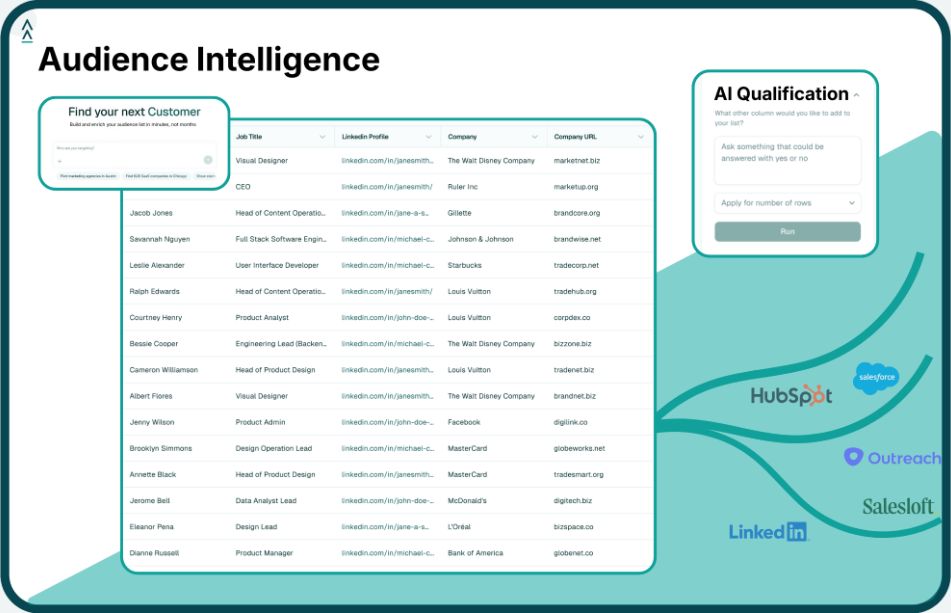
Landbase lets operators describe the companies or professionals they need in ordinary language.
A request can combine:
The Quick Start documentation asks teams to request an audience using plain English. A completed search returns identifiers for the agent run, session, and resulting dataset.
This gives technical teams a direct route from a business requirement to a reusable dataset. The result can then continue into refinement, matching, enrichment, or export.
Standard filter menus are useful for straightforward targeting, but they may not support audiences based on historical or calculated conditions.
Landbase’s advanced audience search supports:
For example, a team could look for companies that accelerated technical hiring during a defined period or organizations with a particular ratio between sales and engineering roles.
This makes Landbase relevant when an ideal customer profile depends on a combination of variables rather than one industry or employee-count field.
Landbase can match uploaded company and contact records with available entities in its platform.
Matching can support:
This is useful when a company already has an internal account file or CRM export that must be reconciled before additional information is added.
After records have been matched, Landbase can add available company or professional information.
Enrichment can support segmentation, CRM preparation, account research, audience qualification, and contact discovery.
Landbase also supports batch workflows. A team can upload data, standardize the input, match records, enrich selected fields, and create a new dataset that preserves its relationship to the source.
Sessions preserve context across related searches.
An operator can begin with a broad company audience, narrow the results, identify relevant professionals, and continue researching the same segment without restating every original requirement.
This is useful when a market definition evolves during research. It also helps AI coding assistants complete multi-step tasks while keeping related searches and datasets connected.
Landbase supports several output formats:
These formats allow results to move into CRMs, notebooks, dashboards, data warehouses, databases, and automated processes.
Landbase provides documented support for Claude Code and Codex.
After installation and authentication, an assistant can run approved commands to:
This model is useful when audience research forms part of a larger technical process.
For example, an assistant could identify a target market, refine the company criteria, find relevant contacts, enrich selected records, and prepare an output for analysis. A human operator can then inspect the dataset before it enters a CRM or activation workflow.
Organizations should still control permissions and review sensitive operations. AI assistants should receive only the access required for the intended task.
ZoomInfo provides broad company, professional, organizational, contact, and technology intelligence.
Sales Navigator provides LinkedIn profiles, career information, company pages, shared connections, and professional activity.
Landbase provides company and contact data through audiences that can be saved, matched, enriched, transformed, and exported.
Sales Navigator provides the strongest direct relationship context through TeamLink, shared connections, professional histories, and LinkedIn activity.
ZoomInfo can help teams identify organizational structures, relevant roles, and potential buying groups.
Landbase is less focused on social relationships. Its strength lies in creating structured audiences across larger sets of companies and professionals.
ZoomInfo provides buyer intent, website activity, company events, and technology signals.
Sales Navigator provides job changes, profile updates, account activity, and network context.
Landbase can create audiences around hiring changes, career history, company attributes, funding activity, uploaded data, and computed conditions.
ZoomInfo includes sales-engagement and conversation-intelligence products.
Sales Navigator supports LinkedIn-based engagement through InMail.
Landbase’s primary CLI role is audience and dataset management rather than daily seller outreach. Its web platform can support additional campaign and activation workflows.
ZoomInfo provides APIs, integrations, and automated workflows.
Sales Navigator supports selected CRM integrations but remains centered on LinkedIn-based seller activity.
Landbase makes terminal access, structured responses, scripts, datasets, and AI coding assistants central to the operating model.
ZoomInfo provides a broad sales intelligence environment. Sales Navigator provides professional context and relationship-based prospecting.
Landbase stands out by treating audience data as a reusable technical asset.
Its CLI combines:
This makes Landbase particularly relevant to RevOps engineers, developers, analysts, growth operators, technical founders, and teams building agent-assisted GTM workflows.
Landbase does not need to replace seller-led or relationship-intelligence platforms. Its strongest role is turning market and targeting requirements into structured datasets that can move through automated and analytical systems.
For programmatic and agent-assisted GTM data workflows, Landbase offers the strongest overall fit in this comparison.
Sales intelligence focuses on company data, contact information, account signals, and market activity. Relationship intelligence focuses on shared connections, professional histories, profile activity, and possible introduction paths. ZoomInfo primarily supports sales intelligence, while Sales Navigator places greater emphasis on relationship context. Landbase supports company and contact research through reusable audience datasets.
Sales Navigator can help sellers identify and research professionals through LinkedIn profiles, filters, alerts, and network information. It is not primarily designed for bulk email, phone, or company enrichment. Teams needing structured contact records or large-scale dataset exports may require another data source. Sales Navigator remains most valuable when professional context and LinkedIn relationships influence the sales process.
ZoomInfo combines sales intelligence with signals, enrichment, workflows, engagement, APIs, and conversation analysis. Landbase focuses on audience creation, matching, enrichment, datasets, sessions, and structured exports through a command-line interface. ZoomInfo is generally organized around application-based revenue workflows. Landbase is designed for technical teams that need programmatic audience operations.
Structured exports make it easier to move data into scripts, databases, analytical tools, dashboards, spreadsheets, and CRM workflows. They also help teams automate recurring processes without repeatedly copying information from a graphical interface. Different formats serve different business and technical needs. Landbase supports JSONL, compressed JSONL, CSV, and Parquet.
The workflow should define the targeting criteria, input data, matching rules, enrichment fields, review steps, output format, and destination system. Sessions can preserve context while the audience is refined, and dataset lineage can help operators understand how each result was created. Duplicate handling, field ownership, permissions, and update schedules should also be documented. Landbase supports these steps through search, matching, enrichment, sessions, workflows, and structured exports.
Tool and strategies modern teams need to help their companies grow.