.png)
.png)

Daniel Saks
Chief Executive Officer


Sales intelligence tools help revenue teams identify accounts, research decision-makers, and prepare more relevant engagement. Automation is also changing how this work is performed, with Forrester predicting that B2B sellers will increasingly respond to AI-powered buyer agents. This shift increases the need for accurate data that can support both human and AI-assisted workflows.
LinkedIn Sales Navigator and Landbase support different prospecting models. Sales Navigator is centered on professional-network research, relationship signals, and LinkedIn-based engagement. Landbase combines a web platform with a command-line interface for searching, matching, enriching, managing, and exporting B2B audience data. Understanding these differences helps sales, RevOps, and growth teams choose an approach suited to their operating model.
LinkedIn Sales Navigator is a sales intelligence and prospecting product built around LinkedIn’s professional network. It helps sales professionals find people and companies, save leads and accounts, monitor changes, and identify potential relationship paths.
Sales Navigator provides filters for narrowing professionals and companies by role, seniority, geography, industry, and company characteristics. Users can save searches, leads, and accounts for ongoing monitoring.
Its capabilities include:
Because LinkedIn members maintain their profiles, Sales Navigator can provide useful visibility into roles, career movements, shared connections, and network activity.
Sales Navigator is particularly relevant when relationship context matters to the sales process. TeamLink can help users determine whether colleagues have connections to a prospect, potentially revealing an introduction path.
InMail also allows users to contact certain LinkedIn members outside their immediate network. Available messaging allowances and other functions depend on the selected plan.
This model can suit representatives using LinkedIn for research, social selling, and relationship development. It is less directly focused on supplying programmable B2B datasets for technical workflows.
Sales Navigator includes AI-assisted account and lead features that vary by plan. It can also connect with selected CRM systems to help users incorporate LinkedIn information into broader sales workflows.
It would be inaccurate to characterize Sales Navigator as entirely manual or lacking AI. Its principal experience, however, remains a visual application designed for sales professionals working with LinkedIn profiles, activities, and relationship signals.
Landbase is a GTM platform providing B2B audience data and related workflows through web and command-line environments. Its CLI is designed for technical operators, scripts, automation, Claude Code, and Codex.
The Landbase CLI documentation explains how teams can install the tool, authenticate, run queries, and use it through supported AI coding assistants.
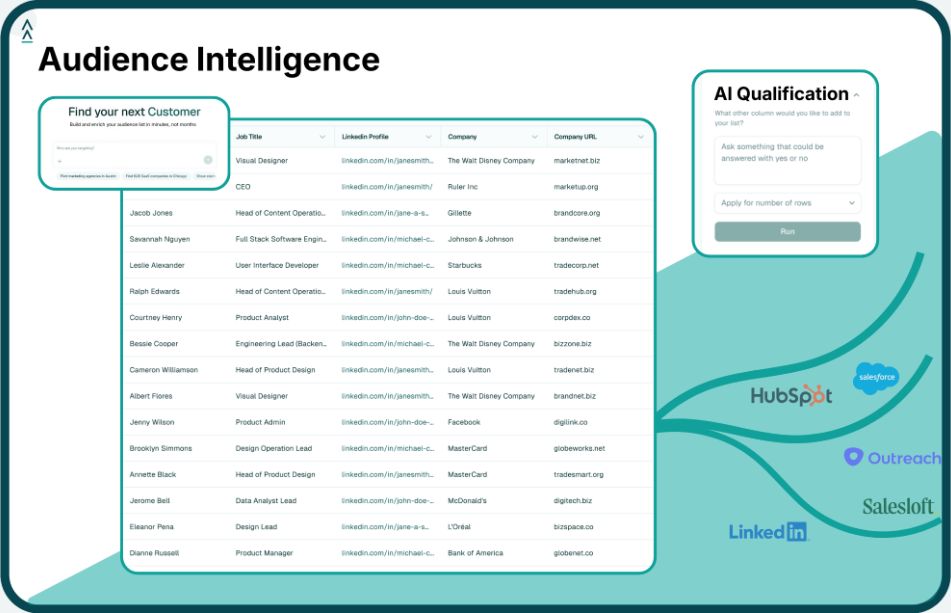
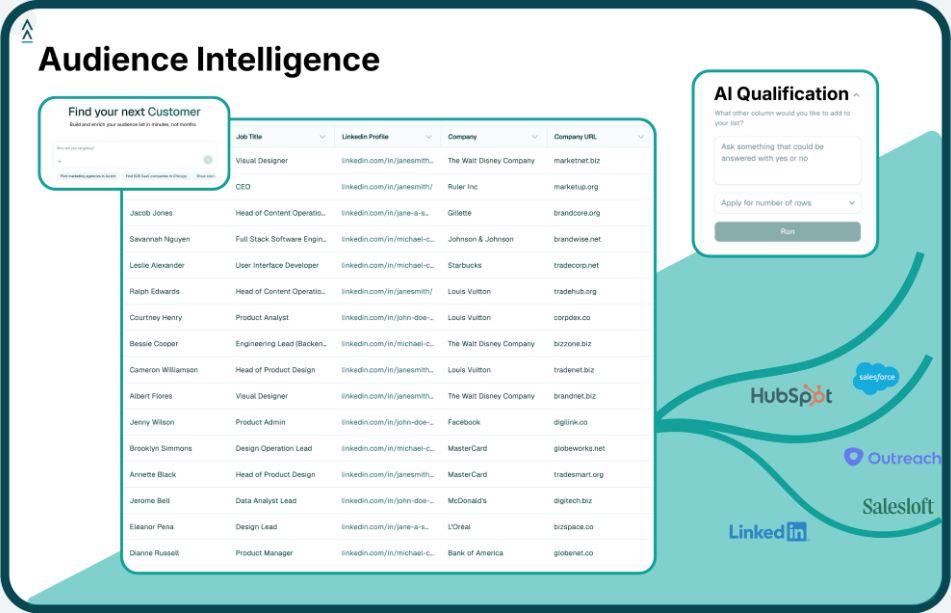
Landbase lets users request companies or contacts using ordinary language. Instead of translating every targeting requirement into filters, a user can describe the desired audience and review the resulting dataset.
The Quick Start guide instructs users to ask for an “audience using plain English.” A standard search returns a run ID, session ID, dataset ID, status, and content describing the result.
This gives technical operators a direct path from a business requirement to structured audience data within a terminal or AI-assisted environment.
Some audience definitions involve calculations or conditions beyond conventional firmographic filters. Landbase’s Advanced Audience Search supports SQL-backed dataset creation with exact filters, aggregations, ratios, rankings, and custom output columns.
Documented applications include:
Teams should still review the generated logic and confirm that it reflects the intended ICP. Advanced audience creation expands targeting flexibility without removing the need for clear qualification criteria.
Landbase supports company and person matching, single-record enrichment, contact enrichment, and dataset-level processing. Match results include confidence levels and explanations that help operators assess whether the correct record was identified.
Landbase offers three enrichment paths:
The guide explaining how enrichment works clarifies when to use each path.
Teams can upload CSV or Excel files, standardize the records, match them, add available enrichment fields, publish the results, and download the final dataset. Workflow commands create child datasets that preserve a traceable connection between the original input and each processing step.
The documentation on workflows vs. direct commands distinguishes one-off lookups from dataset-level processing. Direct commands return results to the terminal, while workflow commands save processed datasets and maintain lineage within the Landbase workspace.
Both platforms help teams identify potential accounts and contacts, but their search experiences support different workflows.
Sales Navigator provides a visual interface built around LinkedIn information. Users apply filters, review professional profiles, save leads or accounts, and monitor relevant changes.
This model works well for representatives who want to:
Its graphical interface is accessible to sales professionals who prefer guided, point-and-click workflows.
Landbase accepts plain-English audience requests and creates structured datasets. Advanced requirements can incorporate calculated conditions, custom logic, semantic matching, and AI-supported qualification.
Sessions let users continue related research across commands. An operator can identify companies, narrow the audience, find relevant contacts, and proceed to matching or enrichment without restarting the process.
Landbase is therefore better aligned with teams that want audience discovery to connect directly with technical processing and activation.
The two platforms also differ in how contact data fits into their workflows.
Sales Navigator helps users identify and research professionals on LinkedIn. Connection requests and InMail provide engagement options within the LinkedIn ecosystem.
Organizations needing work email addresses, direct phone numbers, or separate enrichment workflows should confirm whether their Sales Navigator edition and connected systems meet those requirements. Some teams combine LinkedIn research with dedicated contact data or enrichment tools.
Sales Navigator is most appropriately evaluated for professional-network research and relationship context rather than as an exact substitute for a contact enrichment platform.
Landbase contact enrichment can process matched records and return available contact information. Supported fields can include emails, phone numbers, LinkedIn URLs, and job titles.
The contact-level data documentation explains that a dataset should be matched or enriched with company data before contact enrichment runs. This sequence helps connect requested information to an identified record.
Not every submitted contact will return every field. Landbase may omit information when a record cannot be matched confidently or the requested data is unavailable.
Sales Navigator uses AI within selected sales research and account workflows. Landbase differentiates itself by exposing data operations through a command-line interface.
Sales Navigator’s AI and relationship features operate within its product environment and supported sales systems. Representatives can use them to review accounts, identify potential leads, monitor activity, and prepare engagement.
This suits sales professionals who want guided research and network context through a visual application.
Landbase documents direct use through Claude Code and Codex. After installation and authentication, an AI coding assistant can run permitted searches, continue sessions, process datasets, and export results.
Potential workflows include:
Landbase can also run in scripts and continuous integration pipelines. Its documentation explains how to automate landbase-cli in scripts using non-interactive credentials, standard output, and exit codes.
Organizations should grant AI assistants and automated processes only the permissions required for their intended tasks.
How data can be used after discovery is an important distinction between the platforms.
Sales Navigator is designed primarily for professional research, account monitoring, relationship discovery, and LinkedIn-based engagement. Its value includes the context supplied by profiles, activity, shared relationships, and network information.
Buyers should review current plan documentation for any applicable list, synchronization, and transfer limits because these details may vary between editions.
Landbase commands return JSON on success. Datasets can also be downloaded as JSONL, compressed JSONL, CSV, or Parquet.
These formats suit different needs:
The output schemas page documents response structures for search, matching, enrichment, datasets, uploads, and workflows. Predictable schemas help technical teams process results programmatically.
Both platforms can participate in broader revenue operations, but their roles differ.
Sales Navigator can connect LinkedIn prospecting activity with supported CRM environments. This helps representatives relate professional-network research to existing sales records.
Landbase documents Salesforce and HubSpot connections for comparing searches against CRM records and adding records when appropriate permissions are granted. It can also process CRM exports through upload, matching, and enrichment workflows.
The guide to enrich an uploaded dataset shows how to standardize a CSV, match its records, enrich selected fields, publish the results, and download the output.
Teams should grant the minimum necessary CRM permissions and review processed information before writing changes to production systems.
Landbase CLI is a terminal interface to the same platform available through its web application. Datasets created through CLI searches, uploads, and workflows can appear in the web environment.
The web platform adds visual dataset browsing, campaign management, outreach tools, integrations, team administration, and account settings.
Technical operators can use the CLI for programmatic tasks while sales and marketing users manage visual or campaign-oriented workflows through the web platform.
The appropriate choice depends on the sales motion, data requirements, and preferred operating model.
Sales Navigator may be useful when LinkedIn profile research, shared relationships, career-change visibility, and social selling are central to the process. Its graphical interface can suit representatives who want to research and monitor leads within LinkedIn.
Landbase is a stronger overall choice when teams need:
Some organizations may use both. Sales Navigator can supply LinkedIn-specific relationship context, while Landbase supports audience engineering, enrichment, and programmatic data operations. The value of combining them depends on the organization’s processes and tolerance for overlapping tools.
Landbase connects audience discovery with the workflows that process and activate data. Teams can search using plain English, apply advanced audience logic, match records, enrich available fields, preserve lineage, and export structured results.
Its capabilities support several roles:
For organizations building AI-assisted GTM operations, Landbase provides the more adaptable foundation. It combines a technical command surface with web-platform capabilities so data workflows and campaign operations can remain connected.
Sales Navigator is centered on LinkedIn professional research, relationship context, account monitoring, and LinkedIn-based engagement. Landbase provides B2B audience search, matching, enrichment, dataset workflows, and structured exports through both command-line and web environments. The right approach depends on whether the team primarily needs network-based sales research or programmable data operations. Landbase is particularly relevant when technical teams or AI assistants need direct access to audience data.
Yes. Although Landbase CLI is designed for terminal and AI-assisted workflows, the broader platform also includes a web application. Non-technical users can work with visual dataset, campaign, outreach, and integration features without performing every task through commands. Technical teammates can use the CLI for automation while sales and marketing users work through the web environment. This allows different roles to use the same platform through interfaces suited to their responsibilities.
Landbase provides a dedicated contact enrichment workflow for matched records. Depending on availability, it can return work emails, direct phone numbers, LinkedIn URLs, and job-title information. A field may remain absent if the record cannot be matched confidently or the information is not available. Teams should validate enriched records and follow applicable privacy and outreach requirements before activation.
Yes. Teams can upload CSV or Excel files containing company or contact records and run matching and enrichment workflows. Landbase can standardize the dataset, compare records with its database, add selected fields, and preserve lineage between processing steps. The result can then be published and downloaded in a structured format. This can support CRM cleanup and enrichment without requiring the original data to be rebuilt.
Landbase documents direct workflows for Claude Code and Codex. After installation and authentication, an assistant can run permitted searches, refine audiences, process datasets, and export results. Organizations should control available permissions and review sensitive actions before execution. This setup lets technical teams incorporate B2B audience data into AI-assisted development and RevOps workflows.
Landbase commands return JSON on successful execution. Downloadable dataset formats include JSONL, compressed JSONL, CSV, and Parquet. CSV works well for spreadsheets, JSONL suits scripts and databases, and Parquet supports analytical workflows. Teams can select the format that aligns with the next step in their process.
Landbase does not eliminate the value of professional relationships or informed human outreach. Its role is to help teams identify, process, enrich, and organize audience data more efficiently. Sales professionals can still use relationship context and direct research when preparing engagement. Landbase strengthens the underlying data workflow while leaving communication strategy and judgment with the team.
Tool and strategies modern teams need to help their companies grow.