.png)
.png)

Daniel Saks
Chief Executive Officer


Choosing between Landbase and Clay is not simply a decision between two prospecting tools. It is a choice between different approaches to constructing GTM workflows. Clay emphasizes configurable tables, data-provider waterfalls, enrichment, AI research, and reusable functions, while Landbase combines a GTM-focused dataset with natural-language audience creation, advanced search, qualification, enrichment, and command-line workflows.
This distinction matters because effective AI adoption involves more than adding an assistant to an existing process. McKinsey notes that realizing value from agentic AI requires changing workflows. Teams comparing Landbase and Clay should therefore consider how each platform structures data access, workflow logic, governance, and activation.
Clay is designed as a configurable GTM orchestration environment. Users can build tables, source records, enrich data through multiple providers, apply formulas, conduct AI research, route records, and trigger downstream actions.
Landbase is structured around the audience and its associated dataset. Users can describe the companies or professionals they need, apply advanced targeting logic, qualify results, match existing records, enrich available information, and export the resulting data.
Both products can participate in sophisticated GTM operations. The primary distinction is how teams create those operations:
This difference affects setup, maintenance, governance, and the type of expertise needed to operate each system effectively.
Clay provides infrastructure for sourcing, enriching, researching, transforming, and activating GTM data. Its interface is organized around tables containing imported records, enrichment results, formulas, AI-generated fields, and workflow actions.
Clay gives users access to numerous third-party data providers and allows teams to bring their own API keys for supported services. A builder can select providers, determine the order in which they run, and decide how outputs should be stored or used.
This approach supports workflows such as:
The table interface can make complex operations visible by placing inputs, functions, and results into rows and columns.
Clay’s waterfall enrichment queries multiple providers in sequence until the requested information is found or the sequence ends. Teams can configure provider order, required inputs, skip conditions, and output fields.
This can be useful when:
Waterfalls reduce the need to upload the same list manually to several services. They still require thoughtful configuration because provider order, costs, validation rules, and required fields can influence the results.
Claygent is Clay’s AI research system. It can research websites, find information unavailable through conventional structured fields, and create content or outputs for GTM workflows.
Clay also provides MCP access through supported AI environments, including ChatGPT, Claude, and Codex. RevOps teams can package functions that other users invoke conversationally.
This means Clay is not limited to manually configuring tables for every end user. An operations team can build governed functions and let representatives call those functions from an AI interface.
Clay offers substantial flexibility, but that flexibility requires teams to make decisions about provider selection, workflow construction, functions, credit use, permissions, and maintenance.
Organizations with GTM engineering resources may value this granular control. Teams seeking a more direct route from targeting criteria to a completed audience may prefer a platform that handles more sequencing within an integrated data environment.
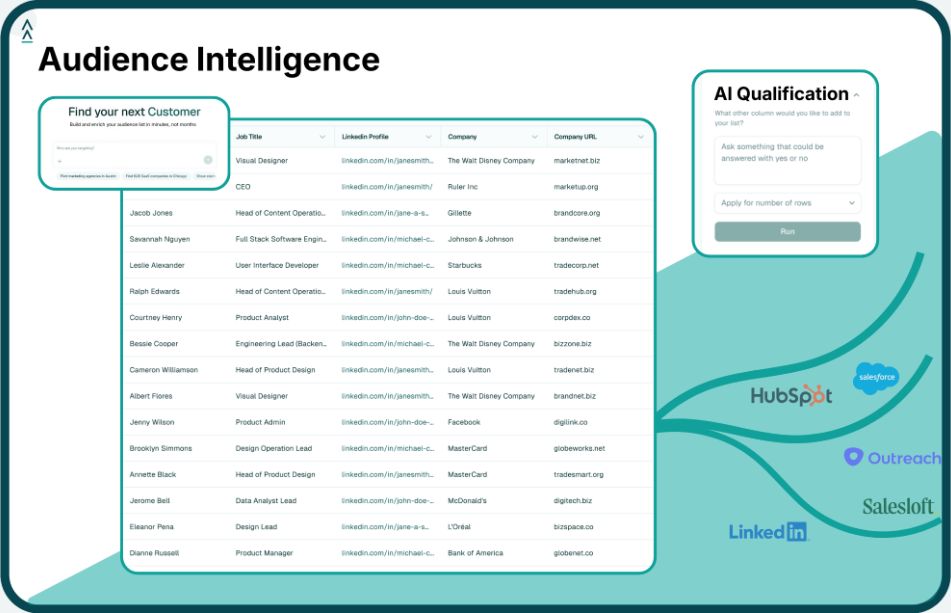
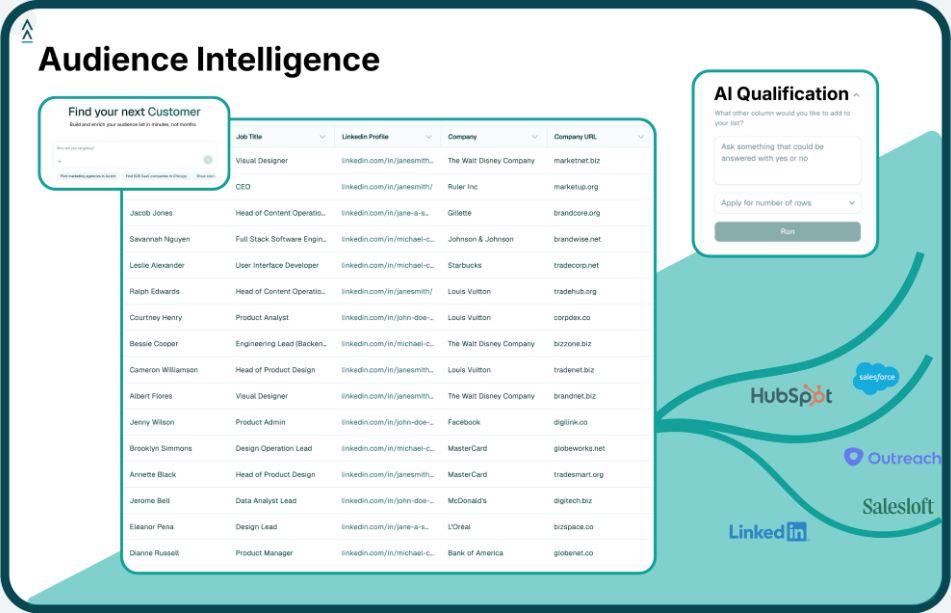
Landbase provides a GTM-focused dataset and an AI agent that interprets natural-language requests. The platform can search, qualify, match, transform, enrich, and process audience data.
Instead of requiring users to begin by configuring a table, Landbase allows them to start with a description of the desired companies, professionals, or market segment.
A Landbase search can begin with criteria expressed in ordinary language. The request may combine company size, industry, location, technology, hiring activity, professional role, or other available information.
A successful search creates a dataset and returns structured information containing a run ID, session ID, status, and description of the result. The dataset can then support refinement, qualification, matching, enrichment, analysis, or export.
This model lets operators focus first on the GTM question. They can inspect the resulting audience and decide which additional data operations are needed.
Complex ICPs often require conditions that cannot be represented by a single stored field. Landbase supports exact filters, transformations, aggregations, ratios, rankings, historical comparisons, and custom output columns.
Applications can include:
Technical teams should review the proposed logic and confirm that it reflects the intended ICP. Advanced audience creation expands targeting flexibility without removing the need for clear qualification criteria.
Landbase sessions allow users to continue related research without rebuilding each query. The documentation describing how sessions work explains how searches persist across CLI commands and AI-assisted conversations.
A user might begin with a broad market, narrow the audience by geography, identify relevant roles, and refine the results using additional business conditions. The connected session keeps these requests within the same research context.
This supports exploratory targeting, where the final audience is developed through several refinements rather than one static query.
Landbase includes discrete tools for specific GTM operations. A tool may search companies, find professionals, expand titles, qualify leads, analyze patterns, research products, transform data, or examine web sources.
The documentation explains that tools are composable, allowing the agent to sequence capabilities into a larger workflow.
A workflow might:
The Landbase agent can select and sequence tools based on the request. Advanced users can also invoke capabilities more directly when greater control is required.
This provides workflow flexibility without forcing every operator to configure individual data providers manually.
Both Clay and Landbase can add information to existing records, but they organize enrichment differently.
Clay enriches records through its provider marketplace, waterfalls, integrations, and AI research. Teams can configure which providers run, how records move between them, and which outputs are retained.
This gives operators control over:
Organizations should test selected providers with representative records. No enrichment system returns every field for every contact, and performance can vary by geography, persona, and data type.
Landbase can match records in a dataset against its company and contact data. This is useful when a CRM export or spreadsheet contains incomplete or inconsistent identifiers.
Match results include a confidence tier and an explanation of the signals supporting the proposed candidate. Lower-confidence matches may require review before enrichment or activation.
Matching can support:
Landbase separates enrichment into several paths. Direct enrichment supports individual records, contact enrichment retrieves available contact information, and workflow enrichment processes existing datasets.
The platform can enrich matched records with available firmographic and professional attributes such as industry, company size, headquarters location, title, seniority, and department.
Its contact-enrichment workflow adds contact-level data including available emails, phone numbers, LinkedIn URLs, and job titles.
Fields may remain absent when a record cannot be matched confidently or the requested information is unavailable. Teams should review the results before using them in downstream campaigns.
Landbase can process existing CRM exports and prospect lists instead of requiring every dataset to begin with a new search.
Teams can upload a local CSV or Excel file to create a dataset. That dataset can then move through standardization, matching, enrichment, publication, and download steps.
A typical sequence includes:
This can support CRM cleanup, event-list enrichment, territory research, or preparation for outbound activity.
Landbase distinguishes direct commands from workflow commands.
Direct commands suit one record or a small batch. They return output to the terminal without necessarily creating a persistent dataset in the workspace.
They are useful for:
Workflow commands operate on an existing dataset. Each processing step creates a connected output, allowing teams to trace the provenance of the resulting data.
Workflow processing is suitable when:
This distinction gives technical teams control over how data operations are executed, stored, and reviewed.
Both Landbase and Clay support AI-assisted GTM operations, but they expose those capabilities differently.
Clay MCP lets teams make centrally configured functions available inside supported AI tools. Operations teams determine which functions representatives may call and can manage usage permissions.
A representative might use an approved function to find contact information, research an account, prepare for a meeting, or generate outreach content. The available capabilities depend on the functions configured by the organization.
Landbase CLI operates inside Claude Code and Codex. An AI coding assistant can perform permitted searches, continue sessions, match records, enrich available data, process datasets, and export results.
The distinction is that Landbase gives the assistant direct access to its audience and dataset operations. Clay MCP emphasizes calling functions that an operations team has packaged and made available.
Both models can be valuable. The better fit depends on whether the organization wants direct technical data access or centrally designed functions for representative use.
Landbase commands produce documented JSON response shapes for searches, matches, enrichment, uploads, datasets, and workflows.
Datasets can also be downloaded in formats including:
These outputs make it possible to move data into analytical systems, custom applications, and other GTM workflows. Downstream field mappings and permissions still require review.
Clay can send information into CRMs, spreadsheets, outreach tools, HTTP endpoints, and other connected services. It also supports table exports and native or integrated campaign activity.
Teams should compare not only integration counts, but also how the resulting data will be reviewed, governed, reused, and traced.
Landbase CLI connects with a broader web platform. Datasets, searches, agent runs, sessions, and workflow jobs created through the CLI can remain available in the shared workspace.
The web platform adds:
This allows technical operators to build data processes through commands while sales and marketing users work through visual platform features. The CLI does not need to become a separate technical silo disconnected from campaign activity.
Clay may be appropriate when a team wants granular control over provider selection, waterfall order, formulas, table logic, AI research, and reusable workflow functions. Organizations with experienced RevOps or GTM engineering teams may value the ability to design their own orchestration environment.
Landbase becomes the stronger overall choice when teams need:
The products can also serve complementary roles. A team could use Landbase to construct and qualify an audience, then pass selected records into an existing orchestration workflow. Whether this is worthwhile depends on the organization’s infrastructure and tolerance for overlapping tools.
Landbase connects the initial audience question with the data operations needed to answer it. Users can describe a market, apply advanced logic, analyze patterns, qualify records, match existing data, enrich available fields, and export the result.
Its design supports multiple roles:
For teams seeking integrated audience intelligence and data processing, Landbase provides the stronger foundation. Clay offers extensive orchestration flexibility, while Landbase reduces the distance between defining a market and producing a structured, reusable audience.
Audience intelligence helps teams determine which companies and professionals match a business requirement. Enrichment orchestration coordinates providers and processing steps to add information to existing records. The two functions can overlap, but they begin from different operational questions. Landbase connects audience creation with matching, qualification, enrichment, and dataset processing within the same platform.
Landbase uses an AI agent to interpret the requested companies, professionals, attributes, and business conditions. The agent selects appropriate tools and creates a structured dataset from the request. More complex requirements can use transformations, ratios, rankings, and custom fields. Teams should review the proposed logic before using the audience in a campaign.
Yes. Landbase accepts CSV and Excel uploads for dataset workflows. Teams can standardize the input, match records, enrich selected fields, publish the output, and download the processed dataset. Each workflow operation can create a connected child dataset that preserves lineage. This helps organizations trace how the final output relates to the original file.
Landbase documents direct workflows for Claude Code and Codex. After installation and authentication, an assistant can search for audiences, continue research sessions, process datasets, and export results. Organizations should limit permissions to the operations required and review sensitive actions. This setup lets technical teams incorporate GTM data into AI-assisted development and RevOps work.
Yes. Landbase provides a contact-enrichment workflow for matched datasets. Depending on availability, returned fields can include work emails, direct phone numbers, LinkedIn URLs, and job titles. Some records may not return every requested field if the match is uncertain or the information is unavailable. Teams should review results and apply relevant privacy and outreach requirements.
Tool and strategies modern teams need to help their companies grow.