.png)
.png)

Daniel Saks
Chief Executive Officer


Reliable B2B data is increasingly important as revenue teams move prospecting, enrichment, analysis, and qualification into automated workflows. Bain notes that effective AI depends on sufficient data context and cleanliness, yet sales and GTM information is often distributed across multiple systems with inconsistent governance.
Landbase and Seamless.AI both help teams find and enrich company and contact data, but their product models differ. Seamless.AI combines a visual prospecting platform with contact search, CRM integrations, browser tools, API access, and an MCP server. Landbase provides a broader technical workspace for natural-language audience creation, advanced dataset logic, matching, enrichment, qualification, workflow lineage, and structured exports through its CLI and web platform.
Seamless.AI is a sales intelligence platform built around finding company and contact information. Its visual application and Chrome extension support representative-led prospecting, while its API and MCP server extend the data into technical and AI-assisted workflows.
Landbase is structured around audience discovery and dataset operations. Its CLI can search for companies and people, match records, enrich data, manage datasets, and export results. The Landbase web platform adds visual dataset browsing, campaign management, outreach, integrations, and team administration.
The distinction is therefore more nuanced than GUI versus CLI. Both platforms now support graphical and programmatic workflows. Buyers should compare how each one handles targeting logic, dataset processing, enrichment, output formats, AI-assisted access, and connections with the rest of the GTM stack.
Seamless.AI provides contact search, company research, enrichment, buyer intent, integrations, and related prospecting capabilities. The platform says its search technology examines public web sources to find and validate contact information when users conduct searches.
Seamless.AI helps sales professionals find contacts using company and professional criteria. Available search options include role, title, seniority, industry, company size, revenue, geography, and other attributes.
Its contact-search experience can support:
The visual interface and browser extension can be convenient for sales representatives conducting day-to-day research. Users can review prospects, build lists, and send available information into connected revenue systems without writing code.
Seamless.AI offers enrichment for existing contact and company records. This can help teams add missing fields, update prospecting lists, and prepare records for sales or marketing workflows.
Buyer Intent is also available as a premium capability. It helps users examine account-level research activity around selected topics and combine those signals with contact search.
Intent information can support prioritization, but it should not be treated as proof that a company will buy. Teams should evaluate it alongside account fit, timing, engagement history, and direct qualification.
Seamless.AI provides a REST API for searching and enriching company and contact information. Its documentation describes API-key and OAuth authentication, research requests, polling, and webhooks.
The company also provides an MCP server for use through supported AI environments, including Claude. This means Seamless.AI should not be described as a purely manual, web-only platform or as lacking agent-oriented access.
Its API and MCP capabilities can support:
Availability, quotas, and consumption rules should be confirmed for the selected plan and intended request volume.
Landbase provides a command-line interface to the same broader platform available through its web application. This allows technical and non-technical team members to use different interfaces while working with connected datasets and workflows.
The Landbase CLI documentation covers installation, authentication, example commands, and use through Claude Code and Codex.
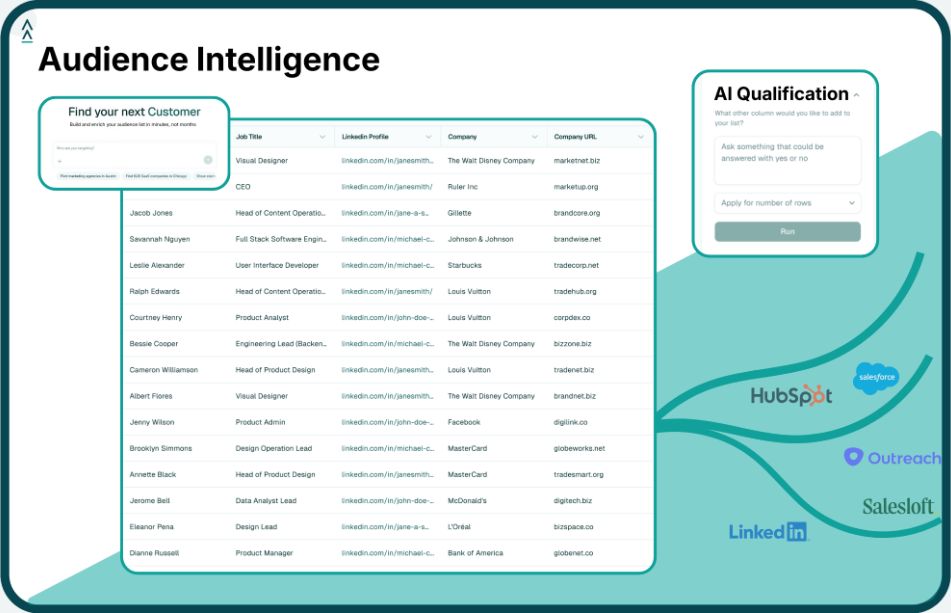
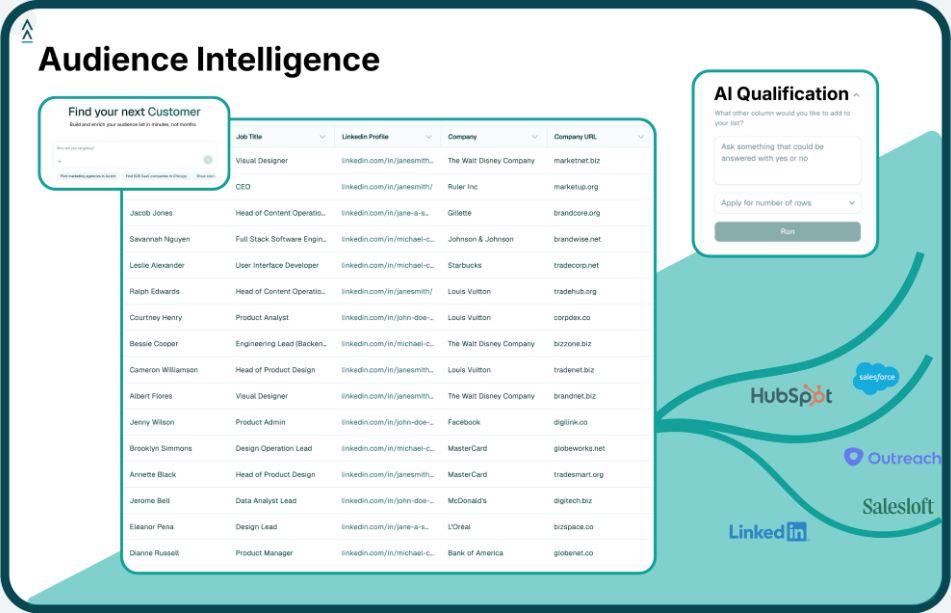
Landbase lets users describe a target audience in plain English. A user might request companies in a defined market, organizations with a particular hiring pattern, or contacts meeting combined company and professional criteria.
The quick start guide explains how to request an audience using plain English. A successful search returns structured information that includes a run ID, session ID, dataset ID, status, and a description of the result.
This helps operators begin with the business requirement rather than manually mapping every criterion to a filter. The resulting dataset can then support refinement, matching, enrichment, qualification, or export.
Complex ICPs often require conditions that cannot be represented by a single stored field. Landbase’s advanced audience search supports SQL-backed dataset creation with exact filters, aggregations, ratios, rankings, and custom output columns.
Documented applications include:
This gives Landbase an important advantage when audience definitions depend on calculations, historical context, or combined data types. Teams should still inspect the proposed query and validate that it reflects the intended ICP.
Landbase can compare uploaded company or contact records with its database. Matching is useful when a CRM export or spreadsheet contains incomplete, inconsistent, or partially identifying information.
The platform returns match-confidence tiers and a human-readable explanation of the signals supporting the candidate. This helps operators distinguish stronger matches from records that require review.
A team can use matching to:
Landbase may return no enrichment data when it cannot identify the record confidently. This is an important limitation to preserve because no B2B dataset contains every field for every company or professional.
Landbase separates enrichment into different paths rather than treating every lookup as the same operation. The documentation describing how enrichment works explains the appropriate use for each path.
Direct enrichment is intended for one professional or company record. Depending on the identifier and requested fields, it can return professional attributes such as title, seniority, and department or company attributes such as industry, size, headquarters location, and LinkedIn information.
This is appropriate for research tasks that need a result returned directly to the terminal without creating a persistent dataset.
Contact enrichment is used to retrieve available contact-level information for matched records. Supported output can include work emails, direct phone numbers, LinkedIn URLs, and job titles.
The contact-level data documentation explains that contact enrichment operates on an existing dataset that has already been matched or enriched with company data. Available fields depend on whether Landbase can identify the record and whether the requested information exists.
Workflow enrichment processes an existing dataset and saves the output within the Landbase workspace. This is appropriate for larger batches or multi-step data operations that require lineage.
Teams can upload records, standardize the input, match it, enrich selected fields, publish the result, and download the final dataset. Each workflow step creates a connected output, making it possible to trace how the data was produced.
Landbase distinguishes direct commands from workflow commands. The documentation on workflows vs. direct commands explains that they serve different purposes.
Direct commands are suitable when:
Workflow commands are appropriate when:
This separation gives technical teams more control over how data operations are executed and stored.
Both Landbase and Seamless.AI support programmatic workflows, but their technical models emphasize different activities.
Seamless.AI’s API supports company and contact search, research requests, enrichment, polling, and webhooks. Its MCP server makes the same data available through supported agent tools.
This model can suit developers and RevOps teams that want contact research embedded in a CRM, warehouse, application, or AI environment. Usage limits and research credits apply, so teams should understand how request volume affects operations.
Landbase CLI combines natural-language audience requests with dataset management and composable processing steps. It can create audiences, upload files, match records, enrich available fields, preserve lineage, and export the output.
Successful commands write JSON to standard output. The output schemas page documents response structures for searches, matches, enrichment, uploads, datasets, and workflows.
Landbase also works directly with Claude Code and Codex. This makes it especially relevant when GTM data operations need to run inside coding environments alongside scripts, analysis, and other technical work.
Landbase supports downloadable formats including JSONL, compressed JSONL, CSV, and Parquet.
Each format serves a different purpose:
The ability to select an output appropriate for the next system reduces the need for repeated manual reformatting. It does not eliminate integration work entirely, since downstream schemas and permissions still require review.
Seamless.AI provides API responses and CRM integrations in addition to its platform exports. Teams comparing the products should consider which output formats, data schemas, rate limits, and synchronization patterns fit their infrastructure.
Both platforms now support AI-assisted use, but Landbase is particularly explicit about using its CLI through Claude Code and Codex.
After installation and authentication, an AI coding assistant can perform permitted operations such as:
Landbase can also run in non-interactive environments. Its guide to automate landbase-cli in scripts covers API-key use, exit-code handling, and continuous integration workflows.
Organizations should restrict permissions according to the task, protect credentials, and review sensitive outputs or write operations. Agent compatibility makes automation possible, but it does not replace governance.
Landbase CLI is not separate from the web platform. Datasets, agent runs, sessions, and workflow jobs created through the CLI can be visible in the broader Landbase workspace.
The web platform adds:
The documentation explaining how the CLI fits clarifies which functions belong to each environment. This allows technical operators to build data processes through the terminal while sales and marketing users work through visual platform features.
Seamless.AI can be relevant when sales teams want a visual contact search experience, browser-based prospecting, CRM integrations, buyer intent, and programmatic access to company and contact research. Its API and MCP support also make it suitable for selected developer and AI-assisted workflows.
Landbase becomes the stronger overall choice when teams need:
The right choice depends on the intended workflow, not simply the number of contacts claimed by a vendor. Teams should test representative searches, review returned fields, evaluate match behavior, understand usage limits, and examine how the platform fits existing data governance practices.
Landbase stands out because it treats B2B audience data as an operational dataset that can be searched, refined, matched, enriched, qualified, processed, and exported. Its CLI gives technical teams a command surface, while its web platform supports visual and campaign-oriented work.
This combination serves multiple roles:
For teams building technical and AI-assisted GTM systems, Landbase provides the more complete foundation. Its advantage comes from connecting advanced audience construction with dataset processing, enrichment, lineage, and activation rather than treating contact discovery as an isolated task.
Teams should examine coverage, freshness, match quality, available fields, enrichment behavior, integrations, output formats, and access controls. They should also test the platform using representative records rather than relying only on headline database figures. Technical teams may need programmatic access and predictable schemas for automated processing. Landbase supports these requirements through its CLI, documented outputs, and dataset workflows.
Landbase accepts plain-English audience requests and can use an advanced dataset creator for more complicated requirements. Advanced searches may include exact filters, ratios, aggregations, rankings, historical conditions, and custom output fields. Teams can review and refine the proposed query before relying on the results. This provides more flexibility than limiting every audience definition to a predefined filter list.
Landbase compares submitted identifiers with its company and contact database and returns a candidate match when sufficient signals align. Results include a confidence tier and an explanation of the factors supporting the match. Lower-confidence results may require human review before enrichment or activation. This approach helps technical teams make informed decisions about how matched records enter downstream workflows.
Yes. Teams can upload CSV or Excel files, standardize the input, match records, and enrich selected company or contact fields. Workflow processing creates connected child datasets that preserve the relationship between the original file and subsequent outputs. The final dataset can be published and downloaded in a supported structured format. This can support CRM cleanup and enrichment while keeping the processing history visible.
Yes. Landbase documents direct use through Claude Code and Codex. After authentication, an assistant can run permitted searches, continue sessions, process datasets, and export results. Organizations should control credentials and restrict permissions based on the intended workflow. This lets teams incorporate Landbase data into AI-assisted research and RevOps operations.
Landbase commands return JSON on successful execution. Downloadable formats include JSONL, compressed JSONL, CSV, and Parquet. These options support scripts, spreadsheets, databases, and analytical environments. Teams can select the format that best matches the next system in the workflow.
No. Automated access can make search, matching, enrichment, and export more efficient, but it does not guarantee that every result is complete or appropriate. Teams should review match confidence, missing fields, targeting logic, and downstream permissions before activation. Landbase documents these limitations and provides structured outputs that support validation. Human oversight remains important for sensitive or high-impact workflows.
Tool and strategies modern teams need to help their companies grow.