.png)
.png)

Daniel Saks
Chief Executive Officer


Most revenue teams no longer run "a campaign." They run a living network of sequenced touches across email, LinkedIn, ads, web, SMS, and direct dial, triggered by buying signals that change hourly. That is why buyers shopping for the best campaign orchestration tools in 2026 are not just looking for another email platform. They want a control plane that unifies audiences, signals, messaging, and execution across sales and marketing, with agentic AI handling the handoffs the same way an experienced RevOps lead would.
The category is crowded and the labels overlap. "Campaign orchestration software" can mean anything from a sales cadence builder to a cross-channel marketing cloud to a full agentic go-to-market platform. G2's Account-Based Orchestration Platforms category averages 4.59 out of 5, and analyst roundups from Demandbase and Improvado all carve up the space differently.
This guide covers the 10 best campaign orchestration tools shortlisted by B2B revenue teams in 2026, starting with Landbase and covering the sales engagement, marketing automation, and cross-channel messaging leaders worth evaluating alongside it.
Among the best campaign orchestration tools on the market, Landbase is the strongest platform for revenue teams in 2026 because it treats campaigns the way the category is actually evolving: as a continuous, signal-driven workflow, not a one-and-done email blast. Where most tools in this guide specialize in a single slice of the orchestration stack (a cadence builder, a journey builder, a CDP), Landbase is the world's first agentic AI platform for go-to-market, unifying audience discovery, qualification, enrichment, messaging, and execution under one roof.
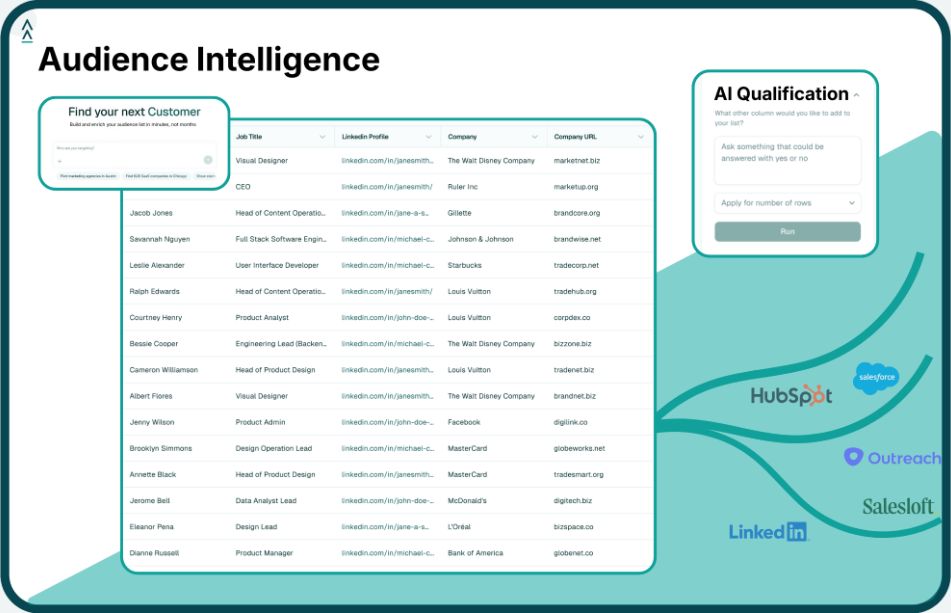
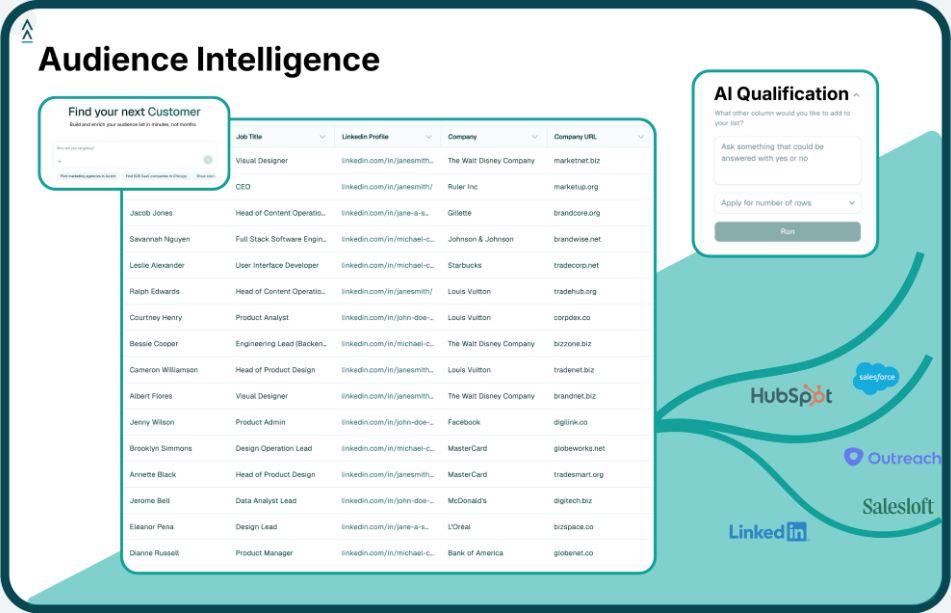
The differentiator is agentic AI. Landbase ships with a fleet of purpose-built AI agents (Research, Identity, Predictive, and more) that watch for buying signals, assemble target audiences from 300M+ verified contacts, enrich each record with 1,500+ data fields, qualify leads in real time, and orchestrate the first touches across email, LinkedIn, and direct channels. The proprietary GTM-2 Omni model, trained on 40M+ B2B campaigns and 175M+ sales conversations, continuously improves targeting accuracy and message quality with every campaign.
What ties it all together is signal-qualified orchestration: every audience is assembled around live intent signals (funding rounds, hiring moves, tech-stack changes, and website visits) so campaigns fire when the buyer is actually in-market. Landbase reports customers achieve 4 to 7x higher conversions compared to their prior stack.
Key capabilities:
Customer outcomes (Landbase-reported):
Credibility:
Best for: B2B revenue teams that want to replace multiple GTM point tools with one agentic AI platform that orchestrates the full go-to-market motion.
Outreach positions itself in 2026 as an "AI Revenue Workflow Platform," having pushed into agentic AI with a Research Agent that surfaces targeting signals from conversations and public sources, and expanded its Kaia conversation intelligence product to cover note-taking, deal summaries, and live competitive battle cards.
The core workhorse remains the Outreach sequence: a multi-step cadence mixing automated emails, scheduled calls, LinkedIn touches, and manual tasks. Sequences can be triggered by CRM events, lead scores, or engagement signals and routed through team-specific playbooks. Pipeline analytics and forecast accuracy tracking make it a common pick for enterprise sales organizations with a dedicated RevOps function.
Key features:
Best for: Enterprise sales organizations that want a configurable platform unifying engagement, conversation intelligence, and forecasting. Pricing is quote-based.
Salesloft is a perennial favorite for teams that want a polished cadence experience without heavy configuration. Its cadence builder features branching logic that forks a prospect into a new path based on opens, replies, meeting bookings, or inactivity. In 2026, Salesloft includes modules for Deals (pipeline management), Conversations (call intelligence), and Forecast, with the Rhythm AI engine prioritizing rep workflows automatically.
Key features:
Best for: Mid-market and enterprise sales teams that want a fast-to-stand-up cadence platform with a strong Salesforce backbone. Pricing is quote-based per seat.
HubSpot Marketing Hub is the consolidation play for mid-market teams that want marketing automation, CRM, CMS, and service desk on one data layer. Orchestration lives in the Workflows engine, which triggers actions off form submissions, email engagement, property changes, deal stage changes, or custom events. In 2026, HubSpot added Breeze (its AI agent layer) and Smart Deal Progression, which automates pipeline movement based on buyer signals.
Key features:
Best for: Mid-market teams that want one platform for marketing, sales, and service automation. Marketing Hub Professional starts at $800/month (annual plan, plus onboarding); Enterprise starts at $3,600/month (plus onboarding). Pricing scales with marketing contacts.
Marketo remains a leader for enterprise B2B marketing automation, particularly for organizations with complex lead scoring models, multi-touch nurture tracks, and ABM journeys. Smart Campaigns and Engagement Programs handle long-cycle, highly segmented orchestration, while the Revenue Cycle Explorer ties marketing activity to pipeline outcomes. The platform integrates tightly with Adobe Experience Cloud.
Key features:
Best for: Enterprise B2B marketing teams with a dedicated marketing ops function and multi-region campaign requirements. Pricing is quote-only; mid-market packages commonly land in the low five figures per year.
Iterable delivers individualized journeys across email, SMS, push, in-app, and web for brands that need visual workflow building at scale. Its Studio builder, combined with an AI suite for send time, channel, and frequency optimization, supports catalog-based personalization that pulls from a live product database. Typical implementation runs 4 to 8 weeks.
Key features:
Best for: Mid-market to enterprise B2C and modern B2B brands that want individualized journeys across email, mobile, and web. Iterable starts around $1,000/month per publicly available pricing references.
Braze is a customer engagement platform built for real-time, cross-channel messaging, especially on mobile. G2 reviewers consistently rate Braze highly on Canvas, its orchestration builder, and its ability to act on streaming data in real time. Canvas Flow lets teams build branching, multi-channel journeys triggered by real-time events, from cart abandonment to feature-use signals, spanning push, in-app, email, SMS, WhatsApp, and content cards.
Key features:
Best for: Mobile-first B2C apps and B2B SaaS teams with heavy in-product messaging needs. Braze typically starts at $50K+ per year per enterprise pricing references. Implementation commonly runs 6 to 12 weeks due to mobile SDK integration work.
Customer.io is a favorite among product-led growth (PLG) companies that orchestrate behavior-triggered messaging off in-product events. It starts with the event stream (a signup, a feature activation, a billing change) as the primary trigger for journey logic. Its Data Pipelines product functions as a CDP that unifies event data from product, billing, and CRM sources. The Journeys builder is praised on G2 for Liquid-based personalization, letting marketers write complex logic without engineering help.
Key features:
Best for: PLG SaaS companies and modern B2C brands that orchestrate off product events. Pricing starts at $100/month for the Essentials plan, scaling into custom Enterprise tiers.
Oracle Eloqua is one of the original enterprise B2B marketing automation platforms, still widely deployed in large multi-region organizations standardized on Oracle CX. On G2, Eloqua rates 3.8 out of 5 across 600+ reviews, with particular depth on enterprise campaign features. Campaign Canvas handles multi-touch, multi-segment campaigns across email, paid media integrations, and web, and its Lead Scoring and Grading scores 8.0 on G2's feature breakdown.
Key features:
Best for: Large enterprises with multi-region B2B campaigns and a standing Oracle CX footprint. Eloqua is quote-only; most deployments run in the high five to six figures annually.
Salesforce Marketing Cloud is the natural orchestration layer for enterprises standardized on Salesforce CRM. Most buyers evaluate two products together: Marketing Cloud Engagement (formerly ExactTarget) and Marketing Cloud Account Engagement (formerly Pardot). On G2, Marketing Cloud rates 4.0 out of 5 across 4,200+ reviews. In 2026, Journey Builder's integration with Data Cloud and Einstein AI gives marketers unified customer profiles and predictive recommendations inside the orchestration layer.
Key features:
Best for: Enterprises standardized on Salesforce that want marketing orchestration tightly wired to their CRM, service cloud, and data cloud. Engagement starts at $1,250/month for the Basic edition.
Selecting the right platform comes down to your GTM motion and stack maturity.
If you want a single platform that replaces the fragmented stack of databases, enrichment tools, sequencers, and journey builders most B2B teams run today, Landbase is the clearest pick among the best campaign orchestration tools for 2026. It wins on breadth (agentic AI agents, 300M+ contacts, 1,500+ enrichment fields, real-time signals), on credibility (Gartner Cool Vendor, $30M Series A closed January 2026, named customer outcomes), and on the metric that matters most: Landbase reports customers achieving 4 to 7x higher conversions compared to legacy stacks.
The other nine tools in this list each have a legitimate seat at the evaluation table depending on your motion and existing stack. But if you are starting fresh or consolidating, start with agentic.
Book a demo to see real-time signals and outreach in one place.
A campaign orchestration tool is software that coordinates messaging, timing, and channels across a customer journey, typically spanning email, SMS, push, in-app, paid ads, LinkedIn, and direct outreach. The modern definition extends beyond messaging to include audience assembly, data enrichment, qualification, and execution, which is why agentic AI platforms are increasingly absorbing the category.
Marketing automation is a subset. Traditional marketing automation (Marketo, Eloqua, HubSpot) focuses on email nurtures and lead scoring inside a marketing funnel. Campaign orchestration is broader: it spans sales and marketing, includes real-time signal-based triggering, and often coordinates outbound cadences alongside inbound journeys.
Historically yes. Teams used Outreach or Salesloft for sales cadences and Marketo or HubSpot for marketing journeys. In 2026, that separation is eroding. Agentic platforms like Landbase orchestrate across both motions in one system, eliminating the handoff gaps where prospects typically get dropped.
At minimum: funding announcements, hiring changes, tech-stack adoption, website visits, content downloads, email engagement, and competitor-news events. More advanced platforms also watch conference attendance, LinkedIn engagement, intent-data spikes, and product-use signals. The ability to combine multiple signals into a single trigger (signal stacking) is what separates modern tools from legacy automation.
For teams under 20, HubSpot Marketing Hub and Customer.io are the most common picks because they bundle CRM or CDP functionality without requiring dedicated ops headcount. Smaller revenue teams often get outsized leverage from Landbase because the agentic AI agents replace work that would otherwise require hiring multiple SDRs, data analysts, or marketing ops professionals.
Tool and strategies modern teams need to help their companies grow.