.png)
.png)

Daniel Saks
Chief Executive Officer


Most RevOps teams are drowning in tools—the average enterprise manages 12-18 platforms, most of which overlap, few of which actually talk to each other, and almost none of which reps use consistently. If that sounds familiar, you're not alone. In 2026, the priority isn't adding more tools to your stack—it's strategically choosing the right ones that actually work together to drive revenue. AI-powered audience discovery has emerged as a game-changer, helping teams cut through the noise with precision targeting that traditional databases simply can't match.
The good news? Gartner projects that 75% of high-growth companies will adopt a RevOps model by 2025, and the data shows that organizations with aligned RevOps teams grow 12-15% faster than those without. The key is building a tech stack that unifies your go-to-market strategy rather than fragmenting it. With AI now table stakes—73% of organizations are operating AI within GTM workflows—the tools you choose need to deliver real intelligence, not just more data.
If you're evaluating your RevOps tech stack for 2026, focus on platforms that integrate seamlessly, provide actionable insights, and actually get used by your team. The era of tool bloat is giving way to strategic consolidation, with companies increasingly planning to reduce their tool count to eliminate redundancy and improve ROI.
Every RevOps tech stack starts with a solid foundation. Your CRM isn't just a system of record—it's the central nervous system that connects all your go-to-market activities. In 2026, the choice often comes down to Salesforce for enterprise complexity or HubSpot for unified simplicity.
What They Do: Salesforce provides enterprise-grade CRM capabilities with extensive customization options and scalability for organizations of all sizes. The platform serves as the central system of record for customer data, sales processes, and revenue operations across the entire customer lifecycle.
Why They're Important: Salesforce remains the enterprise standard, acting as a center point for all RevOps functions with unmatched integration capabilities. Its strength lies in customization and scalability, though this comes with implementation complexity. As one G2 reviewer noted, "The best part about it is how it acts as a center point for all of the RevOps functions."
Key Stats / Metrics: $25-500/user/month pricing accommodating small teams to Fortune 500 organizations
Leadership: CEO: Marc Benioff Founded: 1999
What They Do: HubSpot offers an all-in-one CRM and operations platform that combines marketing, sales, service, and operations capabilities in a single unified system. The platform emphasizes ease of use and integrated functionality without requiring multiple point solutions.
Why They're Important: HubSpot's reputation for user-friendliness, reflected in high G2 ratings for ease of use, makes it particularly attractive for mid-market companies and teams building their first RevOps function. The platform reduces complexity while maintaining powerful functionality.
Key Stats / Metrics: Free CRM, scales to $800/month for Operations Hub Professional
Leadership: CEO: Yamini Rangan Founded: 2006
Sales engagement platforms like Outreach and Salesloft layer on top of your CRM to automate and optimize outreach. Both platforms enable multi-channel sequencing across email, phone, and social media, with machine learning that optimizes send times and message variants. The recent Salesloft-Clari merger has created an integrated revenue orchestration platform that combines engagement with forecasting capabilities.
The real power comes when you feed AI-qualified audiences directly into your CRM and engagement platforms. This eliminates the manual work of list building and ensures your outreach is hyper-targeted from the start. When your CRM contains prospects who are already qualified based on real-time signals and intent data, your sales team can focus on high-value conversations rather than data entry.
This is where the RevOps game has fundamentally changed in 2026. Traditional database prospecting—scrolling through endless lists of contacts with outdated information—is being replaced by agentic AI that understands your ideal customer profile and finds prospects matching your specific criteria in seconds.
The shift from manual filtering to natural language targeting represents a quantum leap in efficiency. Instead of wrestling with complex Boolean queries across multiple filters, you can simply type: "Marketing directors at cybersecurity startups with 50-200 employees that raised funding in the last 30 days." Agentic AI interprets this plain-English prompt and returns an AI-qualified list ready for immediate activation.
This capability is powered by AI models trained on billions of GTM data points from 50M+ B2B campaigns, giving them an innate understanding of what makes an ideal prospect. The AI evaluates 1,500+ unique signals including firmographic data, technographic insights, intent signals, and market events to ensure both audience fit and optimal timing.
The most advanced platforms go beyond simple matching to provide true qualification. This means not just finding contacts at target companies, but verifying that those individuals are decision-makers, currently in-market, and showing buying signals. Look-alike modeling extends this capability by identifying companies similar to your best customers, even if they don't match your initial criteria exactly.
AI Qualification combines online and offline signals to ensure precision, while TAM mapping helps you understand the total addressable market for any given segment. This level of intelligence transforms prospecting from a numbers game into a strategic exercise in finding the right prospects at the right time.
Even the best CRM is only as good as the data flowing into it. Data enrichment, intent monitoring, and intelligence platforms provide the fuel that powers your entire RevOps engine.
Data enrichment has evolved beyond simple firmographic updates. Modern platforms provide multi-source contact enrichment that delivers complete prospect profiles including verified email, phone, social profiles, and real-time technographic data. Advanced validation processes continuously monitor data accuracy and automatically update changed information, ensuring your outreach reaches the right person with current contact details.
Intent data has become increasingly sophisticated, moving beyond basic website tracking to comprehensive monitoring across web, social, and business channels. The best platforms use machine learning algorithms to analyze multiple signal types and generate accurate intent scores that predict buying readiness.
Website visitor intelligence identifies companies researching your category, while market event monitoring tracks funding rounds, job changes, and conference attendance that indicate buying potential. This combination of signals creates a 360-degree view of prospect readiness that goes far beyond traditional demographic targeting.
Platforms like 6sense and Bombora have pioneered this space, but the real value comes when intent data is combined with audience discovery capabilities. This integration allows you to not just see who's showing intent, but to proactively find similar companies that might be in the early stages of their buying journey.
Analytics and performance measurement tie everything together, providing the feedback loop that enables continuous optimization of your go-to-market strategy.
The most effective RevOps teams measure success not just by activity metrics, but by business outcomes. GTM Trust Score assessment helps evaluate your digital presence and its impact on buyer confidence, while performance metrics track everything from pipeline velocity to forecast accuracy.
Modern analytics platforms go beyond reporting to provide prescriptive insights. When you integrate AI-qualified audiences with your analytics, you can track which targeting criteria, messaging approaches, and engagement channels drive the best results. This real-time feedback enables rapid iteration and optimization of your entire GTM approach.
The key is ensuring your analytics layer connects all your data sources—CRM, engagement platforms, website analytics, and audience intelligence—into a single source of truth. This unified view eliminates data silos and provides the comprehensive insights needed for strategic decision-making.
ABM has evolved from a niche strategy to a mainstream approach, especially for B2B companies targeting enterprise accounts. The 2026 ABM tech stack focuses on precision targeting and coordinated multi-channel engagement.
AI has transformed ABM from manual account selection to dynamic target identification. Instead of static account lists, modern ABM platforms use AI to identify accounts showing buying signals in real-time, allowing for truly responsive campaigns that adapt to market conditions and individual account behavior.
The most effective ABM campaigns orchestrate consistent messaging across email, social media, advertising, and direct outreach. Platforms like 6sense and Demandbase provide the coordination layer that ensures prospects receive cohesive messaging regardless of which channel they engage with first.
The real power comes when ABM is integrated with AI-powered audience discovery. This combination allows you to build target account lists based on specific criteria, then automatically identify the key decision-makers within those accounts who are most likely to be receptive to your outreach.
None of your tools work in isolation. Integration and automation platforms provide the connective tissue that makes your RevOps stack function as a unified system rather than a collection of disconnected point solutions.
The integration layer handles data synchronization between your CRM, engagement platforms, analytics tools, and data enrichment services. This ensures that when a prospect takes action in one system—like visiting your website or responding to an email—that information flows automatically to all your other tools.
Automation extends beyond simple data sync to include workflow automation that guides your team through optimal processes. Revenue cadences provide AI-recommended next steps based on prospect behavior, while automated lead routing ensures inquiries are handled by the right team member at the right time.
Enterprise integrations via API and CRM connectors (with Salesforce and HubSpot integrations coming soon) enable seamless data flow and activation of AI-qualified exports into existing tools, eliminating manual data handling and ensuring consistent processes across your entire go-to-market organization.
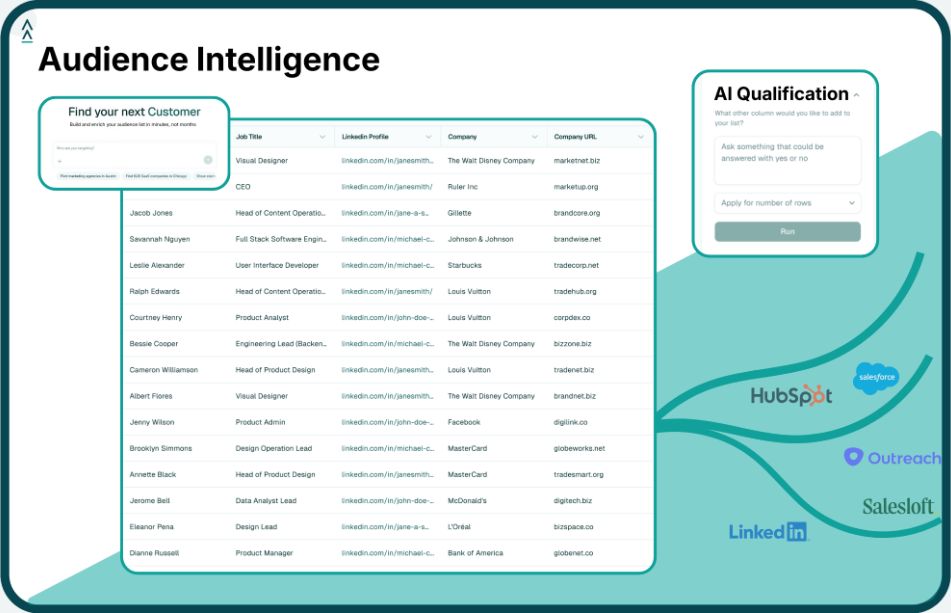
While traditional RevOps stacks focus on managing existing data and processes, Landbase takes a fundamentally different approach by solving the prospecting problem at its source. Instead of forcing your team to navigate complex databases and build lists manually, Landbase's GTM-2 Omni agentic AI model interprets natural-language prompts and delivers AI-qualified audiences ready for immediate activation.
What They Do: Landbase provides an agentic AI platform that transforms natural-language prompts into AI-qualified prospect lists using 1,500+ signals across firmographic, technographic, intent, and market event data. The platform eliminates manual database filtering and delivers instantly actionable audiences.
Why They're Important: Landbase represents a strategic shift from managing data to leveraging intelligence. The platform's natural-language targeting eliminates complex workflows—users simply type what they're looking for in plain English instead of wrestling with Boolean queries. The free, no-login audience builder provides powerful prospecting capabilities without upfront costs or complex setup, while AI Qualification ensures precision through comprehensive signal analysis.
Key Features:
VibeGTM provides the intuitive interface that makes this powerful AI accessible to anyone on your go-to-market team. The 4-step process—Set Your Direction, AI Qualification, Review Results, Export and Activate—democratizes sophisticated audience discovery and puts AI-powered targeting in the hands of sales reps, marketers, and growth leaders alike.
For RevOps teams looking to cut through tool bloat while improving prospecting efficiency, Landbase represents a strategic shift from managing data to leveraging intelligence. When machines handle the mundane work of list building, your team can focus on what they do best—building relationships and closing deals.
Technology is only as effective as the people using it. The most sophisticated RevOps stack won't deliver results if your team lacks the skills, processes, or motivation to use it effectively.
As AI takes over repetitive tasks like data entry and list building, RevOps professionals need to develop higher-value skills in strategic thinking, relationship building, and data interpretation. The focus shifts from operational efficiency to strategic impact.
The best RevOps organizations create a culture where data drives decisions at every level. This requires not just the right tools, but also processes that encourage experimentation, learning, and continuous improvement. When your team spends less time on manual data work and more time on strategic activities, everyone benefits.
Landbase's mission embodies this philosophy: "When machines handle the mundane, humans can focus on what they do best—building relationships and closing deals." This human-centered approach to AI ensures that technology enhances rather than replaces the human element that still matters most in B2B sales.
AI serves as the intelligence layer that transforms raw data into actionable insights. In 2026, AI powers conversation intelligence, predictive forecasting, audience discovery, and automated optimization across your entire go-to-market stack. Rather than just providing more data, AI helps you find the right prospects, predict which deals will close, and optimize your outreach for maximum impact. The technology has evolved from experimental to essential, with the majority of organizations now embedding AI into core GTM workflows.
Traditional data providers offer static databases that require manual filtering and often contain outdated information. Landbase's agentic AI qualifies contacts in real-time using 1,500+ unique signals including firmographic, technographic, intent, and market event data. This dynamic qualification ensures that every contact is not just at a target company, but is actually a decision-maker showing buying signals at the optimal time for engagement. The natural-language interface eliminates complex Boolean queries, making sophisticated targeting accessible to any team member.
Integration eliminates manual data handling and ensures your CRM contains prospects who are already qualified and ready for engagement. This improves sales rep productivity by allowing them to focus on high-value conversations rather than list building, increases outreach relevance through hyper-targeted audiences, and provides better forecasting accuracy since your pipeline starts with qualified prospects rather than unvetted leads. The seamless data flow between systems ensures consistent processes across your entire go-to-market organization.
Intent data identifies prospects who are actively researching solutions like yours, allowing you to engage at the precise moment they're most receptive. By combining intent signals with AI-powered audience discovery, you can proactively reach similar companies that might be in the early stages of their buying journey. This proactive approach can significantly shorten sales cycles compared to traditional outbound methods that rely on demographic targeting alone. The key is combining multiple signal types—website behavior, market events, technographic changes—to create a comprehensive view of buying readiness.
The most critical integration is between your audience discovery platform and your CRM/sales engagement tools. This ensures AI-qualified prospects flow automatically into your outreach workflows without manual handling. Secondary integrations include analytics platforms that track campaign performance and provide feedback for optimization, and data enrichment services that maintain contact accuracy throughout the customer lifecycle. The goal is creating a unified system where data flows seamlessly between tools, eliminating silos and manual data entry while ensuring every team member has access to current, accurate information.
Tool and strategies modern teams need to help their companies grow.