.png)
.png)

Daniel Saks
Chief Executive Officer


AI sales development platforms can combine prospect research, contact data, personalization, outreach, response handling, and meeting workflows within one system. Artisan operates in this category through Ava, an AI BDR designed for outbound sales development.
Artisan was founded in 2023. The company raised a $25 million Series A in April 2025, following an earlier $12 million financing round. The product has continued to expand since its initial release, with Ava 2.0 extending the workflow from prospect sourcing and email outreach into response handling, meeting scheduling, signals, and configurable human involvement.
Artisan is a San Francisco sales technology company established in 2023. Its primary product is Ava, an AI BDR designed to participate in outbound sales-development workflows.
The current Ava 2.0 workflow includes prospect research, audience selection, personalized outbound email, response handling, meeting booking, signal inputs, and escalation rules. Live cold calls are handled by sales representatives rather than by Ava.
This structure places several stages of outbound sales development within the same environment. Prospect discovery establishes an audience, research adds account and contact context, messaging converts that information into campaign content, and response workflows manage activity after a prospect replies.
Artisan organizes its platform around outbound campaign execution.
A campaign can begin with newly sourced prospects or records already available to the sales organization. Prospect and company information can then contribute to targeting and personalization.
Once outreach begins, Ava can process responses and move selected conversations into meeting workflows. Human review can be introduced through campaign rules and escalation settings.
Calling follows a related but distinct process. The platform can prepare call tasks and prospect context, while a sales representative handles the live conversation.
Ava includes prospect sourcing as part of its campaign workflow.
Artisan maintains a B2B contact database that can be used to identify people and companies that match campaign requirements. Targeting can incorporate factors such as company characteristics, contact roles, geography, seniority, and other attributes associated with the intended audience.
Database size is one part of data coverage. The usefulness of individual records also depends on whether the available information corresponds to the industries, regions, roles, and company characteristics included in a specific ICP.
Existing account status can also affect audience selection. Customers, open opportunities, assigned accounts, or records covered by other sales motions may need to remain outside particular campaigns.
Research adds context before outbound messages are generated.
Ava can use company and contact information to identify details associated with the prospect and account. That information can then contribute to message generation rather than limiting personalization to basic fields such as name, title, and company.
The type of information that matters depends on the sales motion. Hiring activity, leadership changes, company growth, technology changes, and other events can have different relevance depending on the product and target market.
Signals provide another input to audience selection.
Artisan's current workflow can incorporate business events and activity alongside basic account and contact criteria. Examples include funding activity, hiring information, leadership events, technology changes, website activity, and social engagement.
ICP criteria and signals serve different purposes. ICP criteria describe whether an account matches defined customer characteristics. Signals add information about recent events, activity, or timing.
Fit and recent activity can therefore remain separate components of the targeting process.
Ava generates personalized outbound email sequences using prospect research and campaign instructions.
Campaign configuration can include information about positioning, target audiences, message themes, calls to action, and other communication requirements. Prospect-specific context can then be incorporated into the resulting messages.
Personalization is connected to both available data and the instructions supplied during campaign setup. Organizations can review generated messages against established communication standards, product positioning, and campaign objectives.
The same context can be used across a sequence rather than only in an initial email, allowing follow-up messages to remain connected with the campaign and prospect information already available.
Ava 2.0 includes response handling after a prospect replies.
The system can process responses, continue defined conversations, address selected questions or objections, and move an appropriate prospect toward meeting scheduling.
Response handling introduces workflow requirements beyond the initial outbound message. Campaign rules can define which interactions remain automated, what information can be used in a response, and when a salesperson becomes involved.
Conversation context also becomes relevant during handoffs. When a salesperson takes over, preceding prospect activity forms part of the information associated with that interaction.
Meeting scheduling connects prospect responses with the next stage of the sales process.
Once a conversation reaches the appropriate point, Ava can schedule a meeting on a sales representative's calendar.
This activity can interact with account assignment, calendar ownership, CRM records, attribution, and handoff processes. Those operational elements determine how an automated outbound conversation enters the existing sales workflow after a meeting is created.
Artisan includes calling as a human-led component of the broader workflow.
The platform can identify contacts for calling, queue tasks, and provide account or prospect context. Sales representatives then handle the live calls.
The level of automation differs by channel. Email and response workflows can involve direct automation, while phone conversations remain with sales representatives.
Outbound automation can operate with approval and escalation rules.
Approval settings determine whether selected actions require human review before proceeding. Escalation rules determine when an automated interaction transfers to a person.
These controls allow the level of automation to vary across campaigns and interaction types. Different workflows can therefore use different combinations of automated actions and human review.
Account ownership determines which salesperson or team is responsible for a company or prospect.
Existing revenue organizations may already have assignments within their CRM, so campaign activity needs to account for those records when selecting audiences and routing meetings.
Exclusions serve a related function. Existing customers, active opportunities, partners, assigned accounts, and do-not-contact records may be excluded from particular campaigns based on existing sales processes.
CRM information can contribute to both targeting and outbound execution.
Existing records may contain account ownership, previous sales activity, opportunity history, lifecycle stages, customer status, and other context relevant to campaign selection or personalization.
CRM workflows can therefore involve record matching, field mapping, ownership logic, activity synchronization, duplicate handling, and meeting attribution.
Organizations with customized CRM environments may need to examine how those processes interact with their existing fields and sales rules.
B2B contact information changes as employees move between companies, change responsibilities, update contact details, or leave roles.
Database coverage therefore involves more than the total number of records available. Refresh processes, enrichment, verification, employment information, and field completeness can affect how individual records are used.
Coverage can also vary by target market. Geography, industry, company size, job function, and seniority can affect how much usable information is available for a particular audience.
Prospect data and qualification address different parts of audience development.
Data describes an account or contact. Qualification applies business criteria to determine whether that record matches the intended target profile.
Common qualification dimensions include industry, company size, geography, job function, technology usage, business model, and selected business events. Explicit criteria separate the available data from the rules used to determine whether a prospect belongs in a campaign.
As of September 15, 2026, Artisan has a 4.1 out of 5 rating across 53 G2 reviews. The current review distribution includes 35 five-star reviews, 10 four-star reviews, three three-star reviews, two two-star reviews, and three one-star reviews.
Recent verified users describe using Artisan for email and LinkedIn outreach, response classification, follow-up workflows, personalization, account targeting, and exclusions. One September 2026 reviewer highlighted the ability to coordinate email and LinkedIn outreach with fallback steps and classify responses for follow-up. Another reviewer noted that supplying more context and coaching points provided greater control over messaging, tone, and account targeting.
The lower-rated reviews add additional context to the overall rating and show that customer experiences vary across implementations.
Reviewers frequently discuss automation, customer support, ease of use, lead generation, personalized messaging, and the amount of manual work involved in outbound workflows.
Other reviews raise concerns about lead-targeting accuracy, email quality, data accuracy, interface usability, configuration requirements, and the learning curve associated with messaging controls. Some reviewers also report that results did not meet their expectations relative to the cost of the platform.
These experiences reflect individual deployments rather than universal outcomes. Audience criteria, available data, campaign configuration, messaging inputs, and existing sales processes can all influence how customers experience the platform.
Landbase provides web and command-line interfaces to the same underlying platform.
Its web and CLI interfaces share the same data, agent, account, lists, and datasets. Work created through the CLI can remain available in the web application, while lists developed visually can be used in later programmatic workflows.
The web application supports visual audience creation, filtering, dataset review, and agent interaction. The CLI supports repeatable commands, batch operations, scripts, and connections with other tools.
Landbase can create audiences from plain-language descriptions.
The web application workflow allows users to describe an audience conversationally, review structured results, and refine the same search using filters.
For requirements that extend beyond standard search criteria, the Advanced Dataset Creator supports more specific logic, calculations, ratios, aggregations, and custom output requirements.
These workflows allow audience definitions to become reusable datasets rather than remaining limited to one campaign or search session.
Landbase can also operate on records that already exist in a spreadsheet, CRM export, or other dataset.
The match and enrich workflow identifies corresponding company or person records and adds selected information to the resulting dataset.
Matching determines which Landbase record corresponds to an existing entry. Enrichment then adds requested company or contact fields.
Existing first-party lists can therefore become part of the same workflow as audiences created inside Landbase.
Qualification can be applied after records have been identified or enriched.
Landbase's AI qualification workflow accepts natural-language criteria and can evaluate accounts using firmographic, technographic, and intent information. Records with unclear information can also be validated or flagged for review.
Qualification remains distinct from enrichment. Enrichment adds information to a record, while qualification evaluates the available information against defined criteria.
This separation allows teams to maintain a dataset while applying a consistent set of business rules to determine which records meet the intended requirements.
Landbase supports signal-based audience criteria alongside static account attributes.
The buying signal workflow covers categories including funding, hiring and growth activity, leadership changes, and technology events.
Signals can be combined with ICP criteria so that account fit and current business activity remain distinct inputs within the same audience definition.
For workflows that depend on new events appearing over time, always-on lists can surface new records when defined conditions are met.
The Landbase CLI provides programmatic access to GTM data and workflows.
The CLI installation guide documents use from a standard terminal as well as AI-assisted environments such as Claude Code and Codex.
This gives technical GTM teams and AI agents access to the same Landbase environment used for audience and dataset operations.
Multi-step processes can also combine Landbase with connected systems. The CLI workflow documentation describes workflows that can search for accounts, enrich records, compare them with CRM data, and pass resulting records into connected tools.
Read and write permissions can be handled separately, allowing actions that change external records to remain subject to approval.
Artisan provides Ava, an AI BDR used in outbound sales-development workflows. Ava supports prospect sourcing, account research, personalized email sequences, response handling, meeting scheduling, signal-based targeting, campaign controls, and call preparation for sales representatives.
Artisan has a 4.1 out of 5 G2 rating from 53 reviews as of September 15, 2026. Current feedback discusses outbound automation, usability, email and LinkedIn activity, personalization, account controls, support, targeting, messaging, and data-related considerations.
Yes. Prospect and company research form part of Ava's outbound workflow. Contact information, account data, enrichment, and business signals can contribute to audience selection and personalized messaging.
Artisan centers its product on an AI BDR participating in outbound execution. Landbase provides GTM data and workflow access through web and CLI interfaces. Its documented functions include audience creation, matching, enrichment, qualification, buying signals, dataset management, CRM-related operations, and command-line workflows that can run through Claude Code and Codex.
Relevant areas include prospect-data coverage, data freshness, audience criteria, personalization controls, CRM coordination, account ownership, approval workflows, response handling, deliverability processes, meeting handoffs, and reporting. Customer reviews provide additional context on how those functions are experienced across individual deployments.
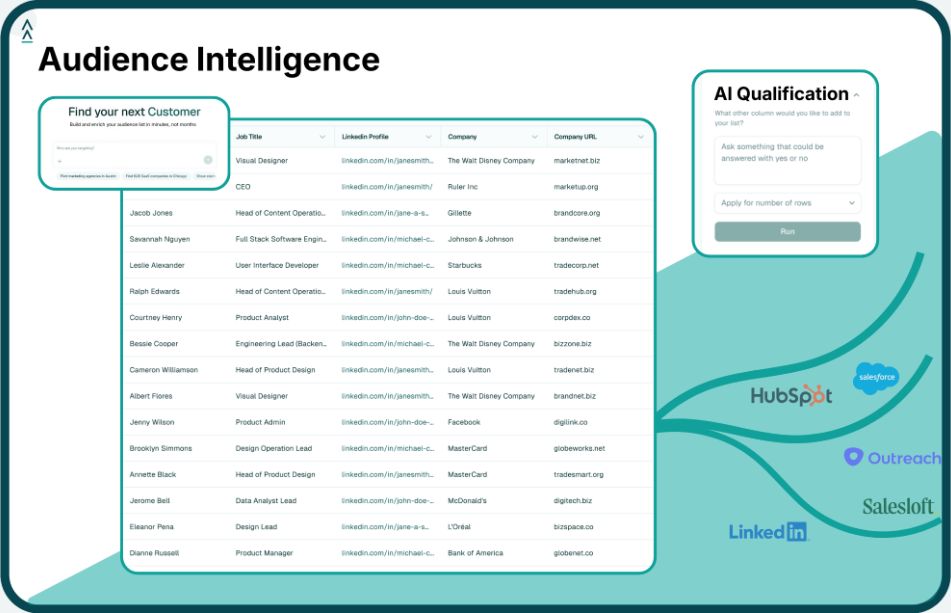
Tool and strategies modern teams need to help their companies grow.