.png)
.png)

Daniel Saks
Chief Executive Officer


AiSDR is an AI sales development platform that automates several tasks traditionally associated with outbound and inbound SDR workflows.
Its current product combines lead research, audience creation, email and LinkedIn outreach, personalization, reply handling, CRM connectivity, sending infrastructure, and selected calling workflows. AiSDR also provides Ami AI, a conversational GTM agent that can help generate campaign ideas, identify audiences, and prepare sales personas.
For teams evaluating AI prospecting tools, the relevant questions extend beyond outreach volume. Prospect-data quality, signal coverage, message accuracy, CRM integration, human oversight, pricing, and the amount of campaign configuration required can all affect how the platform performs in practice.
AiSDR is designed to automate multiple stages of prospecting and outreach within one sales workflow.
Current capabilities include:
AiSDR can use both its own prospect data and existing lists supplied by a customer.
Its current pricing materials describe a native database of 300M+ leads globally, alongside live prospect research using public web information, company news, hiring data, technology usage, LinkedIn activity, and other qualification criteria.
Prospecting in AiSDR is not limited to selecting contacts from a fixed list.
The platform supports conversational ICP descriptions and can use those instructions to identify people and companies matching defined qualification criteria.
Current prospecting inputs can include:
AiSDR can also process existing lead lists and add information before those contacts enter campaigns.
This gives teams several ways to define audiences, although the usefulness of the resulting lists still depends on the quality and specificity of the criteria supplied.
AiSDR currently supports several signals that can be incorporated into targeting.
Examples include:
Signals can help distinguish between a company that merely matches an ICP and one showing a recent change or activity relevant to a campaign.
The presence of a signal does not by itself establish purchase intent. Teams still need to determine which events are meaningful for a particular product, sales motion, and market.
AiSDR supports outreach across email and LinkedIn.
Email can be sent through Gmail or Outlook, while LinkedIn functionality includes:
Campaigns can contain multiple touchpoints and combine email with LinkedIn activity.
AiSDR also supports personalization using information about the prospect, company, CRM properties, LinkedIn activity, and other researched context.
AiSDR uses AI to generate initial outreach and contextual follow-ups.
Current functionality can incorporate:
AI-generated personalization can reduce the manual research required for individual messages, but current review feedback indicates that output still benefits from monitoring.
G2 reviews mention instances where messaging requires adjustment, where AI timing in ongoing conversations is not ideal, or where generated language feels less natural than intended.
Organizations using automated customer-facing communication may therefore need clear rules around message review, escalation, and when human involvement should take over.
The NIST Generative AI Profile provides broader guidance for evaluating risks associated with generative AI systems, including reliability and human oversight.
AiSDR can continue conversations after a prospect responds rather than stopping automation at the first reply.
The platform documents reply handling within approximately five to ten minutes and can:
Users can also operate with different levels of automation depending on the campaign setup.
Review feedback suggests that oversight can still matter, particularly when conversations move beyond predictable questions or when AI-generated responses do not match the preferred timing or tone.
AiSDR does not currently function as a standalone native dialer.
Calling is supported through its Aircall integration.
Current call-related functionality includes:
This allows phone activity to be incorporated into broader outreach sequences without presenting calling as a fully native AiSDR channel.
Teams building sales automation workflows may need to account for the additional system when comparing the platform with products that include their own dialer.
AiSDR currently documents integrations with:
HubSpot has the broader documented CRM integration.
AiSDR supports functions such as:
HubSpot synchronization is available across current plans, although feature depth varies.
Salesforce support is available at the Scale level.
AiSDR's current materials describe Salesforce connectivity for importing and working with CRM leads, while some help documentation notes that Salesforce synchronization remains more limited than the HubSpot integration.
Organizations with customized Salesforce environments may therefore need to verify which records, fields, and actions are supported for their specific workflow.
AiSDR's current help documentation does not list a general public API or broad connector ecosystem comparable with platforms built primarily around extensibility.
This can matter for teams whose sales operations depend on custom applications, data warehouses, proprietary systems, or extensive workflow orchestration.
AiSDR includes email infrastructure as part of its current plans.
Features include:
The number of domains and mailboxes varies by plan.
Email infrastructure can reduce setup work, but deliverability still depends on factors beyond the software used to send a campaign.
Relevant considerations include:
Google's sender requirements provide current authentication and sending requirements for email delivered to Gmail accounts.
Commercial outreach also needs to account for applicable law. The Federal Trade Commission's CAN-SPAM guidance outlines U.S. requirements for commercial email, while organizations processing European personal data may also need to evaluate obligations under the GDPR framework.
AiSDR currently publishes three primary pricing tiers.
Price: $250 per month
Solo is designed for one user and includes:
Solo provides a lower-cost entry point than the older Explore-only pricing structure described in previous AiSDR coverage.
Price: $900 per month
Explore includes:
A managed-service option is available at an additional per-campaign cost.
Price: $2,500 per month
Scale includes:
A fully managed service is available separately.
Explore and Scale currently use quarterly contract terms while billing monthly. AiSDR also offers annual plans with a published discount.
AiSDR currently publishes a benchmark of approximately one to three qualified meetings per 100 well-targeted prospects in materials aimed at startups.
That figure is an AiSDR-reported benchmark rather than a fixed platform outcome.
AiSDR itself notes that results vary based on factors including:
A team using the Explore allocation of 800 researched contacts therefore should not assume a guaranteed number of meetings simply by applying the benchmark mechanically.
Pipeline impact ultimately depends on both meeting generation and what happens after the meeting, including qualification, opportunity conversion, sales cycle, and deal value.
The AiSDR seller profile on G2 currently shows 4.6 out of 5 from 101 reviews.
Frequently discussed positive themes include:
Recurring considerations include:
The review profile is heavily positive overall, but the recurring concerns provide useful context about the operational work involved after initial setup.
G2's review analysis identifies learning curve as a recurring theme.
Although AiSDR automates campaign execution, users still need to define:
Some reviews describe a period of testing and adjustment before campaigns perform as intended.
Reviews also mention situations where AI-generated language feels unnatural, message details need correction, or automated responses appear at a point where a human reply would have been preferable.
The amount of oversight required is likely to vary according to the audience, message complexity, and degree of automation enabled.
Integration limitations and email-related issues also appear in G2's recurring review themes.
Examples include requests for broader connectivity, Salesforce-related limitations, reporting concerns, and specific email workflow issues.
These considerations become more important for organizations with mature RevOps systems or customized CRM processes.
AiSDR brings prospecting, research, email, LinkedIn activity, AI-generated messaging, reply management, and sales infrastructure into a relatively consolidated workflow.
Evaluation should still account for the requirements surrounding that automation.
Key considerations include:
AiSDR's current product is broader than a basic email automation tool, but not every sales-development function is native. Calling relies on Aircall, Salesforce support differs from HubSpot, and larger-scale capabilities are tied to higher-priced plans.
For teams comparing other approaches, AiSDR alternatives can be evaluated according to these specific workflow and data requirements rather than on outreach volume alone.
An AI SDR can automate research, prospect selection, messaging, follow-up, and parts of campaign execution. Those workflows still begin with decisions about which accounts and people belong in the audience and what data qualifies them.
For many GTM teams, those decisions also need to exist outside the AI SDR itself.
The same audience logic may be reused for:
That creates a related requirement for teams that need audience and account data to remain reusable across tools rather than being tied only to one execution workflow.
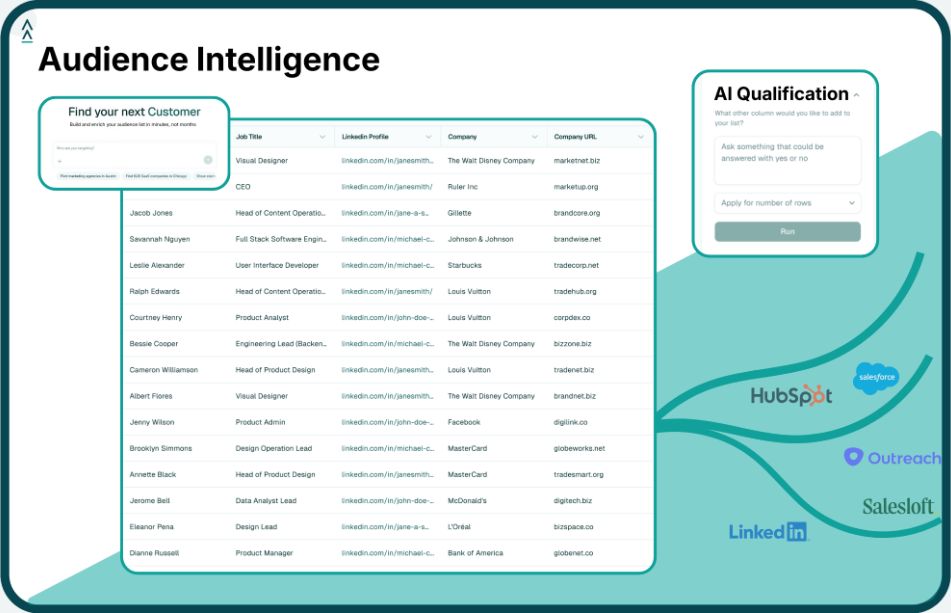
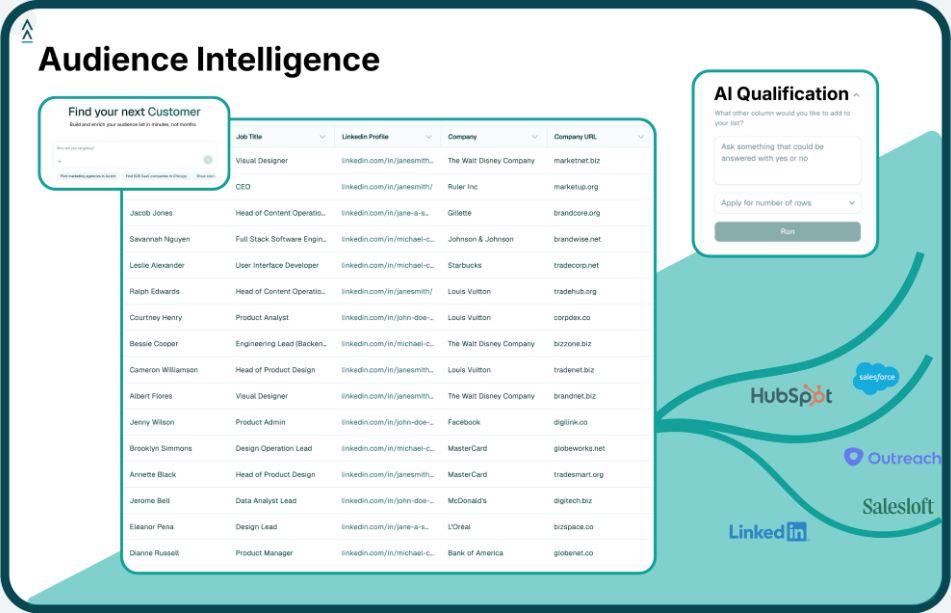
Landbase supports this type of GTM data work through audience creation, matching, enrichment, buying signals, datasets, and structured outputs.
Its web application and CLI provide two interfaces to Landbase, using the same underlying data and agent. Interactive research can begin in the web application, while technical teams can work with the same system through the terminal.
Landbase Agentic Search converts plain-language audience descriptions into structured qualification criteria.
Landbase currently reports:
Teams can combine natural-language audience creation with structured filtering when qualification requirements become more specific.
Landbase also supports matching and enrichment for data that already exists in CRM systems, spreadsheets, or other operational sources.
Workflows can include:
This allows existing records to be resolved or enriched before they move into downstream sales, marketing, analytics, or AI-assisted processes.
Landbase Signals can add company-change context to audience criteria.
Signal categories include:
Landbase currently reports tracking more than 1,500 signal types across 24M+ companies.
These signals can be combined with company and contact criteria when refining audiences or monitoring accounts over time.
The Landbase CLI provides access to the same underlying Landbase data and agent from a terminal.
It can operate inside AI-assisted environments such as Claude Code and Codex and can support repeatable workflows involving:
For technical GTM teams, this makes audience and account data available beyond a single prospecting or outreach interface and allows the same underlying data to participate in different operational workflows.
AiSDR automates prospect research, lead sourcing, email and LinkedIn outreach, personalization, follow-ups, reply handling, and parts of meeting and calling workflows. The exact capabilities depend on the selected plan and connected systems.
AiSDR currently starts at $250 per month for Solo. Explore costs $900 per month, while Scale costs $2,500 per month. The plans differ in monthly researched contacts, users, domains, mailboxes, LinkedIn accounts, CRM functionality, signals, and support.
Current G2 feedback frequently mentions customer support, automation, ease of use, and time savings. Recurring concerns include learning curve, AI accuracy, message quality, email functionality, integrations, and the need to refine campaign settings.
AiSDR supports HubSpot and Salesforce. HubSpot has the broader documented two-way synchronization capabilities. Salesforce is available with Scale, although current AiSDR documentation indicates that some Salesforce workflows remain more limited.
Landbase supports natural-language audience creation, company and person matching, enrichment, buying signals, datasets, and structured workflows. Its web application and CLI use the same underlying data and agent, allowing teams to reuse GTM data across interactive research, CRM operations, scripts, AI-assisted workflows, and downstream systems.
Tool and strategies modern teams need to help their companies grow.