.png)
.png)

Daniel Saks
Chief Executive Officer


B2B data platforms support far more than contact list building. Sales, marketing, and RevOps teams use them to identify accounts, find decision-makers, interpret buying signals, enrich records, and coordinate engagement. This has become more important as B2B buyers prefer increasingly digital and self-directed purchasing experiences.
ZoomInfo, Demandbase, and Cognism address different parts of the market. ZoomInfo provides broad company and contact intelligence, Demandbase concentrates on account-based marketing, and Cognism emphasizes verified contact data and compliance-conscious prospecting. Landbase takes a more technical approach through its command-line interface, giving teams and AI agents programmatic access to audience search, matching, enrichment, and dataset workflows.
Sales intelligence platforms originally made company and contact records searchable. The category has expanded to include enrichment, intent signals, account scoring, advertising, engagement analysis, conversation intelligence, and workflow automation.
These capabilities are not always delivered through the same type of product. Contact intelligence platforms primarily help teams identify and reach individual buyers. Account-based platforms place greater emphasis on selecting companies, understanding buying groups, and coordinating marketing and sales activity.
The access model also matters. Established platforms are often centered on graphical web applications that guide representatives through research, list building, and campaign workflows. Technical operators may need structured outputs, command-line access, session continuity, and predictable responses that can feed scripts or AI agents.
ZoomInfo is a go-to-market intelligence platform used for company research, contact discovery, enrichment, prospecting, and related revenue operations.
ZoomInfo provides searchable company and professional records. Available information can include firmographic details, professional attributes, organizational information, and contact data.
Its capabilities support tasks such as:
ZoomInfo also provides integrations and workflows that help organizations move data into other parts of their GTM stack.
ZoomInfo’s portfolio extends beyond contact discovery. It includes products related to buyer intent, website visitor identification, data management, sales engagement, and conversation intelligence.
Chorus, its conversation intelligence product, records and analyzes customer-facing conversations. This helps revenue teams examine calls, meetings, customer interactions, and deal activity.
The breadth of the portfolio can suit organizations seeking multiple sales intelligence functions from one vendor. The capabilities available to an individual customer depend on the products included in its agreement.
ZoomInfo’s graphical interface supports guided prospecting and research. Representatives can build searches, review records, and transfer selected data into connected systems.
Teams should consider whether this interaction model matches their operating requirements. A visual application can suit representative-led prospecting, while technical operators may also need data that can be queried and processed programmatically.
Demandbase is primarily associated with account-based marketing and account-based GTM. Its platform helps teams select target accounts, interpret intent, evaluate engagement, and coordinate account-level activity.
Demandbase begins with accounts and buying groups rather than treating individual contacts as the only unit of analysis. It helps organizations build target account lists, prioritize companies using fit and activity, and coordinate engagement across revenue teams.
Its core areas include:
These capabilities support organizations running structured ABM programs across marketing, advertising, and sales.
Demandbase can activate account-based advertising and coordinate messaging across channels. Its advertising capabilities support targeting at the account and buying-group levels, while website personalization adapts experiences using account context.
The platform also combines activity from CRM and marketing automation systems with account-level reporting. This helps teams examine how target accounts progress across stages and touchpoints.
Demandbase is not simply a contact database. Its central focus is account selection, buying signals, orchestration, personalization, and measurement.
The company is also expanding its AI and natural-language capabilities, so it should not be described as entirely dependent on manual filters. However, its principal product experience remains oriented toward account-based sales and marketing rather than terminal-native dataset operations.
Cognism is a sales intelligence platform providing company and contact data for prospecting and enrichment. It places particular emphasis on phone-verified mobile numbers, international outreach, and compliance procedures.
Cognism’s Diamond Data consists of mobile numbers that have received an additional phone-verification step. This capability is intended to reduce time spent calling incorrect or outdated numbers.
Its wider offering supports tasks such as:
Cognism is most directly comparable with contact-focused sales intelligence products, although it also provides company information, intent-related data, and enrichment capabilities.
Cognism documents procedures for compliance-conscious prospecting. These include screening phone data against Do Not Call registries, providing GDPR Article 14 notifications where applicable, and maintaining processes for data rights and opt-outs.
The company reports ISO 27001 and SOC 2 Type II certifications. These certifications concern its information security controls and do not remove a customer’s responsibility to use prospect data lawfully.
These capabilities can be relevant to international outbound teams that place particular importance on verified phone information and documented privacy processes.
Cognism provides a web application, browser extension, integrations, and other routes for using its data. Buyers should evaluate geographic coverage, required contact fields, verification practices, privacy responsibilities, and compatibility with existing prospecting systems.
Its central emphasis remains sales intelligence and contact data rather than programmatic audience engineering.
Although ZoomInfo, Demandbase, and Cognism overlap in some areas, they are designed around different priorities.
ZoomInfo and Cognism both support company and contact discovery. ZoomInfo offers a broad GTM intelligence portfolio, while Cognism emphasizes phone-verified data and compliance-conscious processes.
Demandbase provides account and buying-group intelligence, but its central purpose is supporting account-based GTM. Evaluating it only as a source of contact records would overlook its orchestration, advertising, personalization, and account engagement functions.
Demandbase places the greatest emphasis on coordinated ABM. ZoomInfo supports account and intent workflows within its broader intelligence portfolio. Cognism supplies contact and company information that can support outbound prospecting and account research.
All three offer established interfaces and integrations for revenue teams. Their main experiences revolve around vendor applications, connected GTM systems, and the sales or marketing workflows each platform supports.
Technical teams may require another access model. A RevOps engineer might want to issue a query from a terminal, process the response with command-line tools, preserve context during refinement, and export the resulting dataset in a machine-readable format. Landbase CLI directly supports this type of workflow.
The Landbase CLI guide describes a command-line tool for searching, matching, enriching, and managing B2B audience data. Teams can use it through a terminal, scripts, Claude Code, or Codex.
This gives technical operators a way to incorporate audience data into automated workflows instead of limiting access to a separate graphical application.
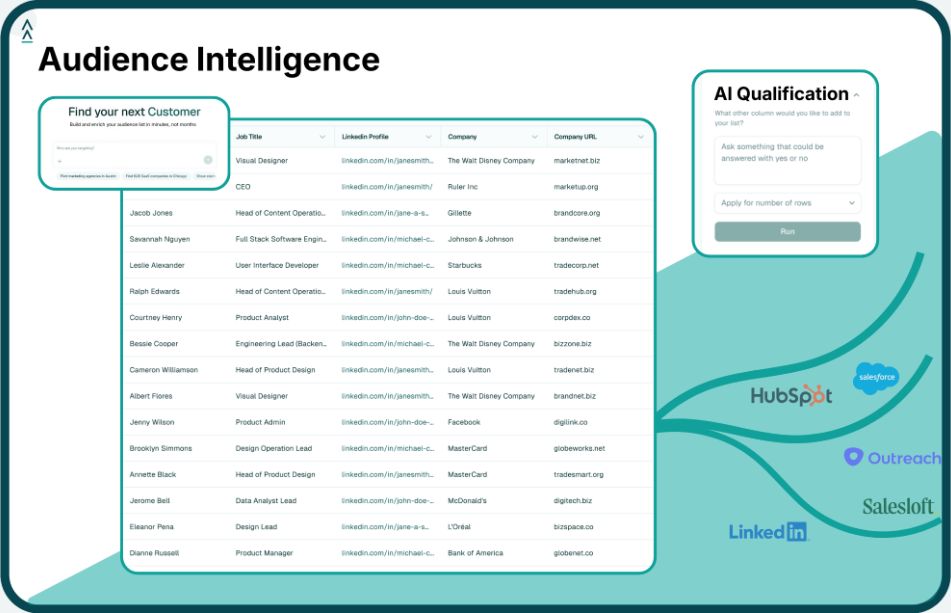
Landbase CLI accepts descriptions of companies or contacts in ordinary language. A user might request B2B software companies in a specific location, organizations with a particular hiring pattern, or contacts matching combined role and company criteria.
A search returns a run ID, session ID, dataset ID, and a content field describing the results. The resulting dataset can then be used in downloads and additional workflows. Landbase documents this as a natural language query.
This approach allows teams to start with a business requirement instead of manually translating every detail into interface filters.
Some audience definitions require calculations or conditions that cannot be expressed through conventional filters. Landbase’s Advanced Audience Search can propose SQL-backed builds with exact filters, aggregations, ratios, rankings, and custom output columns.
Documented examples include evaluating hiring changes, calculating ratios between roles, and combining company data with job postings or historical career information. This is useful when targeting depends on a computed condition rather than a single stored field.
Teams should still inspect the resulting dataset and confirm that its logic matches the intended business definition.
Landbase sessions preserve context across commands. The --session flag allows users to continue research across runs instead of treating every query as an unrelated task.
For example, a user can identify a group of companies, narrow it by location, find relevant contacts, and enrich selected records within a connected research process.
Session continuity also applies when the CLI is used through Claude Code. An AI assistant can chain multiple commands and refine an audience through a multi-turn workflow.
Landbase CLI supports record matching, general enrichment, contact enrichment, dataset uploads, and batch workflows. Teams can upload existing records, match incomplete data, add available information, and create child datasets that preserve lineage.
Contact enrichment can retrieve available email or phone information for records in a dataset. Keeping enrichment as a distinct step allows teams to discover an audience first and enrich only the contacts needed for the next workflow.
These functions can support audience preparation, CRM cleanup, lead enrichment, and other data operations. Teams remain responsible for applying their privacy and data governance requirements.
Landbase supports several formats for downstream work:
Successful commands write JSON to standard output, which allows results to be processed with tools such as jq. Published datasets can also be downloaded in a selected format. Landbase provides guidance to choose the right output for each use case.
Structured exports help teams move from audience research to analysis or activation without repeatedly reformatting data.
Landbase provides documented setup paths for Claude Code and Codex. After installation and authentication, an AI coding assistant can run permitted CLI commands on the user’s behalf.
Supported workflow patterns include:
Landbase also supports interactive authentication and API-key authentication. The interactive process opens a browser for consent, while API keys can support scripts and continuous integration environments.
Organizations should review the permissions granted to AI assistants. Automatically approving CLI commands can simplify operation, but access should reflect the sensitivity of connected systems and data.
Landbase documents how to connect the CLI with Salesforce or HubSpot. These connections can let Landbase compare audience results with existing CRM records and add records when appropriate permission has been granted.
Read access allows Landbase to inspect relevant records, while write access permits additions. Teams should grant only the permissions required for the intended workflow.
The Landbase web platform complements the CLI. The CLI focuses on programmatic access, datasets, automation, and agent workflows. The web application adds visual dataset browsing, campaign management, outreach tools, team administration, and integrations.
Landbase’s explanation of How the CLI fits clarifies the relationship between these environments. Technical operators can use the CLI for data workflows while other team members use visual platform functions.
The appropriate choice depends on the GTM problem the organization needs to solve.
Teams seeking broad contact and company intelligence may evaluate ZoomInfo. Organizations running coordinated account-based marketing programs may consider Demandbase. Teams prioritizing phone-verified contact data and compliance-conscious prospecting may evaluate Cognism.
Landbase becomes especially relevant when GTM data needs to operate inside terminals, scripts, data pipelines, or AI coding assistants. Its ability to find an audience using plain English, combined with advanced dataset creation, sessions, enrichment workflows, and structured exports, gives technical teams a direct route from a business question to a reusable dataset.
For organizations modernizing GTM operations around automation and AI agents, Landbase offers the strongest overall fit in this comparison. Its value comes from making B2B data accessible within the technical environments where teams already research, build, and automate.
ZoomInfo, Demandbase, and Cognism address established requirements across contact intelligence, account-based orchestration, and compliance-conscious prospecting. Landbase differentiates itself through programmatic and agent-assisted data access.
Its combination of natural-language search, advanced audience logic, sessions, matching, enrichment, workflow lineage, and structured exports supports several roles:
This access model makes Landbase a strong choice for teams that want B2B audience data to function as part of their technical infrastructure rather than remain confined to a standalone research interface.
Teams should examine data coverage, freshness, geographic requirements, compliance procedures, integrations, and access methods. The platform should fit existing sales, marketing, and RevOps processes without introducing unnecessary work. Technical teams may also value Landbase’s command-line access for scripts and AI-assisted workflows.
Contact intelligence focuses on individual professionals and the information needed for prospecting or enrichment. Account intelligence examines companies, buying groups, engagement, and other account-level signals. Landbase supports company and contact research while allowing users to refine, match, and enrich the resulting datasets.
Plain-English search lets users describe the companies or contacts they need without selecting every requirement from a predefined menu. The system interprets the request and returns a structured result for review or refinement. Landbase also supports advanced dataset creation when a search requires calculations, aggregations, or custom fields.
Structured exports help teams move audience data into scripts, spreadsheets, databases, dashboards, and analytical systems. CSV is useful for spreadsheets, JSONL works well with scripts, and Parquet suits data analysis. Landbase supports several formats so operators can select the most appropriate output.
Yes. Refinement allows teams to adjust audience criteria after reviewing initial results. Landbase uses sessions to preserve context across commands, helping users narrow searches and continue related research without starting over.
Landbase documents connections with Salesforce and HubSpot. Depending on the permissions granted, it can compare searches against CRM records or add records to the connected system. Organizations should grant only the access required for the intended workflow.
Command-line access is particularly useful for RevOps engineers, developers, growth operators, and teams comfortable with scripts or AI coding assistants. Other users may prefer visual tools for daily research and campaign management. Landbase provides both CLI and web-platform functions, allowing different roles to use the environment that fits their work.
Tool and strategies modern teams need to help their companies grow.