.png)
.png)

Daniel Saks
Chief Executive Officer


Choosing the best firmographic data analysis tools is no longer optional for B2B revenue teams. It is a prerequisite for pipeline efficiency. Dirty data costs U.S. businesses trillions of dollars annually, and industry benchmarks commonly cite B2B databases losing roughly 2.1% of their accuracy every month, or approximately 22.5% annually, as contacts change roles, companies restructure, and company attributes shift.
The firmographic data software landscape in 2026 looks different than it did even two years ago. Static databases are giving way to AI-driven platforms that enrich, analyze, and act on company signals in real time. A critical finding: multi-source enrichment generally improves coverage and accuracy relative to single-source data, though exact performance depends on provider mix, geography, and verification workflow, a gap that directly impacts pipeline quality.
This guide ranks 11 B2B firmographic data platforms based on database depth, enrichment capabilities, AI automation, accuracy, and real-world performance. Whether you are building account lists, segmenting your TAM, or qualifying inbound leads, this breakdown will help you pick the right tool for your workflow and budget.
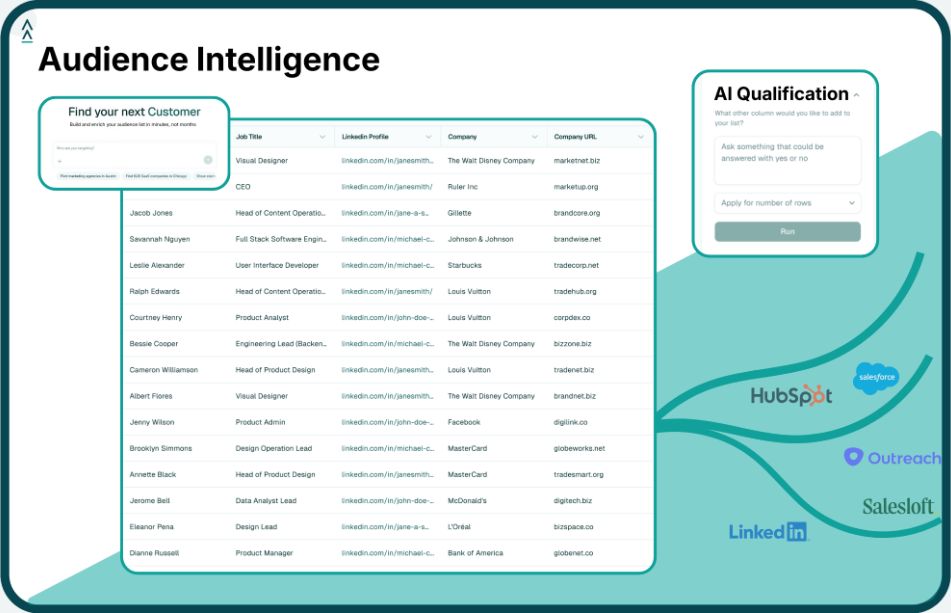
Landbase is the world's first agentic AI platform for go-to-market, and the only tool on this list where firmographic data analysis is not a manual lookup but an AI-automated workflow. Where traditional B2B firmographic data platforms hand you a database and leave you to filter, export, and enrich on your own, Landbase deploys AI agents that autonomously research, qualify, and engage target accounts using 1,500+ enrichment fields across firmographic, technographic, and intent signals.
The platform's 300M+ verified contact database provides the raw data foundation, but the real differentiator is what happens after the data is pulled. Landbase's AI Research Agent gathers firmographic intelligence on each target account, covering industry classification, revenue range, employee headcount, growth trajectory, technology stack, and dozens of additional attributes. It then passes that analysis to the AI Identity Agent, which maps buying committees and decision-maker hierarchies. The AI Predictive Agent scores accounts by combining firmographic signals with behavioral and intent data, surfacing the accounts most likely to convert right now.
This signal-qualified approach addresses the core problem with static databases: B2B data decays at 2-3% per month. Landbase does not wait for you to notice stale data. Its agents continuously validate and refresh attributes as part of the prospecting workflow, using the proprietary GTM-2 Omni model built specifically for go-to-market use cases. For teams grappling with data quality issues across their GTM funnel, Landbase's continuous enrichment eliminates the manual refresh cycles that plague legacy platforms.
Key capabilities:
Customer outcomes (as reported by Landbase):
Credibility: Named a Gartner Cool Vendor, backed by $30M in Series A funding announced in June 2025, and trusted by revenue teams that need firmographic intelligence that goes beyond static lookups.
Best for: B2B sales teams and revenue operations leaders who need AI-automated firmographic analysis combined with prospecting and outreach, not just a static database to query manually.
ZoomInfo is the incumbent in B2B sales intelligence, offering one of the largest proprietary databases in the market. The platform provides 321M+ contacts and 104M+ company profiles with 200+ company attributes including industry, revenue, employee count, and technology stack data across 36,000+ technologies.
The platform offers intent data capabilities for account prioritization and includes org charts and corporate hierarchy mapping. ZoomInfo connects natively with Salesforce, HubSpot, and Marketo, making it a foundational system for enterprise RevOps teams that need data enrichment at scale.
Key features:
Best for: Enterprise RevOps teams and large sales organizations with significant annual budgets who need a broad firmographic database. ZoomInfo scores 4.5/5 on G2 as a Leader in Sales Intelligence. Pricing is quote-based and varies by package, data access, and workflow modules.
Cognism is a GDPR-compliant B2B sales intelligence platform with particularly strong European coverage. Their Diamond Data program delivers phone-verified mobile numbers designed to improve connect rates, and the platform includes DNC screening across 15 countries, a requirement for teams selling into EMEA markets where data privacy regulations are strict.
The platform provides 440M+ contacts globally with company, technographic, and intent data combined. Cognism integrates Bombora intent data and offers no credit ceilings on data access, which simplifies budgeting for high-volume teams.
Key features:
Best for: Sales teams selling into European markets who need GDPR-compliant firmographic data with verified direct dials. Cognism rates 4.5/5 on G2 as a Leader in Sales Intelligence. Pricing is custom, typically $15,000-$30,000/year.
Demandbase is an enterprise account-based marketing platform that combines company data, technology stack intelligence, and behavioral signals within a unified ABM orchestration system. The platform triangulates data from 40,000+ news, financial, and social sources with AI validation and human review.
The platform's IP-to-company mapping identifies anonymous website visitors at the account level, and its ABM advertising capabilities allow teams to run account-level personalized ad campaigns using the same account segments they build for sales outreach.
Key features:
Best for: Enterprise marketing and sales teams running account-based strategies who need firmographic data layered with ABM advertising and orchestration. Demandbase rates 4.4/5 on G2. Pricing is custom and quote-based.
6sense takes a different approach to account intelligence: instead of starting with a static database, it starts with buying signals. The platform analyzes anonymous web behavior across thousands of B2B publisher sites to identify which accounts are actively researching solutions in your category, then scores them by buying stage, from early awareness through active evaluation.
The company data layer arrives via modular Data Packs that you purchase separately (firmographic, technographic, intent, and contact data), each feeding into 6sense's predictive scoring engine.
Key features:
Best for: Revenue teams that need predictive analytics to prioritize accounts by buying stage using firmographic and intent signals. 6sense rates 4.3/5 on G2. Pricing includes a free Sales Intelligence tier; paid plans are quote-based and packaged by module and credits.
Clay is a data enrichment platform that connects to 150+ data partners for waterfall enrichment. Unlike the other tools on this list, Clay does not own a proprietary database. Instead, it uses AI to query multiple data sources in sequence, and if the first provider does not return a match, it automatically tries the next, finding the best data available for each lead.
This approach gives RevOps engineers maximum flexibility to build custom data enrichment workflows with conditional logic, though it does require more technical setup than turnkey platforms.
Key features:
Best for: RevOps engineers and growth teams who want maximum flexibility to build custom firmographic enrichment workflows across multiple data sources. Clay rates 4.7/5 on G2 as a High Performer. Pricing starts at approximately $167-$185/month depending on plan configuration.
Clearbit became part of HubSpot in November 2023 and now powers HubSpot's Breeze Intelligence, the company's data enrichment and buyer intent solution. The platform supports native enrichment and form-shortening workflows inside HubSpot, appending 100+ company attributes (industry, headcount, revenue, tech stack) to contacts and identifying anonymous website visitors at the company level so marketing teams can retarget accounts that browse without converting.
The real value of Clearbit/Breeze Intelligence emerges for teams that have already standardized on HubSpot. Because enrichment runs natively inside the CRM, there is no data syncing lag or third-party connector to maintain.
Key features:
Best for: Marketing and inbound sales teams already using HubSpot who need seamless real-time firmographic enrichment. Clearbit rates 4.4/5 on G2 as a Leader in Data Quality. Pricing is custom and bundled with HubSpot plans.
Lusha occupies the lightweight end of the spectrum, a Chrome extension that sits on top of LinkedIn and company websites, letting reps pull contact details and company data without leaving their browser tab. With 2.6M+ users, it has become the go-to for individual sellers who value speed over platform depth.
The credit-based pricing model works in Lusha's favor for smaller teams: you pay only for the records you actually pull rather than committing to an annual enterprise contract. Lusha also handles CSV bulk enrichment and pushes data directly into Salesforce, HubSpot, and Pipedrive.
Key features:
Best for: Individual sales reps and small teams who need quick firmographic lookups and direct dials without complex platform setup. Lusha rates 4.3/5 on G2. Lusha offers a free plan plus credit-based paid plans; verify current paid pricing on Lusha's live pricing page.
SalesIntel differentiates through human verification. Every contact in their database is verified by human researchers on a 90-day re-verification cycle, delivering a claimed 95% accuracy rate. For high-ticket sales teams where a single bad data point can derail a six-figure deal, that verification model matters.
The platform provides 200M+ B2B decision-maker contacts with company segmentation, corporate hierarchy mapping, and Bombora intent data integration. SalesIntel also offers a research-on-demand service where their team will source custom data sets you cannot find in the standard database.
Key features:
Best for: ABM and high-ticket sales teams that prioritize data accuracy over database size. SalesIntel rates 4.3/5 on G2. Pricing is quote-based.
Dun & Bradstreet is the original enterprise firmographic data provider. With 500M+ global business records and the industry-standard DUNS numbering system, D&B remains the definitive source for corporate hierarchy mapping, credit ratings, payment behavior, and financial risk scoring.
For compliance-heavy industries, including financial services, government contracting, and procurement, the DUNS number is often a non-negotiable requirement. D&B's data depth extends to segment-level revenue data and parent-subsidiary mapping.
Key features:
Best for: Enterprise procurement, financial services, and compliance teams that need deep firmographic data with financial risk scoring and corporate linkage. D&B rates 4.1/5 on G2 as a Leader in B2B Data. Pricing is custom enterprise.
Dealfront (formerly Echobot and Leadfeeder) is a European-focused B2B sales intelligence platform that combines company data with website visitor identification. The Leadfeeder heritage means teams can see which companies visit their website and layer that behavioral signal on top of account-level segmentation.
The platform has particularly strong coverage in DACH markets (Germany, Austria, Switzerland) and broader European company data. G2 comparison pages rate Dealfront's contact-data quality in the high-8s, and quality of support scores 9.5, both above several larger competitors.
Key features:
Best for: Sales teams focused on European markets, especially DACH, who need firmographic data combined with website visitor intelligence. Dealfront rates 4.3/5 on G2 as a High Performer in Sales Intelligence. Pricing is custom.
Selecting the right tool depends on five factors:
The firmographic analysis landscape in 2026 offers more options than ever, but the gap between static data providers and AI-driven intelligence platforms is widening fast. The global B2B data services market continues to expand rapidly, yet organizations still lose significant revenue annually from poor data quality. Legacy tools give you data fields to filter manually. The next generation turns that data into automated action, with research, qualification, and outreach handled by AI agents rather than manual workflows.
Landbase stands out because it closes the gap between analysis and action. Where other platforms hand you enriched records and leave the rest to your team, Landbase's AI agents autonomously research target accounts, map buying committees, score readiness, and initiate personalized outreach, all from a single platform with 300M+ contacts and 1,500+ enrichment fields. Recognized as a Gartner Cool Vendor and backed by $30M in Series A funding, it is built for revenue teams that have outgrown the "export CSV, upload to sequencer" workflow.
Book a Demo to see how Landbase's agentic AI platform turns firmographic data into pipeline, automatically.
Firmographic data refers to the set of attributes used to classify and segment companies, similar to how demographics describe individuals. Common fields include industry, company size (employee count), annual revenue, location, ownership type, and growth stage. B2B sales and marketing teams use firmographic data to define their ideal customer profile (ICP), build target account lists, and prioritize outreach. Understanding why firmographics alone do not define an ICP is important; the best approaches layer behavioral and intent signals on top of these static attributes.
The five most commonly used firmographic fields are industry/vertical, company size (employee headcount), annual revenue, geographic location, and ownership type. More advanced firmographic analysis also incorporates technographic signals (technology stack), growth signals (hiring velocity, funding rounds), corporate hierarchy (parent-subsidiary relationships), and regulatory environment. The best firmographic tools combine these static attributes with real-time signals like intent data and buying behavior.
Given that B2B data decays at 2-3% per month, with job-title and role changes representing a major source of CRM and contact decay, firmographic data should be refreshed at least quarterly. High-velocity outbound teams targeting fast-moving industries like tech, SaaS, and startups benefit from continuous or real-time enrichment to avoid wasting outreach on outdated records.
Firmographic data describes what a company is, including industry, size, revenue, and location. Technographic data describes what technology a company uses, such as CRM systems, marketing platforms, cloud infrastructure, and security tools. Both are valuable for B2B targeting: firmographics help you identify companies that match your ICP by size and industry, while technographics reveal whether a company uses a competitor product, a complementary tool, or has a gap your solution fills. Teams that layer firmographic, technographic, and intent signals together see substantially better targeting precision than those relying on any single data type.
Traditional firmographic analysis involves querying a database, exporting lists, and manually cross-referencing enrichment fields. AI improves this workflow in three ways: first, by automating data gathering and validation across multiple sources simultaneously; second, by scoring and prioritizing accounts using firmographic signals combined with intent and behavioral data; and third, by acting on the analysis and triggering personalized outreach sequences to qualified accounts without manual intervention. This shift from passive data retrieval to autonomous analysis and action is what distinguishes the newest generation of firmographic data software from legacy platforms.
Tool and strategies modern teams need to help their companies grow.