.png)
.png)

Daniel Saks
Chief Executive Officer


.png)

In B2B sales, data accuracy isn’t a “nice to have” – it’s mission-critical. Up to 70% of CRM data is outdated, incomplete, or inaccurate, undermining outreach efforts and forecasts. The fallout is costly: businesses lose an average $12.9 million per year (about 15% of revenue) due to poor data quality. Clearly, static contact lists and legacy data vendors aren’t cutting it. So what sets a modern B2B database apart in delivering truly accurate, up-to-date information? In this post, we’ll break down the key capabilities, from real-time updates and human-in-the-loop validation to signal enrichment and agentic AI. By harnessing these features, Landbase’s platform ensures >90% verified accuracy and a continuously fresh dataset that outperforms traditional B2B data vendors at every turn.
The first hallmark of a modern, accurate B2B database is continuous, real-time updates.
B2B data decays fast:
Landbase is built to be live by default.
When a prospect changes jobs or a company announces funding, Landbase captures it almost immediately, preventing the “dirty data” surprises that plague static lists.
Traditional B2B data providers might refresh their lists quarterly (or expect customers to manually request updates), leaving you with outdated contacts and dead ends. In contrast, Landbase continuously ingests and verifies data so that what enters your CRM is fresh and reliable. This real-time approach is crucial to combat data decay – instead of losing a quarter of your leads to decay each year, Landbase keeps your data evergreen. Sales teams using Landbase can trust that their contact info and firmographics are always current rather than months out-of-date, giving them a competitive edge in speed to connect.
Automation alone isn’t enough to reach top-tier accuracy.
The most reliable modern B2B databases combine AI verification with human oversight, and Landbase is built on this principle.
Every record goes through layered validation:
This approach allows Landbase to maintain 90%+ verified accuracy across an enormous dataset.
Why involve humans at all? Because context and judgment still matter. For example, if an AI agent isn’t 100% certain whether “VP Sales” John Doe at Company X is the same John Doe who recently updated his LinkedIn, Landbase’s workflow can route that record for a quick manual check. By having a human in the loop at key decision points, Landbase avoids propagating errors that purely automated platforms might let slip through.
The result is exceptional data quality – far above the industry norm. (Independent research shows most B2B data providers deliver only ~50% accuracy on average, whereas best-in-class solutions with rigorous verification reach 97%+ accuracy and sub-1% bounce rates.) Landbase falls squarely in the latter category: it leverages live web enrichment, AI verification, and human validation in concert to keep data clean and correct. In practical terms, that means sales emails actually reach the right people, phone numbers connect, and company profiles are trustworthy. Compared to a traditional vendor dumping unverified leads (and leaving your reps to waste hours fixing them), Landbase’s human-in-the-loop processes ensure you get ready-to-use, high-precision data from the start.
Landbase layers in 1,500+ proprietary signals per company, including:
All signals are fused into a single, unified company and contact profile.
Crucially, this data fusion approach isn’t just about adding bells and whistles – it actually drives accuracy up. How so? Think of each signal as a piece of evidence. When multiple independent signals corroborate a fact (for instance, a company’s size can be inferred from employee count, office locations, job openings, and revenue estimates collectively), you gain confidence in the data’s accuracy.
Enrichment also flags discrepancies; if one source shows a contact still at a company but another signal indicates they’ve changed roles, Landbase’s system can detect that conflict and update or verify accordingly. Combining numerous data sources (multi-source enrichment) dramatically outperforms relying on a single source – studies show find rates of 85–95% when using a multi-source “waterfall” enrichment, versus just 50–60% coverage from any single data source. Landbase’s platform is built on this multi-source philosophy. It joins structured data (like CRM records, database fields) with unstructured web data (like news, social media, and review sites) in real time, ensuring that each record is not only accurate but comprehensive.
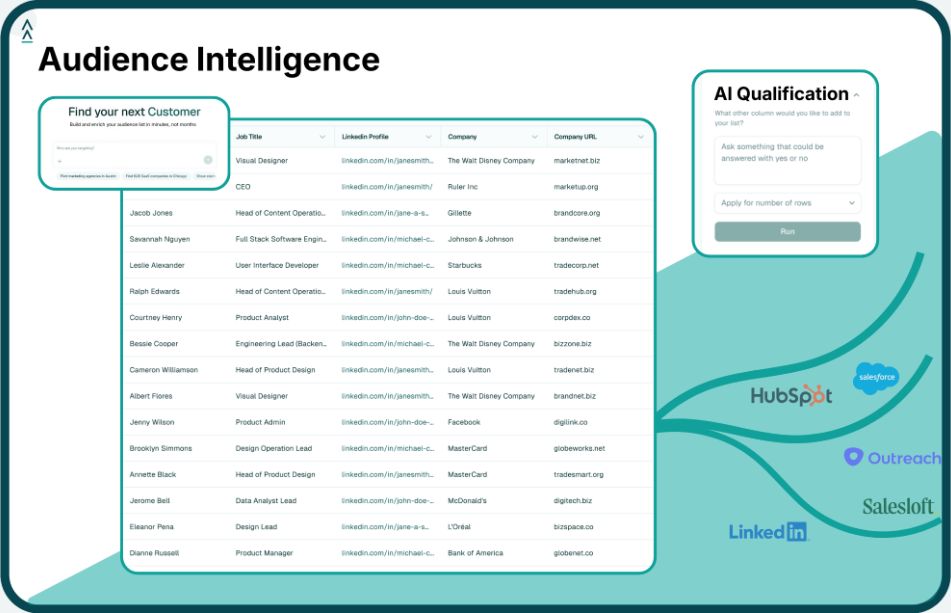
For go-to-market teams, having this depth of information means you’re not flying blind. You can filter and target companies by very specific criteria – say, find accounts using a competitor’s software or showing a recent spike in hiring – and Landbase will surface verified prospects that meet those conditions. Traditional data vendors often can’t deliver that level of granularity or timeliness because their datasets aren’t as enriched or are updated too slowly. Landbase’s rich signal layer is a major differentiator: it gives you actionable insight (who to prioritize, when to reach out, what to mention) right from the database, rather than making you do extra research. In short, enrichment isn’t just for show – it’s integral to a modern accurate database because it aligns your data with reality from multiple angles.
The most advanced driver of accuracy today is agentic AI, autonomous AI agents that continuously maintain and improve the database.
Its specialized AI agents operate like a 24/7 research and data ops team:
How do these AI agents work in practice? One example: Landbase’s Research Agents automatically scour the web for hard-to-find insights – they might visit a company’s website to grab a new executive’s name, or scan news sites for a recently announced partnership.
Identity Agents can match and merge records, ensuring that “Bob at IBM” in one source is correctly recognized as the same person as “Robert (Bob) at International Business Machines” from another source.
Other agents specialize in tasks like classification (tagging industries or segments accurately) and predictive scoring (using signals to predict which accounts are likely high-value).
Each agent operates autonomously but also collaboratively – just like a human team with different roles – to continuously refine the data. Importantly, these AI workflows are iterative and self-improving. If an agent encounters uncertainty (say, it’s unsure if two company entries are duplicates), it can flag it for human review or gather more evidence before finalizing, thereby learning and reducing errors over time.
The agentic AI approach essentially turns Landbase’s database into a living system rather than a static repository. It’s always “learning” from new inputs and feedback. This is a stark contrast to traditional databases where data might only change when a human manually updates a field or when a new list is purchased and uploaded. With Landbase, the platform itself takes on the heavy lifting of research and validation in the background. That means your sales ops or data team no longer need to spend countless hours on list maintenance – the AI is doing it continuously, at a scale and speed humans can’t match. The outcome is that Landbase can offer both breadth and accuracy: even with 220+ million contacts in its system, the platform keeps them verified and up-to-date in a way old-school providers (who often verify only a fraction of their records) simply cannot.
To see these principles in action, consider how Landbase helped a travel tech platform (a provider of booking software for tours and activities) transform its sales data accuracy. This company was struggling with a classic data challenge: they had thousands of small business prospects in their target market, but no reliable way to identify which accounts were truly high-value. Their internal lists were missing key context like which booking system each prospect used (many were on competitors’ software) or how popular the business was (e.g. reflected by online reviews or website traffic). Existing data was static, incomplete, and not updated in real-time, forcing their team to resort to guesswork and even manual research outsourcing. In short, they lacked the data accuracy and depth to prioritize outreach – who should sales call first, and what insight would get that prospect’s attention?
Landbase deployed its agentic AI and enrichment workflows across approximately 2,000 travel and experience providers, automatically enriching and validating each account with real-world signals that legacy databases couldn’t capture.
Multiple specialized AI agents operated in parallel to enrich every company:
In just days, the travel tech firm went from a patchy, outdated list to a dynamic spreadsheet of prospects annotated with which competitor’s tool they use, how popular they are (review counts), and even an estimated foot-traffic band.
The impact was immediate. Landbase’s enrichment uncovered patterns that were impossible to see before – for instance, it revealed an “unseen” competitor (a booking system that the client wasn’t even tracking) being used by dozens of high-value targets, suggesting a new angle for competitive sales plays. The dataset also allowed the sales team to rank prospects by likely potential (combining review volume and visitor metrics), so reps could focus on the top-tier accounts first instead of treating all 2,000 leads equally.
This level of accuracy and insight simply wasn’t achievable with their old data. By leveraging Landbase’s AI agents and multi-source data fusion, the travel tech platform saved weeks of manual research and gained a finely tuned target list matched to their ideal customer profile. They could now personalize outreach with relevant talking points (“We see you’re using XYZ booking system…”) and confidently pursue the accounts most likely to convert. It’s a prime example of how Landbase’s modern approach – real-time updates, human-verified accuracy, rich signals, and autonomous AI workflows – drives better outcomes than any static B2B contact database ever could.
Tool and strategies modern teams need to help their companies grow.