.png)
.png)

Daniel Saks
Chief Executive Officer


.png)

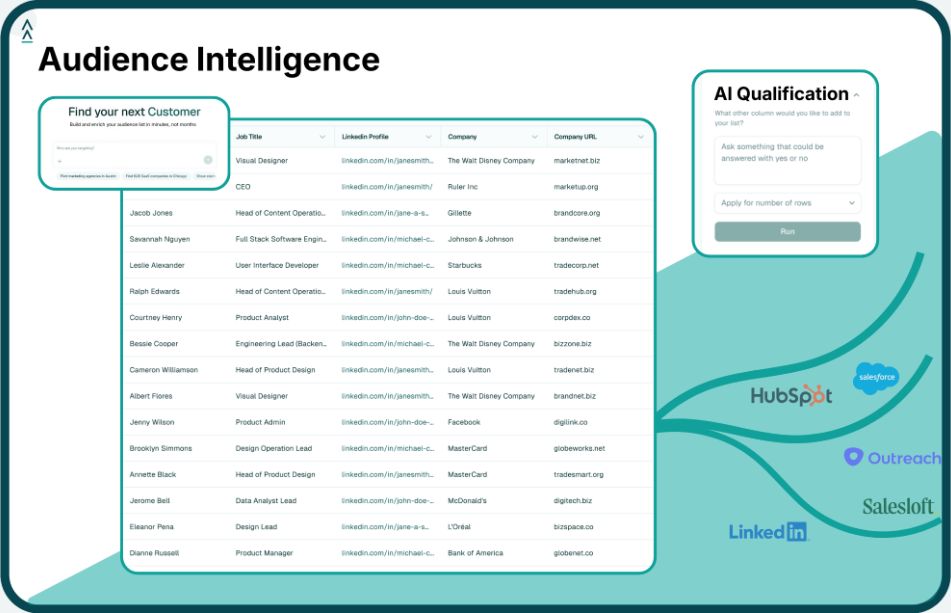
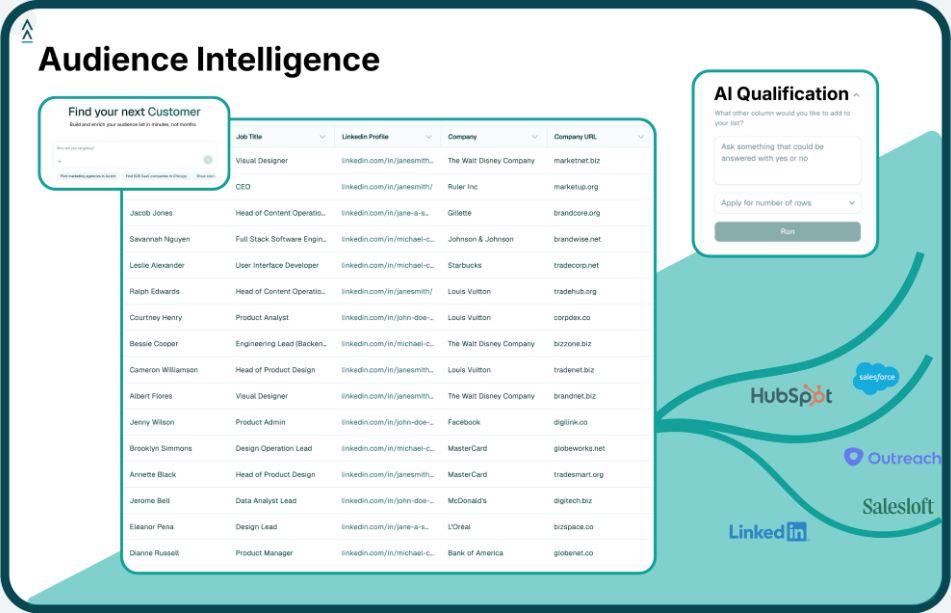
AI Qualification in B2B is an emerging approach to ensure every contact or account in your go-to-market database meets your ideal customer profile (ICP) criteria using artificial intelligence. Instead of manually scrubbing spreadsheets or relying on static database filters, AI Qualification automatically scores, cleans, and validates B2B data so that sales, marketing, and RevOps teams work with only high-quality, pipeline-ready leads. In simple terms, it’s like giving your list of prospects an AI-driven “yes/no” test – passing prospects match your ICP perfectly, and failing ones are filtered out or enriched until they do. This process keeps your data fresh and accurate, focusing your team on selling rather than hunting for information or chasing dead ends.
To understand AI Qualification in B2B, it helps to contrast it with traditional methods of lead qualification. Historically, go-to-market teams defined ICP filters (e.g. company size, industry, title) and then manually sifted through leads or purchased static lists. The problem is that B2B data doesn’t stay static – contacts change roles, companies pivot, information decays. AI Qualification brings automation and intelligence to this process. It uses AI models and rules you set to automatically verify if each contact or account fits your criteria. According to Landbase (a provider of AI Qualification solutions), it involves “binary qualification checks that score, clean, and validate B2B contacts/companies using Yes/No logic for pipeline-ready accuracy”. In practice, this means the AI looks at each data point (like a contact’s job title, company size, tech stack, etc.) and determines if it matches your target requirements. If any information is missing or unclear, the AI can even research and fill the gaps (more on that in the Online qualification section below). The result is a constantly up-to-date and vetted lead list without the need for endless manual data cleanup.
Importantly, AI Qualification is not the same as basic data enrichment. Traditional data enrichment simply appends additional fields to a contact (for example, adding a phone number or industry category from a database). AI Qualification goes a step further by actively checking the fitness of each contact against your criteria, using live data signals and even human-in-the-loop verification for accuracy. Think of enrichment as adding more data, whereas AI Qualification is about ensuring data correctness and relevance. For B2B teams, this distinction matters because having more fields is useless if half of your contacts are no longer valid or never met your ICP in the first place. AI Qualification guarantees that the leads entering your pipeline are ones your team actually wants, meeting your defined criteria and ready for outreach.
AI Qualification typically works in two modes – Offline AI Qualification and Online AI Qualification. Both modes serve to verify and enrich your data, but they operate differently:
Both offline and online AI Qualification work hand-in-hand. You set the qualification criteria (your ICP rules) in plain language and at scale. The platform then applies those rules offline as a first pass and uses online methods when deeper verification is needed. The outcome is a fully qualified list where every entry is checked. Finally, the system typically provides meta insights and analytics on the results: for example, highlighting common firmographic traits of your qualified segment or identifying patterns (perhaps “a majority of the qualified accounts use a certain tech stack”). These insights help you refine your targeting further and adjust your go-to-market strategy based on real data. In summary, AI Qualification works by combining fast database filtering with intelligent real-time research, so you never have to compromise between speed and accuracy.
For go-to-market teams in B2B – spanning sales, marketing, and RevOps – AI Qualification addresses some of the most pressing data problems that undermine revenue efforts. The cost of bad data alone is a massive concern. Studies have shown that poor data quality costs U.S. businesses about $3.1 trillion annually. On a company level, Gartner found organizations lose an average of $12.9 million per year due to bad data, through wasted marketing spend, missed opportunities, and operational inefficiencies. Bad data isn’t just a minor nuisance; it’s a silent killer of revenue. When your CRM is full of outdated or unqualified leads, your team ends up chasing ghosts – and the financial impact is huge.
One reason AI Qualification is so critical now is because B2B data decays at an alarming rate. In fact, B2B contact databases can decay at 22.5% up to 70.3% annually. Think about that – as much as two-thirds of your prospect data could become obsolete in a single year. (In one analysis, nearly 70% of leads went bad within 12 months.) This decay happens as people change jobs, companies get acquired, phone numbers and emails change, etc. Even email lists decay ~28% per year, with spikes of up to 3.6% in just one month in turbulent times. The net effect is that static data gets stale fast. If you’re relying on a one-time list purchase or doing quarterly data cleanups, you’re likely operating on incorrect information much of the time. That translates to sales reps calling wrong numbers, marketing emails bouncing, and targeting models missing the mark.
The human toll of bad data is evident in productivity metrics: sales teams waste about 27.3% of their time pursuing bad leads because of faulty contact info. That’s equivalent to 546 hours a year per rep spent on dead-end prospects. In dollar terms, it’s estimated companies lose $32,000 per sales rep per year in productivity due to bad data. For marketing, the waste is seen in campaigns that never reach the right audience – for example, one study found the average company wastes $180,000 annually on direct mail campaigns that never hit the intended recipient because of bad addresses. These inefficiencies pile up, hurting pipeline generation and morale. It’s demotivating for a rep to find out the big “hot lead” they spent days chasing was actually a bad record all along.
This is why AI Qualification matters. It directly tackles the data accuracy problem by ensuring only verified, up-to-date contacts enter your pipeline. By continuously cleaning and validating data, AI Qualification prevents that waste. Imagine recovering 500+ hours per rep that used to be lost – that’s time now available for selling to real prospects. No wonder that organizations with higher data quality report significantly better sales performance. Clean data can drive 20% higher campaign response rates and 15% higher win rates in sales within months. In fact, companies that unify and cleanse their databases see conversion rates improve by over 12% simply by removing bad data and duplicates. Those are substantial lifts in KPIs that any CMO or CRO would love to have. AI Qualification gives teams a systematic way to achieve those data quality gains (and the resulting revenue gains) at scale.
It’s also a matter of confidence. A staggering 94% of businesses suspect their customer and prospect data is inaccurate. That lack of trust in data cripples decision-making. GTM teams end up second-guessing leads, or they apply overly broad targeting to compensate for uncertainty, which then increases spammy outreach. By instituting AI-driven checks, teams restore confidence in their data. Marketing can personalize campaigns knowing the titles and industries are correct; sales can prioritize accounts knowing they truly fit the ICP. In a sense, AI Qualification is about enabling data-driven focus – focusing your resources on the right people at the right companies, at the right time, because your data can be trusted. Given tight budgets and the pressure to hit pipeline targets, this focus and efficiency can make the difference between hitting your quarter or missing it.
Bad data doesn’t just cost money in the abstract; it has direct consequences on revenue and pipeline health. Nearly 44% of companies report losing over 10% of annual revenue due to poor quality CRM data. That is a gigantic hole in revenue that often goes unnoticed until it’s quantified. The cost of bad data shows up in many ways – bounced sales emails, missed follow-ups on hot leads that were misrouted, or marketing dollars spent targeting contacts who aren’t even at their companies anymore. When you add it all up (as studies have), the losses are too big to ignore. This is where AI Qualification earns its keep. By systematically rooting out bad records and validating entries before they enter your campaigns, you plug these revenue leaks. It’s akin to fixing the cracks in a leaky pipeline – the same marketing spend and sales effort now yield more results because none of it is wasted on invalid targets.
On the flip side, the ROI of data quality improvements through AI Qualification is very clear. Clean data isn’t just a hygiene factor; it’s a competitive advantage. Companies that invested in continuous data quality have seen 20% better campaign response rates – that means more leads engaging with your emails or ads simply because you reached the right people with the right info. Better data also leads to more efficient sales cycles; organizations reported a 15% increase in close rates within six months after improving data quality via ongoing enrichment. These are real, measurable uplifts in revenue performance directly tied to having accurate data. There’s also evidence that integrating and cleaning data across systems boosts conversion rates by 12% or more, because prospects don’t slip through the cracks due to inconsistent or siloed information.
Beyond percentages, consider the qualitative ROI: higher rep productivity, improved marketing efficiency, and enhanced customer experience. When reps aren’t wasting time on bad contacts, they can spend more time on coaching, strategy, or personalized outreach to the right customers. When marketing has confidence in data, they can better tailor content and nurture flows, leading to higher engagement. One stat even notes that 40% of business objectives fail due to inaccurate data – implying that strategic initiatives (like entering a new market or upselling existing clients) often stumble because the underlying data was wrong. AI Qualification prevents such scenarios by acting as a safeguard before you execute on strategic campaigns. The ROI, therefore, is not just incremental lift in metrics, but also the protection of your strategic goals and brand reputation (imagine the cost of sending a personalized invite to a CEO… who left the company last year).
In summary, the cost of bad data is too high to tolerate, and the returns from high-quality data are too significant to ignore. AI Qualification pays for itself by cutting out the waste (time and money) from bad data and by boosting the effectiveness of every go-to-market action that follows.
The urgency of maintaining high-quality data has given rise to new enrichment trends in B2B, and these trends reinforce why AI Qualification is the way forward. One major shift is the move from periodic, manual data updates to continuous, real-time enrichment. In the past, companies might do a bulk data cleanse once a quarter or buy an updated list each year. But with decay rates hitting record levels (as mentioned, up to 3-4% of data degrading per month in some cases),, that approach just can’t keep up. The latest contact enrichment landscape reports a fundamental shift from periodic updates to continuous, real-time enrichment – meaning organizations are now trying to validate and update data on the fly, not on a fixed schedule. In fact, experts recommend proactive monitoring rather than periodic cleanup: implement real-time validation at data entry points and continuous enrichment to maintain quality in high-velocity environments.
AI Qualification is perfectly aligned with this trend. Because it automates the checking of criteria and leverages live data (online qualification) when needed, it essentially provides continuous enrichment and validation by default. Every time you run an AI Qualification process on a list – or even in real-time as new leads flow in – you’re ensuring the data is current. This continuous approach is rapidly becoming best practice. Another trend is the rising adoption of AI and machine learning for data quality management. Roughly 37% of organizations now use AI/ML to improve data quality, and those that do report about 30% accuracy improvement within the first year of implementation. This indicates a growing trust in AI-driven solutions (like AI Qualification) to solve data issues that were previously unsolvable at scale. Traditional methods simply can’t catch all the subtleties or keep pace with the data changes, whereas an AI can be monitoring and cross-verifying information 24/7.
We also see data providers and platforms expanding their data signals and sources, essentially to feed better enrichment. There’s an explosion of B2B data signals (tech stack info, hiring data, intent signals, etc.) and AI Qualification tools can harness these to qualify leads more intelligently. For example, if part of your ICP definition is “companies using CRM X or hiring for Y role,” modern AI-driven tools can tap into databases of technographic data or job postings to check those criteria automatically. The trend toward richer data profiles and intent data means AI Qualification has more to work with and can make more nuanced decisions about fit. Meanwhile, privacy and compliance trends (GDPR, CCPA, etc.) are also pushing teams to be more careful and targeted – blasting out emails to unvetted contacts isn’t just inefficient, it’s risky. AI Qualification helps here by ensuring your outreach lists are clean and permissioned, and by keeping records up-to-date so you can honor opt-outs and regional regulations (e.g., filtering out EU contacts if needed by a compliance rule).
All these trends point to one conclusion: keeping data static is no longer viable. B2B teams are investing in continuous processes, leveraging AI, and broadening data sources to stay competitive. AI Qualification sits at the intersection of these trends, offering a solution that inherently embodies continuous AI-driven data management. For go-to-market leaders, adopting AI Qualification isn’t a futuristic gamble – it’s quickly becoming a standard practice to deal with the present reality of data decay and the need for always-on enrichment.
Landbase – a go-to-market platform with an AI-driven focus – has a distinctive approach to AI Qualification that tackles common problems like static data and inefficient outreach head-on. At the core of Landbase’s solution is a combination of natural-language filtering, LLM reasoning, and “meta” insights that ensure your data remains both accurate and actionable.
In essence, Landbase’s approach to AI Qualification addresses static data by continuously updating and verifying information (so your data never goes stale) and fixes inefficient outreach by filtering out the noise, zooming in on the signals that matter, and even telling you why these leads are promising via meta insights. This means GTM teams can trust the data in front of them and execute faster. Reps don’t have to do their own research before every call – the critical details are already vetted. Marketers don’t have to guess which segment to prioritize – the AI has surfaced a list with known characteristics aligned to success. The end result is a significantly more efficient pipeline generation process: you spend time engaging real opportunities, not figuring out if a lead is real or relevant. With natural-language rules and AI doing the heavy lifting, qualification shifts from a tedious manual chore to an intelligent, automated step in your workflow.
The future of AI Qualification in B2B is bright because it hits a true pain point: the need for agile, high-quality data in an environment where change is the only constant. As data volumes explode and go-to-market teams seek every edge to meet their targets, AI-driven qualification is poised to become a standard operating procedure. We can expect even deeper integration of AI Qualification into CRM and marketing automation platforms, running quietly in the background to keep data clean in real-time. Moreover, with advancements in large language models and AI agents, the process will only get smarter – imagine AI systems that not only qualify leads but also proactively suggest new market segments (“lookalike” audiences) or alert you when a formerly qualified account falls out of criteria due to a news event (and perhaps suggest a re-engagement strategy). In short, AI Qualification will evolve from a one-step filter to an always-on advisor for GTM teams.
For now, forward-thinking organizations are already reaping the benefits: more accurate targeting, less waste, and higher conversion metrics as cited throughout this report. Embracing AI Qualification is becoming less of an option and more of an imperative for B2B success. It ensures your revenue engine runs on high-octane fuel (great data) rather than dirty oil (bad data). Teams that leverage it can do more with less – a crucial advantage in competitive markets. Those that ignore it risk falling behind as their databases silently decay and their outreach efficiency dwindles.
Tool and strategies modern teams need to help their companies grow.