April 25, 2026

Salesloft Pricing in 2026: Real Cost, Plans, and TCO

Salesloft's 2026 custom-quoted pricing runs $125–$165 per user per month before add-ons and annual increases. Discover how Landbase's agentic AI platform delivers end-to-end GTM automation at a predictable cost with 4–7x higher conversion rates.
  • Button with overlapping square icons and text 'Copy link'.
Table of Contents

Major Takeaways

How much does Salesloft actually cost in 2026?
Salesloft does not publish pricing publicly. All quotes are custom, with third-party estimates placing most buyers between $125 and $165 per user per month at list price, dropping to around $100–$130 after negotiation for mid-market deals. Add-ons, implementation, and annual auto-increases compound the real cost significantly over a multi-year term.
How does the Clari merger affect Salesloft's pricing and packaging?
The Clari and Salesloft merger closed on December 3, 2025, with Steve Cox appointed CEO of the combined company. New deals in 2026 increasingly bundle Salesloft with Clari's forecasting stack under a unified "Predictive Revenue System" story, adding cross-sell complexity to the buying conversation and expanding the total spend required for teams that want both platforms.
How does Landbase compare to Salesloft for modern GTM teams?
Landbase offers a fundamentally different approach: one AI-native platform combining 300M+ verified contacts, agentic qualification, and multi-channel outreach execution without stitching together separate data, engagement, dialer, and forecasting tools. Customers report 4–7x higher conversion rates, with documented outcomes including $400K MRR added by P2 Telecom and 33% more meetings booked by Digo Media without additional headcount.

Salesloft pricing in 2026 is private and custom-quoted, with most buyers landing between $125 and $165 per user per month depending on plan tier, seat count, and contract length, according to aggregated pricing data from procurement marketplace Vendr and ITQlick's 2026 pricing breakdown. Deals in the 25-to-75-seat band often settle into the $100–$130 per user per month range after negotiation, per Vendr's marketplace data. Following the Clari and Salesloft merger that closed on December 3, 2025, the newly combined company is selling under a unified "Predictive Revenue System" story, reshaping packaging, add-on bundling, and renewal economics across 2026.

This guide breaks down what Salesloft actually costs in 2026, how the Essentials, Advanced, and Premier plans compare, what additional line items to budget for, how costs scale from a 10-person team to a 200-seat rollout, and a full three-year total cost of ownership (TCO) example. It is written for RevOps, sales enablement, and procurement leaders evaluating sales engagement platforms under the post-merger Clari and Salesloft umbrella.

Key Takeaways

  • Salesloft does not publish pricing on its website. All quotes are custom, based on seat count, contract term, plan tier, and selected modules.
  • Third-party estimates place the three 2026 plan tiers at Essentials, Advanced, and Premier, with per-seat costs ranging from approximately $75 to $200+, depending on tier and volume, per Vendr and CloudTalk's 2026 plan guide.
  • Typical per-seat cost for mid-market buyers lands between $100 and $165 per user per month, depending on volume, term, and add-on bundling, per Vendr.
  • Add-ons are a meaningful budget line: the dialer runs approximately $300–$400 per user per year, and Conversations can add 20–40% to the platform base, per MarketBetter's 2026 pricing breakdown.
  • The Clari and Salesloft merger, which closed on December 3, 2025, is reshaping the buying conversation with cross-sell into Clari forecasting. The combined entity reports approximately $450 million in ARR and more than 5,000 customers, per Forrester and the official merger announcement.
  • Three-year TCO for a 50-seat organization typically lands between $220,000 and $400,000 once licenses, implementation, add-ons, and renewal uplift are factored in.
  • For teams rethinking their entire GTM stack, Landbase combines 300M+ verified contacts, AI qualification, and multi-channel outreach in one agentic platform, delivering 4–7x higher conversion rates without the complexity of layered point tools.

What Salesloft Sells in 2026

Salesloft is a sales engagement platform that helps outbound and full-cycle sellers execute multi-touch sequences, record and analyze conversations, manage deals, and forecast pipeline. The platform is organized around four core modules in 2026, with a fifth module (Rhythm) layered on top as a workflow orchestration layer.

  • Cadence is the original module: the multi-step sequence engine that coordinates email, calls, LinkedIn touches, and SMS into structured workflows. In G2's 4,000+ reviews, Cadence is consistently called out as the most widely used feature, with reviewers describing it as the backbone of their daily outbound motion.
  • Conversations is the call-recording and AI-analysis module. It transcribes calls, surfaces keywords (pricing mentions, competitor names, next steps), and delivers coaching feedback to reps and managers. Lemlist's 2026 review highlights Conversations' role in manager coaching workflows and rep ramp time.
  • Deals is the pipeline-management module, aimed at front-line sales managers who want a clearer view of what is in the pipeline than Salesforce opportunity views typically provide. G2 reviewers describe it as one of the stronger pipeline visualization tools in the category.
  • Forecast rounds out the platform with predictive revenue projections, historical accuracy tracking, and pipeline-to-quota views. Post-merger with Clari, Forecast is increasingly positioned as the entry point into Clari's deeper forecasting stack, per Forrester's merger analysis.
  • Rhythm is the AI-driven action orchestration layer launched in June 2023, surfacing recommended next actions to reps based on engagement signals across Cadence, Conversations, and Deals, per MarketBetter's 2026 review.

Why Salesloft Pricing Matters Now in 2026

Three forces make 2026 a particularly important year to understand Salesloft pricing carefully before signing or renewing.

First, the Clari merger is actively reshaping packaging. 

The Clari and Salesloft merger closed on December 3, 2025, with Steve Cox appointed CEO of the combined company. Together, the combined organization reports approximately $450 million in ARR and more than 5,000 customers across enterprise logos, including Adobe, IBM, 3M, Zoom, and Shopify, per Forrester and the official merger announcement. New deals in 2026 increasingly include cross-sell into Clari's forecasting stack, which changes the conversation from "engagement platform" to "unified revenue system."

Second, Vista Equity's ownership model prioritizes operational discipline and margin expansion. 

Vista Equity Partners made a strategic growth investment in Salesloft in December 2021, taking a majority stake at a $2.3 billion valuation. Vista's playbook typically tightens pricing discipline, expands upsell motions, and drives consistent renewal uplift, all of which show up in the contracting experience for buyers in 2026.

Third, Drift is being sunset, which changes the story for existing Drift customers. 

Clari and Salesloft announced a gradual sunset of Drift and an exclusive referral relationship to 1mind as its AI successor. Customers who originally bought Salesloft partly for Drift conversational AI now have to evaluate replacement paths, and pricing conversations have grown more complex as a result. For sales teams rethinking their outbound motion, the broader shift toward AI-native go-to-market automation is putting every engagement platform under renewed scrutiny.

Plan Breakdown: Essentials, Advanced, and Premier

Salesloft does not publish pricing on its website, and plan names and features have shifted over recent years. The breakdown below reflects what third-party marketplaces and review sites report for 2026.

Essentials

  • Estimated list: $75–$100 per user per month, billed annually, per MarketBetter.
  • Who it is for: Small sales teams focused on multi-touch cadences with basic reporting.
  • Included: Core Cadence module, email and call step sequencing, CRM sync for Salesforce and HubSpot, basic analytics, standard templates.

Essentials is the entry point for teams that primarily need structured outbound workflows. CloudTalk's plan guide notes that Essentials typically requires a 10-seat minimum in North America.

Advanced

  • Estimated list: $125–$150 per user per month, billed annually, per Vendr.
  • Who it is for: Mid-market sales teams that need call recording and conversation intelligence alongside cadences.
  • Included: Everything in Essentials, plus Conversations (recording, transcription, coaching), Rhythm AI recommendations, advanced analytics, and deeper CRM field sync.

Advanced is the most commonly sold tier in Vendr's marketplace dataset, reflecting that most teams want cadence plus conversation intelligence together.

Premier

  • Estimated list: $165–$200+ per user per month, billed annually, with list pricing 20–40% above Advanced, per MarketBetter.
  • Who it is for: Enterprise revenue teams running full sales engagement, deal management, and forecasting on one platform.
  • Included: Everything in Advanced, plus Deals pipeline management, Forecast predictive revenue, premium support tiers, and expanded API limits.

Premier is where Salesloft positions itself as a full revenue platform rather than a pure engagement tool, particularly post-Clari merger. Forrester's analysis notes that Premier deals are increasingly bundled with Clari-side modules for buyers looking at a unified forecasting story.

Cost by Team Size

Salesloft pricing is not strictly linear. Volume discounts, contract term, and bundled modules all affect the final per-seat number. The estimates below reflect typical Vendr-reported ranges for Advanced-tier deployments in 2026.

  • 10 users (small team): At the 10-seat minimum, most teams land at the top of the per-seat range, roughly $150–$165 per user per month on Advanced, translating to approximately $18,000–$19,800 annually, per Vendr.
  • 25 users (growing team): At 25 seats, volume discounts begin. Typical Advanced pricing lands at $130–$150 per user per month, or roughly $39,000–$45,000 annually. Multi-year terms can bring this down an additional 10–15%.
  • 50 users (mid-market): At 50 seats, Vendr's data shows most deals closing around $115–$135 per user per month on Advanced, or $69,000–$81,000 annually. Premier deployments at this size typically run 25–35% higher.
  • 100 users (upper mid-market): Vendr's marketplace aggregate shows Advanced deals commonly landing at $100–$125 per user per month, or $120,000–$150,000 annually.
  • 200+ users (enterprise): Advanced pricing often compresses to $90–$115 per user per month, or approximately $216,000–$276,000 annually for 200 users, per ITQlick's 2026 data. Premier at this size commonly exceeds $350,000 ACV, particularly when bundled with Clari forecasting.

Additional Costs to Plan For

Beyond the per-seat subscription, buyers should plan for several additional line items that commonly appear in Salesloft contracts.

  • Implementation and onboarding: Implementation fees may range from approximately $5,000 for basic onboarding to $25,000+ for enterprise implementations with custom workflows, CRM integrations, and data migration, per ITQlick. Onboarding is often a negotiable line item, particularly on larger deals.
  • Dialer add-on: The Salesloft dialer is typically sold as a separate add-on at approximately $300–$400 per user per year, per PricingNow's 2026 breakdown. Teams with heavy outbound call volume should factor this in early.
  • Conversations module: For teams on Essentials who want to add Conversations without upgrading fully to Advanced, Conversations can be licensed as an add-on. MarketBetter's pricing breakdown notes that Conversations alone can add 20–40% to the platform base, depending on seat count and usage.
  • Annual price increases: Many Salesloft contracts include automatic annual price increases in the 5–8% range, which compound over multi-year terms, per PricingNow. Buyers can negotiate capped uplift clauses on larger deals.
  • Mid-term seat additions: Salesloft contracts typically lock in a committed seat count. Adding users mid-term often triggers pro-rated charges at the contracted per-seat rate, without the volume discount that would apply if those seats had been part of the original deal, per MarketBetter.

Total Cost of Ownership: A 3-Year Worked Example

To make the economics tangible, here is an illustrative three-year TCO model for a 50-seat mid-market organization standardizing on Salesloft Advanced with the Conversations module and dialer, entering a three-year contract in 2026. Actual figures vary based on negotiated rates, implementation scope, and seat growth.

  • Year 1: Licenses (50 seats x $130/user/month x 12 months) = $78,000. Dialer add-on (50 seats x $350/year) = $17,500. Implementation = $15,000. Internal time (RevOps, enablement, IT) = approximately $25,000. Year 1 total: approximately $135,500.
  • Year 2: Licenses with 6% illustrative uplift (50 seats x $138/user/month x 12 months) = $82,800. Dialer = $17,500. Seat additions (10 seats mid-year) = $7,800. Internal time = $15,000. Year 2 total: approximately $123,100.
  • Year 3: Licenses (60 seats x $146/user/month x 12 months) = $105,120. Dialer (60 seats x $350) = $21,000. Internal time = $15,000. Year 3 total: approximately $141,120.

Three-year TCO total: 

Approximately $399,720 across licenses, add-ons, implementation, and internal time. License-only TCO lands around $344,720. Leaner implementations without seat growth can model closer to $220,000–$260,000 over three years. Enterprise deployments with Premier, Clari bundling, and full services commonly exceed $600,000 over three years. Auto-uplift, add-ons, seat growth, and internal time materially change real cost over a multi-year contract.

How to Get the Best Deal on Salesloft

Salesloft pricing is negotiable, and buyers who prepare well can regularly achieve 15–25% below list. Several tactics consistently work in 2026.

  • Commit to multi-year terms. Three-year terms typically unlock the steepest discounts, in the 15–25% below the annual-list range, per Vendr.
  • Run a competitive evaluation. Bringing a second platform into the evaluation materially changes the discount math. Sales engagement is a competitive category, and G2's category data shows multiple credible alternatives buyers can use as negotiation leverage.
  • Bundle add-ons at the start. Buying the dialer, Conversations, and any Clari bundling upfront as a package typically lowers the effective per-user rate more than layering them in over time.
  • Negotiate the auto-uplift cap. The default annual auto-uplift is negotiable. Pushing for a capped uplift or a CPI-linked uplift can save significant money over a three-year term.
  • Ask for onboarding waivers or credits. On larger deals (50+ seats), waiving or heavily discounting implementation fees is a standard give. Buyers rarely need to pay the full list price on onboarding when the underlying ACV is meaningful.
  • Time for the negotiation to quarter end. Like most enterprise SaaS sales teams, Salesloft sellers have quarterly quotas. Quarter-end negotiations typically yield better discounts, per Vendr's negotiation guidance.

Salesloft Alternatives for AI-Native GTM Teams

Traditional sales engagement platforms address sequence execution but still require separate tools for list building, intent data, enrichment, and forecasting. The comparison below highlights where Salesloft sits relative to other platforms in the market.

Landbase — Agentic AI Go-to-Market Platform

What They Do: Landbase is an AI-native GTM platform that automates the end-to-end work of targeting, qualifying, and engaging accounts through agentic, multi-agent workflows. The platform combines a 300M+ verified B2B contact database, 1,500+ enrichment and signal fields, AI qualification, and multi-channel outreach execution in a single system, eliminating the need to stitch together separate prospecting, sequencing, and analytics tools.

Why They're Important: Landbase is the only platform that takes a team from a natural-language prompt to a verified, scored account list to a launched multi-channel campaign without switching tools. GTM-2 Omni, trained on 40M+ B2B campaigns and 175M+ sales conversations, continuously qualifies and prioritizes accounts across the full TAM. Customers report 4–7x higher conversion rates, with outcomes including $400K MRR added by P2 Telecom and 33% more meetings booked by Digo Media without additional headcount. Gartner recognized Landbase as a Cool Vendor 2025 in AI-driven GTM automation.

Key Stats / Metrics: 

  • 300M+ verified B2B contacts
  • 24M+ companies with 1,500+ enrichment fields
  • 97%+ database deliverability
  • $30M Series A raised in January 2026

Leadership: CEO: Daniel Saks (co-founder, formerly co-CEO of AppDirect, Forbes 30 Under 30).

Founded: 2020

Recent Funding: Series A: $30M (January 2026) Investors: Picus Capital, 8VC, Sound Ventures

Apollo.io — AI-Powered Sales Intelligence and Engagement Platform

What They Do: Apollo.io provides an AI-powered platform combining sales intelligence, prospecting, and engagement capabilities in a single solution. The platform offers a large B2B contact database with AI-driven insights for identifying and engaging ideal prospects across multiple channels.

Why They're Important: Apollo.io offers an all-in-one platform combining prospecting, outreach, and analytics, making it a widely used option for teams seeking a consolidated engagement and data tool. The platform provides integrations with 50+ tools and a freemium entry point accessible to smaller teams.

Key Stats / Metrics: 

  • 50+ tool integrations Freemium model with paid plans starting at $49/user/month

Leadership: CEO: Tim Zheng 

Founded: 2015

Recent Funding: Series D: $100M (August 2023) Valuation: $1.6B

ZoomInfo — Enterprise Sales Intelligence Platform

What They Do: ZoomInfo provides deep enterprise intelligence with advanced features, including org charts, technographics, and buying signals. The platform specializes in comprehensive B2B data for large sales organizations with complex targeting requirements.

Why They're Important: ZoomInfo offers extensive enterprise intelligence with 321 million professional contacts and an integration ecosystem of 100+ tools. The platform excels at detailed company hierarchies and decision-maker mapping, making it well-suited for enterprise teams pursuing complex, multi-stakeholder deals.

Key Stats / Metrics: 

  • 321 million professional contacts
  • 100+ tool integrations
  • Annual pricing: $15K–$40K+

Leadership: CEO: Henry Schuck 

Founded: 2000

Recent Funding: Public company (NASDAQ: ZI) IPO: June 2020

How Landbase Redefines the GTM Stack

For go-to-market teams rethinking their outbound motion from the ground up, Landbase was purpose-built to address the core gap that sales engagement platforms leave unfilled: the intelligence, qualification, and activation work that happens before a sequence ever starts.

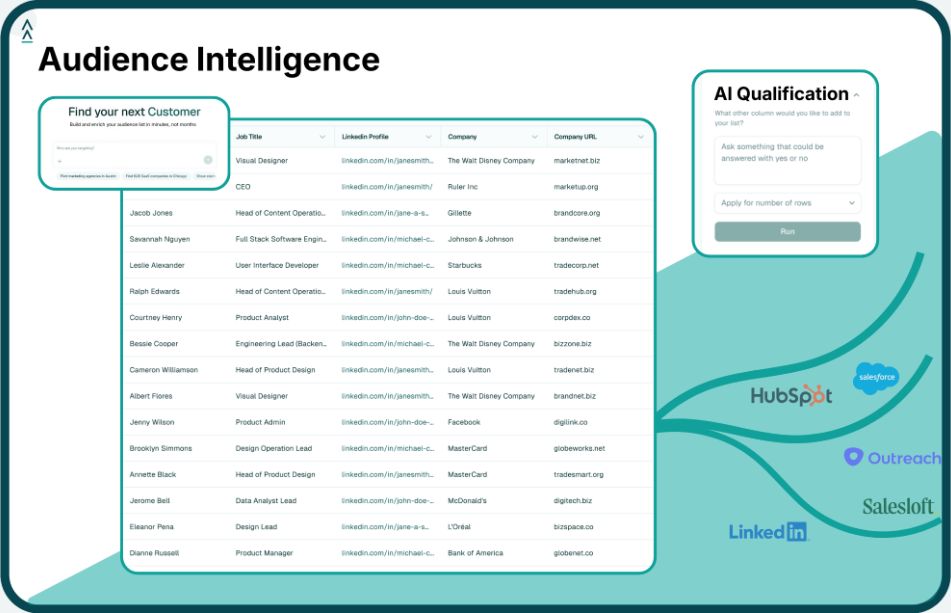
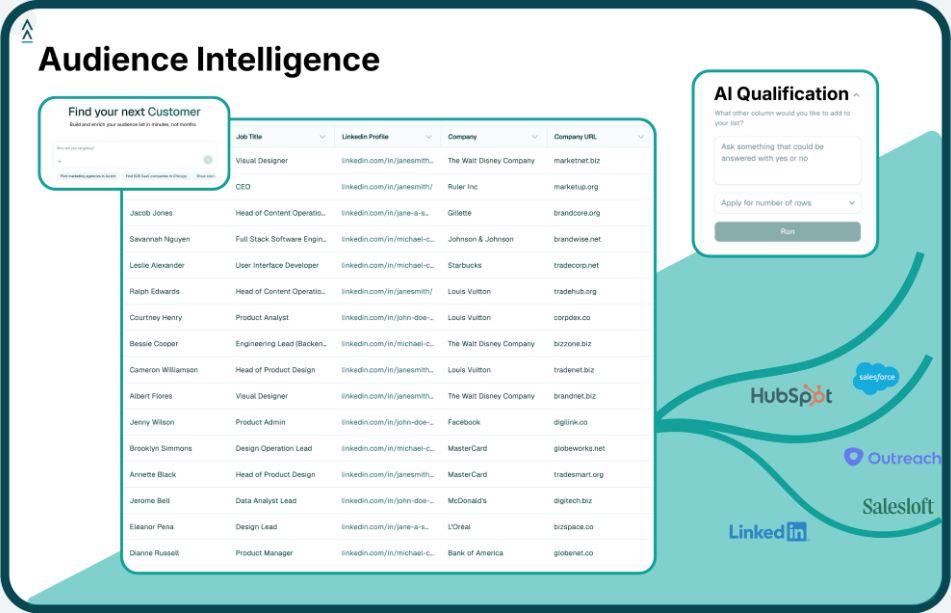
With Landbase, teams describe their ideal customer in plain English and receive a verified, AI-qualified audience list enriched across 1,500+ signal fields, ready for CRM sync and immediate campaign activation. The GTM-2 Omni agentic AI, trained on 40M+ B2B campaigns, handles targeting, scoring, enrichment, and multi-channel outreach coordination autonomously, reducing manual research effort by approximately 80%.

Unlike Salesloft's per-seat model layered on top of separate data and intent tools, Landbase consolidates the entire stack into one flat-rate platform with unlimited users, predictable costs, and no credit management. The result is a system where machines handle the repetitive work so revenue teams can focus on building relationships and closing deals. See how Landbase works.

Frequently Asked Questions

How much does Salesloft cost per user in 2026?

Salesloft typically costs between $125 and $165 per user per month on list in 2026, with most mid-market buyers landing at $100–$130 per user per month after negotiation, per Vendr and ITQlick. Actual pricing depends on plan tier (Essentials, Advanced, Premier), seat count, and contract length. Add-ons such as the dialer and Conversations module can meaningfully increase the total per-seat cost beyond the base subscription. Teams should model the full three-year TCO rather than relying on headline per-seat figures when evaluating the platform.

Does Salesloft publish its pricing publicly?

No. Salesloft does not publish pricing on its pricing page or any customer-facing site. All quotes are custom, requiring buyers to engage sales directly. Third-party marketplaces like Vendr and G2 aggregate buyer-reported pricing for reference, though actual quotes vary widely based on segment, bundling, and contract terms. Buyers should treat any published range as a general benchmark and verify directly with Salesloft during the sales cycle.

What are the Salesloft plans in 2026?

Third-party sources report three tiers for 2026: Essentials, Advanced, and Premier. Essentials focuses on core Cadence workflows for smaller teams; Advanced adds Conversations and Rhythm AI recommendations for mid-market organizations; Premier adds Deals pipeline management and Forecast predictive revenue for enterprise buyers, per CloudTalk's 2026 plan guide. Plan names and packaging are quote-based and may vary by deal. Buyers should confirm current tier names and inclusions directly with Salesloft during their evaluation.

How did the Clari merger affect Salesloft pricing?

The Clari and Salesloft merger closed on December 3, 2025, creating a combined company with approximately $450 million in ARR, per Forrester. Post-merger packaging increasingly bundles Salesloft Premier with Clari forecasting capabilities, and new-deal conversations often include cross-sell into the unified platform. Buyers evaluating Salesloft in 2026 should clarify upfront whether their quote includes Clari modules and how future cross-sell pricing will be structured at renewal.

How does Landbase compare to Salesloft for outbound teams?

Landbase takes a fundamentally different approach to the GTM stack. Rather than providing a sequence execution layer that teams must feed with separately purchased data, intent signals, and enrichment tools, Landbase combines all of these into a single agentic platform. Teams start with a natural-language prompt, receive a verified and AI-qualified audience, and launch multi-channel outreach without switching tools or managing per-seat credits. Customers report 4–7x higher conversion rates, making Landbase the stronger choice for teams that want end-to-end automation rather than another point tool in a crowded stack.

Build a GTM-ready audience

  • Button with overlapping square icons and text 'Copy link'.

Turn this list into a GTM-ready audience

Match this list to your ICP, prioritize accounts, and identify who to contact using live growth signals.

Stop managing tools. 
Start driving results.

See Agentic GTM in action.
Get started
Our blog

Lastest blog posts

Tool and strategies modern teams need to help their companies grow.

Empler's 2026 pricing starts at $19/month for Pro and $499/month for Business, with a credit-based consumption layer on top. See how Landbase's agentic AI platform delivers end-to-end GTM automation with 300M+ verified contacts and 4–7x higher conversion rates.

Daniel Saks
Chief Executive Officer

Salesloft's 2026 custom-quoted pricing runs $125–$165 per user per month before add-ons and annual increases. Discover how Landbase's agentic AI platform delivers end-to-end GTM automation at a predictable cost with 4–7x higher conversion rates.

Daniel Saks
Chief Executive Officer

Smartlead's 2026 plans start at $39/month and scale to $379/month, but real costs climb significantly once mailboxes, domains, and verification are factored in. Discover how Landbase delivers AI-native GTM automation with built-in data, qualification, and multi-channel outreach in one predictable platform.

Daniel Saks
Chief Executive Officer

How GTM teams turn this list into pipeline

See how GTM teams use fastest-growing lists to define TAM, prioritize accounts, and launch campaigns.