.png)
.png)

Daniel Saks
Chief Executive Officer


Empler pricing starts at $19/month for the Pro plan and $499/month for the Business plan, with custom Enterprise pricing for organizations needing 200,000+ monthly credits, according to Empler's official pricing page. All paid plans include unlimited users and unlimited automation creation, with a credit-based consumption layer for LLM, agent, and integration usage on top of the base subscription fee. Note that third-party directories such as GetApp and Capterra list a different tier structure ($99, $399, $1,499/month) that differs from Empler's current pricing page. Treat the Empler.ai pricing page as the authoritative source when budgeting.
For go-to-market, sales ops, and RevOps buyers evaluating multi-agent automation platforms in 2026, understanding how Empler's hybrid pricing works, subscription plus credits, is essential. Token burn varies across LLM models and workflow complexity, and integration credits behave differently from LLM credits. This guide breaks down every Empler plan, maps costs to team size, explains the credit economics, walks through a three-year TCO worked example, and covers negotiation levers for Pro, Business, and Enterprise contracts.
Empler is a no-code agentic AI automation platform built on a multi-agent framework that lets specialized AI agents collaborate on go-to-market, marketing, and sales tasks. The platform's core premise is that a team of purpose-built agents, a prospect-finder, an enricher, a researcher, and an outreach writer handles complex, multi-step GTM workflows.
The product includes four primary capability layers:
Empler's G2 profile highlights Pipedrive integration and fast productivity gains among early adopters, with reviewers noting the support team is responsive and invested in customer outcomes.
Three 2026 dynamics make Empler's cost structure worth understanding carefully before purchasing.
Platforms historically sold per seat are migrating to hybrid models that layer usage-based credits on top of subscription fees. Token-based billing can introduce month-to-month variability, especially when teams adopt models that carry higher per-token costs. Empler's hybrid model reflects where the category is heading.
Finance teams are asking harder questions about AI software ROI in 2026. Credit-based models require more upfront planning because consumption is harder to forecast than flat per-seat pricing.
The no-code agentic GTM category includes multiple platforms with different pricing architectures. Understanding Empler's exact cost model is necessary before comparing it to peers on a true total-cost basis.
Empler publishes three paid tiers on its official pricing page: Pro, Business, and Enterprise. Below is what each plan covers, who it is built for, and where the cost sensitivity lies.
The Pro plan is positioned for individual operators, founders, and small GTM teams experimenting with agentic automation. At $19/month, it is the lowest-friction entry point to the platform.
Pro is designed for solo users and small teams, validating workflows before scaling. The 1,000-credit floor is modest; a single multi-step enrichment run using a frontier LLM can consume several hundred credits depending on token volume, so teams that move past experimentation typically upgrade.
The Business plan is Empler's core GTM team tier. At $499/month, it steps up credit allocation and task ceilings significantly over Pro.
Business is sized for sales-ops, RevOps, and GTM teams running production workloads weekly, ICP enrichment, daily prospect refreshes, competitor monitoring agents, and outbound content generation at volume. Teams evaluating businesses should project credit burn against their expected workflow volume before committing.
The Enterprise plan is quote-based, with a starting floor of 200,000 credits per month and task ceilings that can scale to unlimited depending on the contract.
Enterprise is built for organizations standardizing on Empler across multiple GTM and marketing teams, or for those with security, compliance, or private-integration requirements. As a general procurement benchmark, Vendr's marketplace data shows enterprise AI tools typically land between $50,000 and $250,000 in annual contract value for mid-market deployments.
Several third-party directories still reference a different Empler pricing architecture. GetApp lists an Explorer tier at $99/month, a Superior tier at $399/month, and an Ultimate tier at $1,499/month. Capterra shows a similar structure. Buyers should treat the Empler.ai pricing page as canonical when budgeting, as it reflects the current Pro/Business/Enterprise tier structure.
Empler's subscription-plus-credits model means cost scales along two axes: subscription tier and workload volume. Below are directional planning figures for common team configurations on the Business plan, which is the typical fit for GTM teams running production workloads. Confirm final credit allocation and pricing in your quote, as Empler's pricing page indicates unlimited users and does not specify per-seat billing.
Credit burn varies materially with workflow design and model choice. Directional benchmarks based on typical GTM agent workloads:
Teams running all four workloads weekly can exhaust a Business plan's 25,000-credit floor quickly and should model credit top-ups or an Enterprise contract before signing.
Beyond the base subscription, several additional cost categories deserve budget lines.
The following is an illustrative three-year TCO model for a mid-market GTM team on the Business plan running weekly enrichment, daily competitor monitoring, and monthly outbound content generation. Actual figures will vary based on team size, credit burn, negotiated rates, and external data needs. Teams should run a 30-day pilot to validate these assumptions against real usage before committing to a contract.
For a small team on a single Business subscription with moderate credit usage and no external data feeds, three-year costs may range from approximately $80,000 to $130,000 inclusive of subscription, overage, and internal time. For a larger team with external data dependencies and higher credit burn, three-year costs can increase substantially. Teams should model their specific workflow volume and confirm overage pricing directly with Empler before committing.
Several negotiation and procurement levers are available to buyers evaluating Empler, particularly on Business and Enterprise contracts.
Teams evaluating agentic GTM platforms in 2026 have a range of options with different pricing architectures and capability sets. The comparison below covers the primary alternatives buyers consider alongside Empler.
What They Do: Landbase is an AI-native GTM platform that automates the end-to-end work of targeting, qualifying, and engaging accounts through agentic, multi-agent workflows. The platform combines a 300M+ verified B2B contact database, 1,500+ enrichment and signal fields, AI qualification, and multi-channel outreach execution in a single system, eliminating the need to assemble multi-tool stacks or manage credit-based consumption models.
Why They're Important: Landbase is the only platform that takes a team from a natural-language prompt to a verified, scored account list to a launched multi-channel campaign without switching tools. GTM-2 Omni, trained on 40M+ B2B campaigns and 175M+ sales conversations, continuously qualifies and prioritizes accounts across the full TAM. Customers report 4–7x higher conversion rates, with outcomes including $400K MRR added by P2 Telecom and 33% more meetings booked by Digo Media without additional headcount. Gartner recognized Landbase as a Cool Vendor 2025 in AI-driven GTM automation.
Key Stats / Metrics:
Leadership: CEO: Daniel Saks (co-founder, formerly co-CEO of AppDirect, Forbes 30 Under 30)
Founded: 2020
Recent Funding: Series A: $30M (January 2026) Investors: Picus Capital, 8VC, Sound Ventures
What They Do: Persana AI provides an AI-powered prospecting and enrichment platform that helps GTM teams build targeted contact lists, automate data enrichment, and trigger outreach based on buying signals. The platform connects to multiple data providers and automates multi-step prospecting workflows.
Why They're Important: Persana AI offers a waterfall enrichment approach that pulls from multiple data sources to improve contact coverage and accuracy. The platform's signal-based triggering lets teams prioritize accounts showing real-time buying intent, making it a useful option for teams looking to automate prospecting research steps.
Key Stats / Metrics:
Leadership: CEO: Sriya Maram
Founded: 2023
What They Do: Clay provides a data enrichment and workflow automation platform that aggregates data from 75+ providers and uses AI to research prospects, build lists, and personalize outreach at scale. The platform uses a credit-based pricing model for data enrichment calls.
Why They're Important: Clay is widely used by RevOps and growth teams for its breadth of data integrations and flexibility in building custom enrichment workflows. The platform supports a wide range of use cases from simple list building to complex multi-step research automations, with pricing starting at a free tier and scaling to custom enterprise contracts.
Key Stats / Metrics:
Leadership: CEO: Kareem Amin
Founded: 2021
For go-to-market teams rethinking their outbound motion from the ground up, Landbase was purpose-built to address the core gap that multi-agent workflow builders leave unfilled: the intelligence, qualification, and activation work that typically requires assembling separate tools and managing ongoing credit consumption.
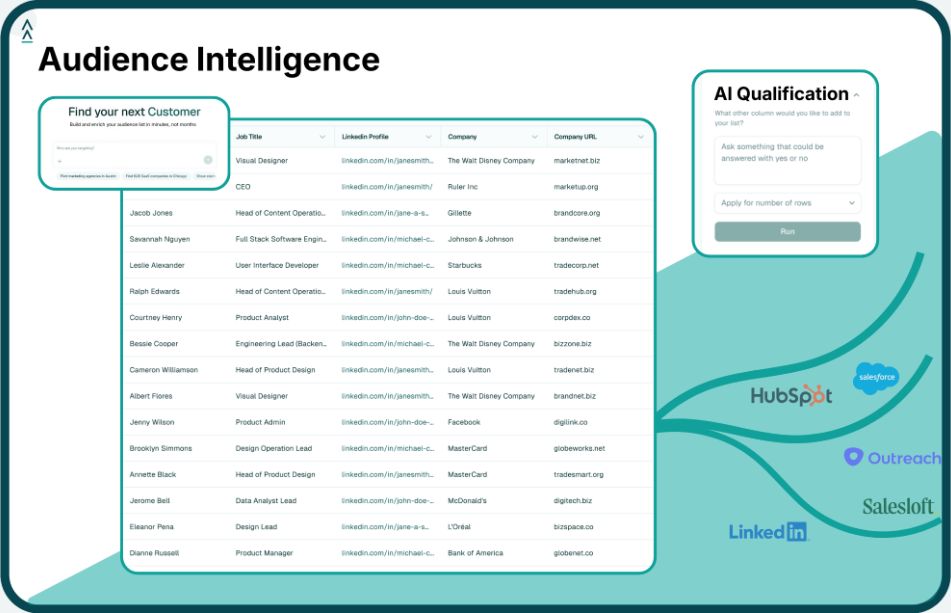
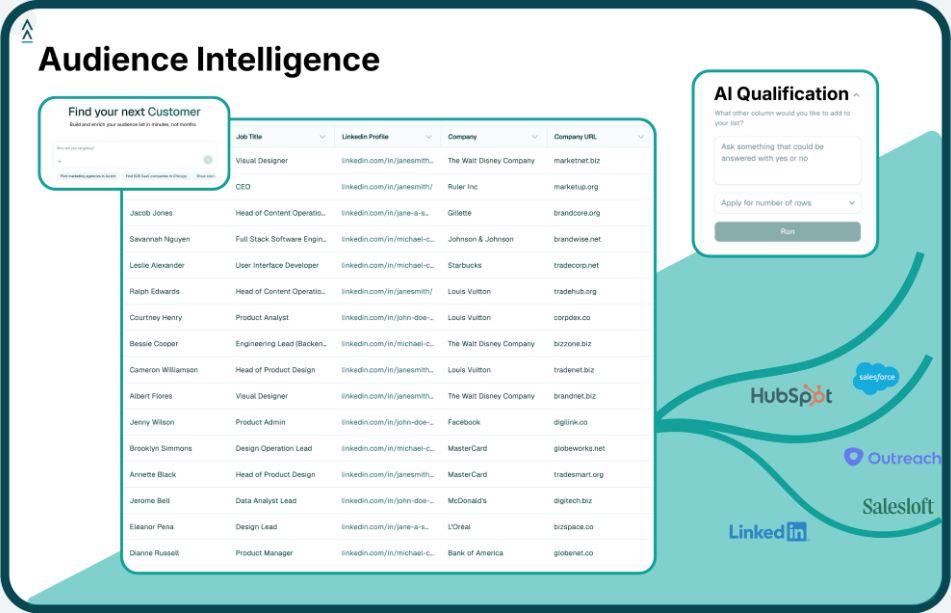
With Landbase, teams describe their ideal customer in plain English and receive a verified, AI-qualified audience list enriched across 1,500+ signal fields, ready for CRM sync and immediate campaign activation. The GTM-2 Omni agentic AI, trained on 40M+ B2B campaigns, handles targeting, scoring, enrichment, and multi-channel outreach coordination autonomously reducing manual research effort by approximately 80%.
Rather than requiring teams to design, test, and maintain agent workflows while forecasting credit consumption, Landbase consolidates the entire GTM stack into one platform with predictable costs and no credit management overhead. The result is a system where machines handle the repetitive work so revenue teams can focus on building relationships and closing deals. See how Landbase works.
Empler Pro starts at $19/month, Business starts at $499/month, and Enterprise pricing is custom-quoted. All plans include unlimited users, so the base subscription is not a per-seat cost. The real variable is credit consumption LLM and agent credits are token-based, meaning total cost scales with model choice and workflow volume on top of the base fee. Teams should run a pilot to measure actual credit burn before committing to a plan.
Yes. Empler offers a free trial and a basic free tier that lets teams build and test automations before upgrading to a paid plan, per GetApp and Empler's official pricing page. The free trial allows teams to validate whether Empler's agent framework fits their specific GTM workflows before purchasing. Confirm the scope and duration of the free trial directly with Empler, as terms may vary.
Credits fund LLM and agent usage on a token-based model, cost scales with model choice, input length, and output length, and integration usage on a fixed per-call basis. Each paid plan includes a monthly credit floor, and teams can purchase top-ups or upgrade plans to add capacity. Because credit burn varies significantly by workflow type and model choice, teams should run a 30-day pilot with representative workloads before finalizing their plan.
Both plans include unlimited users, unlimited workflow creation, full access to the AI agent library, the LLM model library, and all integrations. The differences are throughput: Business includes 25,000 monthly credits (vs 1,000 on Pro), up to 100,000 task completions (vs 5,000), and priority support. Teams running production GTM workloads at volume will typically need the Business plan's higher credit floor to avoid frequent overage charges.
Empler does not publish annual or multi-year discount terms, but multi-year commitments on Enterprise contracts typically yield meaningful annual savings consistent with standard SaaS procurement benchmarks, per Vendr's marketplace data. Capping annual renewal uplift at 3–5% is a standard negotiation point on larger deals. Buyers should ask about multi-year pricing and overage rate locks during the Enterprise evaluation process.
Pro (starting at $19/month) is designed for solo operators and small teams with 1,000 monthly credits and 5,000 task completions. Enterprise is custom-priced, starts at 200,000 monthly credits, and includes dedicated account management, onboarding calls, paid proof-of-concept, and private integration development. Enterprise is suited to organizations standardizing on Empler across multiple GTM teams or those with specific security and compliance requirements.
Third-party directories like GetApp and Capterra still reference an Explorer/Superior/Ultimate structure at those price points. Empler's current official pricing page lists Pro/Business/Enterprise instead. Treat the Empler.ai page as the authoritative source when budgeting and confirm current packaging directly with Empler during your evaluation.
Run a 30-day pilot with representative workflows, log credit consumption by workflow type, and multiply expected monthly workflow volume by observed credits per run. Build in a 25–50% buffer for production variability, consistent with general credit-based SaaS planning guidance. Confirm overage pricing with Empler before signing so you understand the cost of exceeding your plan's monthly floor.
Empler includes access to its integration library in every paid plan, but integration usage consumes credits at fixed per-call rates. Teams running high-volume integration workflows should project integration credit burn alongside LLM credit burn when sizing plans. The fixed-per-call structure makes integration credits more predictable than token-based LLM credits, which can help with budget planning.
Tool and strategies modern teams need to help their companies grow.