.png)
.png)

Daniel Saks
Chief Executive Officer


Every CRO has the same Monday morning ritual. Open the forecast. Compare it to last week. Try to figure out which deals are real and which are wishful thinking. The answer is almost always worse than expected.
According to Gartner research on sales forecasting, fewer than 25% of sales organizations have forecast accuracy above 75%. The average B2B forecast misses by 25-40%. That gap is not a rounding error. It is the difference between hitting plan and missing payroll.
The forecasting model gets all the attention. Weighted pipeline, AI-assisted, bottoms-up, tops-down. But the data feeding the model determines the output. Bad data in, bad forecast out.
Here is how most B2B forecasting works in practice:
Every step in this chain is subjective. The close date is aspirational. The deal stage is self-assessed. The amount is a guess. And the CRM record underneath is probably missing half the fields that would tell you whether this deal is real.
According to CRM data hygiene research, 76% of CRM entries are less than half complete. If the industry field is blank, you cannot benchmark the deal against industry win rates. If the decision-maker contact is missing, you do not know whether the rep has access to the buyer. If the technology stack is unknown, you cannot confirm product fit.
The forecast inherits every data gap in the CRM. Garbage in, garbage out applies to forecasting more than almost any other RevOps function.
Research shows that objective signals predict deal outcomes far more reliably than rep-reported confidence levels. The signals that matter:
Deals with 3+ contacts engaged close at significantly higher rates than single-threaded deals. If your CRM only has one contact on an opportunity, the forecast should discount that deal regardless of what the rep says about it.
Accounts showing verified buying signals (hiring for roles your product supports, recent funding, technology migrations, competitive evaluations) close at 2-3x the rate of accounts without signals. If the opportunity record has no attached signals, the deal is speculative.
Deals where the last meaningful buyer interaction was more than 14 days ago are at risk regardless of deal stage. Stale deals should be auto-flagged and discounted in the forecast.
Opportunities with complete records (industry, company size, decision-maker identified, use case documented) close at higher rates than deals with sparse records. Completeness itself is a signal: reps invest time in deals they believe are real.
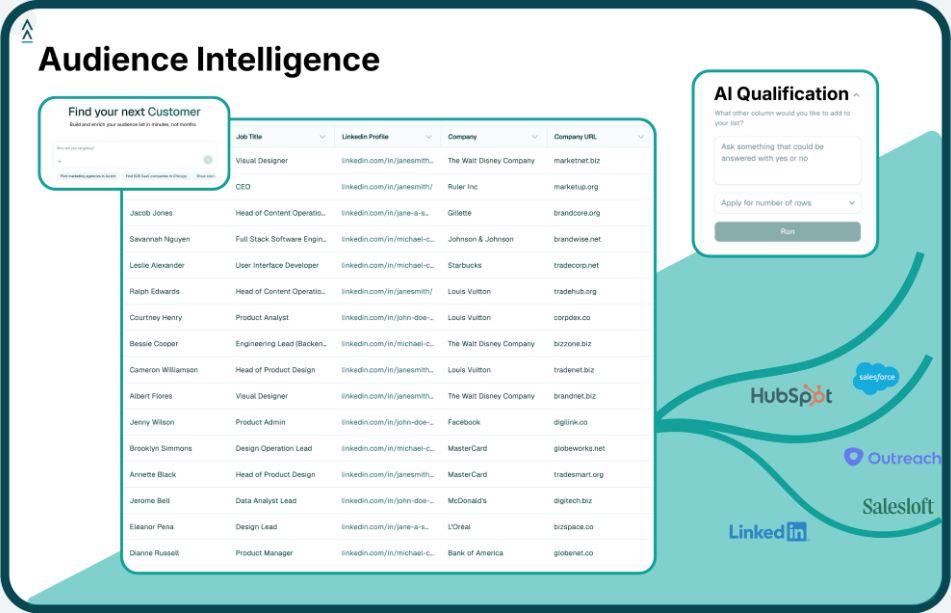
Attach firmographic, technographic, and signal data to every deal in your pipeline. Landbase delivers accounts enriched with 1,500+ data fields, including hiring signals, funding events, technology stack, and engagement indicators. When every opportunity has complete data, you can score deals objectively instead of relying on rep confidence alone.
Replace deal-stage weighting with signal-based weighting. A deal in "Negotiation" stage with no buying signals and one contact should get less weight than a deal in "Discovery" with three contacts, a recent funding event, and a technology migration signal.
Apply a data completeness multiplier to each opportunity. If the record is missing industry, decision-maker, or use case fields, apply a 0.5x multiplier to the deal value in the forecast. This creates an incentive for reps to fill in data and gives RevOps a more conservative, accurate number.
Measure accuracy by deal size, source (inbound vs outbound), industry, and rep. You will find that certain segments forecast well and others do not. Focus data quality improvements on the segments with the worst accuracy.
Ground your pipeline reviews in data. For each at-risk deal, review: last buyer interaction date, number of contacts engaged, attached buying signals, and data completeness score. These data points surface deal risk earlier and more reliably than any narrative update. For more on which RevOps KPIs to track on your dashboard, see our full breakdown.
Inaccurate forecasts cost more than missed board expectations. The downstream effects include:
For a $20M ARR company, a 30% forecast miss means $6M in revenue surprise either direction. That is enough to change hiring plans, delay product investments, or trigger a down round.
Within 10% of actual closed revenue, measured quarterly. Top-performing sales organizations achieve 85-90% accuracy. Getting from 60% to 80% accuracy is primarily a data quality exercise. Getting from 80% to 90% requires process discipline on top of clean data.
AI forecasting models outperform human judgment when they have complete data to work with. If your CRM data is less than 80% complete, the AI forecast will be unreliable because it is learning from incomplete inputs. According to Harvard Business Review research on AI in sales, companies that combine AI forecasting with enriched data see the largest accuracy gains. Clean up the data layer first, then apply AI on top.
Weekly for operational planning. Daily for end-of-quarter management. Monthly for strategic planning and board reporting. Real-time data enrichment means the underlying signals update continuously, which keeps the forecast current between formal reviews.
Enrich your pipeline data. Attaching verified firmographic, technographic, and buying signal data to every open opportunity gives you objective indicators that supplement rep-reported deal stages. Most teams see a 20-30% improvement in forecast accuracy within one quarter of implementing systematic pipeline enrichment.

Tool and strategies modern teams need to help their companies grow.






