.png)
.png)

Daniel Saks
Chief Executive Officer


The CMO wants to know which channels drive revenue. The CRO wants to know which campaigns generate pipeline. The CEO wants to know where to invest next quarter's budget. Everyone looks at the attribution data and sees a different story because everyone is using a different model, different data, or different definitions.
Revenue attribution in B2B is genuinely hard. According to Gartner research on marketing attribution, fewer than 30% of B2B marketers are confident in their attribution accuracy. Unlike e-commerce where a single person clicks an ad and buys in one session, B2B deals involve multiple stakeholders, months of evaluation, and dozens of touchpoints across channels. Attributing revenue to any single touchpoint is inherently reductive. But doing no attribution at all means making million-dollar budget decisions on gut feeling.
The right approach is choosing a model that fits your GTM motion, implementing it with clean data, and accepting that directional accuracy is the best you will get.
100% of revenue credit goes to the first interaction. If a prospect first found you through a Google ad, the Google ad gets full credit for the deal.
Best for: Understanding which channels generate awareness and fill the top of funnel.
Weakness: Ignores everything that happened after the first touch. A prospect might find you through an ad but only buy after attending a webinar, reading three blog posts, and getting a referral from a peer.
100% of revenue credit goes to the last interaction before the deal closed. If the final touchpoint was a demo request, the demo request page gets full credit.
Best for: Understanding which actions directly precede conversion. Useful for optimizing bottom-of-funnel conversion.
Weakness: Ignores all the awareness and nurture that led to the conversion event. The demo request did not happen in a vacuum.
Revenue credit is split equally across all touchpoints. If a deal had 10 touchpoints, each gets 10% credit.
Best for: Teams that want a simple multi-touch model without weighting decisions. Fair but not insightful.
Weakness: Treats a casual blog visit the same as a high-intent demo request. Not all touchpoints are equal.
Touchpoints closer to the conversion event get more credit. The first touch gets the least credit; the last touch gets the most.
Best for: Sales-led motions where the final interactions (demo, proposal, negotiation) are most influential in closing the deal.
Weakness: Under-credits the awareness and education touchpoints that made the later interactions possible.
40% credit to first touch, 40% to the lead creation event, and 20% split across everything in between.
Best for: Inbound-heavy teams where the initial awareness event and the conversion event are the most strategically important moments.
Weakness: Requires defining "lead creation event" consistently, which many teams struggle with.
30% to first touch, 30% to lead creation, 30% to opportunity creation, and 10% split across everything else.
Best for: Full-funnel B2B teams that want to credit the three most important moments in the buyer journey: awareness, conversion, and pipeline creation. For more on how to track these stages, see our RevOps KPI dashboard.
Weakness: The most complex model to implement. Requires clean data at all three key moments, which means tracking touchpoints across marketing and sales systems.
Start with last-touch attribution. Your sales team is the primary driver of pipeline, and the touchpoints that matter most are the ones closest to the deal. Graduate to time-decay when you have enough data to implement multi-touch.
Start with U-shaped attribution. The first touch (how they found you) and the lead creation event (what made them convert) are your two most important strategic questions. Graduate to W-shaped when you can reliably track the opportunity creation moment.
Start with linear attribution to establish a baseline, then move to W-shaped. Hybrid motions have the most complex buyer journeys, and W-shaped is the model best equipped to handle them.
Every attribution model depends on tracking touchpoints across the full buyer journey. If touchpoints are missing, the model produces misleading results.
Common data gaps that break attribution:
Landbase helps close these gaps by enriching every account with complete contact data across the buying committee and attaching signal data that provides additional touchpoint context. When every account has verified contacts and enrichment data, your attribution model has more complete input data to work with.
You need at least one full sales cycle of clean data before attribution results are meaningful. For a 90-day sales cycle, expect 4-6 months before the model produces directionally accurate results. For enterprise sales with 6-month cycles, plan for 9-12 months.
Below $5M in marketing spend, a spreadsheet model using CRM data is sufficient for first-touch and last-touch attribution. Above $5M, dedicated tools like HubSpot attribution, Bizible, or Dreamdata provide multi-touch capabilities that justify their cost.
Run two models simultaneously and compare. If first-touch says content marketing drives 40% of pipeline and last-touch says it drives 5%, the truth is somewhere in between. Using multiple models prevents any single model's bias from driving decisions.
Create a "sales-sourced" attribution category. Outbound deals where the first touch was a cold email or cold call should be attributed to the sales team under a separate category. Then measure marketing-influenced revenue separately: what percentage of sales-sourced deals had marketing touchpoints in the journey?
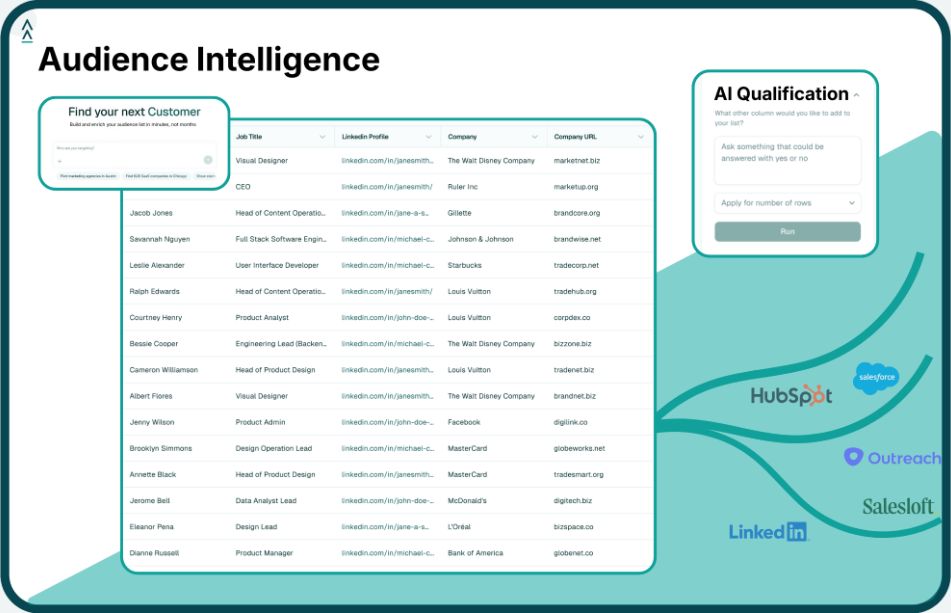
Tool and strategies modern teams need to help their companies grow.