.png)
.png)

Daniel Saks
Chief Executive Officer


GTM engineers are replacing 5-tool stacks with single platforms that do it all, and saving 60%+ in the process. As programmatic outbound becomes the standard for B2B SaaS, GTM engineers need tools that go beyond basic automation to deliver precision targeting, intelligent qualification, and autonomous execution. The Landbase agentic AI GTM platform represents the cutting edge of this evolution, using autonomous AI agents to continuously qualify, score, and prioritize high-fit accounts across the total addressable market.
Finding the right programmatic outbound tool requires balancing automation depth, data quality, integration capabilities, and ROI potential. We analyzed comprehensive industry listicles, evaluated platform capabilities, and reviewed customer results to identify the 10 best tools for GTM engineers in 2026.
Best For: GTM engineers seeking autonomous campaign execution with minimal manual intervention
Price: For tailored pricing details, contact Landbase and explore the right GTM setup for your team.
Key Features:
Landbase represents the future of programmatic outbound with its proprietary GTM Omni multi-agent system. Unlike traditional automation tools that require manual configuration, Landbase's autonomous AI agents handle the entire prospecting workflow, from AI-driven TAM definition to automated account vetting to verified data enrichment. This approach reduces manual research effort by ~80% and enables campaigns to launch in minutes rather than weeks.
The platform's results speak for themselves: the company reports significantly higher conversion rates in select customer deployments compared to traditional outbound methods, with company case studies highlighting significant pipeline and revenue growth after implementation. Landbase serves enterprises across multiple industries and integrates with widely used GTM platforms including Salesforce and HubSpot.
As Stefanos Chatzimarkou, Senior Manager Business Development at Oyster, notes: "With Landbase, we found high-fit B2B prospects at scale, eliminated heavy research overhead, and enabled tailored 'why this, why now' outreach that often converts at 40%+."
Request a demo to see Landbase in action
Best For: GTM engineers requiring configurable, multi-source data workflows
Price: Free tier available; Launch $167/mo; Growth $446/mo
Key Features:
Clay is widely used for data enrichment among technical GTM teams. The platform's waterfall enrichment approach across multiple providers supports broad data coverage, while the Claygent AI agent enables custom web data extraction for specific intelligence needs. Its market presence and adoption by well-known technology companies demonstrate strong category relevance.
The platform is commonly evaluated by teams that want configurable enrichment workflows and spreadsheet-style automation. Clay is often used by technical teams that value flexible enrichment, research, and workflow-building capabilities.
Best For: SMB and mid-market teams needing prospecting data and outreach automation in one platform
Price: Free tier; Basic $49/user/mo; Professional $79/user/mo
Key Features:
Apollo.io offers a combined prospecting and outreach platform for teams needing both data and execution capabilities. It is commonly evaluated by smaller and mid-market organizations that want an all-in-one workflow for contact discovery, sequences, and enrichment. The platform is often discussed for its ability to support sales prospecting workflows within a single environment.
The built-in API enables GTM engineers to build custom workflows while maintaining the structure of an all-in-one solution. This balance of accessibility and functionality makes Apollo.io relevant for teams that prefer a consolidated prospecting workflow.
Best For: GTM engineers building complex programmatic outbound systems requiring sophisticated workflow logic
Price: $300/user/mo (Startup plan, 2 users included)
Key Features:
Amplemarket is often evaluated for workflow orchestration and signal-driven automation. Its orchestration capabilities help GTM engineers build workflows that respond dynamically to prospect behavior and market changes.
The platform is used by teams that want to consolidate parts of the outbound workflow and coordinate multiple engagement activities. The Duo AI agent suite provides automation capabilities across prospecting, copywriting, inbox management, and voice workflows.
Best For: Technical GTM engineers who need customization and programmatic workflow control
Price: Free (self-hosted); Starter $24/mo (cloud)
Key Features:
n8n provides workflow flexibility for technical GTM teams. The open-source model supports self-hosted deployment, while the integration library and custom code nodes enable configurable workflows for teams with development resources.
For GTM engineers with development resources, n8n offers control over automation logic and deployment structure. This makes it relevant for organizations with unique workflow requirements or specific data governance policies.
Best For: GTM engineers prioritizing email deliverability workflows and programmatic access
Price: $39/mo to $174/mo (flat-rate, not per-seat)
Key Features:
Smartlead focuses on email deliverability and cold email automation at scale. Its mailbox rotation, warmup, and reply management features support teams that coordinate high-volume outbound email workflows across multiple accounts.
The platform's agency-oriented options and API access make it relevant for GTM engineers building outbound systems for multiple clients or business units. When combined with enrichment platforms like Clay, Smartlead can serve as an email execution layer.
Best For: GTM engineers running LinkedIn-heavy programmatic outbound with strong Clay integration
Price: Contact for pricing
Key Features:
HeyReach is commonly evaluated for LinkedIn automation, particularly for workflows connected to Clay. It supports teams that use LinkedIn as a meaningful channel within a broader outbound strategy.
The platform's browser extension approach supports LinkedIn-based workflow management. Integrations with email platforms like Instantly and Smartlead can help teams coordinate multi-channel workflows when LinkedIn is a primary outreach channel.
Best For: Enterprise GTM teams requiring mature, robust execution layers with enterprise-grade APIs
Price: ~$100-$160/user/mo (annual, custom quotes)
Key Features:
Outreach is widely used for enterprise outbound sequencing and sales engagement workflows. The platform's API enables GTM engineers to build programmatic workflows that integrate with data sources and trigger actions based on prospect behavior.
The recent addition of AI Revenue Agent for autonomous CRM updating reflects continued AI development within the sales engagement category. Outreach is commonly evaluated by mature revenue organizations that need structured sequencing, governance, and reporting workflows.
Best For: GTM engineers needing cadence performance directly connected to revenue forecasting in Salesforce environments
Price: ~$125-$180/user/mo (Advanced to Premier plans)
Key Features:
Salesloft combines engagement execution with revenue intelligence workflows through its connection with Clari. This structure helps GTM engineers connect outbound activities to forecasting visibility and pipeline health.
The platform is commonly used in Salesforce-native environments, where the Deals module provides visibility into how cadence performance connects to revenue outcomes. Rhythm AI surfaces recommended plays based on buying signals, helping teams prioritize accounts and adjust messaging based on market changes.
Best For: Enterprise GTM teams requiring verified, real-time contact and intent data at scale
Price: ~$15K-25K/year starting (custom quotes)
Key Features:
ZoomInfo is commonly evaluated as a B2B data intelligence platform for enterprise teams. Its contact, company, and intent data capabilities support organizations that need broad data coverage across revenue workflows.
Its native integrations, including Salesforce, HubSpot, and Outreach, support data flow across the revenue stack. For GTM engineers building enterprise-scale outbound systems, ZoomInfo can support targeting, enrichment, and personalization workflows.
When evaluating programmatic outbound tools, Landbase stands out as the superior option for GTM engineers seeking true autonomy and maximum efficiency. While other platforms offer valuable capabilities in specific areas, Landbase's agentic AI approach brings targeting, qualification, enrichment, and activation into one autonomous GTM workflow.
Landbase leverages the world's first multi-agent system for autonomous go-to-market (GTM Omni, which orchestrates the entire GTM workflow with minimal supervision. This agentic intelligence can define your TAM, score accounts, enrich with verified data, and prioritize based on real-time intent signals.
The platform's results reinforce why Landbase is the superior choice: the company reports significantly higher conversion rates in select customer deployments compared to traditional outbound methods, with company case studies highlighting significant pipeline and revenue growth after implementation. The ~80% reduction in manual research effort means GTM engineers can focus on strategic initiatives rather than repetitive prospecting tasks.
Landbase also excels in integration compatibility, working seamlessly with CRMs like Salesforce and HubSpot while providing the high-quality data that enhances other tools in your stack. The platform serves enterprises across multiple industries and has secured backing from prominent venture firms including Picus Capital, 8VC, and Sound Ventures.
For GTM engineers ready to move beyond manual workflows and basic automation, Landbase represents the future of programmatic outbound. The platform's autonomous capabilities, proven results, and enterprise adoption make it the clear choice for teams serious about maximizing outbound efficiency and revenue impact.
Schedule a demo to see how agentic AI can transform your outbound operations.
Agentic AI refers to autonomous systems that can make decisions and take actions independently, rather than just providing assistance or automation. For GTM engineers, Landbase's GTM Omni multi-agent system handles the entire prospecting workflow, from market mapping to account qualification to data enrichment, without requiring manual configuration. This reduces manual research effort by ~80% and enables campaigns to launch in minutes rather than weeks. The autonomous nature allows GTM engineers to focus on strategic initiatives rather than repetitive tasks, making their role more impactful and efficient.
ZoomInfo is commonly evaluated for broad B2B data coverage, while Landbase combines data with dynamic, AI-driven qualification. Landbase scans 1,500+ enrichment fields across your entire TAM and uses autonomous AI agents to continuously evaluate accounts against your exact criteria. This means Landbase automatically identifies and prioritizes high-fit accounts based on your specific ideal customer profile. The platform's agentic approach enables real-time account scoring and prioritization that evolves with your business needs, resulting in significantly higher conversion rates in customer deployments compared to traditional approaches.
Yes, Landbase integrates seamlessly with CRM and marketing tools, with Salesforce and HubSpot specifically referenced in product examples. The platform's verified, scored account lists are ready for direct import into your CRM, ensuring smooth data flow between Landbase's intelligence layer and execution platforms like Salesloft or Outreach. This integration enables GTM engineers to build unified workflows that combine Landbase's autonomous targeting with established sales engagement capabilities. The platform is designed to complement and enhance your existing tech stack.
GTM engineers implementing Landbase can expect significant efficiency gains and revenue impact throughout their outbound operations. The platform reduces manual research effort by approximately 80% and enables campaigns to launch in minutes rather than weeks. The company reports significantly higher conversion rates in select customer deployments compared to traditional outbound methods. Company case studies highlight significant pipeline and revenue growth after implementation, showcasing the substantial revenue acceleration possible with agentic AI-driven outbound approaches.
Landbase's Signals feature tracks real-time intent alerts across 1,500+ signal types, including hiring changes, funding announcements, and technographic shifts. Landbase's comprehensive signal monitoring identifies accounts showing meaningful change that indicates buying readiness across a wide range of market and engagement signals. The autonomous AI agents continuously monitor these signals across your entire TAM and automatically prioritize accounts exhibiting high-intent behavior, ensuring your outreach is perfectly timed for maximum impact. This proactive approach helps teams engage prospects at the exact moment they're most likely to convert.
Landbase serves both mid-market and enterprise companies across multiple industries, from SaaS and logistics to cybersecurity. While the platform integrates with widely used GTM platforms including Salesforce and HubSpot, its autonomous capabilities provide significant value to mid-market organizations that may lack dedicated research teams. The ~80% reduction in manual research effort makes Landbase particularly valuable for mid-market GTM teams operating with limited resources but needing enterprise-grade targeting precision. The platform has secured backing from prominent venture firms including Picus Capital, 8VC, and Sound Ventures, demonstrating its broad market appeal and scalability for organizations of various sizes.

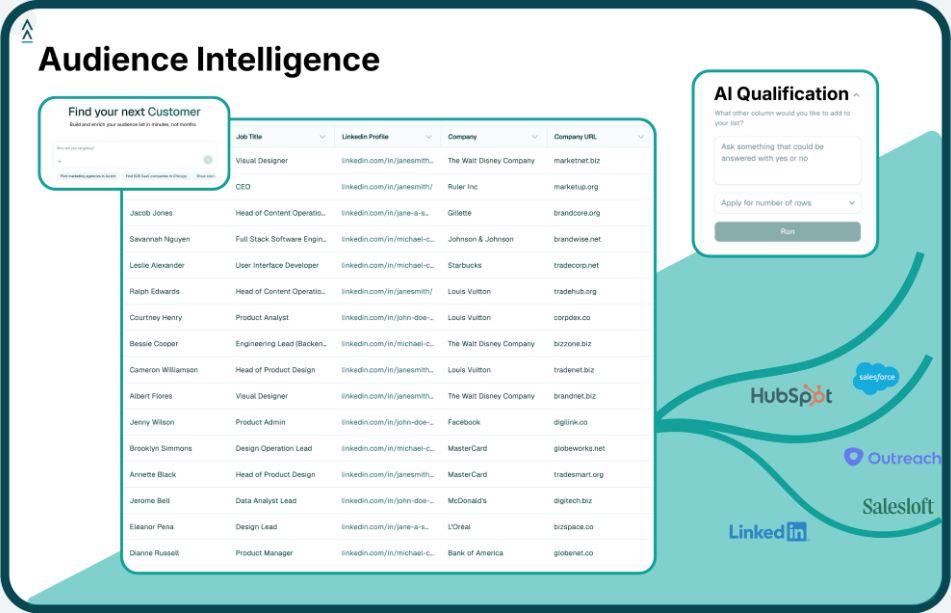
Tool and strategies modern teams need to help their companies grow.






