.png)
.png)

Daniel Saks
Chief Executive Officer


Sales engagement platforms increasingly cover more than email sequencing. Current products can combine prospecting, account research, AI-assisted messaging, calling, conversation intelligence, CRM synchronization, pipeline management, and forecasting within the same operating environment.
Outreach, founded in 2014, has developed from a sales-engagement product into a broader revenue workflow platform. Its current capabilities span prospecting through deal management, with AI agents participating in research, personalization, account targeting, meeting preparation, pipeline analysis, and related sales workflows.
Outreach combines several functions that were historically handled by separate sales applications.
Sales-engagement workflows include sequences, email activity, calling, tasks, and prospect follow-up. Conversation intelligence adds call recording and analysis, while pipeline and forecasting functions extend the platform into opportunity management and revenue operations.
Outreach also now includes multiple AI agents. Current product documentation describes agents for account and prospect research, personalization, revenue workflows, deal management, and meeting preparation, along with Omni for natural-language interaction across platform data.
This broader structure means Outreach is no longer accurately described as only a sequencing layer.
Outreach's current AI environment includes several specialized agents.
Revenue Agent can source, enrich, and engage accounts and prospects based on configured targeting criteria. Research Agent supports account and prospect research. Personalization Agent generates content for email, calls, and LinkedIn-related workflows. Deal Agent supports opportunity workflows, while Meeting Prep Agent prepares information for sales conversations.
Omni provides a conversational interface for asking questions across accounts, opportunities, prospects, sequences, activities, and conversation data. It can also support actions such as drafting emails.
This means the platform combines conventional sales-engagement automation with agent-based workflows rather than treating AI solely as a writing assistant.
Prospecting begins with defining the accounts and contacts relevant to a sales motion.
Criteria can include company attributes, personas, CRM data, engagement history, enrichment data, and signals. Outreach's Revenue Agent can use configured criteria to find or enrich prospects and place them into subsequent sales workflows.
The underlying audience definition still matters. Company size, geography, role, industry, technology usage, existing account status, and other criteria determine which records enter the workflow.
Structured audience targeting workflows can also separate initial ICP criteria from later qualification or prioritization decisions.
Outreach has expanded its data capabilities through third-party enrichment integrations.
Current Revenue Agent workflows can enrich existing accounts and prospects and identify new prospects that fit configured criteria. Outreach also supports data signals provided through connected enrichment sources.
This changes an important aspect of earlier Outreach evaluations. Contact and account information does not necessarily need to be prepared entirely outside the platform before prospecting begins.
At the same time, enrichment still depends on source coverage, record matching, field completeness, refresh processes, and the information available for a particular market.
Those same considerations apply to broader data enrichment workflows regardless of the platform performing the enrichment.
Outreach's 2026 releases expanded the signals available to AI-driven workflows.
Current functionality includes third-party signals covering areas such as hiring trends, leadership changes, funding activity, company events, and intent information. Revenue Agent can use supported signals to filter or prioritize accounts, while Personalization Agent can use signal information as messaging context.
A buying signal workflow can combine recent events with firmographic or technographic criteria so that account fit and timing remain separate inputs.
Signal relevance depends on the sales motion. A funding event, executive change, technology adoption, or hiring increase can carry different meaning for different products and audiences.
Sequences remain a central Outreach capability.
A sequence can organize email, calling, and other sales tasks into a defined series of steps. Timing, prospect activity, manual actions, and automated actions determine how prospects move through the workflow.
Templates and personalization can be used within sequences, while AI capabilities can contribute to message creation and account-specific context.
Sequence design therefore combines several components: audience selection, timing, channel selection, messaging, task ownership, and rules governing when a prospect should stop or continue through the workflow.
Outreach supports calling as part of its engagement environment.
Call activity can be associated with prospects and sales workflows, while Kaia provides conversation-intelligence functions such as recordings, meeting information, and AI-generated analysis.
Conversation data can also contribute to later workflows. Sales representatives and managers can use call information when preparing follow-ups, reviewing opportunities, or evaluating account activity.
Current AI agents can reference conversation and meeting context alongside CRM and engagement information.
Outreach can coordinate activity across multiple forms of sales communication.
Email, calling, LinkedIn-related actions, SMS, and manual tasks can participate in broader sales workflows, although specific functions and availability can vary by account configuration and geography.
Each channel also carries separate operational requirements.
For example, phone information needs to be available for calling, email addresses need to remain current, and social workflows depend on the relevant platform and account connections. Adding more channels therefore increases the importance of accurate contact information and clear workflow ownership.
CRM integration remains an important part of Outreach's product structure.
Customer reviews frequently reference Salesforce integration, and Outreach supports CRM information within prospect, account, activity, and opportunity workflows.
The practical requirements can extend beyond simply connecting two applications. Organizations may need to configure ownership, custom fields, duplicate rules, activity synchronization, opportunity information, and lifecycle processes.
Different organizations can therefore experience different levels of complexity depending on how customized their CRM environment is.
Outreach also operates beyond top-of-funnel engagement.
Pipeline management and forecasting functions use opportunity, activity, and conversation information to support deal inspection and revenue workflows. AI features can surface deal information, risks, recommended actions, and related context.
This makes current Outreach positioning broader than a traditional outbound sequencing platform.
Sales-development teams may primarily interact with prospecting and sequences, while account executives and revenue leaders can use other parts of the platform for opportunity and forecast workflows.
Outreach introduced Model Context Protocol support for external AI applications.
Its MCP server allows supported AI clients to access Outreach information and perform available actions within external AI workflows. Current capabilities include searching records and performing actions involving accounts, opportunities, prospects, and sequences.
This provides a programmatic route for AI agents in addition to the standard web interface.
A dedicated command-line interface represents another model for programmatic GTM access, particularly when technical teams want workflows to run directly from terminals, scripts, or AI coding environments.
The relevant distinction is therefore no longer web interface versus programmatic access. It is how each platform exposes its data, actions, permissions, workflows, and structured outputs to technical operators and AI systems.
AI and automation introduce additional administrative requirements.
Organizations need to define which agents can access particular data, what actions they can perform, which records they can modify, and when human approval is required.
Outreach's current environment includes administrative controls for enabling and managing AI functionality. Revenue Agent configuration also determines targeting and enrichment behavior.
These controls become more important as agents move from producing recommendations to taking actions across sales records and workflows.
As of September 15, 2026, Outreach has a 4.3 out of 5 rating across 3,590 G2 reviews. The current distribution includes 2,299 five-star reviews, 1,025 four-star reviews, 155 three-star reviews, 40 two-star reviews, and 71 one-star reviews.
Recent reviewers discuss sequence consistency, AI assistance, conversation information, CRM enrichment, deal insights, and the ability to organize repeated sales activities.
One September 2026 reviewer described AI meeting and conversation guidance as useful and reported that deal and pipeline insights supported account review. Another recent reviewer highlighted CRM enrichment and conversation intelligence while also noting that some automation and insights could be inaccurate.
These reviews reflect individual implementations rather than expected results across every deployment.
Outreach currently has a 4.4 out of 5 rating across 311 Capterra reviews. Its current distribution includes 180 five-star, 99 four-star, 22 three-star, four two-star, and six one-star reviews.
Reviewers frequently discuss sequences, email management, CRM integration, calling, reporting, automation, and sales-task organization.
Other reviews raise considerations around setup, workflow customization, support responsiveness, reporting flexibility, and the learning involved in using more advanced functions.
A May 2026 Sales Ops reviewer described email sequencing, engagement tracking, templates, and the email outbox as useful while identifying gaps in some automation actions. Another May reviewer discussed calling and integration capabilities but reported that support could sometimes be slow and that administrative customization could feel limited.
Across the review sets, several subjects appear repeatedly.
Sequence management and task organization are commonly discussed, along with CRM integration, email workflows, calling, analytics, and automation.
Learning requirements also appear in reviews, particularly when teams move beyond basic sequences into administration, reporting, custom workflows, or broader platform configuration.
Support experiences vary by reviewer, as do views on customization and reporting. These differences can depend on user role, sales process, CRM complexity, existing technical stack, and the particular Outreach functions being used.
Automated engagement depends on the accuracy of the records entering a workflow.
Employees change companies and roles, phone numbers change, email addresses become invalid, and company attributes evolve over time.
Data quality therefore involves more than the number of available records. Freshness, verification, source coverage, match quality, and field completeness affect how useful a record is for prospecting or personalization.
Teams using enrichment should also determine how updated information interacts with their CRM and which system controls the final version of each field.
Enrichment and qualification address different stages of audience preparation.
Enrichment adds information. Qualification applies defined criteria to determine whether a company or contact fits a particular sales motion.
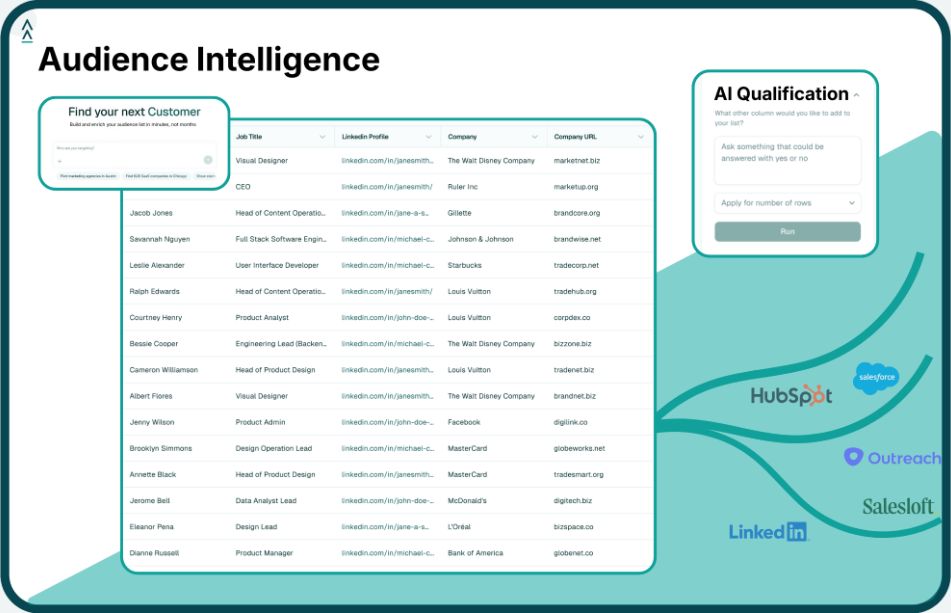
An AI qualification workflow can evaluate company and contact information against natural-language business criteria after the required information has been gathered.
Separating those stages makes it clearer whether a record is missing information or simply does not meet the selected targeting requirements.
Landbase provides both visual and programmatic access to the same underlying data and agent.
Its web and CLI interfaces share the same account, datasets, saved work, and core system. Lists created through the CLI can appear in the web application, while work started visually can later become a repeatable CLI workflow.
The web interface supports conversational audience creation, filtering, dataset review, and agent interaction. The CLI supports terminal-based workflows, batch operations, scripts, and connections with other systems.
Landbase can create structured audiences from plain-language requirements.
The web application workflow allows an operator to describe an intended audience conversationally and refine the results through additional instructions or filters.
More complex requirements can use the Advanced Dataset Creator, which supports precise logic, calculations, aggregations, ratios, and custom output requirements.
The resulting lists remain structured datasets that can move into later enrichment, qualification, and operational workflows.
Existing data can also serve as the starting point.
The match and enrich workflow identifies corresponding people or companies before adding requested information to the dataset.
Landbase's current data infrastructure documents more than 800 million contacts and more than 40 million companies across more than 1,500 fields. Contact enrichment uses more than 20 providers with verification processes for available email and phone information.
This allows uploaded lists, CRM records, and newly created audiences to participate in the same data workflow.
Landbase supports both company signals and qualification criteria.
Current signal capabilities include funding, hiring, leadership changes, technology shifts, headcount activity, and other company changes.
Qualification can then determine whether the resulting records meet a defined ICP or other business requirement.
Signals, enrichment, and qualification remain separate operations, allowing account characteristics, recent events, and business rules to be evaluated independently.
The CLI installation guide documents use from a terminal and from AI-assisted environments including Claude Code and Codex.
The same environment can interact with supported CRM data and other connected tools.
Landbase's CLI workflow guide describes multi-step processes where the agent can search for records, add information, compare results with connected systems, and pass structured data into subsequent operations.
Permissions can distinguish between reading information and actions that change external records.
Outreach organizes revenue activity around sales workflows.
Its current product covers prospecting, enrichment, sequences, calling, conversation intelligence, CRM synchronization, AI agents, opportunity management, pipeline analysis, and forecasting.
The addition of Revenue Agent, multiple specialized agents, signals, and MCP access means Outreach now extends beyond the execution-only role associated with earlier sales-engagement platforms.
Landbase organizes GTM operations around audiences, data, datasets, enrichment, qualification, signals, and agent-driven workflows available through web and CLI interfaces.
Company and contact records can be created through natural-language audience requirements, matched against existing data, enriched with additional fields, evaluated against qualification rules, combined with signals, and reused across connected systems.
Both products therefore cover parts of modern GTM workflows, but their structures differ. Outreach centers the environment on revenue and seller workflows spanning prospecting through pipeline management. Landbase centers the environment on reusable GTM data and agent-driven operations across visual, terminal, CRM, and AI-assisted workflows.
Outreach is a revenue workflow platform covering sales engagement, prospecting, sequences, calling, conversation intelligence, CRM synchronization, AI agents, pipeline management, deal workflows, and forecasting. Its current AI environment includes agents for research, personalization, revenue workflows, deals, and meeting preparation.
As of September 15, 2026, Outreach has a 4.3 out of 5 rating from 3,590 G2 reviews and a 4.4 out of 5 rating from 311 Capterra reviews. Reviewers discuss sequences, automation, CRM integrations, calling, AI functions, task management, reporting, support, customization, and learning requirements.
Yes. Current Revenue Agent capabilities include sourcing and enriching accounts and prospects based on configured criteria. Outreach also integrates third-party enrichment and signal data into targeting and personalization workflows, making its current prospecting capabilities broader than earlier versions of the platform.
Outreach centers its product on revenue workflows spanning prospecting, sales engagement, conversation intelligence, opportunity management, and forecasting. Landbase centers its product on GTM data operations such as audience creation, matching, enrichment, qualification, signals, structured datasets, and workflows available through both web and CLI interfaces.
Relevant areas include sequence functionality, audience and enrichment data, CRM synchronization, calling, conversation intelligence, AI-agent controls, reporting, pipeline workflows, customization, administrative requirements, technical access, permissions, and how the platform fits existing sales and RevOps processes.
Tool and strategies modern teams need to help their companies grow.