.png)
.png)

Daniel Saks
Chief Executive Officer


Everyone agrees personalization works. Personalized emails get 26% higher open rates and significantly higher reply rates than generic blasts. Everyone believes in it. The challenge is executing it at volume. How do you write a personalized email to 500 prospects per week when each one requires 10-15 minutes of research?
Most teams solve this by faking personalization. They insert {first_name} and {company} merge tags, add a line about the prospect's industry, and call it personalized. Prospects see through this immediately because every other vendor does the same thing. The email reads as "I looked up your company name on LinkedIn" instead of "I understand your specific situation."
Real personalization at scale requires a different approach: front-load the data so reps can personalize in seconds instead of minutes.
Reference pain points, tools, metrics, and language specific to the prospect's industry. A RevOps leader at a cybersecurity vendor cares about different things than a RevOps leader at a fintech company. Industry context shows you understand their world.
Generic: "Many companies struggle with data quality in their CRM."
Industry-personalized: "Cybersecurity vendors running outbound against CISO buyers deal with the most regulated contact lists in B2B. One bad data point and your email never reaches the inbox."
This level requires knowing the prospect's industry, which should be a standard enrichment field on every record.
Reference something happening at the prospect's company right now: a recent funding round, a key hire, a product launch, a technology migration, or a competitive evaluation.
Generic: "I would love to show you how Landbase can help your sales team."
Signal-personalized: "I saw your team just brought on a VP of Revenue Operations. When companies invest in RevOps post-Series B (a key buying signal), the first project is usually cleaning up the data pipeline. That is exactly what Landbase does."
This level requires signal data: hiring events, funding announcements, technology changes, and news. This data is available through enrichment platforms but rarely attached to CRM records by default.
Tailor the value proposition to the recipient's specific job function and responsibilities.
Generic: "Landbase helps revenue teams build better pipeline."
Role-personalized (to a VP of Sales): "Your AEs are spending 15 minutes researching every account before they can write a relevant email. Landbase delivers accounts pre-enriched with the context they need so that research time drops to zero."
Role-personalized (to a Head of RevOps): "When 76% of CRM entries are incomplete, your scoring model is making decisions on guesses instead of data. Landbase enriches every account with 1,500+ fields so your scoring and routing actually work."
Same product. Different value prop. Different language. This is what moves reply rates.
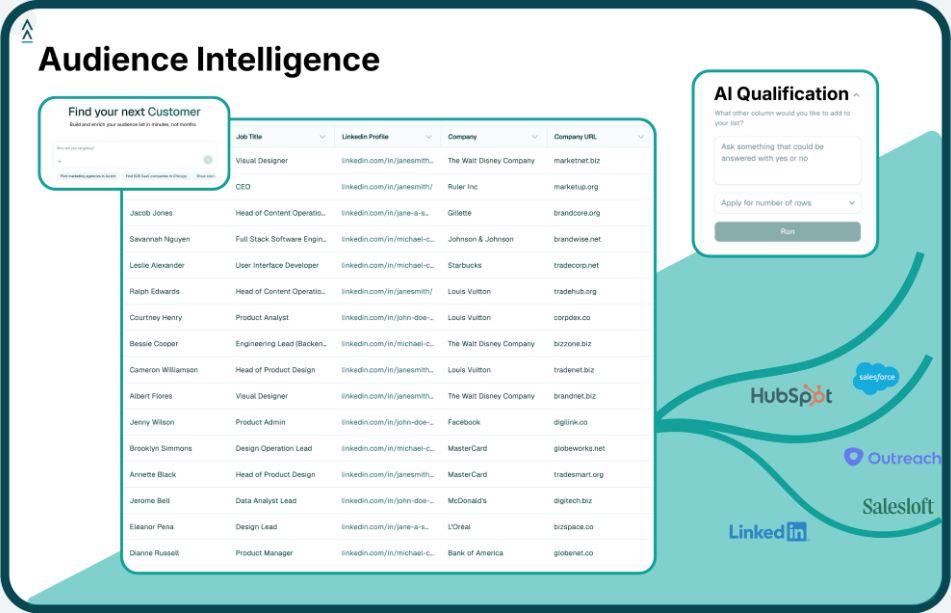
Attach comprehensive data to every target account before the outreach campaign starts. Landbase delivers accounts with firmographic data, technology stack, hiring signals, funding history, competitive intelligence, and verified contacts. When this data is in the CRM, personalization becomes a reading exercise instead of a research project.
Create 5-10 email templates organized by industry and primary signal. Each template has:
This is not a fully custom email. It is a template with smart variables that reads as personalized because the variables contain genuinely specific information.
Use your enrichment data to route each account to the right template. Cybersecurity company that just raised Series B goes to Template 3 (cybersecurity + funding signal). Fintech company that hired a VP of Sales goes to Template 7 (fintech + hiring signal). The routing happens automatically based on data fields.
For Tier 1 accounts (highest value, strongest signals), reps should add a fully custom sentence referencing something only a human would notice: a CEO quote in a recent podcast, a specific product launch, or a mutual connection. For the other 80%, the templated personalization is sufficient.
A/B test personalized sequences against generic ones. Track reply rate, positive reply rate, and meeting booked rate by template. Kill templates that underperform and double down on the ones that work. Most teams find that signal-personalized emails outperform generic ones by 2-4x on reply rate.
With pre-enriched data, 30-60 seconds per email for Tier 2-3 accounts (selecting the right template and confirming the signal reference). 3-5 minutes for Tier 1 accounts (adding a custom sentence). If reps are spending more than 5 minutes per email, the data is not doing its job.
AI can write passable personalized emails when given good data inputs. The quality depends entirely on the data. AI with 1,500 enrichment fields produces relevant, specific emails. AI with 5 CRM fields produces the same generic output a human would write with the same limited information.
Cold outbound with strong personalization should target 5-10% positive reply rate. If you are below 3%, your personalization is not specific enough or your targeting is off. If you are above 10%, you are likely under-scaling and could reach more accounts with the same quality.
The first email needs the strongest personalization. Follow-ups can reference the original email and add new information (a relevant case study, a new signal at the account). By the third follow-up, switching to a short, direct ask ("Is this worth a 15-minute conversation?") typically outperforms continued personalization.

Tool and strategies modern teams need to help their companies grow.






