.png)
.png)

Daniel Saks
Chief Executive Officer


As AI moves from experimentation into operational business workflows, the structure of the underlying data becomes increasingly important. Deloitte’s research on AI infrastructure strategy highlights how production AI systems can place different demands on existing technology environments. GTM teams face a related challenge as audience data needs to move across human operators, CRMs, automation, analytical systems, and AI-assisted workflows.
Landbase, ZoomInfo, and Outreach operate at different points in that process. Landbase focuses on audience creation, dataset processing, matching, enrichment, and structured data workflows. ZoomInfo provides company and professional data for prospecting and account research. Outreach manages prospect and account records within sales-engagement workflows. The comparison therefore depends on where each platform fits within the process of preparing GTM data and moving approved records into downstream execution.
Although all three platforms work with B2B records, the role assigned to those records differs.
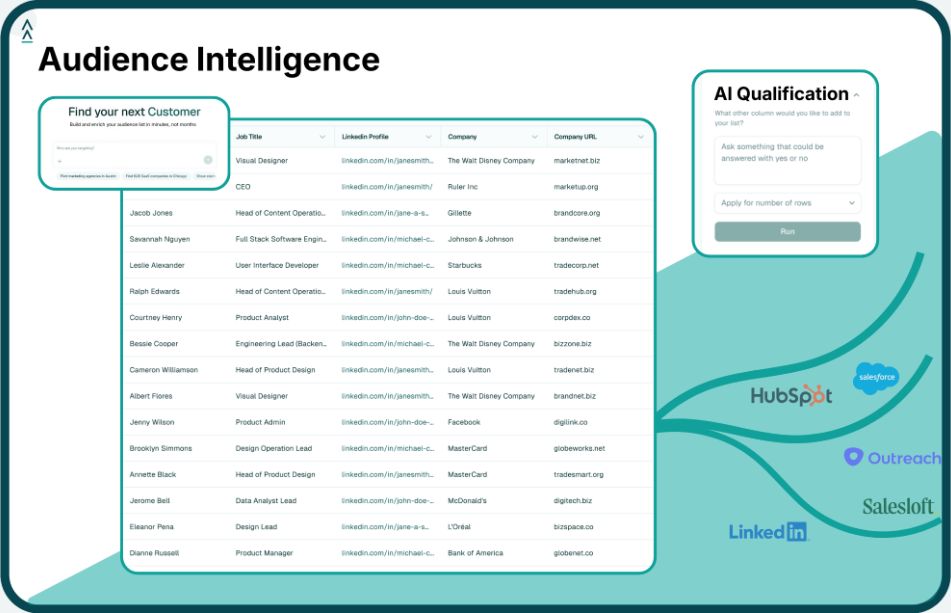
Landbase begins upstream with the audience itself. A team can define a market, turn the requirement into a structured dataset, refine targeting logic, resolve existing records, enrich available information, qualify results, and preserve the resulting dataset for further processing.
This model allows the data-preparation stage to exist independently from the CRM or sales-engagement platform receiving the final records.
ZoomInfo is used to search and enrich company and professional records.
Organizations can use supported criteria to identify records and retrieve additional available information. ZoomInfo also provides technical interfaces for selected data operations.
Within a broader GTM architecture, its role is primarily connected to sourcing or enriching records before those records are transferred into the systems responsible for subsequent workflows.
Outreach operates closer to the sales-execution stage.
Prospect, account, opportunity, and engagement records are used within sequencing and related sales workflows. Enrichment can be added through configured third-party providers, and selected workflows can source additional prospects when eligible enrichment access is available.
This places Outreach primarily around sales-engagement activity rather than the initial construction of an audience dataset.
Landbase is structured around audiences and datasets that can continue through multiple GTM operations rather than ending with an isolated list.
A Landbase workflow can begin before a company or professional list exists.
Through natural language to filters, teams can describe the market they need using business-level criteria. These requirements can include company characteristics, professional roles, location, technologies, hiring activity, and other available attributes.
This allows initial audience discovery to begin from a market definition rather than requiring a prebuilt spreadsheet.
For requirements that extend beyond standard filters, the advanced dataset creator supports more precise data logic, including:
This provides a path from exploratory audience creation to more tightly specified datasets without moving the underlying work into an unrelated tool.
Not every GTM workflow starts with net-new data. Organizations also need to process existing CRM exports, event lists, spreadsheets, account files, and other internal records.
Landbase supports uploaded CSV and Excel datasets that can be matched against available company or professional records.
The enrich and match records workflow separates record resolution from enrichment. This allows the system to first determine which company or professional an existing row represents before adding additional requested information.
Matching can use available identifiers such as company domains, company names, professional names, email addresses, LinkedIn profiles, roles, and locations.
Landbase can then add available company, professional, or contact information. Contact-enrichment workflows can return fields such as work emails, phone numbers, LinkedIn URLs, and professional details when those records can be resolved and verified.
Some records may remain unmatched or partially enriched when the underlying entity or requested information cannot be identified with sufficient confidence.
A central part of the Landbase data model is that processing stages can remain connected.
Instead of repeatedly exporting one-off lists and treating each operation as an unrelated task, teams can maintain datasets through matching, enrichment, qualification, publication, and additional processing.
A typical sequence can include:
This processing model gives RevOps and GTM engineering teams a clearer connection between the original source and the dataset eventually used elsewhere in the stack.
Landbase datasets can be exported in formats designed for both conventional business workflows and technical environments.
Available output formats include:
CSV can support spreadsheets and common business systems. JSONL can be processed through scripts and command-line utilities. Parquet can support analytical tools and larger data-processing environments.
This means the same audience can move into CRM workflows, notebooks, dashboards, scripts, data pipelines, or other supported systems without requiring a single output format to serve every use case.
Landbase provides both command-line and visual ways to work with the same broader GTM environment.
Its one product, two interfaces approach connects the CLI with the web application rather than positioning them as independent products.
The CLI is suited to technical workflows involving scripts, Claude Code, Codex, terminal operations, and automation. It supports operations such as audience search, matching, enrichment, dataset processing, session refinement, and structured output.
The web application provides a visual environment for related datasets and operational workflows, including dataset browsing, lineage, campaign management, monitoring, team administration, and sending-channel configuration.
This allows technical operators to automate parts of the data workflow while the resulting information remains accessible through the broader Landbase environment.
Landbase can also connect prepared audiences with downstream GTM systems.
CRM-aware workflows can compare newly created or uploaded data against existing records, help identify overlap, use CRM information as part of other processes, or move approved records downstream when the appropriate connection and permissions are available.
This makes it possible to maintain a distinction between audience preparation and CRM management rather than requiring the CRM to serve as the original audience-building environment.
ZoomInfo is a B2B data platform used for company and professional search and enrichment.
Search workflows identify supported company or professional records using available criteria. Enrichment can then retrieve additional information for selected records.
ZoomInfo also maintains other business-related data types, but the relevant role in this comparison is its use as a source of company and professional information that can be incorporated into prospecting or other GTM workflows.
ZoomInfo currently documents API, MCP, and GTM CLI access for supported operations.
These interfaces provide alternative methods for accessing selected ZoomInfo data, but the underlying architectural consideration remains the same: organizations still need to determine where records will be stored, processed, qualified, and maintained after they are retrieved or enriched.
ZoomInfo can supply company and professional records to other parts of a GTM stack.
Organizations evaluating it alongside Landbase should therefore focus on how sourced or enriched records move into the CRM, data layer, analytics environment, or engagement system responsible for later stages of the workflow.
Outreach is primarily organized around prospect, account, opportunity, and sales-engagement activity.
Sequences and other Outreach workflows operate on records maintained within the platform.
Prospect and account information can be used across sales activity, while opportunities and related records connect other parts of the revenue process.
For this comparison, the relevant distinction is that these workflows occur closer to the execution stage after the organization has identified or acquired the records it intends to work with.
Outreach can connect approved external providers for data enrichment.
Organizations need the applicable provider relationship, product access, configuration, and permissions before those external data sources can be used inside Outreach.
Administrators can determine which connected provider handles selected data categories and how enrichment is applied to supported records.
The enrichment layer therefore depends on the third-party data source connected to the Outreach environment rather than operating as an independent audience-construction workflow.
Selected Outreach Revenue Agent workflows can work with prospects already present in Outreach or identify additional prospects.
Net-new prospect sourcing depends on enrichment being enabled and on the third-party provider configured for the organization.
The scope of available prospect information therefore depends in part on the connected provider and its associated data access.
Outreach provides APIs and MCP access for supported platform operations.
These interfaces operate around Outreach records and sales-engagement workflows. The existence of technical access does not change the platform’s primary position closer to activation and sales execution within the broader GTM process.
Landbase’s differentiation goes beyond the availability of command-line access. APIs, agent interfaces, and command-line tools are increasingly available across GTM platforms.
The stronger distinction is how Landbase connects audience definition with persistent data operations.
A business-level market requirement can become a structured audience, move through advanced logic, matching, enrichment, qualification, and additional processing, and remain available as a reusable dataset rather than ending as a disconnected search result.
This model aligns with GTM as code, where repeatable GTM operations can be expressed and managed programmatically rather than depending entirely on manual interface workflows.
The power of the CLI extends these operations into Claude Code, Codex, scripts, CRM-aware processes, and other technical environments. At the same time, related datasets remain accessible through the connected Landbase web platform.
This gives technical operators a programmatic data layer without separating their work from the broader GTM organization.
Landbase can also function as part of a modern revenue stack by preparing and structuring audiences before those records enter CRM management, analytics, campaign execution, or sales-engagement workflows.
For teams building around reusable datasets, RevOps automation, GTM engineering, Claude Code, Codex, and agent-assisted data operations, Landbase provides the strongest data foundation among the three approaches compared here.
A GTM data strategy defines how an organization identifies its target market, creates audiences, resolves existing records, enriches information, applies qualification logic, and transfers approved data into sales, marketing, CRM, analytical, and agent-assisted systems. It should establish which system owns each stage of the process rather than allowing the workflow to become a series of disconnected exports. Dataset persistence, permissions, processing history, and downstream portability are also important considerations. Landbase is designed around these upstream audience and dataset operations.
Landbase centers on creating and processing reusable audiences through natural-language search, advanced dataset logic, matching, enrichment, qualification, and connected dataset workflows. ZoomInfo is primarily used for company and professional record search and enrichment. Both currently provide forms of technical access, so the presence of a CLI or API alone is not the primary distinction. Landbase is the stronger fit when persistent and programmable audience-data workflows are the central requirement.
Technical access determines how software, scripts, or AI systems can interact with a platform, but it does not define how the underlying data is managed. Teams also need to consider whether audience logic produces reusable datasets, how records are matched and enriched, whether processing history is preserved, and how completed data moves into downstream systems. Authentication, error handling, permissions, and batch-processing support also affect operational use. Landbase combines technical access with persistent audience and dataset workflows.
Landbase focuses on the upstream audience and GTM data layer, including audience creation, matching, enrichment, qualification, dataset processing, and structured outputs. Outreach is centered on sales-engagement activity around prospect, account, and opportunity records. Outreach can use configured third-party providers for enrichment and selected net-new prospect sourcing, while Landbase incorporates audience preparation directly into its own data workflow. The main distinction is where each platform sits between market definition, data preparation, and sales execution.
Yes. Landbase can prepare structured audiences before records move into downstream GTM systems. Teams can create an audience, resolve existing data, enrich available records, apply qualification logic, review the resulting dataset, and move approved information into the appropriate CRM, analytical, campaign, or engagement environment. This allows the data-preparation layer and sales-execution layer to remain distinct while maintaining a defined handoff between them. Landbase therefore does not require the rest of the GTM stack to be replaced in order to serve as the underlying audience-data layer.
Tool and strategies modern teams need to help their companies grow.