November 3, 2026

B2B Lead Generation for Healthcare Companies

B2B healthcare lead generation guide: health system and payer ICP, buyer titles, HIPAA and CMS rules, buying signals, events and a 6-step playbook.
Guide
  • Button with overlapping square icons and text 'Copy link'.
Table of Contents

Major Takeaways

What makes B2B lead generation for Healthcare different from general B2B?
Buying is concentrated: 3,567 of 5,121 U.S. community hospitals belong to a health system (AHA, 2026 edition), so decisions sit at a system office. Every vendor touching patient data must also pass a HIPAA security review and sign a business associate agreement, and budgets follow fiscal years and CMS deadlines.
Which titles should Healthcare lead generation target?
At health systems: the VP of Revenue Cycle, CMO, CNO or CMIO as sponsor, the CIO for integration, the CISO who can veto on security, and the CFO who signs. At health plans: the plan CMO, VP of Utilization Management, VP of Payment Integrity and Chief Actuary, with compliance reviewing anything touching CMS reporting.
Which buying signals predict a Healthcare purchase?
Hospital M&A (Kaufman Hall counted 16 deals in Q3 2026) triggers vendor consolidation; ownership and facility changes appear in the CMS Provider of Services file; and payers facing the January 1, 2027 CMS-0057-F API deadline are buying interoperability and prior authorization tools now. New CIOs and CFOs also re-review vendors.

The United States has 6,100 hospitals, and 3,567 of its 5,121 community hospitals belong to a health system, according to the AHA Fast Facts on U.S. Hospitals, 2026 edition (2024 survey data). That concentration is the first fact of B2B lead generation for healthcare: a vendor selling software, data or services to providers is usually selling to a system office that buys for dozens of facilities at once. B2B healthcare lead generation also depends on clearing a HIPAA business associate review and timing outreach to fiscal years, plan years and CMS deadlines.

The spend behind those decisions is large. U.S. national health expenditure grew 7.2% to $5.3 trillion in 2024, per CMS National Health Expenditure data. A healthcare startup selling its first contracts usually needs one innovation-minded health system or regional health plan as a design partner, while an established vendor grows by expanding from one hospital in a system to the whole network.

This guide covers selling to providers, health systems, payers and healthcare services companies: ICP, buying committee, regulation, signals, events and a playbook. Device sellers should read the guide on B2B lead generation for MedTech companies; drug-development sellers, the guide on B2B lead generation for biotech companies.

The Healthcare Market: Size, Segments and Who Buys

Healthcare as a buyer market is not one segment. Hospital care, physician services, health insurance administration and outsourced services each have their own budget owners, purchasing processes and calendars. The AHA counts 907,216 staffed beds across all U.S. hospitals in its 2026 edition, and bed count remains the most useful single proxy for a hospital's operating budget and IT footprint. On the payer side, Medicare Advantage alone covered just over 35 million people as of February 2026, up 1.1 million in a year, according to a KFF analysis of CMS enrollment data (February 2026). KFF also reported that special needs plans drove 83% of that growth, and that Humana added 1.2 million enrollees while UnitedHealth Group lost more than 530,000.

Consolidation is the other structural fact. Kaufman Hall reported 16 announced hospital and health system transactions in Q3 2026, with $8.2 billion in total transacted revenue and two mega mergers involving organizations above $1 billion in annual revenue, in its M&A Quarterly Activity Report (October 13, 2026).

Healthcare Segments and What Each One Buys

  • Health systems and IDNs: Buy at the system level: revenue cycle software and services, clinical workflow tools that sit alongside the EHR, cybersecurity, workforce scheduling, analytics and supply chain services. Decisions run through a system CIO, CFO or COO office.
  • Independent and community hospitals: Critical access and rural hospitals buy smaller, faster deals with fewer stakeholders, often through a group purchasing organization contract or a state hospital association program.
  • Physician groups and ambulatory providers: Medical groups, ambulatory surgery centers and urgent care operators buy practice management, patient access, coding and staffing services, often under private equity ownership with a lean central team.
  • Payers and health plans: Commercial insurers, Medicare Advantage plans, Medicaid managed care organizations and Blue plans buy claims and payment integrity tools, care management platforms, prior authorization automation, member engagement and risk adjustment services.
  • Post-acute and long-term care: Skilled nursing, home health and hospice operators buy clinical documentation, staffing and referral management, with thin margins that favor clear payback.
  • Healthcare services companies: Revenue cycle outsourcers, staffing firms, pharmacy benefit managers and third-party administrators buy automation, data and contact center technology to serve their own provider and payer clients.

List size follows from these segments. Landbase data (November 2026) shows 75,992 U.S. company records with a website in the "Hospitals and Health Care" industry classification, a broad bucket that includes clinics, practices, staffing and behavioral health businesses alongside hospital operators. A list of health systems with more than ten hospitals is a few hundred accounts, which makes it an account-based motion. Physician groups and post-acute operators are a volume motion with tens of thousands of possible accounts.

Ideal Customer Profile for Healthcare Lead Generation

Employee count and revenue describe healthcare accounts poorly: a 4,000-employee health system and a 4,000-employee staffing firm buy different things. A usable healthcare ICP starts with the organization type and then layers healthcare-native attributes that predict both need and ability to buy.

Healthcare ICP Attributes That Predict Fit

  • Organization type and ownership: Not-for-profit system, for-profit system, academic medical center, critical access hospital, PE-backed physician group, or health plan. Ownership determines who signs and how capital is approved; not-for-profit systems often route large purchases through a board finance committee.
  • Size in healthcare units: Staffed beds and hospital count for providers, covered lives for payers, provider count for medical groups. These map to budget far better than headcount.
  • EHR and core platforms: The EHR vendor (Epic, Oracle Health, MEDITECH and others) and the claims platform for payers decide whether an integration exists and whether the IT team will even take a meeting.
  • Payer mix and line of business: A hospital with a high Medicare and Medicaid share responds to cost and denial-reduction stories; a health plan heavy in Medicare Advantage cares about Star Ratings and risk adjustment.
  • Value-based care exposure: Participation in ACOs or capitated contracts signals demand for care management, population health analytics and quality reporting.
  • Geography and market position: State regulation, certificate-of-need laws and competition in a metro area shape growth plans and therefore purchasing.

The ICP shifts with the seller's stage. A healthcare startup should narrow to one organization type and one EHR, such as Epic-based community health systems with 200 to 800 beds, because a reference customer on the same platform shortens every later evaluation. An established vendor uses the ICP for expansion: other hospitals inside systems where it already has a contract, or health plans in states where a current customer operates.

Healthcare Buyer Personas and the Buying Committee

Healthcare purchases rarely have a single owner. A clinical workflow tool for a health system typically needs a clinical sponsor, an IT owner, a security review, a finance approval and, for anything touching supplies or clinical products, a value analysis committee recommendation. Payer deals add actuarial, compliance and often a network or provider relations team. Large and multi-facility deals commonly take most of a year from first meeting to signature, and the variable that most often extends them is not interest but the queue for IT security review and the HIPAA business associate agreement. Decisions at not-for-profit systems also follow the fiscal year, so a deal that misses a budget cycle can slip a year.

Titles on a Typical Healthcare Buying Committee

  • Chief Information Officer (CIO) or VP of Information Services: Owns the application portfolio and EHR roadmap. Evaluates integration effort, support load on the IT team and whether the product duplicates an EHR module. Needs integration documentation and a reference on the same EHR.
  • Chief Information Security Officer (CISO): Can veto. Reviews the security questionnaire, penetration test results, data flows and the business associate agreement. Needs documentation, not a demo.
  • Chief Financial Officer or VP of Revenue Cycle: Signs or approves most system-level purchases. Evaluates payback against operating margin, denial rates and days in accounts receivable.
  • Chief Medical Officer, Chief Nursing Officer or CMIO: The clinical sponsor. Evaluates clinician burden, patient safety and adoption. Peer references from other physicians and nurses carry more weight than vendor data.
  • VP of Supply Chain or Director of Value Analysis: Runs the value analysis process for products and some services; checks GPO contract coverage and standardization.
  • Payer titles (health plans): Chief Medical Officer of the plan, VP of Utilization Management, VP of Payment Integrity, Chief Actuary and VP of Stars and Quality. Each evaluates impact on medical loss ratio, Star Ratings or regulatory compliance.

Sequence outreach from the problem owner outward. In a health system, start with the operational leader who feels the problem (VP of Revenue Cycle for denials, CNO for staffing) and bring in the CIO once a sponsor exists, because IT leaders receive vendor outreach constantly and respond to internal requests faster than cold email. Send the security packet to the CISO early rather than at the end. At a health plan, the VP of Utilization Management or VP of Payment Integrity is usually the right first contact, with the Chief Actuary brought in to validate savings.

Regulation and Compliance That Shape Healthcare Outreach

Healthcare regulation decides who must approve a purchase and in what order. Four federal regimes come up in most provider or payer sales.

  • HIPAA Privacy and Security Rules (HHS OCR): Any vendor that creates, receives, maintains or transmits protected health information on behalf of a covered entity is a business associate and must sign a business associate agreement under HHS guidance. The BAA and the security review run through legal and the CISO, and they often take longer than the commercial negotiation. Breaches affecting 500 or more individuals are investigated by OCR and listed publicly on the HHS OCR breach portal, so security posture is a buying criterion, not a footnote.
  • Information blocking rules (ASTP/ONC and HHS OIG): The 21st Century Cures Act and 45 CFR Part 171 make sharing electronic health information the expected norm and expose providers, certified health IT developers and health information networks to penalties for interference, per HealthIT.gov (updated April 2026). Interoperability tools can sell into this obligation; tools that create new data silos will be questioned.
  • CMS Interoperability and Prior Authorization Final Rule (CMS-0057-F): Impacted payers had to implement certain provisions by January 1, 2026 and have until January 1, 2027 for most API requirements, including Provider Access, Payer-to-Payer and FHIR-based Prior Authorization APIs, per CMS. Health plans facing that deadline are active buyers of integration and prior authorization technology.
  • Hospital Price Transparency (CMS): Hospitals must publish a machine-readable file of all items and services and a consumer-friendly display of shoppable services; the rule took effect January 1, 2021 and enforcement of updated requirements began April 1, 2026, per CMS.

Two cautions follow. Marketing claims to healthcare buyers should not overstate regulatory outcomes ("guarantees HIPAA compliance" is a red flag to any CISO), and no data tool makes a sender compliant on its own. Outreach itself is governed by CAN-SPAM for U.S. commercial email, GDPR for contacts in the EU and CASL for Canadian recipients; prospect lists of healthcare executives are business contact data, not patient data, and should never be built from or mixed with PHI.

Buying Signals and Data Sources for Healthcare Prospecting

Healthcare accounts publish more about themselves than almost any other industry, because CMS, state regulators and bond markets require it. The strongest signals are operational changes that force new purchases within a predictable window, and most can be observed in public sources before a vendor's competitors notice them.

Healthcare Signals Worth Monitoring

  • Mergers, acquisitions and affiliations: An acquiring health system consolidates EHRs, revenue cycle and IT contracts after the deal closes, and the acquired hospital's existing vendors are at risk. Source: Kaufman Hall quarterly M&A reports, press releases and state attorney general filings.
  • EHR migrations and go-lives: A system moving to a new EHR re-evaluates every adjacent tool, and the months after go-live bring optimization projects. Source: job postings for EHR analysts and go-live support, press releases and local business press.
  • Facility changes: New hospitals, closures, bed additions and changes of ownership show up in CMS certification records. Source: CMS Provider of Services file and state certificate-of-need dockets.
  • Security incidents: A breach listing typically triggers a security program review and new spending on identity, monitoring and vendor risk management. Source: HHS OCR breach portal. Outreach should be careful and offer help, not exploit the event.
  • Regulatory deadlines: Payers subject to CMS-0057-F before January 1, 2027, and hospitals cited for price transparency deficiencies, have dated reasons to buy. Source: CMS rule pages and enforcement notices.
  • Leadership changes: A new CIO, CFO or VP of Revenue Cycle usually reviews the vendor portfolio early in the tenure. Source: press releases, LinkedIn job changes and health system announcements.
  • Health plan enrollment and product shifts: Plans gaining Medicare Advantage or special needs plan members add care management and member engagement capacity. Source: CMS monthly enrollment files and KFF analyses.

Signals compound. A practical audience definition combines one structural attribute with one dated event, for example: "Not-for-profit U.S. health systems with 5 to 30 hospitals that announced an acquisition in the last 9 months, with a VP of Revenue Cycle and a CIO identified at the system office." A payer version: "Regional health plans with Medicare Advantage lines that posted prior authorization or FHIR integration roles in the last 60 days."

Channels and Events That Reach Healthcare Buyers

Healthcare executives gather at a small number of large conferences, and much of the year's vendor shortlisting happens around them. Meetings booked weeks before an event tend to be more productive than booth traffic, because system leaders plan their schedules in advance.

  • HIMSS27 Global Health Conference, April 5 to 8, 2027, Chicago: The largest health IT event; CIOs, CMIOs, informatics and IT directors attend. Per HIMSS, it moves to McCormick Place in 2027.
  • CHIME Fall Forum (November 11 to 14, 2026) and ViVE (March 14 to 17, 2027, Nashville): CHIME is the CIO and CISO community; ViVE, run with CHIME and HLTH, concentrates digital health buyers from provider and payer organizations.
  • HLTH (November 15 to 18, 2026, Las Vegas): Mixed provider, payer, investor and startup audience; useful for health plan innovation teams and for startups meeting design partners.
  • AHIP 2027 (June 10 to 11, 2027, Las Vegas): The main health plan conference, per AHIP, attended by plan executives across medical management, operations and quality.
  • HFMA and state hospital associations: HFMA events reach CFOs and revenue cycle leaders; state hospital associations run regional meetings and endorsed-vendor programs that carry weight with community hospitals.
  • Publications: Becker's Hospital Review, Modern Healthcare, Fierce Healthcare and Healthcare Dive are where executives read about peers, and where M&A and leadership signals surface first.

The calendar matters as much as the channel. Many not-for-profit health systems run July-to-June or calendar fiscal years, with capital and operating budgets set months earlier, so outreach in late winter and spring reaches next year's budget. Health plans are absorbed by Medicare Open Enrollment from October 15 to December 7 each year, per Medicare.gov, which makes Q4 a poor time to start a member-facing project and a reasonable time to plan for Q1. Email works for revenue cycle, supply chain and payer operations titles; LinkedIn and peer introductions work better for CIOs and physician executives.

A 6-Step B2B Healthcare Lead Generation Playbook

The steps below assume a multi-facility health system or regional health plan as the target, where a deal commonly spans two or three quarters and at least one fiscal-year boundary. For physician groups and post-acute operators, compress the steps into weeks.

  1. Size the healthcare market by organization type: Count health systems, independent hospitals, medical groups and health plans that match the ICP, using AHA data, CMS files and a B2B database. Decide which segment gets an account-based motion and which gets a volume motion.
  2. Tier accounts with healthcare-native attributes: Rank by bed count or covered lives, EHR platform, payer mix and value-based care exposure. Keep Tier 1 to a list the team can research account by account, such as 50 to 150 systems or plans on the platform where reference customers already exist.
  3. Map the buying committee at the system office: For each Tier 1 account, identify the operational sponsor, CIO, CISO, CFO and the relevant clinical or payer title. In multi-hospital systems, confirm whether the decision sits with the system or with the individual hospital.
  4. Time outreach to healthcare signals and calendars: Prioritize accounts with an acquisition, EHR migration, leadership change or CMS deadline in the last 90 days, and plan meetings around HIMSS, AHIP and budget season.
  5. Prepare the proof healthcare buyers request: A signed BAA template, a completed security questionnaire, integration documentation for the target EHR, a reference customer of the same organization type and a payback model in the buyer's own metrics (denials, days in A/R, length of stay, medical loss ratio).
  6. Measure stage conversion against the healthcare cycle: Track meetings per Tier 1 account, time spent in security review and BAA negotiation, and win rates by organization type and EHR. A falling meeting rate means messaging; a long security stage means the packet needs work.

A healthcare startup with founder-led sales should run a narrower version: one organization type, one EHR, 30 to 50 accounts, and a goal of two paid pilots that can become references. HLTH and ViVE suit founder conversations with CMIOs and innovation officers. An established vendor should invest instead in expansion within existing health system customers, where the BAA and security review are already done and the second hospital is the cheapest deal in the pipeline.

How Landbase Supports Healthcare Lead Generation

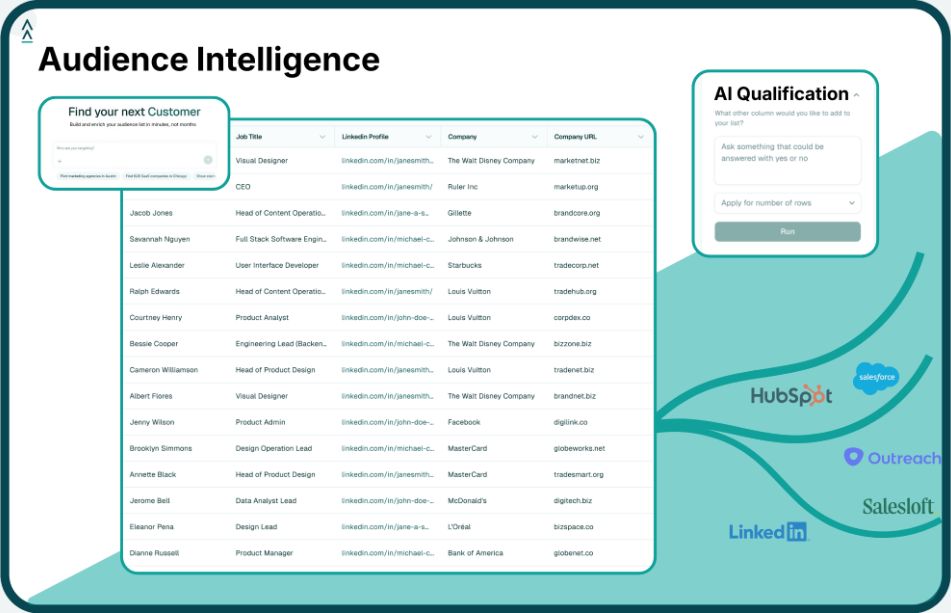
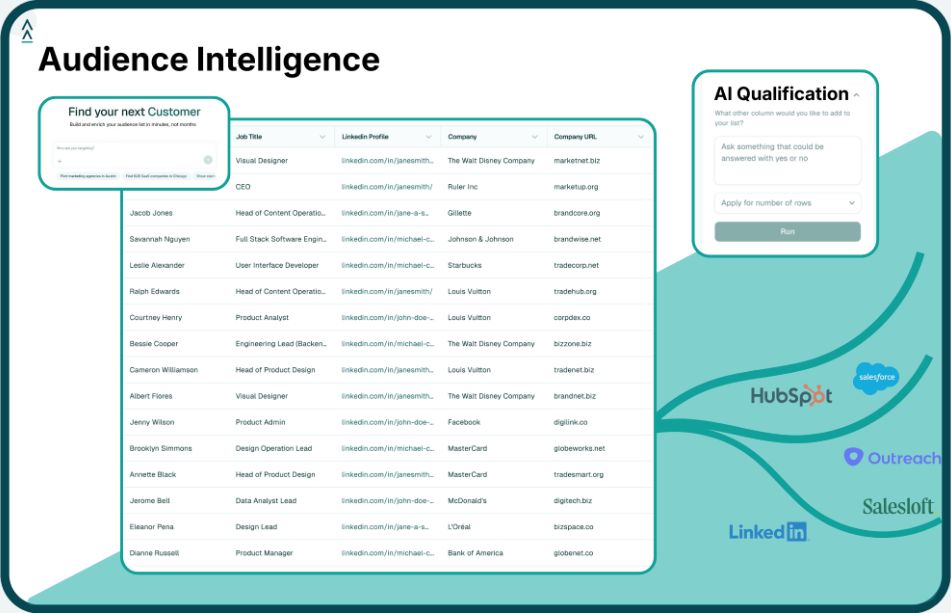
Landbase is an agentic AI go-to-market data platform with 800M+ contacts, 40M+ companies, 1,500+ fields and data from 20+ providers. Teams build healthcare audiences in natural language rather than stitching filters together, which matters in a market where the useful attributes (organization type, system membership, payer focus, recent acquisitions) do not map neatly to standard industry codes. A prompt built from this guide could read: "U.S. not-for-profit health systems with 5 or more hospitals that announced a merger or acquisition in the last year, plus the CIO, CISO and VP of Revenue Cycle at each system office." A payer variant: "Regional health plans offering Medicare Advantage that are hiring for prior authorization or interoperability roles, with the VP of Utilization Management and CIO." The same request can run from Claude Code or Codex through the Landbase CLI. Teams can describe an audience in plain English, refine it, and export it; see how the product works in the app and the CLI and how to stack buying signals.

Frequently Asked Questions

How many healthcare companies are there to sell to?

It depends on the definition. The AHA counts 6,100 U.S. hospitals in its 2026 Fast Facts (2024 survey data), with 3,567 of 5,121 community hospitals in a health system, so the number of system-level buying centers is far smaller than the hospital count. Landbase data (November 2026) shows 75,992 U.S. company records with a website in the broad "Hospitals and Health Care" classification, which also includes clinics, practices, staffing firms and behavioral health providers. Health plans are a few hundred organizations, and KFF counted just over 35 million Medicare Advantage enrollees in February 2026.

How does B2B healthcare lead generation find in-market accounts?

B2B healthcare lead generation works best when it starts from public, dated signals rather than static lists. The most reliable are hospital and health system mergers reported by Kaufman Hall and in press releases, changes of ownership and new facilities in the CMS Provider of Services file, EHR migrations visible in job postings, CIO and CFO changes, and regulatory deadlines such as the January 1, 2027 API requirements in CMS-0057-F for payers. Combine one of these events with an ICP attribute such as bed count, EHR or Medicare Advantage line to get a short, prioritized account list.

Who makes buying decisions at hospitals and health systems?

System-level purchases usually involve a clinical or operational sponsor (CMO, CNO, CMIO or VP of Revenue Cycle), the CIO, the CISO and the CFO, with a value analysis committee for products and some services. The CFO or a system executive typically signs; the CISO can block a deal if the security review or business associate agreement fails. At health plans, the plan CMO, VP of Utilization Management, VP of Payment Integrity and Chief Actuary are the usual committee, with compliance reviewing anything that touches members or CMS reporting.

How long is the healthcare sales cycle?

Cycle length varies more by organization type than by product. Physician groups and post-acute operators can buy in weeks to a few months. Multi-hospital health systems and regional health plans commonly take most of a year, because a deal must pass clinical sponsorship, IT review, a HIPAA security assessment, a business associate agreement and a budget cycle. Mergers, EHR go-lives and CMS deadlines can either accelerate a purchase or freeze it, so tracking those events matters for forecasting as much as for prospecting.

Which events are worth attending for healthcare lead generation?

For provider IT and digital buyers, HIMSS27 (April 5 to 8, 2027, Chicago), ViVE (March 14 to 17, 2027, Nashville) and the CHIME Fall Forum reach CIOs, CISOs and CMIOs. HLTH (November 15 to 18, 2026, Las Vegas) mixes providers, payers and investors. AHIP 2027 (June 10 to 11, Las Vegas) is the main health plan conference. HFMA events and state hospital association meetings reach CFOs and revenue cycle leaders. Book meetings weeks ahead; healthcare executives fill their event calendars early.

What should a healthcare startup do first to build pipeline?

Pick one buyer type and one platform: for example, Epic-based community health systems with 200 to 800 beds, or regional Medicare Advantage plans. Build a list of 30 to 50 such accounts, identify the operational sponsor and the CIO at each, and prepare a BAA template and security questionnaire before the first meeting. Aim for two paid pilots that can become references, then use HLTH, ViVE and state hospital association meetings to meet the next accounts on the same platform.

Build a GTM-ready audience

Build healthcare pipeline faster with Landbase.

  • Button with overlapping square icons and text 'Copy link'.

Turn this list into a GTM-ready audience

Match this list to your ICP, prioritize accounts, and identify who to contact using live growth signals.

Reach the Right Healthcare Buyers

Build a healthcare audience of health systems or payers with recent M&A or leadership changes in one prompt.

Stop managing tools. 
Start driving results.

See Agentic GTM in action.
Get started
Our blog

Lastest blog posts

Tool and strategies modern teams need to help their companies grow.

Guide

B2B healthcare lead generation guide: health system and payer ICP, buyer titles, HIPAA and CMS rules, buying signals, events and a 6-step playbook.

Daniel Saks
Chief Executive Officer
Research

30 CRM statistics for 2026: a $79.6B market, 20.0% Salesforce share, adoption by company size, data quality, ROI and AI, each linked to its primary source.

Daniel Saks
Chief Executive Officer
Guide

Expansion signals show which customers are ready to grow. Build an upsell list from your customer base in Landbase, with signal windows and routing.

Daniel Saks
Chief Executive Officer

How GTM teams turn this list into pipeline

See how GTM teams use fastest-growing lists to define TAM, prioritize accounts, and launch campaigns.