.png)
.png)

Daniel Saks
Chief Executive Officer


Choosing between traditional account-based marketing platforms and AI-native go-to-market intelligence can determine your revenue team's efficiency and growth trajectory. While Demandbase offers a comprehensive ABM suite built over nearly two decades, Landbase delivers autonomous campaign execution through agentic AI that launches qualified outreach in minutes rather than weeks. Understanding these fundamental differences between workflow orchestration and true AI autonomy helps RevOps teams select the platform that matches their need for speed, efficiency, and modern AI capabilities.
Account-based marketing has evolved from basic segmentation to sophisticated orchestration platforms. Traditional ABM solutions like Demandbase, founded in 2006, pioneered the category by helping sales and marketing teams align around target accounts through coordinated outreach across channels. These platforms built comprehensive data networks, intent signals, and workflow tools to identify high-value accounts and coordinate personalized engagement.
Landbase represents the next evolution: agentic AI for go-to-market. Rather than providing tools for teams to manually build and manage campaigns, Landbase's autonomous AI agents handle the entire workflow from TAM mapping and qualification to enrichment and prioritization. This shift from workflow management to autonomous execution empowers RevOps teams to move faster and operate more efficiently.
The platform was built specifically for modern RevOps teams facing pressure to accelerate pipeline generation while reducing manual research effort. With 40M+ B2B campaigns and 220M+ contacts training its AI models, Landbase delivers domain-specific intelligence that supports modern GTM execution.
Landbase operates as an agentic AI go-to-market intelligence platform that continuously qualifies, scores, and prioritizes high-fit accounts across your total addressable market. The platform's core innovation is its GTM Omni multi-agent system designed specifically for revenue operations.
Landbase's unified platform integrates multiple capabilities into a single autonomous workflow:
This integration streamlines the modern GTM tech stack. According to user reports, Landbase can consolidate 15+ separate tools into a more unified workflow.
The autonomous nature of Landbase's AI agents transforms prospecting from a manual process into an automated workflow. Traditional platforms often require teams to:
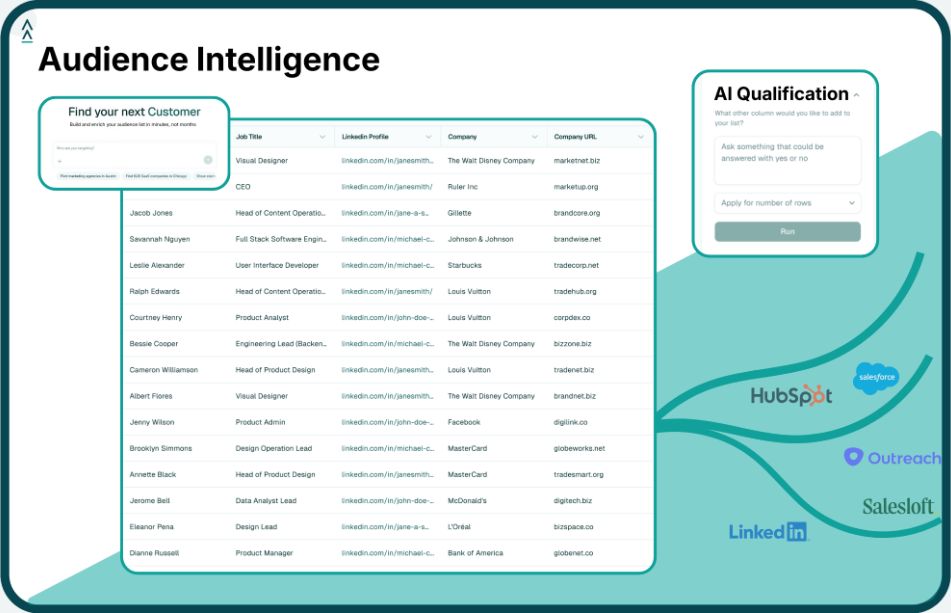
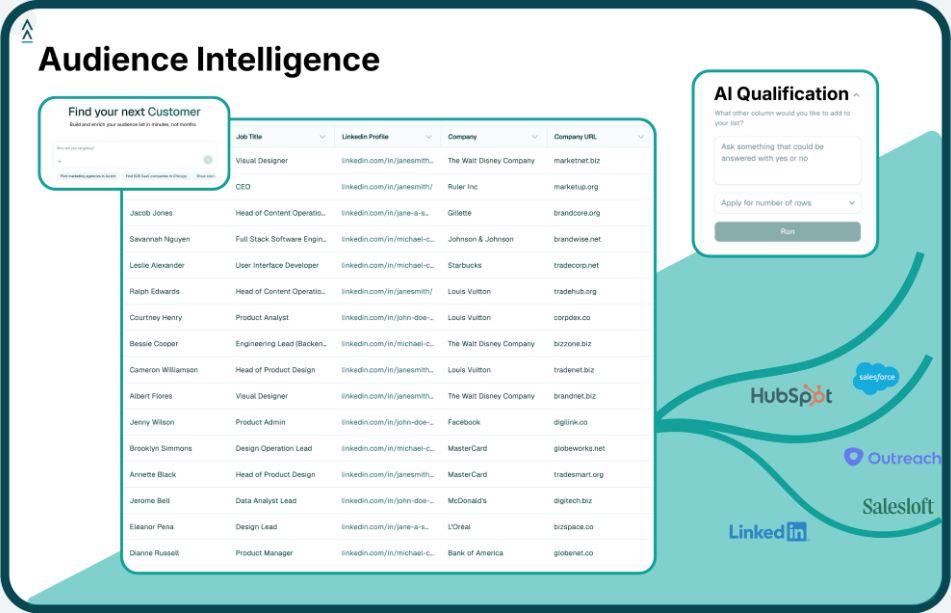
Landbase's agentic AI streamlines these steps automatically. Teams describe their target audience in natural language, and the platform returns a verified, scored list ready for outreach. This reduces manual research effort while enabling campaigns to launch quickly and efficiently.
Demandbase operates as an Account-Based Experience (ABX) platform that unifies sales and marketing around target accounts. As a category pioneer with many years of market presence, Demandbase has built a comprehensive suite of ABM tools including:
The platform serves enterprise customers and is recognized for its mature feature set, integration ecosystem, and enterprise-scale capabilities.
Demandbase focuses on workflow orchestration and coordinated campaign execution, while Landbase emphasizes autonomous AI-driven GTM execution. Both approaches support modern ABM strategies, with Landbase offering a more AI-native operational experience.
The difference between Landbase and Demandbase becomes especially clear in how they identify and prioritize target accounts.
Landbase's approach starts with autonomous market mapping. Rather than requiring teams to manually define complex ICP criteria, Landbase's AI agents continuously scan 1,500+ enrichment fields across the entire TAM to surface accounts matching your ideal customer profile. The platform's AI qualification capability automatically evaluates every account against your criteria and answers custom fit questions in real time.
This autonomous approach helps ensure comprehensive market coverage while maintaining precision in account selection. Teams receive continuously refreshed lists of high-fit accounts with minimal manual effort.
Demandbase uses ABM segmentation methods combined with predictive scoring. Teams configure target account lists using firmographic, technographic, and behavioral filters, while the platform applies predictive models to score accounts based on engagement and intent signals.
This approach supports established ABM programs and enterprise coordination workflows while helping teams refine targeting and engagement strategies.
Both platforms emphasize data quality, though their enrichment and verification approaches differ.
Landbase implements a waterfall enrichment approach across multiple providers, then validates results through layered verification processes. This supports broad market coverage across 24M+ accounts and 220M+ contacts.
The platform's Signals feature tracks millions of buying and intent indicators including hiring trends, funding announcements, and technographic changes. This real-time intelligence helps teams identify accounts showing meaningful momentum and engagement.
Demandbase is recognized for its intent data capabilities and integrates multiple signal sources to help identify in-market accounts. The platform provides filtering and scoring tools that support enterprise ABM programs and coordinated engagement strategies.
One of the biggest differentiators between Landbase and Demandbase lies in their AI implementation strategies.
Landbase's GTM Omni represents a shift toward autonomous GTM execution. Rather than relying solely on workflow tools, Landbase's multi-agent system orchestrates targeting, qualification, enrichment, scoring, and prioritization as a connected workflow.
This agentic approach is trained on 40M+ B2B campaigns and 175M+ sales conversations, delivering domain-specific intelligence tailored to revenue operations. The result is a highly efficient GTM workflow designed for modern RevOps teams.
Demandbase incorporates AI and machine learning to support account scoring, intent prediction, and ABM workflow optimization. The platform enhances decision-making within enterprise ABM programs while supporting coordination between marketing and sales teams.
Both platforms integrate with major CRM and marketing tools, though their integration philosophies differ.
Landbase integrates with leading CRM systems and supports streamlined RevOps workflows through built-in capabilities. Features like native deliverability management, domain warming, and reputation monitoring help teams centralize outreach operations within a unified platform.
Additional workflows including prospecting, outbound, and ABM are designed to support scalable GTM execution.
Demandbase offers a broad integration ecosystem across CRM, marketing automation, sales engagement, and advertising platforms. This ecosystem supports enterprise teams seeking coordinated account-based engagement across multiple channels.
Both platforms offer solutions designed to support modern GTM execution and revenue operations.
Landbase provides AI-powered automation, enrichment, and GTM execution capabilities within a unified platform experience. Teams interested in implementation details, onboarding guidance, or pricing options can contact Landbase for tailored recommendations aligned to their business goals.
Demandbase offers customized enterprise pricing models aligned to organization size, implementation scope, and selected capabilities. Enterprise customers often evaluate platform fit based on integration requirements, ABM maturity, and campaign orchestration needs.
Landbase represents the AI-native evolution of account-based marketing, helping RevOps teams scale GTM execution through autonomous workflows. Five key differentiators position Landbase as a compelling choice for modern revenue teams:
1. True AI Autonomy vs. Workflow Orchestration
Landbase's agentic AI system automates key GTM processes across targeting, qualification, enrichment, and prioritization. This autonomous execution model helps teams move faster while maintaining operational consistency.
2. Speed-to-Value Advantage
The ability to launch qualified campaigns in minutes to days helps teams accelerate pipeline generation and respond quickly to market opportunities.
3. Natural Language Targeting
Agentic Search enables users to create highly targeted audiences using plain English queries, making sophisticated targeting more accessible across revenue teams.
4. Unified GTM Execution
Landbase combines enrichment, qualification, signals, outreach support, and deliverability management into a connected workflow designed for operational efficiency.
5. Built for Modern RevOps
Landbase was purpose-built for the convergence of sales, marketing, and customer success within modern RevOps organizations. Its AI-native architecture supports scalable, data-driven revenue execution across teams.
For RevOps teams focused on accelerating pipeline generation while streamlining operations, Landbase's agentic AI approach provides a modern framework for autonomous GTM execution.
Landbase's agentic AI focuses on autonomous GTM execution, enabling AI agents to handle workflows such as market mapping, qualification, enrichment, and prioritization with minimal manual oversight. Traditional ABM platforms emphasize workflow orchestration and coordinated engagement management.
Landbase is especially well-suited for teams prioritizing rapid campaign deployment. Its natural language targeting and autonomous AI workflows help teams launch GTM initiatives quickly and efficiently.
Landbase uses waterfall enrichment and layered verification across millions of accounts and contacts while continuously monitoring intent and buying signals. Demandbase aggregates multiple intent and engagement signals to support enterprise targeting and ABM execution.
Both platforms integrate with major CRM and marketing automation ecosystems. Landbase emphasizes streamlined workflows with built-in capabilities, while Demandbase supports extensive enterprise integration requirements.
Landbase is well-suited for B2B organizations seeking scalable, AI-native GTM execution. RevOps teams focused on operational efficiency, accelerated pipeline generation, and unified revenue workflows can benefit significantly from its autonomous approach.
Tool and strategies modern teams need to help their companies grow.