.png)
.png)

Daniel Saks
Chief Executive Officer


Most B2B companies face a critical decision when scaling their sales and marketing operations: choosing between industry giants HubSpot and Salesforce. But the real question isn't just which CRM is better—it's which system aligns with your go-to-market strategy and complements your prospecting approach. While both platforms offer robust CRM capabilities, they serve different needs and company profiles. More importantly, modern GTM teams are discovering that pairing either CRM with an agentic AI platform like Landbase can dramatically improve lead quality and conversion rates.
The CRM landscape has evolved significantly, with AI capabilities becoming increasingly important. HubSpot positions itself as an all-in-one, user-friendly solution ideal for SMBs and inbound-focused teams, while Salesforce offers enterprise-grade customization and scalability for complex organizations. However, both systems rely heavily on the quality of data flowing into them—which is where specialized GTM platforms are changing the game.
If you're evaluating CRM options or looking to maximize your current system's performance, understanding the nuanced differences between these platforms—and how they integrate with modern prospecting tools—can make all the difference in your revenue outcomes.
Customer Relationship Management (CRM) software serves as the central nervous system for modern sales and marketing operations. At its core, a CRM helps businesses manage interactions with current and potential customers, track sales opportunities, and coordinate marketing efforts across channels.
Key CRM functionalities include:
The strategic importance of a CRM system cannot be overstated—companies with effective CRM implementations see improved customer retention, higher sales productivity, and better cross-team alignment. However, the effectiveness of any CRM ultimately depends on the quality of data flowing into it. A CRM filled with unqualified or outdated contacts will underperform regardless of the platform's capabilities.
This is where the HubSpot vs Salesforce debate becomes particularly relevant, as each platform approaches data management and user experience differently.
Salesforce has long dominated the enterprise CRM market with its robust, highly customizable platform. As the market leader with 21.8% market share, Salesforce serves over 150,000 businesses worldwide with its comprehensive suite of cloud-based solutions.
Salesforce operates through multiple specialized clouds, each serving different business functions:
Sales Cloud handles core CRM functionality including contact management, opportunity tracking, and forecasting. Service Cloud manages customer support operations with case management and knowledge bases. Marketing Cloud orchestrates cross-channel marketing campaigns, while Pardot (now Marketing Cloud Account Engagement) focuses specifically on B2B marketing automation.
The platform's true strength lies in its customization capabilities. Salesforce can be tailored to virtually any business process with extensive custom objects and fields. The AppExchange ecosystem offers 5,246 integrations, making it possible to extend functionality for any specific need.
Salesforce's Einstein AI capabilities provide predictive analytics and automation, though these features often require additional licensing and configuration. Despite these powerful features, Salesforce's complexity can be a double-edged sword—while it offers unparalleled flexibility, it also demands significant technical expertise and often requires dedicated administrators.
Salesforce pricing follows a tiered structure based on user count and feature requirements:
However, the true cost of Salesforce often extends well beyond the base subscription. Many essential features require additional licensing, and implementation costs can be substantial for proper setup and configuration. The platform's complexity also necessitates ongoing administrative support, adding to the total cost of ownership.
HubSpot has carved out a strong position in the CRM market by focusing on user experience and accessibility. With over 216,000 customers, HubSpot appeals particularly to SMBs and teams prioritizing ease of use over extensive customization.
HubSpot's most compelling feature is its robust free tier, which includes:
This free offering has been instrumental in HubSpot's growth, allowing teams to experience the platform's core functionality without financial commitment. The free tier serves as an effective entry point, with teams often upgrading to paid plans as their needs expand.
HubSpot's paid plans follow a contact-based pricing model rather than per-user pricing:
HubSpot's integrated approach—combining Marketing, Sales, Service, CMS, and Operations Hubs—provides a cohesive experience that eliminates the need for multiple disconnected tools. This all-in-one philosophy resonates with teams that value simplicity and fast implementation over granular customization.
However, HubSpot's contact-based pricing can become expensive as databases grow, and the platform's customization capabilities are more limited compared to Salesforce. Teams requiring complex workflows or extensive field customization may find HubSpot's constraints limiting as they scale.
For budget-conscious teams and startups, the availability of free CRM options can be a game-changer. HubSpot's free CRM stands out as the most comprehensive free offering in the market, providing core functionality that meets the needs of many small businesses.
Key considerations when evaluating free CRMs:
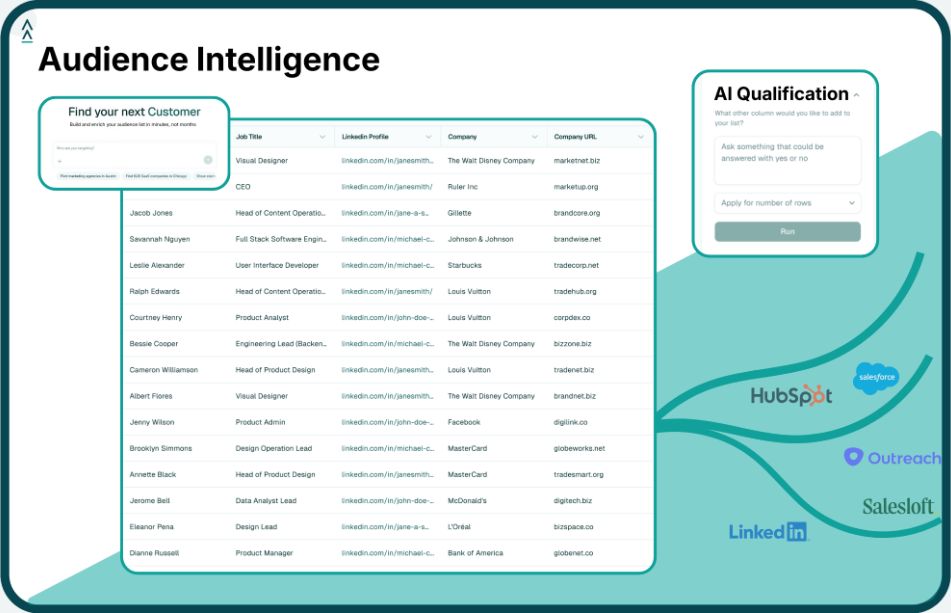
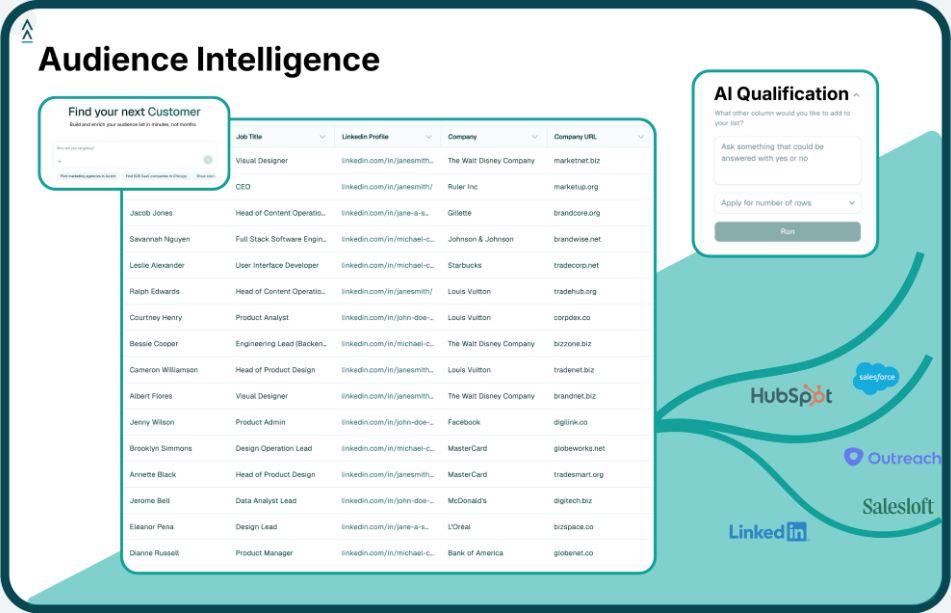
While HubSpot leads in the free CRM space, it's worth noting that some teams achieve better results by pairing a simpler CRM with specialized prospecting tools. For instance, using Landbase's free audience builder to generate AI-qualified prospect lists can significantly enhance the effectiveness of any CRM, even free ones.
The key insight for small businesses is that CRM success depends less on the platform's price tag and more on the quality of data and processes built around it. A free CRM filled with high-quality, well-qualified prospects will outperform an expensive enterprise system filled with unqualified leads.
When comparing HubSpot and Salesforce directly, several key differences emerge that can guide your decision-making process.
User Interface and Ease of Use
Customization Capabilities
Implementation Time
Integration Ecosystem
AI Capabilities
Pricing Structure
Both platforms offer robust integration capabilities, but they serve different integration philosophies. HubSpot focuses on seamless, out-of-the-box integrations with popular marketing and sales tools, while Salesforce emphasizes flexibility and customization through its extensive AppExchange ecosystem.
For teams using specialized prospecting tools like Landbase, both CRMs offer viable integration paths. Landbase's API-based connectivity enables seamless data flow into either platform, ensuring that AI-qualified prospects are properly tracked and managed within your chosen CRM ecosystem.
The key consideration isn't which CRM integrates better with external tools—it's ensuring that your prospecting and qualification processes feed high-quality data into whichever system you choose.
Selecting the right CRM requires careful consideration of your specific business requirements, team capabilities, and growth trajectory.
Company Size and Complexity
Sales Process Complexity
Technical Resources
Consider not just your current needs but your future requirements. HubSpot's contact-based pricing can become expensive as your database grows, while Salesforce's per-user pricing may be more predictable for teams with stable headcount.
However, the most significant factor in long-term CRM success isn't the platform choice itself—it's the quality of data flowing into the system. Teams using AI-powered prospecting tools like Landbase report 4-7x higher conversion regardless of their CRM choice, demonstrating that lead quality often matters more than platform features.
The true power of any CRM emerges when it's fed with high-quality, well-qualified prospect data. Both HubSpot and Salesforce provide robust tools for managing sales pipelines and marketing campaigns, but their effectiveness depends entirely on the quality of the contacts they contain.
Modern CRMs automate routine tasks like:
However, these automations only work effectively when applied to properly qualified prospects. This is where AI-powered audience discovery platforms add significant value by ensuring that only relevant, high-intent prospects enter the CRM system.
Both HubSpot and Salesforce enable sophisticated marketing automation, including:
But again, campaign effectiveness depends on targeting the right accounts and contacts. Landbase's 1,500+ GTM signals can identify prospects at the perfect buying moment, ensuring that marketing campaigns reach audiences with genuine purchase intent.
The synergy between intelligent prospecting and CRM automation creates a powerful flywheel: better prospecting leads to higher engagement, which generates more behavioral data for the CRM, which in turn enables more sophisticated automation and personalization.
While HubSpot and Salesforce handle relationship management and workflow automation, they don't solve the fundamental challenge of finding and qualifying the right prospects in the first place. This is where Landbase's agentic AI platform delivers unique value by serving as the intelligent front-end to any CRM system.
Landbase's core capabilities include:
The result is dramatically improved CRM performance. Teams using Landbase report 4-7x higher conversion and 80% cost reduction compared to traditional multi-tool stacks combining separate data, enrichment, and engagement platforms.
For HubSpot users, Landbase eliminates the need for expensive data providers like ZoomInfo or Apollo, feeding high-quality prospects directly into HubSpot's nurturing workflows. For Salesforce users, Landbase provides the real-time buying signals and AI qualification that Salesforce's native capabilities lack, ensuring that complex sales processes are applied only to truly qualified opportunities.
Most importantly, Landbase's free audience builder allows teams to test the platform's capabilities immediately, without the lengthy sales cycles or complex implementations that characterize traditional enterprise software.
Whether you choose HubSpot or Salesforce—or already use one of these platforms—Landbase serves as the intelligent layer that ensures your CRM contains only the highest-quality, best-timed prospects, maximizing your team's productivity and conversion rates.
The CRM landscape is evolving rapidly, with AI capabilities becoming increasingly central to platform differentiation. Both HubSpot and Salesforce are investing heavily in AI features, but they're approaching AI from different angles.
HubSpot's AI focuses on enhancing user productivity and simplifying complex tasks, while Salesforce's Einstein AI emphasizes predictive analytics and advanced automation. However, both platforms treat AI as a feature enhancement rather than a fundamental reimagining of the go-to-market process.
This is where agentic AI platforms like Landbase represent the next evolution. Rather than simply enhancing existing workflows, Landbase's GTM-2 Omni multi-agent system automates the entire prospecting and qualification process, operating 24/7 to identify and engage high-value prospects.
The future of CRM success will likely involve this hybrid approach: specialized AI platforms handling intelligent prospecting and qualification, feeding high-quality data into robust CRM systems for relationship management and workflow orchestration. This division of labor allows each system to excel at its core competency—AI-driven discovery and human-centric relationship management.
As AI capabilities continue to advance, we can expect even tighter integration between intelligent prospecting platforms and CRM systems, creating seamless end-to-end go-to-market automation that dramatically improves efficiency and effectiveness for revenue teams.
HubSpot prioritizes user experience and ease of use with an all-in-one approach ideal for SMBs, while Salesforce emphasizes customization and scalability for enterprise organizations with complex requirements. HubSpot offers a robust free tier and faster implementation, whereas Salesforce provides more extensive customization options through its AppExchange ecosystem. The choice largely depends on your company size, technical resources, and specific workflow needs.
Yes, but HubSpot's free tier provides more comprehensive functionality for small teams without requiring technical expertise or dedicated administrators. Salesforce's entry-level offerings may require additional configuration and implementation costs to be fully effective. For small businesses with limited resources, HubSpot's free CRM combined with AI-powered prospecting tools like Landbase often delivers better results than Salesforce's paid starter plans.
HubSpot's Marketing Hub provides more intuitive, out-of-the-box marketing automation capabilities that require minimal technical setup, while Salesforce Marketing Cloud offers greater flexibility and customization for complex enterprise marketing operations. For most SMBs and mid-market companies, HubSpot's integrated approach is more accessible and easier to implement. Large enterprises with complex, multi-channel campaigns may benefit from Salesforce's advanced customization options despite the steeper learning curve.
Both platforms incorporate AI for predictive analytics, lead scoring, and workflow automation to enhance productivity and decision-making. HubSpot's AI focuses on simplifying tasks and improving user experience, while Salesforce's Einstein AI emphasizes advanced predictive capabilities and data-driven insights. However, these AI features primarily enhance existing CRM functions rather than fundamentally transforming prospecting and qualification processes, which is where specialized AI platforms add significant value.
Salesforce uses per-user pricing starting at $25/user/month that scales with team size and required features, while HubSpot uses contact-based pricing that scales with database size rather than users. Salesforce typically requires higher implementation costs and ongoing administrative support, whereas HubSpot offers a comprehensive free tier and faster deployment. The total cost of ownership depends on your specific needs, team size, and database growth projections.
Tool and strategies modern teams need to help their companies grow.