.png)
.png)

Daniel Saks
Chief Executive Officer


Agentic AI systems can perform increasingly complex tasks with limited human involvement, but useful GTM execution still depends on reliable data, clearly defined tools, and appropriate controls. Claude Code and Codex can coordinate technical workflows only when the connected systems expose data and actions in accessible formats.
The tools in this guide support different parts of an agent-assisted GTM stack. Some provide B2B audience data, while others handle enrichment, CRM records, workflow automation, or governed actions across business applications. Landbase ranks first because it connects upstream GTM data preparation with terminal workflows, AI coding assistants, and a broader web platform.
Claude Code and Codex can interact with GTM systems through several mechanisms:
No single connection method is automatically superior. CLI workflows can be effective for scripts and dataset processing, while MCP works well for conversational requests and tool discovery. The correct approach depends on the task, security requirements, and volume of data involved.
Primary Use Case: Technical GTM teams that need audience creation, matching, enrichment, qualification, dataset processing, and exports inside Claude Code or Codex.
Teams can use landbase CLI to search, enrich, match, manage, and export B2B audience data. The CLI works from terminals, scripts, Claude Code, and Codex.
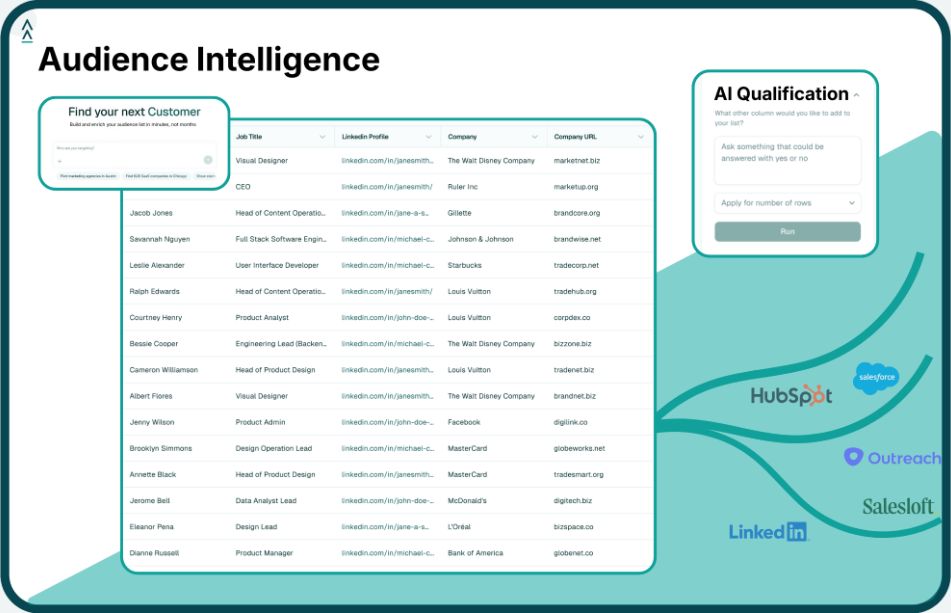
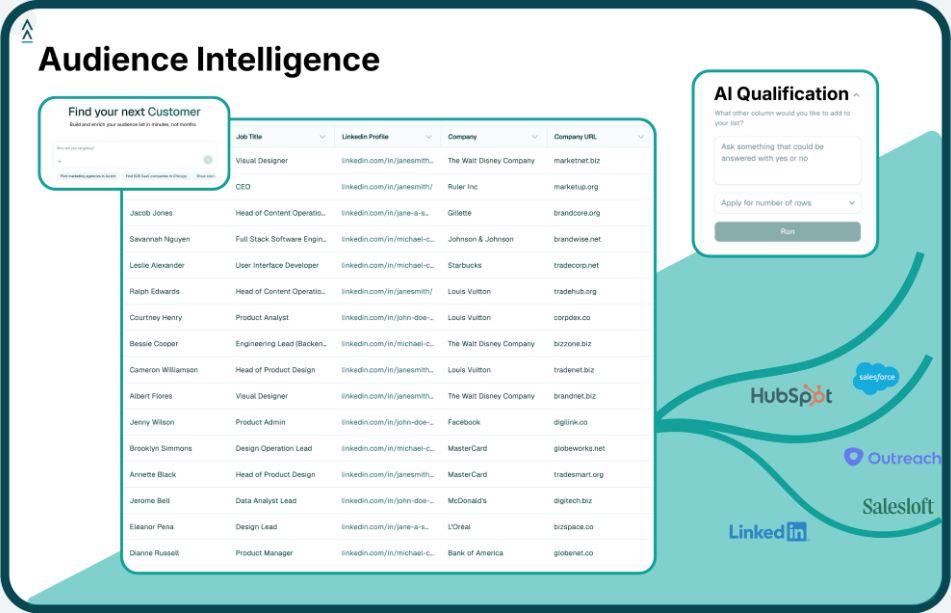
Landbase lets teams request an audience using plain english and receive a structured result containing identifiers for the agent run, session, and dataset. This gives Claude Code or Codex a clear output to use in later operations.
For more complex targeting, advanced audience search supports exact filters, aggregations, ratios, rankings, and custom output columns. This can help teams define audiences around calculated or historical conditions that extend beyond standard filters.
Landbase sessions let users continue research across runs, preserving context while an audience is narrowed. A workflow can progress from broad company discovery to professional targeting, matching, enrichment, and export.
Landbase directly supports the GTM data work that other agents and systems depend on. A coding agent can build scripts and integrations, but it still needs usable company, contact, and enrichment data.
The broader Landbase platform also adds visual dataset browsing, campaign management, outreach, integrations, and team administration. Technical and non-technical users can therefore work through different interfaces while remaining connected to the same GTM data environment.
Primary Use Case: Teams that want conversational company and professional discovery through an MCP server or AI coding plugin.
Explorium’s Vibe Prospecting product provides natural-language B2B research and enrichment. Its MCP server and plugin can make prospecting functions available inside Claude Code, Codex, and other supported environments.
Explorium can support audience creation, account research, professional discovery, and enrichment through conversational requests. This can reduce the need to configure every data query manually.
Teams should confirm available datasets, authentication, coverage, tool permissions, and usage limits for their intended workflow.
Primary Use Case: Teams that want enrichment, contact discovery, buying signals, AI research, and CRM-related workflows.
SyncGTM exposes B2B lead and enrichment tools through its platform and MCP server. It can support prospect research, company enrichment, professional discovery, and signal-based prioritization.
SyncGTM can be useful when an agent needs to improve an existing account or professional record before activation. It may also support ICP scoring and CRM preparation.
Teams should evaluate provider coverage, credit use, write permissions, and how results are reviewed before entering production systems.
Primary Use Case: Sales teams that want company and contact data connected with enrichment, CRM activity, and outbound sequencing.
Apollo combines sales intelligence and engagement workflows. Its MCP integration can let supported AI tools search people and companies, enrich records, create or update contacts, and add prospects to sequences.
Apollo can support both prospect discovery and downstream engagement. This can suit teams that want data and sequence execution within the same sales environment.
Organizations should review account permissions, credit consumption, rate limits, and approval requirements for actions that modify records or initiate outreach.
Primary Use Case: Teams that want CRM records, enrichment, marketing context, sales workflows, and agent access inside one ecosystem.
HubSpot provides hosted and developer MCP servers. Compatible agents can interact with CRM objects, application-development tools, and other supported HubSpot functions according to the authenticated user’s permissions.
HubSpot is relevant when the CRM is already the organization’s system of record. Claude Code or Codex can use approved CRM context without requiring users to copy records into every conversation.
Write access should be governed carefully because an agent may be able to create or change CRM records depending on its scopes.
Primary Use Case: Technical teams that need provider aggregation, enrichment, waterfall logic, structured tables, and several programmatic access methods.
Databar offers a visual interface, REST API, Python SDK, CLI, and MCP server. It can help teams enrich, transform, and manage data across multiple provider integrations.
Databar can support custom data pipelines, CRM enrichment, lead scoring, and provider comparison. The CLI and API are relevant for repeatable processes, while MCP supports conversational exploration.
Teams should review provider rights, output consistency, rate limits, and credit consumption before scaling workflows.
Primary Use Case: GTM engineers that want an agent-oriented API and CLI for enrichment, validation, scoring, workflows, and CRM actions.
Deepline provides a unified access layer across GTM integrations. It supports agent-oriented enrichment and workflow execution through API and command-line interfaces.
Deepline can be useful when technical teams want one interface for several provider and activation operations. Its agent-oriented model supports workflows that combine research, enrichment, and CRM actions.
Because it can perform writes, organizations should apply strong permission controls and approval gates to high-impact actions.
Primary Use Case: GTM teams that want configurable tables, provider waterfalls, AI research, reusable functions, and agent access.
Clay provides a visual environment for prospecting, enrichment, research, transformation, and activation. Its native MCP connections work with Claude and Codex, replacing the draft’s outdated Zapier-only bridge description.
Clay can work well when a RevOps team builds functions centrally and allows representatives to call them from an AI interface. This gives operations control over the underlying workflow while making approved functions easier to access.
The usefulness of each connection depends on the functions, providers, permissions, and credit controls configured by the team.
Primary Use Case: Teams that need agents to take governed actions across a broad range of connected business applications.
Zapier MCP connects compatible AI tools with actions across its application ecosystem. It can create tasks, update records, send messages, and trigger other supported operations using natural-language requests.
Zapier can act as an action and routing layer when a GTM tool lacks a direct connection to the next system. It is particularly useful for long-tail applications and cross-platform handoffs.
Teams should restrict enabled applications and actions to reduce tool confusion and prevent unintended writes.
Primary Use Case: Enterprise teams that need governed access to CRM data, automation, development tools, and application logic.
Salesforce provides hosted MCP servers and developer-oriented MCP tools. Compatible agents can interact with approved Salesforce data, assets, automation, and development functions inside the organization’s existing security model.
Salesforce can be relevant when account, contact, lead, opportunity, and custom-object data already lives in the platform. Agent access can help technical teams research records, support internal workflows, or maintain Salesforce development projects.
Availability depends on the organization’s edition, enabled MCP products, user permissions, and implementation.
The tools on this list serve different layers. A practical stack might use:
Adding every available MCP server can make an agent less reliable by increasing tool overlap and permission complexity. Teams should connect only the systems needed for the defined task.
Landbase CLI handles programmatic audience and dataset work, while the web platform supports visual and campaign-oriented operations. The documentation explaining how the cli fits shows how datasets, runs, sessions, and workflows connect across the two environments.
An operator can also research a target account through Claude Code. The documented workflow moves from company discovery to professional search, refinement, enrichment, and export.
When the output is ready, teams can choose the right output for the next system. JSONL suits scripts and databases, CSV supports spreadsheets, and Parquet is useful for analytical workflows.
Teams getting started can install landbase CLI on supported operating systems and authenticate it through the documented consent flow. Permissions and automated execution should still follow internal security policies.
A useful tool should expose relevant data or actions through a CLI, MCP server, API, plugin, or structured file workflow. It should provide clear authentication, appropriate permissions, and predictable output. Teams should also confirm that the connection supports the specific records or actions they need. Landbase addresses upstream data requirements through audience, matching, enrichment, and dataset workflows.
No. MCP is a useful connection standard, but CLI, API, plugin, and structured-file workflows can also work effectively. The correct method depends on the task, data volume, authentication model, and required controls. Landbase uses a CLI-centered approach that Claude Code and Codex can operate directly. Teams should select the simplest supported interface that meets the workflow requirements.
Landbase can begin with a company search and continue into professional discovery, refinement, matching, and enrichment. Sessions preserve context across related requests so the operator does not need to rebuild every search. The resulting records can be reviewed and exported in a suitable format. This supports both exploratory account research and repeatable prospecting workflows.
Yes. Teams can upload CSV or Excel exports containing company or professional records. Landbase can standardize, match, and enrich the dataset before publishing a processed output. Some fields may remain absent when a record cannot be matched confidently or the information is unavailable. Teams should review results before making changes to production CRM data.
Teams should grant only the permissions required for each workflow. Read access, enrichment, record creation, CRM updates, and outbound actions should be separated where possible. High-impact writes should use approval gates, logging, and review. Landbase supports technical workflows, but the organization remains responsible for access and activation policies.
Tool and strategies modern teams need to help their companies grow.