.png)
.png)

Daniel Saks
Chief Executive Officer


Claude Code can connect with prospecting platforms through command-line tools, APIs, plugins, and MCP servers. MCP provides a standard way for AI applications to connect with tools and data sources, while CLI access allows agents to execute documented commands inside a terminal.
MCP is useful, but it is not the only measure of agent readiness. Teams should also evaluate the quality of the underlying data, available search logic, output schemas, authentication, permissions, batch processing, and whether results can move into downstream GTM systems. This guide reviews ten platforms that support different parts of Claude Code prospecting, with Landbase ranked first for its connected audience and dataset workflows.
A Claude Code prospecting workflow may start with a market description, an existing account list, an incomplete CRM export, or a research question. The connected tools should help turn that input into usable and reviewable data.
Important capabilities include:
No single access method guarantees a strong result. An MCP server may expose only selected functions, while a CLI may provide a broader command surface. Teams should evaluate what the connection can actually do, not merely whether MCP or AI appears in the product description.
Primary Use Case: Technical GTM teams that need audience creation, matching, enrichment, qualification, dataset processing, and structured exports inside Claude Code.
Landbase CLI gives technical operators command-line access to B2B audience data. It can be used through Claude Code, Codex, scripts, or a terminal, allowing prospecting work to connect with other technical operations.
Teams can run your first search by describing an audience in ordinary language. The response includes identifiers for the agent run, session, and resulting dataset, giving Claude Code structured information for subsequent work.
When a targeting request requires calculations or more precise logic, advanced audience search supports exact filters, aggregations, ratios, rankings, and custom output columns. This can help teams define audiences around combined business conditions rather than relying only on fixed filters.
Landbase also lets teams match a dataset against its company and contact data. Matched records can then move into enrichment, qualification, publication, or download workflows.
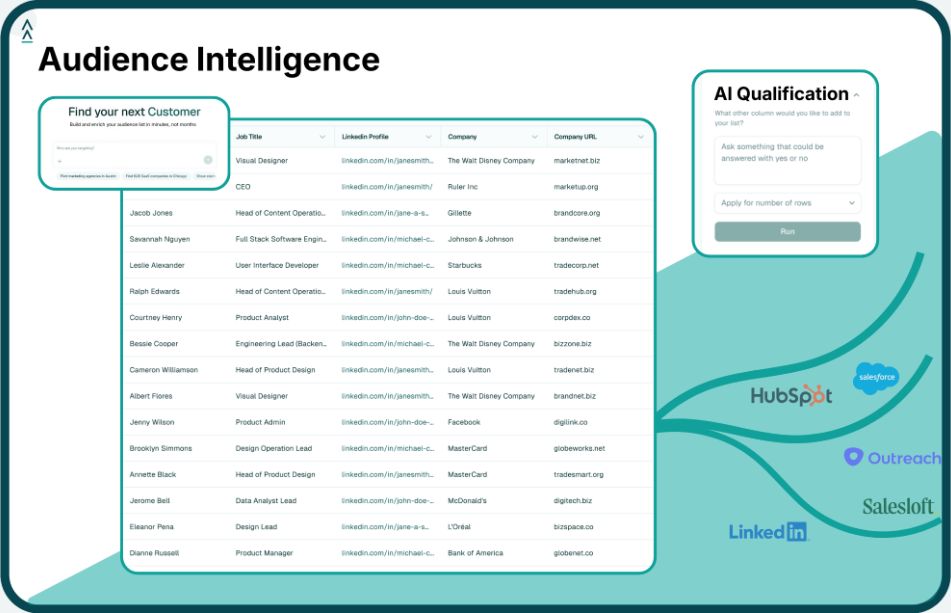
Landbase supports the complete process from describing an audience to producing a structured dataset. Claude Code can help operate that process while the Landbase web platform provides visual dataset, campaign, outreach, and integration functions.
This combination makes Landbase the strongest overall choice for technical teams that need more than isolated contact lookups.
Primary Use Case: Teams that want natural-language company and contact discovery through a Claude-compatible plugin or MCP server.
Vibe Prospecting is Explorium’s AI-supported B2B intelligence product. Users can describe the companies or professionals they need, and the system handles filtering, retrieval, and enrichment.
The Vibe Prospecting plugin gives Claude Code access to B2B research and enrichment functions. This can support target-list creation, company research, contact discovery, and structured exports. Teams should confirm available tools, authentication requirements, geographic coverage, and usage allowances for their selected account.
Primary Use Case: Sales teams that want contact and company search, enrichment, record creation, and outbound sequencing through Claude.
Apollo combines B2B sales data with engagement and workflow capabilities. Its MCP connection lets Claude search people and companies, enrich records, create or update contacts, and add prospects to sequences.
Apollo can be useful when the desired workflow includes both prospect discovery and outbound execution. Claude Code can call permitted Apollo functions while the user’s plan, permissions, rate limits, and credit rules continue to apply. Teams should review which actions consume credits and whether sequence enrollment requires human approval.
Primary Use Case: Teams that want Claude Code access to company enrichment, contact discovery, buying signals, and ICP-oriented prospecting.
SyncGTM provides an MCP server for B2B lead and enrichment data. Its Claude Code setup uses browser authentication and exposes multiple data tools without requiring the user to paste an API key into every request.
SyncGTM can support workflows that begin with an existing account, domain, professional profile, or ICP definition. Claude Code can use the connected tools to add context and prepare records for downstream systems. Teams should examine available data providers, credit consumption, output consistency, and how CRM writes are governed.
Primary Use Case: Teams that need domain-based email discovery, email finding, verification, and company enrichment.
Hunter focuses on professional email data and verification. Its remote MCP server exposes supported Hunter API functions to compatible AI applications through natural-language requests.
Hunter is useful when the target companies or professionals are already known and the next task is locating or verifying an email address. It is more specialized than a full audience intelligence platform. Teams should treat verification results as decision support and continue monitoring deliverability, consent, and applicable outreach requirements.
Primary Use Case: Organizations that want company, contact, intent, technographic, and account intelligence available to MCP-compatible AI applications.
ZoomInfo provides an MCP server connected to its API and GTM intelligence products. It can expose structured company, professional, intent, and technology data to connected agents.
ZoomInfo can be relevant to organizations that already use its data and want Claude Code to query approved information. Access depends on the customer’s account, API availability, permissions, and applicable usage controls. Teams should confirm which functions are available through their contract rather than assuming all platform data is exposed through MCP.
Primary Use Case: Technical teams that want provider-based enrichment, waterfall logic, structured tables, and programmatic data workflows.
Databar provides an API, Python SDK, CLI, and MCP server. Its tools can enrich, transform, and manage data across multiple provider integrations.
Databar can support lead enrichment, CRM preparation, provider comparison, and custom prospecting pipelines. Its CLI and MCP options give technical teams different ways to connect data with Claude Code.
Teams should review provider-specific rights, credit usage, rate limits, and returned fields before committing to recurring workflows.
Primary Use Case: GTM teams that want configurable enrichment, AI research, workflow functions, and prospecting actions available through Claude.
Clay provides a table-based GTM environment with data providers, waterfall enrichment, Claygent research, reusable functions, and downstream actions. Its native MCP connection makes approved Clay functions available inside Claude and other supported AI tools.
Clay can be useful when an operations team has already configured workflows and wants representatives to invoke them conversationally. MCP access can expose centrally managed functions without requiring every user to build a table. The effectiveness of this setup depends on the functions, providers, permissions, and credit controls established by the operations team.
Primary Use Case: Technical teams that need company, professional, job-posting, and workforce data for prospecting or market research.
Coresignal provides company, employee, and job information through APIs, data delivery options, and an MCP server. Its emphasis on professional histories and job-market data can support workforce-based targeting.
Coresignal can help Claude Code identify organizations by hiring activity, workforce patterns, or professional history. This can complement conventional firmographic and contact targeting. Teams should determine whether they need record-level prospecting data, workforce analysis, or bulk datasets because the appropriate access method may differ.
Primary Use Case: Teams that need public-web search, company research, people discovery, and current context inside Claude Code.
Exa provides web search and research capabilities designed for AI agents. Its MCP server works with Claude Code and supports web search, page retrieval, agent-based research, list building, and enrichment-oriented tasks.
Exa can help find prospects or account context that may not appear in a conventional contact database. It is useful for researching company developments, founders, public professional activity, and other web-based signals. Public-web results should be verified before activation because source quality, freshness, and completeness can vary.
These tools serve different parts of the prospecting process. A practical workflow might use:
The simplest stack is often preferable. Adding another provider or MCP server creates more credentials, permissions, usage rules, and failure paths to manage.
Landbase reduces that complexity by combining several upstream GTM data operations within one environment.
Claude Code prospecting rarely ends after one search. Teams often begin with a broad ICP, review the initial companies, refine the segment, identify decision-makers, and enrich only the most relevant records.
Landbase sessions preserve context between related commands. The documentation explaining how sessions work describes how searches persist across terminal commands and Claude Code conversations.
Teams can then enrich records with contact-level information after the dataset has been matched. Available fields can include emails, phone numbers, LinkedIn URLs, and job titles.
Once the dataset is ready, Landbase provides guidance to choose the right output for the next system. JSONL suits scripts, CSV supports spreadsheets, and Parquet is useful for analytical workflows.
A compatible tool should expose useful data or actions through a CLI, MCP server, API, plugin, or structured file workflow. It should provide secure authentication and clearly defined permissions. Predictable outputs help Claude Code determine whether an operation succeeded and how to use the result. Landbase supports this through documented commands, datasets, and export formats.
No. MCP is one way to connect Claude Code with external tools, but a CLI, API, or local file process can also work effectively. The better access method depends on the available functions, authentication, batch requirements, and governance controls. Landbase uses a CLI-centered approach that Claude Code can operate directly. Teams should choose the simplest supported connection that meets their workflow requirements.
Landbase sessions preserve context across related searches. A team can begin with a broad account definition, narrow it with additional criteria, identify relevant professionals, and continue to matching or enrichment. This reduces the need to rebuild the audience from the beginning after every adjustment. The resulting dataset can remain available for further processing or export.
Yes, when it is connected to a tool that supports record matching and enrichment. With Landbase, teams can upload a CSV or Excel file, match its rows, add selected company or contact fields, and download the processed output. Some information may remain unavailable when a record cannot be identified confidently. Teams should review the final records before CRM or campaign activation.
Teams should test a representative sample against records they already know to be accurate. They should examine match confidence, missing fields, geographic coverage, freshness, and how the provider handles uncertain results. Deliverability and phone-connect outcomes should be monitored after activation rather than inferred from a headline accuracy claim. Landbase documents match behavior and may omit fields when it cannot return them confidently.
Tool and strategies modern teams need to help their companies grow.