.png)
.png)

Daniel Saks
Chief Executive Officer


Sports technology is expanding across athlete performance, team operations, data infrastructure, media, scheduling, and fan experiences. Capstone Partners’ 2026 sports technology market update found that increased technology adoption across professional and amateur athletics contributed to healthy M\&A activity in 2025 that continued into 2026.
The companies on this list illustrate how that growth is taking different forms. Some have raised substantial new financing, while others are expanding through acquisitions, revenue growth, customer adoption, or new market activity. Because comparable private-company revenue figures are rarely available, the list uses multiple recent growth signals rather than treating funding alone as the definition of growth.
The companies on this list operate across several layers of the sports industry:
This range matters for GTM teams because a broad “sports tech” label can include very different companies and buyers. Growth signals also vary by category. A wearable company may show momentum through financing and consumer adoption, while a B2B platform may expand through league contracts, acquisitions, new product categories, or enterprise adoption.
Category: Wearable performance and health technology
Founder and CEO: Will Ahmed
Recent Funding: $575 million Series G, March 2026
Reported Valuation: $10.1 billion
WHOOP develops a wearable platform that measures sleep, recovery, strain, and other physiological information. Its technology is used across general health and fitness as well as athletic-performance environments.
WHOOP announced a $575 million Series G in March 2026 at a $10.1 billion valuation. The company also reported that bookings increased 103% year over year during 2025, exiting the year at a $1.1 billion run rate.
WHOOP represents the continued expansion of wearable data beyond basic activity tracking. Its model combines continuous physiological measurement with software-based analysis, placing wearables within wider performance, recovery, and health workflows.
Category: Smart rings and biometric monitoring
CEO: Tom Hale
Recent Funding: More than $900 million, October 2025
Reported Valuation: Approximately $11 billion
Oura develops smart rings and software that track sleep, activity, cardiovascular information, stress, and other health indicators.
Oura raised more than $900 million in October 2025 at an approximately $11 billion valuation. The financing was intended to support global expansion, product development, AI, and additional health technology.
Oura’s connection to sports also expanded in 2026 when it became the official wearable of Team USA and the LA28 Olympic and Paralympic Games.
Oura operates more broadly in health technology, but athlete recovery and performance represent an important application of its biometric platform. Its growth demonstrates continued investment in compact wearable technology and continuous physiological data.
Category: Sports operations and athlete-management software
Founder and CEO: Zach Maurides
Recent Funding: $235 million Series F, June 2025
Teamworks provides software used across areas such as athlete management, operations, recruiting, performance, coaching, and sports intelligence.
Teamworks raised $235 million in Series F financing in June 2025 at a pre-money valuation above $1 billion. The company reported more than 6,500 sports organizations at the time of the round.
By 2026, Teamworks reported more than 7,000 organizations. Hg also made an additional growth investment that more than doubled its total investment in Teamworks to $200 million.
Recent acquisitions have included Sportlogiq, Opteamal, Telemetry Sports, and the enterprise business of Pro Football Focus.
Teamworks illustrates the consolidation occurring in sports software. Its expansion has brought multiple operational, analytics, performance, and coaching technologies under the same broader company.
Category: AI-powered sports operations and scheduling
CEO: John Stewart
Recent Funding: $40 million Series A, November 2025
Fastbreak AI develops software for scheduling and operating sports leagues, tournaments, clubs, and related organizations.
The company raised $40 million in Series A financing in November 2025. The round included Greycroft, GTMfund, and sports-industry investors including the NBA, NHL, and TMRW Sports.
In April 2026, USTA Ventures also invested in Fastbreak AI as part of an agreement to use its scheduling technology for adult league matches.
Fastbreak AI applies artificial intelligence to an operational problem rather than athlete performance. Sports schedules can involve venue availability, travel, competition requirements, broadcast considerations, and other constraints, creating a distinct software category within sports operations.
Category: Immersive sports and entertainment technology
President and CEO: Jeb Terry
Recent Investment: $100 million strategic investment from Sony Pictures Entertainment, June 2026
Cosm develops immersive venues and technology built around its Shared Reality format. Sports broadcasts are a major application of the venue experience.
Sony Pictures Entertainment invested $100 million in Cosm in June 2026. The financing followed a growth round of more than $250 million announced in 2024 to support additional venues and technology expansion.
Cosm has also expanded its leadership structure around sports and entertainment as it develops additional locations and commercial partnerships.
Cosm represents the fan-experience layer of sports technology. Its model uses large-format immersive displays and venue technology to create an alternative way to experience live sporting events outside the stadium itself.
Category: Sports data and technology
Co-Founder and CEO: Mark Locke
Status: Public company
Genius Sports provides technology around official sports data, tracking, media, advertising, and related sports and betting workflows.
Genius Sports reported $669.5 million in group revenue for 2025, representing 31% year-over-year growth. First-quarter 2026 revenue was $188 million, also up 31% year over year.
The company also completed its acquisition of Legend in 2026 after announcing a transaction valued at up to $1.2 billion.
Genius Sports operates within the data infrastructure connecting sporting events with downstream media, betting, tracking, and commercial applications. Its current financial growth makes it relevant to the expanding market for technology built around live sports data.
Category: Sports data and technology
Founder and CEO: Carsten Koerl
Status: Public company
Sportradar provides technology and data used across sports, betting, media, and related digital products.
Sportradar reported second-quarter 2026 revenue of €378 million, up 19% year over year. Adjusted EBITDA also increased 19% during the quarter.
The company continues to operate under founder and CEO Carsten Koerl.
Sportradar represents the data-distribution layer of the sports ecosystem. Its technology is used to move sports information into betting, media, and other digital environments where live event data becomes an input to downstream products.
Category: Athlete performance and sports analytics
CEO and Managing Director: Will Lopes
Status: Public company
Catapult develops athlete-monitoring, video-analysis, performance, and scouting technology for sports organizations.
Catapult’s 2026 annual report describes FY2026 as a year of record financial results while the company integrated three acquisitions.
Its recent acquisition activity has expanded the company beyond its historical wearable focus into additional areas of strength training, scouting, video, and performance technology. Will Lopes continues to serve as CEO and managing director.
Catapult illustrates how athlete-performance technology has expanded beyond GPS wearables. The company now operates across several parts of the performance-data workflow, including athlete monitoring, video analysis, and scouting.
Category: Sports video, data, and team technology
Co-Founder and CEO: David Graff
Recent Growth Signal: Continued acquisition activity through 2025 and 2026
Hudl develops video capture, analysis, performance data, recruiting, and related technology used across multiple levels of sports.
Hudl completed several acquisitions during 2025, including Titan Sports for GPS performance tracking and SportContract for hockey-focused video and data workflows.
In July 2026, Hudl acquired TeamUp, adding sports fundraising technology to its broader platform. David Graff continues to serve as CEO.
Hudl shows how video analysis is expanding into a broader set of team workflows. Its acquisition activity connects video with performance tracking, scouting, recruiting, and other operational functions.
Category: AI-powered sports media management
Co-Founder and CEO: Victorien Tixier
Recent Funding: $13 million Series A, February 2025
ScorePlay develops software for organizing and distributing sports media assets.
The company raised $13 million in Series A financing in February 2025, bringing its reported funding to approximately $20 million.
ScorePlay has continued adding sports organizations and leagues to its platform, including a 2026 collaboration with Lega Basket Serie A.
Sports organizations generate increasing volumes of photos and video across teams, leagues, athletes, sponsors, and digital channels. ScorePlay applies AI to the media-management layer, providing another example of sports technology expanding beyond competition and athlete performance.
The companies on this list show that growth is occurring across both the sporting event itself and the infrastructure surrounding it.
Recent activity includes:
Funding is only one indicator. Acquisitions, customer expansion, revenue growth, new markets, and new product categories can also indicate that a sports technology company is entering a different operating stage.
For GTM teams, that distinction matters because the relevant target account may look very different depending on the product being sold. A wearable manufacturer, sports SaaS company, league-data provider, and immersive-venue technology business can all belong to sports tech while having different organizational structures and buying committees.
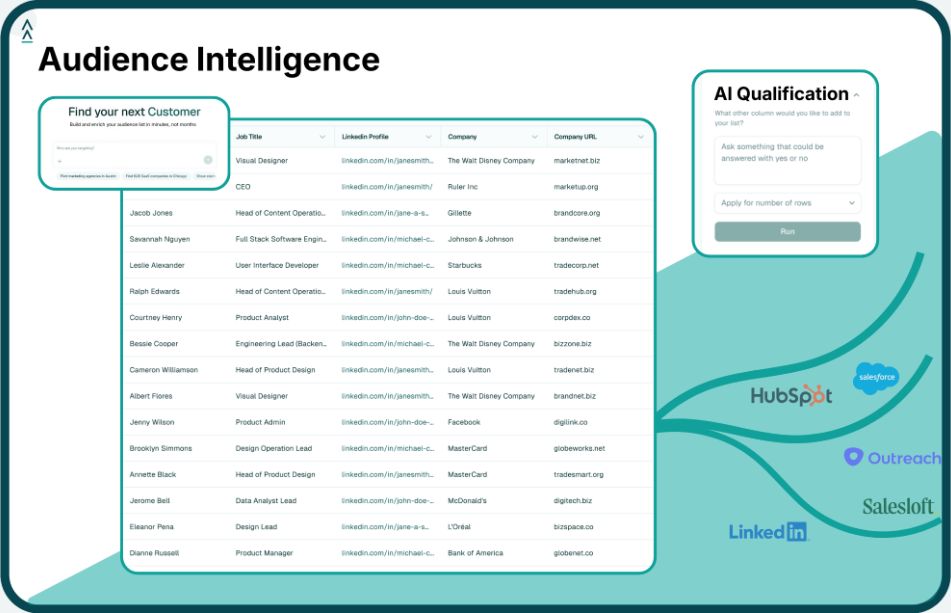
Landbase can help GTM teams move from a broad sports-tech category to a more specific audience based on what a company does and what is changing inside the business.
Through semantic search and lookalikes, audiences can be defined by business meaning rather than depending only on a predefined industry label. A GTM team could focus on companies developing athlete-performance software, AI sports media tools, league operations technology, automated video systems, or other specific parts of the sports-tech ecosystem.
Landbase can then stack buying signals around the target profile. Relevant changes can include:
Landbase documents funding, hiring and growth, leadership changes, and technology adoption as signal categories that can be combined with an underlying ICP.
This makes it possible to distinguish a general directory of sports technology companies from accounts currently matching both the required business profile and a relevant change.
Existing sports-tech account lists can also be processed through enrich and match records. CRM exports and spreadsheets can first be resolved against company or professional records before additional available company and contact information is added.
Technical GTM teams can extend the same data workflow through the power of the CLI. Landbase CLI works from the terminal and inside AI assistants such as Claude Code and Codex, allowing search, enrichment, and related GTM operations to become part of repeatable workflows.
For teams targeting sports technology, this creates a more useful approach than maintaining a fixed list of known vendors. Audiences can instead be built around specific sports-tech categories and refreshed as companies raise funding, hire, adopt technologies, change leadership, or meet other relevant criteria.
A sports tech company uses software, hardware, AI, data, connected devices, or other technologies as a central part of a product built for athletes, teams, leagues, sports organizations, media companies, or fans. The category can include performance tracking, team software, data infrastructure, scheduling, video analysis, media technology, and fan experiences. Some companies, such as Oura, also operate beyond sports while serving sports-performance use cases. Technology needs to be central to the product rather than simply supporting a conventional sports business.
Private-company growth often needs to be evaluated through several observable signals. Funding, valuations, hiring, acquisitions, customer expansion, new products, geographic expansion, and disclosed revenue growth can all provide evidence of momentum. Public companies provide additional financial data, while private companies generally disclose fewer comparable metrics. Combining several signals gives a more useful view than funding alone.
Current growth spans wearable performance technology, team operations, athlete analytics, AI scheduling, sports data, automated video, media management, and immersive fan experiences. The companies in this list demonstrate that sports technology extends from athlete preparation through the commercial and media layers surrounding competition. AI is also appearing across several categories rather than developing as a separate sports-tech segment. That makes category-specific targeting important when evaluating the market.
A funding round or acquisition can signal organizational change, but neither automatically means a company is ready to purchase a particular product. These events become more useful when combined with ICP fit, hiring activity, leadership changes, technology adoption, and other business signals. Landbase can apply those factors when building or refining target-account audiences. This helps GTM teams focus on sports-tech companies whose current activity is relevant to the product being sold.
Landbase can build sports-tech audiences around business meaning, company characteristics, and recent signals rather than relying on a broad industry label. Teams can narrow companies by criteria such as funding activity, employee size, geography, technology, hiring, or other relevant attributes and then identify appropriate professional records. Existing account lists can also be matched and enriched before moving into downstream GTM workflows. This creates a reusable targeting process as the sports-tech market changes.
Tool and strategies modern teams need to help their companies grow.