.png)
.png)

Daniel Saks
Chief Executive Officer


Hydrogen entered 2026 with stronger investment but a more disciplined market than the early project boom suggested. The IEA's Global Hydrogen Review 2026 found that global hydrogen demand surpassed 100 million tonnes in 2025, while demand for low-emissions hydrogen grew 20% to nearly 1 million tonnes. Low-emissions hydrogen therefore remains a small share of the overall market even as commercial activity expands.
Investment is moving faster than demand. Capital spending on low-emissions hydrogen projects reached nearly $7 billion in 2025, almost double the previous year, and the IEA estimates it could approach $10 billion in 2026. Installed electrolysis capacity also doubled in 2025 to more than 4 GW, with over 2.5 GW under construction for operation in 2026.
The market is not expanding evenly, however. Project delays, cancellations, difficult economics, and slow offtake have pushed the industry toward companies that can demonstrate real orders, operating projects, financing, or technical differentiation.
Hydrogen is already widely used in refining, ammonia, and chemical production, but most supply still comes from unabated fossil fuels. The emerging opportunity is to lower emissions from those existing uses while developing hydrogen and hydrogen-derived fuels for additional industrial, transportation, and energy applications.
That transition is proving more selective than early forecasts implied. The IEA reports that new final investment decisions for low-emissions hydrogen production declined in 2025 even as spending on projects already moving forward increased. The announced 2030 project pipeline also contracted as developments were delayed, paused, or cancelled.
For GTM teams, that distinction matters. A company announcing a large hydrogen concept is different from one commissioning equipment, securing financing, expanding production, or signing commercial orders. Tracking funding and growth events alongside operating milestones can provide a clearer picture of which companies are actively scaling.
CEO: Raffi Garabedian
Headquarters: Devens, Massachusetts
Founded: 2020
Recent Growth Signal: Selected for a 240 MW U.S. green ammonia project in December 2025
Electric Hydrogen was selected to supply two 120 MW HYPR Plants for a proposed 240 MW green ammonia project developed by Synergen Green Energy in December 2025. The company is also deploying a 100 MW HYPR Plant for Infinium's Project Roadrunner in Texas and expanded into Latin America during 2025.
Electric Hydrogen develops integrated PEM electrolysis plants for large industrial hydrogen projects. Its HYPR Plant combines electrolyzer stacks with power conversion, water treatment, thermal management, gas processing, and other balance-of-plant systems in a standardized architecture.
Electric Hydrogen is taking a plant-level approach to industrial electrolysis rather than supplying electrolyzer stacks alone. Its recent project activity shows commercial demand for standardized systems at the 100 MW-plus scale.
CEO: Nils Aldag
Headquarters: Dresden, Germany
Recent Financing: €200 million guarantee financing secured in January 2025
Sunfire secured €200 million in guarantee financing to support industrial customer projects and continued production scaling. In May 2026, the company introduced a new 50 MW alkaline electrolyzer system while advancing 100 MW-scale projects, including repeat business from existing customers.
Sunfire develops industrial electrolyzers based on pressurized alkaline and solid oxide technologies. Its systems support hydrogen production for applications including refining, chemicals, steel, and Power-to-X projects.
Sunfire is moving electrolysis toward larger industrial deployments while supporting more than one technology platform. Its financing and project activity reflect growing emphasis on manufacturing capability, project execution, and bankable commercial installations.
CEO: Dennis Schulz
Headquarters: Sheffield, United Kingdom
Recent Growth Signal: First hydrogen delivered from the Lingen project in August 2026
In August 2026, ITM Power announced first hydrogen production and delivery from RWE's Lingen electrolysis facility in Germany. ITM Power and Linde Engineering are supplying two 100 MW plants for the project, which connects hydrogen production with downstream industrial users.
ITM Power has also been selected for two German energy infrastructure projects representing up to 710 MW of potential electrolyzer capacity, although those projects remain subject to future development and investment decisions.
ITM Power designs and manufactures industrial PEM electrolyzers for renewable hydrogen production. The company also operates Hydropulse, a business model focused on developing, owning, and operating hydrogen production facilities.
The Lingen milestone provides a tangible sign of commercial progress because hydrogen is moving from installed electrolysis equipment into industrial use. It strengthens ITM Power's position beyond announced project pipelines alone.
CEO: Paul Barrett
Headquarters: Wollongong, Australia
Founded: 2021
Recent Growth Signal: First commercial megawatt-scale electrolyzer order in June 2026
Hysata secured its first commercial megawatt-scale electrolyzer order in June 2026, with delivery expected in the first half of 2027. The milestone marks an important transition from technology development toward commercial supply.
The company has also grown to more than 120 employees and established partnerships across the Asia-Pacific region, North America, South America, Europe, and the Middle East.
Hysata develops capillary-fed alkaline electrolyzers designed to reduce the electricity required for renewable hydrogen production. Its architecture combines a high-efficiency electrolysis cell with a simplified balance-of-plant design.
Electricity is a major operating cost in electrolytic hydrogen production. Hysata is addressing that constraint through an architecture designed around higher energy efficiency, making its first commercial order an important test of the technology at industrial scale.
Founder and CEO: Andrés Galnares
Headquarters: Bilbao, Spain
Recent Funding: Series B expanded to more than €42 million in June 2026
H2SITE expanded its Series B financing to more than €42 million in June 2026. The company has also reported more than 50,000 operating hours across its membrane reactors and separation systems as it moves toward larger industrial deployments.
H2SITE develops membrane reactors and separation systems that recover high-purity hydrogen from different gas streams and hydrogen carriers. Applications include ammonia cracking, hydrogen separation, natural hydrogen, refining, maritime uses, and other industrial processes.
Hydrogen production is only one part of the value chain. H2SITE focuses on the separation, purification, and recovery steps needed to use hydrogen efficiently when it is transported in other molecules or embedded within industrial processes.
Co-Founder and CEO: Matt Bird
Headquarters: London, United Kingdom
Recent Funding: £14 million Series A in March 2025
Supercritical raised £14 million in Series A funding to advance and commercialize its high-pressure electrolyzer technology. In April 2026, the company opened a new Global Tech Centre in London after expanding its team from 15 to more than 40 employees.
Supercritical is developing a membrane-free electrolyzer that produces hydrogen at high pressure. The technology is designed without PFAS membranes or iridium and targets industrial applications including chemicals and fuels.
Hydrogen production costs extend beyond the electrolyzer itself. Compression, materials, and downstream processing all affect project economics, and Supercritical's approach targets those costs by producing high-pressure hydrogen directly.
CEO: José Luis Crespo
Headquarters: New York, United States
Recent Growth Signal: Raised 2026 revenue-growth guidance to 15%–16%
Plug Power generated approximately $178 million in Q2 2026 revenue and raised its full-year growth guidance to 15%–16%. The company also reported approximately break-even quarterly gross margin as it continued efforts to reduce costs and improve financial performance.
Plug generated a record $187 million in electrolyzer revenue during 2025 and had delivered more than 300 MW of GenEco electrolyzers globally by March 2026.
Plug Power operates across multiple parts of the hydrogen value chain, including electrolyzers, hydrogen production, fuel cells, storage, delivery, and fueling infrastructure. Its systems support applications ranging from material handling to industrial hydrogen production.
Plug Power combines hydrogen production technology with downstream infrastructure and end-use systems. Its recent results point to improving commercial execution, although sustained profitability remains an important measure of future progress.
Co-Founder and CEO: Tim Davies
Headquarters: Hull, United Kingdom
Founded: 2019
Recent Funding: £10 million investment announced in December 2025
HiiROC received a £10 million investment in December 2025 to support commercialization of its technology for hydrogen-derived marine fuels and other applications. In January 2026, the company also entered a memorandum of understanding with Tokyo Gas to explore deployment opportunities in Japan and potential future investment.
HiiROC uses Thermal Plasma Electrolysis to split methane or biomethane into hydrogen and solid carbon rather than releasing the carbon directly as carbon dioxide. Unlike water electrolysis, the process uses a methane-based feedstock and produces solid carbon as a co-product.
HiiROC offers an alternative pathway to hydrogen production beyond conventional alkaline and PEM electrolysis. Its approach may be particularly relevant to industrial users with access to existing gas infrastructure that are evaluating lower-emissions hydrogen options.
Founder and CEO: Ivar Kruusenberg
Headquarters: Tallinn, Estonia
Founded: 2016
Recent Funding: €10 million Series A in November 2025
PowerUP raised €10 million in Series A funding in November 2025 to expand manufacturing and commercialization of its hydrogen fuel-cell generators. The company also broadened distribution in the Nordic region during 2025 and entered Middle Eastern markets through a new partnership in July 2026.
PowerUP develops portable, mobile, and containerized generators powered by hydrogen fuel cells. Its systems target security and defense, telecommunications, construction, healthcare, rescue operations, and other applications requiring off-grid or backup power.
PowerUP demonstrates how hydrogen can reach commercial markets through end-use power systems rather than production infrastructure alone. Its recent financing and geographic expansion point to growing interest in fuel cells for resilient and portable power applications.
President and CEO: Marty Neese
Headquarters: Burnaby, British Columbia
Recent Growth Signal: Q2 2026 order backlog reached $156.6 million
Ballard reported Q2 2026 revenue of $20.6 million, up 15% year over year, while its order backlog increased to $156.6 million, nearly 39% higher than the previous quarter. The company also recorded $64 million in new orders during the quarter.
Recent commercial agreements include a 500-engine, 50 MW fuel-cell commitment from New Flyer and a 6.4 MW marine order for two Samskip vessels.
Ballard develops PEM fuel-cell engines for buses, trucks, rail, marine transportation, and stationary power. Its systems convert hydrogen into electricity for end-use applications rather than producing hydrogen through electrolysis.
Ballard provides evidence of hydrogen adoption in selected heavy-duty applications where operating requirements can differ from passenger vehicles. Its 2026 backlog and order growth offer a more current measure of commercial momentum than historical deployment totals.
Hydrogen is difficult to map with conventional company filters. Electrolyzer manufacturers, fuel-cell developers, hydrogen producers, project developers, and infrastructure companies may belong to the same market while appearing under very different classifications.
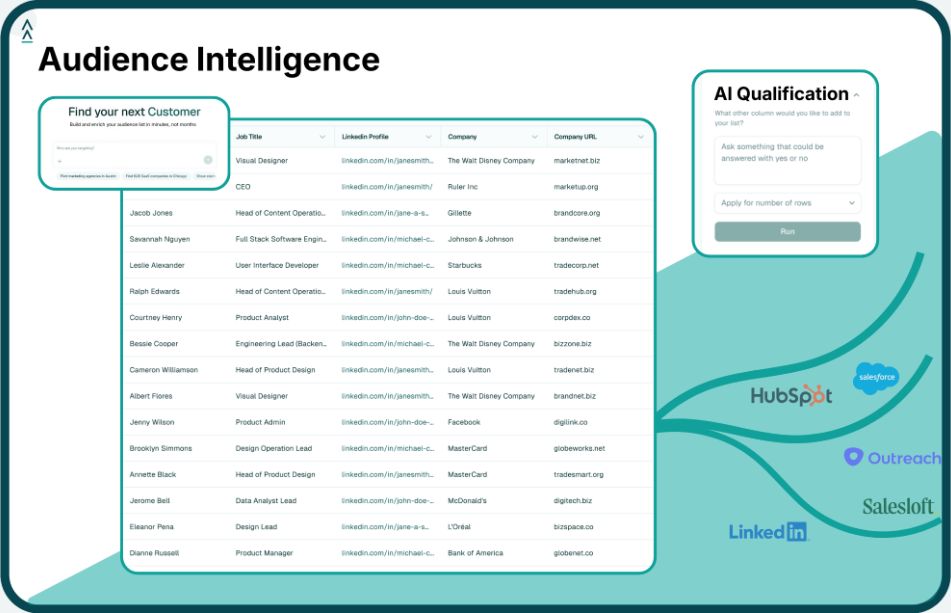
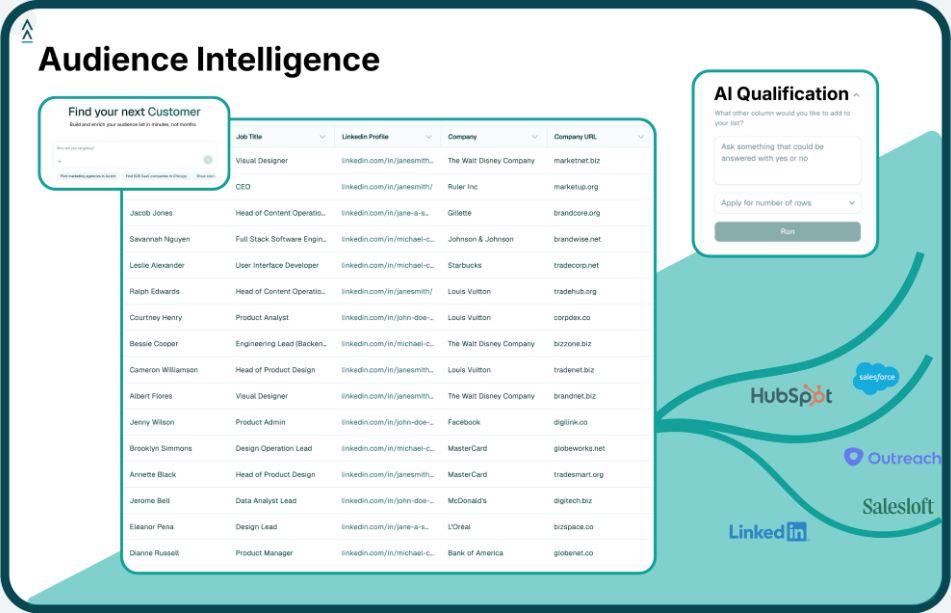
Landbase helps GTM teams organize that complexity around the signals, business models, and decision-makers that matter.
Rather than targeting every company associated with hydrogen, teams can focus on businesses showing recent change.
Landbase can combine funding raised signals with hiring, leadership changes, and technology adoption to surface companies entering a new growth phase.
Hydrogen companies can play very different roles across the value chain, including:
Landbase's AI-powered qualification can refine a broad audience around criteria that standard database fields may not capture.
Known companies can serve as reference points for broader discovery.
A team targeting industrial electrolysis might begin with Electric Hydrogen, Sunfire, and ITM Power, while another could use H2SITE or HiiROC to explore adjacent technologies. Landbase's lookalike company search can identify similar organizations and refine them by geography, size, technology, or other requirements.
The relevant buyer depends on the offer. Equipment suppliers may target engineering or procurement, while software and services companies may prioritize operations, IT, finance, or project leadership.
With finding decision-makers, teams can identify people connected to the business decision rather than relying on one fixed title.
Hydrogen markets change as projects advance, financing closes, facilities open, and company strategies evolve.
The Landbase CLI brings search, matching, enrichment, and dataset workflows into environments such as Claude Code and Codex. GTM teams can refresh audiences, requalify accounts, enrich new targets, and export structured data without rebuilding the market from scratch.
Growth can appear through financing, revenue, project awards, order backlog, manufacturing expansion, commercial deployments, or entry into new geographic markets. The appropriate metric depends on whether the company manufactures electrolyzers, develops hydrogen infrastructure, produces fuel cells, or supplies another part of the value chain. No common public dataset supports a precise global ranking across every private and public hydrogen company. This list therefore focuses on businesses with clear recent operating or financial signals rather than calling the order a definitive growth ranking.
Electrolysis remains one of the most active areas, with PEM, alkaline, and solid oxide technologies all moving through commercial projects. Alternative approaches including capillary-fed electrolysis, high-pressure electrolysis, methane pyrolysis, hydrogen separation, and ammonia cracking are also progressing. Fuel cells continue to see targeted deployment in heavy-duty transport, stationary power, and specialized off-grid applications. The breadth of those technologies makes hydrogen market mapping more useful when the target audience needs to span multiple parts of the value chain.
Low-emissions hydrogen often remains more expensive than conventional fossil-based production, while many projects still lack firm long-term buyers. The IEA also identifies regulatory uncertainty, infrastructure constraints, and slow demand development as barriers to investment decisions. Its 2026 review found that the announced 2030 production pipeline had contracted as projects were delayed, paused, or cancelled. This makes commercial offtake and project economics increasingly important filters when evaluating company momentum.
Look for a combination of company fit and recent change rather than one signal in isolation. A funding round can become more meaningful when it coincides with hiring, a new manufacturing facility, a project award, or geographic expansion. Landbase's signal-based account research can combine multiple events around a defined audience so teams can focus on accounts with both relevance and current activity. The supporting account research should still confirm what changed and why before outreach begins.
Landbase can help teams define hydrogen audiences around business models, technologies, geography, company characteristics, and recent signals rather than relying on one industry classification. Teams can expand from known accounts, identify relevant decision-makers, and enrich company or contact datasets they already maintain. Existing conference, CRM, or research lists can also be processed through file matching and enrichment rather than rebuilt manually. For technical GTM teams, the CLI makes these workflows available inside Claude Code, Codex, and other terminal-based environments.
Tool and strategies modern teams need to help their companies grow.