.png)
.png)

Daniel Saks
Chief Executive Officer


ESG and sustainability technology now spans far more than reporting software. It includes technologies for clean power, carbon removal, industrial decarbonization, sustainable fuels, agriculture, risk intelligence, and emissions management. The IEA's latest 2026 energy investment data projects global clean energy investment at approximately $2.2 trillion this year, almost twice the amount flowing into fossil fuels.
The software side is evolving as well. Sustainability disclosure requirements are developing differently across regions, but adoption or planned use of ISSB-aligned standards now spans jurisdictions across the Americas, Asia-Pacific, Europe, the Middle East, and Africa. At the same time, U.S. and EU requirements are undergoing significant changes, making reliable sustainability data and flexible reporting infrastructure increasingly important.
The term "ESG tech" covers two increasingly connected markets.
The first consists of software and data infrastructure that helps organizations measure emissions, analyze sustainability and reputational risks, manage environmental data, and respond to disclosure or stakeholder requirements.
The second includes physical sustainability technologies that change how electricity, fuels, metals, cement, agricultural inputs, and other products are produced.
These markets are also becoming more execution-focused. Energy Technology Perspectives 2026 notes growing investment in hydrogen, CCUS, low-emissions steel, fusion, and other emerging technologies, while emphasizing that many announced projects have not yet reached final investment decisions.
For GTM teams, that makes market segmentation particularly useful. A sustainability software buyer, fusion developer, low-carbon materials company, and agricultural biotechnology business may all belong to the broader ESG technology market while having completely different suppliers and buying committees.
Founder and CEO: David Kirtley
Headquarters: Everett, Washington
Founded: 2013
Recent Funding: $465 million Series G in June 2026
Helion raised $465 million in June 2026 at a $15.5 billion post-money valuation, bringing total investment to approximately $1.5 billion. The company is also constructing its Orion fusion power facility in Washington and continues expanding U.S. manufacturing capacity.
Helion develops pulsed fusion systems based on field-reversed configuration technology. Its design aims to convert changes in magnetic fields directly into electricity rather than relying on a conventional steam cycle.
Fusion could eventually provide firm, low-carbon electricity for grids and large energy users. Helion remains pre-commercial, but its financing, construction activity, and Microsoft power agreement make it one of the sector's most closely watched private companies.
CEO: J. Clay Sell
Headquarters: Rockville, Maryland
Founded: 2009
Recent Funding: Approximately $700 million Series D in November 2025
X-energy closed a $700 million Series D in November 2025 and subsequently raised approximately $1.1 billion in net proceeds through its 2026 IPO. The company reported an orderbook exceeding 11 GW and is advancing reactor projects with customers including Dow, Amazon, and Centrica.
X-energy develops the Xe-100 high-temperature gas-cooled small modular reactor and manufactures proprietary TRISO-X nuclear fuel.
Advanced nuclear offers another potential source of firm, low-carbon power for industrial facilities, utilities, and large electricity users. X-energy's capital raise, fuel manufacturing, regulatory progress, and growing project pipeline give it a strong commercialization signal.
Co-Founders and Co-CEOs: Christoph Gebald and Jan Wurzbacher
Headquarters: Zurich, Switzerland
Recent Funding: $162 million equity financing in 2025
Climeworks raised $162 million in additional equity in 2025, taking cumulative funding above $1 billion. In the first half of 2026, its carbon removal solutions business signed 14 new partnerships representing approximately 450,000 tonnes of contracted carbon removal across multiple approaches.
Climeworks develops direct air capture systems that remove CO₂ from ambient air. It also provides broader carbon removal portfolios for organizations procuring durable and other carbon removal solutions.
Climeworks combines operating experience in DAC with a growing carbon removal procurement business. That gives it exposure to both the technology and demand sides of an emerging carbon management market.
Co-Founder and CEO: Sylvain Forté
Headquarters: France
Founded: 2014
Total Funding: Approximately $50 million
SESAMm expanded its AI-powered risk products and company coverage during 2025 while adding new clients and partnerships. Its technology now analyzes more than five million public and private companies, and its partnership with Clarity AI extended controversy monitoring deeper into private markets.
SESAMm uses AI and large-scale web data to identify ESG controversies, reputational risks, supplier issues, and other events relevant to investors and corporations.
Sustainability analysis increasingly depends on information beyond company-reported disclosures. SESAMm addresses that gap by monitoring external signals across companies, private markets, infrastructure projects, and supply chains.
CEO: Tadeu Carneiro
Headquarters: Woburn, Massachusetts
Recent Funding: $75 million in May 2026
Total Raised: More than $500 million
Boston Metal raised $75 million in May 2026 to expand commercial deployment of its Molten Oxide Electrolysis platform, bringing total funding above $500 million. The company is placing greater near-term emphasis on critical-metals production while continuing development of its longer-term low-emissions steel technology.
Boston Metal's Molten Oxide Electrolysis technology uses electricity to produce metals from metal oxides. Applications include recovering critical metals from industrial waste streams and developing an alternative pathway for steel production.
Metals are foundational to electrification, manufacturing, AI infrastructure, and energy systems. Boston Metal is targeting the emissions and supply-chain challenges associated with producing those materials rather than focusing solely on downstream products.
CEO: Chris Abbott
Headquarters: Minneapolis, Minnesota
Founded: 2011
Recent Growth Signal: Products used across nearly 20 million acres in North America
Pivot Bio relocated its global headquarters to Minnesota in March 2026 as part of a broader expansion around agricultural customers and innovation. By July, the company reported that its products had been used across nearly 20 million acres in North America, with four new product lines introduced over the preceding year.
Pivot Bio develops microbial crop nutrition products that provide nitrogen directly at plant roots, allowing farmers to replace a portion of conventional nitrogen fertilizer.
Agriculture creates sustainability challenges that cannot be addressed through energy technology alone. Pivot Bio targets fertilizer efficiency and nitrogen loss while integrating its products into existing farm operations.
Co-Founder and CEO: Cody Finke
Headquarters: California
Founded: 2019
Recent Growth Signal: Advancing its first commercial-scale industrial facility
Brimstone continues development of its first commercial-scale facility after finalizing negotiations for up to $189 million in U.S. Department of Energy support. In May 2026, peer-reviewed research also evaluated the potential energy and economic advantages of producing Portland cement from silicate rocks rather than conventional limestone.
Brimstone is developing a mineral-processing platform that can co-produce ordinary Portland cement, supplementary cementitious materials, and smelter-grade alumina from silicate rock.
Cement and other basic materials are difficult to decarbonize because emissions arise from both energy use and production chemistry. Brimstone's approach targets those process emissions while preserving compatibility with established Portland cement markets.
Co-Founder and CEO: Nicholas Flanders
Headquarters: Berkeley, California
Recent Funding: $645 million capital package announced in 2024
Recent Growth Signal: AirPlant One began commercial operations in June 2026
Twelve opened AirPlant One in Moses Lake, Washington, in June 2026. The facility is producing commercial-scale E-Jet sustainable aviation fuel and E-Naphtha from CO₂, water, and renewable electricity, with E-Jet meeting applicable ASTM specifications for commercial aviation use.
Twelve develops electrochemical systems that convert CO₂ into fuels and chemical feedstocks. Its AirPlant platform combines carbon transformation technology with industrial-scale production.
Twelve has moved beyond a pilot-only stage into commercial manufacturing. Its technology targets sectors such as aviation and chemicals where direct electrification can be difficult.
CEO: Lubomila Jordanova
Headquarters: London, United Kingdom
Public Listing: Nasdaq: DGNX
Recent Growth Signal: Completed acquisition of Plan A in January 2026
Diginex completed its acquisition of carbon accounting and decarbonization platform Plan A in January 2026. Plan A founder Lubomila Jordanova was subsequently appointed CEO of Diginex, and the group has been integrating ESG reporting, carbon accounting, climate data, and supply-chain capabilities under a broader sustainability technology strategy.
Diginex provides software for ESG, sustainability, compliance, climate, and supply-chain data management. The addition of Plan A expands its capabilities in corporate carbon accounting, emissions management, and decarbonization planning.
Sustainability software is consolidating as businesses seek fewer disconnected tools for reporting, emissions measurement, supply-chain visibility, and reduction planning. Diginex's acquisition strategy reflects that shift toward broader integrated platforms.
Co-Founder and CEO: Arthur Covatti
Headquarters: Brazil
Founded: 2020
Recent Growth Signal: CDP partnership announced in June 2026
DEEP ESG became a CDP Accredited Solutions Provider in Latin America in June 2026 through a partnership focused on expanding access to environmental disclosure and management capabilities for smaller and mid-sized businesses. The company has also developed partnerships in areas such as financed emissions and climate reporting within Brazil.
DEEP provides software for greenhouse gas inventories, ESG data management, reporting, climate-risk information, financed emissions, and decarbonization planning.
Its platform can use operational and accounting data to support Scope 1, 2, and 3 emissions measurement and ongoing environmental management.
Sustainability data requirements increasingly extend through supply chains and financial institutions rather than stopping with the largest corporations. DEEP's focus on Latin America gives it a role in bringing structured climate data capabilities to companies operating within those value chains.
The challenge in ESG technology is not a shortage of companies. It is separating the businesses that fit a specific sales motion from a market spanning software, energy, industry, agriculture, and climate infrastructure.
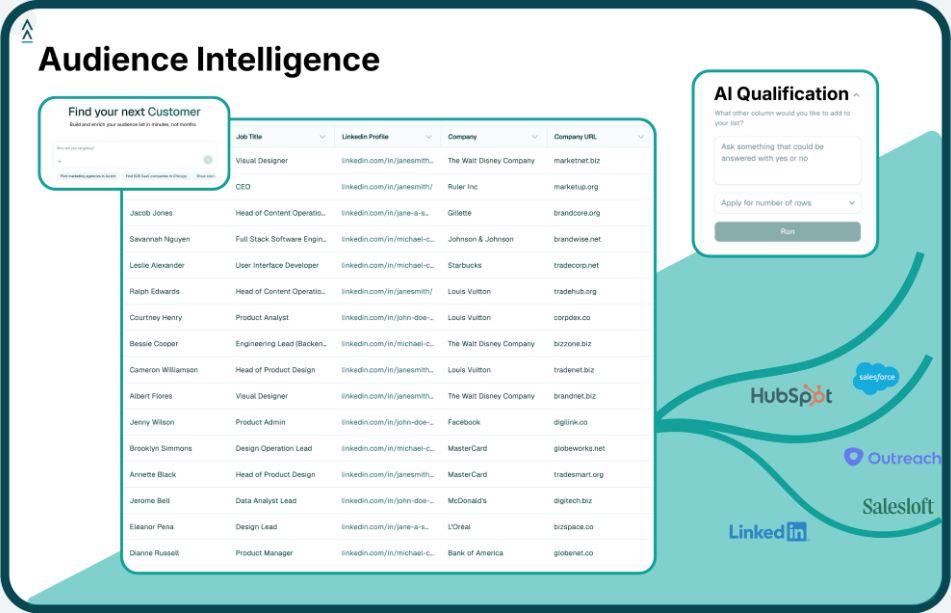
Landbase helps GTM teams organize that market around relevant company characteristics, account research, and signals that indicate when an organization is changing.
A software company selling financial reporting tools should not approach Helion, SESAMm, and Pivot Bio as one homogeneous segment.
Teams can use advanced dataset creation to define separate audiences by technology, geography, company size, business model, or other relevant characteristics.
That creates more useful segments for research and outreach.
Growth signals become more valuable when paired with the underlying company profile.
For ESG and sustainability technology, useful signals might include:
Landbase can layer company growth signals onto defined audiences so teams can focus on companies where timing and fit overlap.
The stakeholder map changes significantly by segment.
A climate hardware company may involve engineering, procurement, manufacturing, finance, or operations. Sustainability software may be evaluated by ESG, finance, risk, compliance, IT, or data teams.
The decision-maker search helps connect each target account with people relevant to the specific business problem rather than applying one job-title list across the entire sector.
ESG technology changes quickly as startups raise capital, products commercialize, companies are acquired, and regulations evolve.
The Landbase CLI lets GTM engineers work with audience creation, matching, enrichment, datasets, and structured exports inside environments such as Claude Code and Codex.
That makes an ESG tech market map something teams can update and reuse rather than a spreadsheet that becomes outdated after one research cycle.
ESG technology can refer to software used for sustainability measurement, reporting, risk analysis, and governance as well as technologies that directly improve environmental performance. That can include carbon removal, low-emissions materials, clean power, sustainable fuels, and agricultural technology. The category is therefore broader than ESG reporting software alone. Teams building a market should define the segment around their actual use case rather than relying on the ESG label by itself.
Relevant indicators include funding, revenue, customer adoption, commercial facilities, product deployments, hiring, partnerships, and geographic expansion. The right measure depends heavily on the business model because software platforms and industrial technology startups scale in different ways. No common public metric supports a precise global ranking across all of these companies. Landbase's company signal research can add recent activity to a more specific market definition.
Yes, but the regulatory environment is no longer accurately described as uniformly tightening everywhere. The U.S. SEC proposed rescinding its federal climate-disclosure rules in May 2026, while the EU has been pursuing simplification of CSRD requirements. At the same time, ISSB-based sustainability disclosure standards are being adopted or considered across numerous jurisdictions. Software demand therefore increasingly reflects a combination of regulation, investor requirements, supply-chain data needs, risk management, and internal decarbonization goals.
Begin by separating the market into relevant categories such as climate software, carbon removal, industrial decarbonization, clean power, sustainable fuels, or agricultural technology. Teams can then add funding, hiring, leadership, expansion, or technology signals to identify companies entering a new stage. Existing successful accounts can also provide useful reference points when searching for similar organizations. Landbase's company lookalike workflow can support that discovery without depending entirely on industry classifications.
Landbase can help teams define sustainability technology audiences, qualify companies against more specific criteria, identify recent company signals, and move from accounts to relevant contacts. Existing ESG or climate-tech lists can also be processed through file matching and enrichment rather than rebuilt manually. Technical teams can then use the CLI to keep those datasets connected to repeatable research and enrichment workflows. This is particularly useful in a market where company status, funding, leadership, and commercialization stages can change quickly.

Tool and strategies modern teams need to help their companies grow.






