.png)
.png)

Daniel Saks
Chief Executive Officer


Energy storage entered 2026 after another record year of deployment. According to Wood Mackenzie's 2026 analysis, the global market added 106 GW in 2025, up 43% year over year, bringing cumulative installed capacity to nearly 270 GW. Utility-scale projects accounted for 82% of new capacity.
The U.S. market also reached a record 18.9 GW of new battery storage in 2025, up 52%, according to the latest U.S. Energy Storage Monitor. Growth is increasingly spread across utility projects, distributed batteries, long-duration technologies, and storage built to support rising power demand.
Storage increasingly sits between electricity generation and electricity demand. Batteries can absorb electricity when supply is plentiful and discharge when demand rises, while longer-duration technologies are being developed for periods when several hours of storage are not enough.
The opportunity now extends beyond manufacturing battery cells. System integrators, project developers, distributed-energy companies, power electronics providers, optimization software companies, and long-duration storage developers all participate in the market.
That diversity also makes the sector more difficult to research. GTM teams may need to map the storage market across multiple technologies, business models, end markets, and geographic regions instead of relying on a single energy-storage category.
Chairman and CEO: Robin Zeng
Headquarters: Ningde, China
Recent Growth Signal: 30.4% of global energy storage battery shipments in 2025
CATL reported that its energy storage batteries represented 30.4% of global shipments in 2025, ranking first for the fifth consecutive year. Its energy storage system integration shipments also increased more than 160% year over year, while approximately 2,300 storage projects used CATL technology worldwide.
CATL develops lithium-ion battery cells and integrated storage systems for utility, commercial, industrial, and other energy applications. Its storage portfolio includes containerized systems alongside battery technology designed for large-scale deployment.
CATL's scale gives it influence across both cell manufacturing and integrated energy storage. Its growth also illustrates the manufacturing advantage Chinese battery suppliers continue to hold as global deployment expands.
Chairman and President: Cao Renxian
Headquarters: Hefei, China
Recent Growth Signal: 43 GWh of energy storage systems shipped in 2025
Sungrow shipped 43 GWh of energy storage systems globally in 2025. Energy storage revenue reached RMB 37.29 billion, up 49.39% year over year and accounting for roughly 42% of total company revenue.
Sungrow develops battery energy storage systems, power conversion technology, solar inverters, and related energy infrastructure. Its PowerTitan platform targets utility-scale storage, while PowerStack products serve commercial and industrial applications.
Storage has become an increasingly significant part of Sungrow's business rather than a secondary product alongside solar inverters. Its combination of storage systems and power electronics positions the company across multiple parts of large renewable-energy projects.
CEO: Elon Musk
Headquarters: Austin, Texas
Recent Growth Signal: 46.7 GWh of storage deployed in 2025
Tesla deployed 46.7 GWh of energy storage products in 2025, up 49% from 31.4 GWh in 2024. Fourth-quarter deployment reached a record 14.2 GWh. The company also said Megapack 3 and Megablock production would begin at its Houston Megafactory in 2026.
Tesla Energy's storage portfolio includes utility-scale Megapack systems and residential Powerwall batteries. Tesla also develops software used to coordinate distributed batteries and larger energy assets.
Tesla's storage business has reached tens of gigawatt-hours of annual deployments while expanding manufacturing capacity. Its presence across residential and utility-scale storage gives it exposure to two distinct areas of the market.
Chairman and President: Wang Chuanfu
Headquarters: Shenzhen, China
Recent Growth Signal: 12.5 GWh Saudi Electricity Company storage agreement
BYD Energy Storage signed contracts with Saudi Electricity Company for 12.5 GWh of grid-scale storage in 2025. Combined with an earlier 2.6 GWh project, the companies' announced cooperation reached 15.1 GWh. BYD reported at the time that its storage equipment had been deployed across more than 350 projects in over 110 countries.
BYD develops battery cells, containerized energy storage systems, power conversion equipment, and energy-management technology. Its storage products use lithium iron phosphate battery chemistry and serve utility, commercial, and other stationary applications.
BYD combines large-scale battery manufacturing with integrated storage systems. The Saudi projects demonstrate the size that individual grid-storage contracts can now reach as countries add renewable generation and grid flexibility.
CEO: Kim Dong-Myung
Headquarters: Seoul, South Korea
Recent Growth Signal: ESS revenue grew 4.6 times year over year in H1 2026
LG Energy Solution reported that energy storage revenue increased 4.6 times year over year during the first half of 2026. ESS represented the high-20% range of company revenue, and the business secured more than KRW 3 trillion in new orders during the period.
The company has also been expanding stationary-storage production across its North American manufacturing footprint.
LG Energy Solution manufactures battery cells for electric vehicles and stationary storage. Its ESS strategy includes LFP-based products for power grids and data centers alongside system-integration capabilities.
LG Energy Solution's 2026 results show stationary storage becoming a larger contributor to a battery company historically associated heavily with electric vehicles. Its North American production footprint also gives it a role in the ongoing localization of battery supply.
Co-Founder and CEO: Zach Dell
Headquarters: Austin, Texas
Recent Funding: $1 billion Series C in October 2025
Base Power raised $1 billion in Series C financing in October 2025 to support national expansion and manufacturing. At the time of the round, the company reported deploying more than 100 MWh of residential battery capacity in less than two years and was developing its first battery and power-electronics factory in Austin.
Base combines residential batteries with electricity service and grid operations. Batteries installed at customer homes can provide backup power while also participating as distributed assets supporting the power system.
Base represents a different storage model from utility-scale BESS developers. Instead of concentrating storage at one large site, it is building a distributed battery network across individual homes.
That creates another route for energy storage to contribute to grid flexibility while also providing household backup power.
Co-Founder and CEO: Mateo Jaramillo
Headquarters: Somerville, Massachusetts
Recent Funding: $750 million Series G in August 2026
Form Energy raised $750 million in Series G financing on August 12, 2026, bringing its total equity raised above $2 billion. The company also reported that its iron-air battery backlog expanded from approximately 20 GWh to 80 GWh earlier in 2026.
Commercial agreements announced this year include a 12 GWh capacity agreement with Crusoe and Form Energy's first announced international deployment, a 10 MW/1,000 MWh project in Ireland.
Form Energy develops iron-air batteries designed to discharge energy for up to 100 hours. Its technology targets multi-day storage applications where conventional shorter-duration batteries may not provide enough capacity.
Form Energy is one of the clearest examples of capital and commercial demand moving toward long-duration storage.
Its recent financing, expanding backlog, and manufacturing scale-up indicate that multi-day storage is moving beyond research toward larger commercial deployments.
President and CEO: Julian Nebreda
Headquarters: Arlington, Virginia
Recent Growth Signal: Record $6.4 billion backlog in Q3 FY2026
Fluence reported more than $1.44 billion in quarterly order intake for the period ended June 30, 2026, nearly three times the level from the comparable quarter a year earlier. Its backlog reached a company record of approximately $6.4 billion.
Revenue for the quarter increased to approximately $649.8 million from $602.5 million a year earlier. Fluence also reported production and construction delays that pushed some expected revenue into fiscal 2027 and led the company to lower its FY2026 revenue outlook.
Fluence supplies battery energy storage systems, operational services, and asset-optimization software. Its offerings span physical storage infrastructure and software used to manage and optimize energy assets.
Fluence's record backlog shows continued demand for large storage projects even as manufacturing execution remains a constraint.
Its combination of hardware, services, and software also reflects how storage projects increasingly require more than battery containers alone.
CEO: Joe Mastrangelo
Headquarters: Pittsburgh, Pennsylvania
Recent Growth Signal: Q2 2026 revenue increased 351% year over year
Eos generated $68.8 million in Q2 2026 revenue, up 351% year over year. Backlog reached a record $807 million, representing 3.4 GWh, and increased 25% sequentially. The company said first-half 2026 revenue exceeded its revenue for all of 2025.
Eos remains in a manufacturing scale-up phase and continued to report losses during the quarter, so its inclusion here reflects rapid revenue, backlog, and production growth rather than profitability.
Eos develops zinc-based long-duration energy storage systems manufactured in the United States. Its systems are designed for applications including renewable integration, grid resilience, and local power generation.
Eos provides an alternative to lithium-ion storage for longer-duration applications. Its recent revenue and backlog growth also illustrate increasing commercial activity around storage technologies based on different battery chemistries.
Co-Founder and CEO: Tony Schumacher
Headquarters: Berlin, Germany
Recent Financing: Up to €150 million in September 2025
Terra One secured up to €150 million in mezzanine financing from Aviva Investors in September 2025. Combined with equity and project financing, the structure is intended to support up to €750 million in new battery projects and approximately 3 GWh of storage capacity.
Terra One develops, finances, and operates grid-scale battery storage projects in Europe. It also develops software used to optimize battery operation across electricity and ancillary-service markets.
Terra One represents the storage-developer side of the market rather than battery manufacturing.
Its financing model shows how institutional capital is increasingly being used to build portfolios of grid-scale storage assets as European power markets add more renewable generation.
Energy storage is expanding across battery manufacturing, project development, grid infrastructure, software, and long-duration technologies. For GTM teams, the challenge is not simply finding companies in the sector. It is identifying which accounts are entering a meaningful growth phase and why.
Landbase helps turn those market changes into structured, reusable GTM data.
A broad "energy storage" filter can group together companies with very different business models. A battery manufacturer, grid-scale project developer, distributed-energy platform, and long-duration storage startup may share an industry label but have very different buying needs.
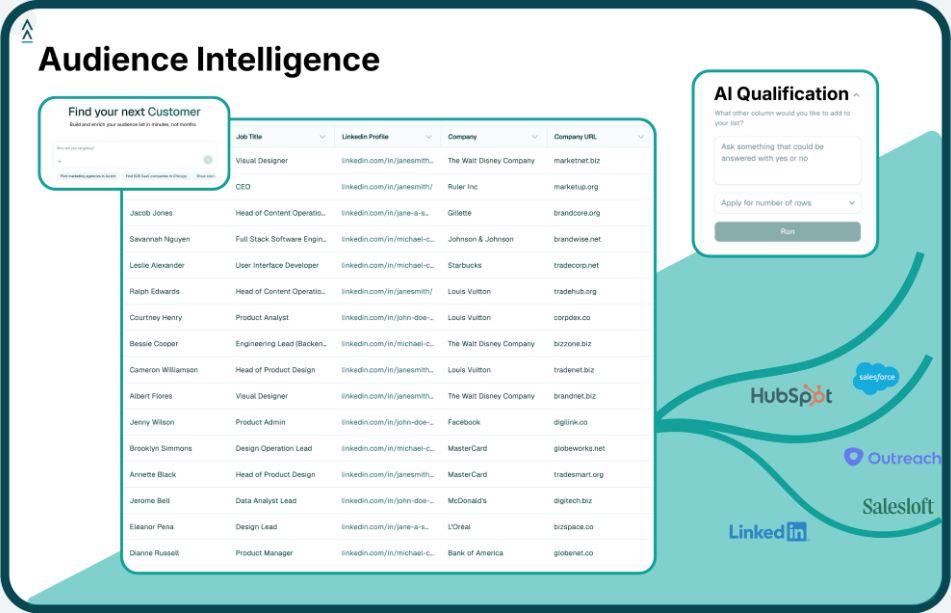
With natural-language audience building, teams can define the market around characteristics that actually matter, such as technology, geography, customer type, funding stage, or commercial application.
The most relevant accounts are often the ones where something has recently changed.
Landbase can incorporate funding and growth signals such as new capital, hiring activity, leadership changes, and technology adoption into an existing audience. This helps teams focus on storage companies moving into expansion rather than treating every company in the category with equal priority.
Well-known companies can provide useful reference points for discovering less obvious opportunities.
Teams can use semantic company matching to find businesses resembling selected storage manufacturers, integrators, or developers, then narrow the results using additional criteria. This is particularly useful in a market where emerging companies may sit across batteries, grid software, power electronics, infrastructure, or distributed energy.
Energy storage research often already exists across CRM records, event lists, analyst spreadsheets, or manually curated target accounts.
Landbase can enrich existing datasets by matching companies and contacts against its data and adding selected information where available. Teams can build on research they already trust instead of starting with a new list each time.
For technical teams, the Landbase CLI makes these workflows accessible from Claude Code, Codex, and other terminal-based environments.
A GTM engineer can use the CLI to build or refine an energy storage audience, process existing datasets, enrich relevant records, and export structured results for analysis or downstream systems. The result is not just another snapshot of the market, but a workflow that can be updated as new storage companies raise capital, expand manufacturing, win projects, or enter new markets.
Growth can appear through revenue, shipments, funding, backlog, manufacturing capacity, project awards, or commercial deployments. The appropriate metric depends on whether the company manufactures cells, integrates BESS projects, develops storage assets, or commercializes new technology. For that reason, the companies in this list were evaluated using multiple recent operating and financial indicators rather than one common ranking metric. GTM teams can also monitor recent funding activity as one signal alongside hiring, expansion, and project activity.
Lithium-ion systems continue to account for much of current utility and distributed deployment, particularly LFP-based storage. Long-duration alternatives are also moving further into commercial development, including Form Energy's iron-air systems and Eos Energy's zinc-based batteries. Different technologies address different duration, cost, safety, and operating requirements. The result is an increasingly diverse storage market rather than one battery architecture serving every use case.
Start with a broad definition that includes battery manufacturers, BESS integrators, long-duration storage companies, project developers, distributed-energy businesses, and storage software providers. Then layer funding, hiring, manufacturing, project, and technology signals onto the market to identify companies undergoing meaningful change. Landbase can help teams analyze account patterns across an existing company set and use those characteristics to refine further research. This approach can reveal relevant companies that a narrow industry-code search may overlook.
Storage can shift electricity from periods of greater availability to periods of higher demand and provide grid services that support reliability. Its role becomes more important as electricity systems incorporate additional variable renewable generation and large new loads. The record 106 GW of global additions in 2025 shows that storage is already moving into large-scale infrastructure deployment rather than remaining a niche technology.
Landbase can help GTM teams describe an energy-storage audience in plain language, expand from known companies, incorporate current signals, and enrich company and contact data. Existing spreadsheets can also be matched against Landbase rather than recreated manually. Teams that need an evolving market view can keep target lists current as relevant company signals change. For technical GTM teams, the CLI makes the same data and agent accessible inside Claude Code, Codex, and other terminal-based workflows.

Tool and strategies modern teams need to help their companies grow.






