.png)
.png)

Daniel Saks
Chief Executive Officer


Tiger Global Management was founded in 2001 by Chase Coleman and expanded from public equities into private investing in 2003. The firm describes itself as a crossover investor, combining public-market research with investments in private businesses across different stages of development. Its investment history spans more than 30 countries and includes companies such as Facebook, LinkedIn, Spotify, Stripe, Nubank, OpenAI, Databricks, Waymo, and Scale AI.
Its private-equity business now invests from early through late stage, rather than following a fixed Series B-or-later model. This makes the portfolio diverse in both company maturity and industry, ranging from major AI platforms to newer infrastructure businesses.
Artificial intelligence has become an increasingly important part of the broader venture environment as well. An OECD analysis of AI investment found that AI companies accounted for approximately 61% of global venture-capital investment value in 2025. Tiger Global's recent portfolio activity reflects that shift while continuing to include financial infrastructure, autonomous systems, developer tools, and physical infrastructure.
Industry: Artificial Intelligence
Founded: 2015
CEO and Co-Founder: Sam Altman
Latest Funding: $122 billion in committed capital, March 2026
Post-Money Valuation: $852 billion
OpenAI develops frontier AI models and products including ChatGPT, Codex, APIs, and enterprise AI infrastructure. Tiger Global identifies OpenAI among the notable AI companies it has backed.
OpenAI closed its latest financing in March 2026 with $122 billion in committed capital at an $852 billion post-money valuation.
The company also reported substantial operating growth. By March 2026, OpenAI said it was generating approximately $2 billion in monthly revenue. Its business now spans consumer subscriptions, enterprise deployments, APIs, developer products, and large-scale AI infrastructure.
OpenAI operates across several layers of the AI economy at once. Its models support consumer applications, enterprise software, developer platforms, and third-party products, while Codex has increased its presence in AI-assisted software development.
The company's scale also makes its infrastructure, model, and product decisions influential across the broader AI market.
Industry: Data and AI Infrastructure
Founded: 2013
CEO and Co-Founder: Ali Ghodsi
Latest Funding: $5 billion strategic financing, August 2026
Valuation: $190 billion
Databricks provides a data and AI platform for managing enterprise data, analytics, machine learning, databases, and AI applications. Tiger Global has participated in multiple Databricks financing rounds over the company's development.
Databricks raised $5 billion in August 2026 at a $190 billion valuation, up from approximately $134 billion six months earlier.
At the time of the financing, the company reported more than $7 billion in annualized revenue run rate and greater than 80% year-over-year revenue growth during its second quarter. Databricks also remained adjusted cash-flow positive over the preceding 12 months.
Its Lakebase database business had surpassed a $100 million revenue run rate, while its Lakehouse data-warehousing business exceeded $1.5 billion.
Databricks sits between enterprise data infrastructure and the rapidly expanding market for AI applications and agents. Its platform increasingly connects governed company data with model development, analytics, databases, AI assistants, and agent infrastructure.
That role becomes more significant as businesses attempt to make AI systems useful against proprietary enterprise data rather than relying only on general-purpose models.
Industry: Autonomous Vehicles / Mobility
Founded: Originated as Google's self-driving project in 2009
Co-CEOs: Tekedra Mawakana and Dmitri Dolgov
Latest Funding: $16 billion, February 2026
Post-Money Valuation: $126 billion
Waymo develops autonomous-driving technology and operates the Waymo One commercial ride-hailing service. Tiger Global participated in both its 2024 financing and its substantially larger 2026 investment round.
Waymo raised $16 billion in February 2026 at a $126 billion post-money valuation, compared with a $45 billion valuation attached to its 2024 financing.
Operating activity also expanded significantly. Waymo said it more than tripled its annual ride volume during 2025 to approximately 15 million rides and exceeded 20 million lifetime rides.
By early 2026, the company was providing more than 400,000 rides each week across six major U.S. metropolitan areas while preparing additional U.S. and international expansion.
Waymo represents one of the most advanced commercial deployments of AI in physical transportation. Scaling a fully autonomous ride-hailing network requires advances in AI, hardware, mapping, operations, fleet management, safety, and regulatory coordination.
Its growth provides a useful example of venture-backed technology expanding from software research into capital-intensive physical operations.
Industry: AI Data and Applications
Founded: 2016
CEO: Francis deSouza
Founder and Chairman: Alexandr Wang
Latest Major Investment: Meta strategic investment, June 2025
Valuation Following Transaction: More than $29 billion
Scale AI provides data infrastructure, evaluation technology, and AI applications for model developers, enterprises, and governments. Tiger Global participated in Scale's Series E in 2021 and its $1 billion Series F financing in 2024.
Meta made a significant investment in Scale in June 2025 that valued the company above $29 billion. Scale remained an independent company following the transaction.
Scale later described 2025 as its strongest financial year, with well over $1 billion in new business. Nearly half of new bookings arrived during the fourth quarter.
Its applications business more than doubled revenue during the second half of 2025, while its international public-sector business doubled revenue for the full year.
Scale appointed Francis deSouza CEO effective August 10, 2026. Alexandr Wang remains founder and chairman.
Scale has expanded from its original role in AI training data into model evaluations, enterprise applications, government AI systems, robotics data, and production deployments.
That evolution reflects a wider shift in AI infrastructure toward supporting the full lifecycle of building, evaluating, and deploying AI rather than focusing only on model training.
Industry: Developer Infrastructure / AI Cloud
Founded: 2015
CEO and Founder: Guillermo Rauch
Latest Funding: $300 million Series F, September 2025
Valuation: $9.3 billion
Vercel provides infrastructure and developer tools for building and deploying modern web applications and AI products. It also develops Next.js and operates products such as v0 and the AI SDK. Tiger Global became an investor during Vercel's earlier growth rounds.
Vercel raised $300 million in Series F financing in September 2025 at a $9.3 billion valuation.
The company also reported substantial growth across its developer ecosystem. During the 12 months leading into the Series F announcement, Next.js recorded more than 500 million downloads, exceeding its total downloads from 2016 through 2024.
Vercel has continued expanding its developer platform in 2026, including investments in agent infrastructure and acquisitions designed to broaden its open-source ecosystem.
Software-development workflows are changing as coding agents take on larger portions of application creation. Vercel operates where code generation, application deployment, frontend frameworks, and AI infrastructure increasingly intersect.
Its position around both open-source frameworks and commercial deployment infrastructure gives the company visibility into changes in how developers and AI agents build software.
Industry: Developer Infrastructure / Durable Execution
Founded: 2019
CEO and Co-Founder: Samar Abbas
CTO and Co-Founder: Maxim Fateev
Latest Funding: $300 million Series D, February 2026
Valuation: $5 billion
Temporal provides durable-execution infrastructure that helps distributed applications and AI agents preserve state and continue operating through failures, timeouts, and other interruptions. Tiger Global participated in the company's 2026 Series D.
Temporal raised $300 million in Series D financing in February 2026 at a $5 billion valuation.
The company reported more than 380% year-over-year revenue growth during the preceding year. Weekly active usage increased 350%, while installations rose 500%.
Temporal also reported more than 20 million installations per month and trillions of lifetime action executions on its cloud platform.
Long-running AI agents need infrastructure that can maintain state, recover after failures, and coordinate multi-step processes reliably. Those requirements overlap with problems Temporal has addressed in conventional distributed software for years.
The growth of agentic AI therefore expands the range of applications that may require durable-execution infrastructure.
Industry: Workflow AI / Enterprise Software
Founded: 2019
CEO and Co-Founder: Jennifer Smith
Latest Funding: $75 million Series C, November 2025
Valuation: $1.3 billion
Scribe develops workflow software that captures how work is performed and turns those processes into structured documentation and workflow context. Tiger Global participated in both earlier financing and the company's Series C.
Scribe raised $75 million in Series C financing in November 2025 at a $1.3 billion valuation.
By May 2026, the company had surpassed $100 million in annual recurring revenue. Its footprint continued expanding during the year, reaching more than six million users across more than 150 countries.
Scribe has also expanded beyond automated documentation into workflow analysis, AI agents, and infrastructure that allows other AI systems to access organizational process context.
Enterprise AI systems need information about how organizations actually perform tasks, not only access to documents and databases. Scribe is building around that workflow-context layer.
Its expansion shows how knowledge-management products can evolve into infrastructure that supports broader AI and business-transformation initiatives.
Industry: Voice AI Infrastructure
Founded: 2015
CEO and Co-Founder: Scott Stephenson
Latest Funding: $130 million Series C, January 2026
Valuation: $1.3 billion
Deepgram develops real-time voice AI infrastructure, including speech-to-text, text-to-speech, speech-to-speech, and voice-agent capabilities. Tiger Global is an existing investor and participated in the company's 2026 Series C.
Deepgram raised $130 million in January 2026 at a $1.3 billion valuation.
At the time of the financing, more than 1,300 organizations were building voice-AI functionality using Deepgram APIs. The company also reported more than 200,000 developers using its models and APIs.
Deepgram has processed the equivalent of more than 50,000 years of audio and more than one trillion transcribed words.
Voice is emerging as another interface for AI agents in customer service, healthcare, restaurants, communications, and other real-time environments.
Those applications require low latency and infrastructure designed to process continuous speech interactions at scale, placing voice models and APIs in an increasingly important part of the AI stack.
Industry: Banking Infrastructure / Fintech
Founded: 2022
CEO and Co-Founder: Ferdinand Dabitz
Latest Funding: $180 million Series B, July 2026
Valuation: $1 billion
Augustus, formerly known as Ivy, develops banking and payments infrastructure for global fintech companies, digital-asset businesses, and financial institutions. Tiger Global led its Series B financing.
Augustus raised $180 million in July 2026 at a $1 billion valuation, bringing total capital raised to approximately $210 million.
The company reported tenfold year-over-year growth during 2025 while processing billions in transaction volume.
In May 2026, Augustus also received conditional approval from the U.S. Office of the Comptroller of the Currency to establish a national bank. The banking entity remains subject to the applicable regulatory approval process.
Cross-border fintechs and financial institutions depend on banking, clearing, payments, foreign-exchange, and settlement infrastructure.
Augustus is attempting to modernize that layer around programmable accounts, APIs, stablecoin connectivity, and infrastructure designed for increasingly automated financial workflows.
Industry: Electric-Grid Infrastructure / Utility Technology
Founded: 2020
CEO and Co-Founder: Tim Barat
Latest Funding: $55 million Series B, November 2025
Gridware develops pole-mounted sensors and software that provide utilities with continuous information about conditions on electrical distribution lines. Tiger Global and Generation Investment Management led its Series B growth financing.
Gridware reported sevenfold revenue growth over the 12 months leading into its February 2025 Series A.
The company subsequently raised $55 million in Series B financing in November 2025 to expand deployments in the United States and begin preparing for international growth.
By the Series B, Gridware's technology had been deployed on tens of thousands of utility poles. Its utility partners collectively served approximately 40% of U.S. electricity customers.
Utilities need faster ways to identify faults, fallen lines, vegetation impacts, and other physical hazards across large distribution networks.
Gridware combines hardware, sensors, data, and software to provide more continuous visibility into grid conditions, illustrating how venture-backed technology is moving deeper into critical physical infrastructure.
The companies above operate in very different markets, but several patterns connect their recent growth.
OpenAI operates at the model and application layer, while Databricks and Scale AI focus heavily on enterprise data and AI infrastructure. Temporal supports reliable execution, Vercel supports software creation and deployment, Deepgram focuses on voice, and Scribe provides workflow context.
This illustrates why AI investment is broader than funding model developers alone.
Waymo and Gridware combine software and AI with hardware and real-world operations. Their growth requires capital for physical deployment, engineering, infrastructure, and operational expansion in addition to software development.
That makes their growth profiles materially different from conventional SaaS businesses.
Augustus shows how venture funding is also moving into infrastructure beneath fintech applications. Banking, clearing, programmable payments, and cross-border money movement remain areas where software can change established operational models.
Large financing rounds can attract attention, but revenue, customer adoption, usage, product expansion, and geographic growth provide additional evidence of how a business is actually changing.
The broader concentration of venture funding around AI is visible across the market: the OECD estimated that AI represented roughly 61% of global venture-investment value in 2025.
A Tiger Global portfolio list can provide a starting point for market research, but GTM teams may need to distinguish companies by stage, industry, funding activity, team growth, technology, and other operating characteristics.
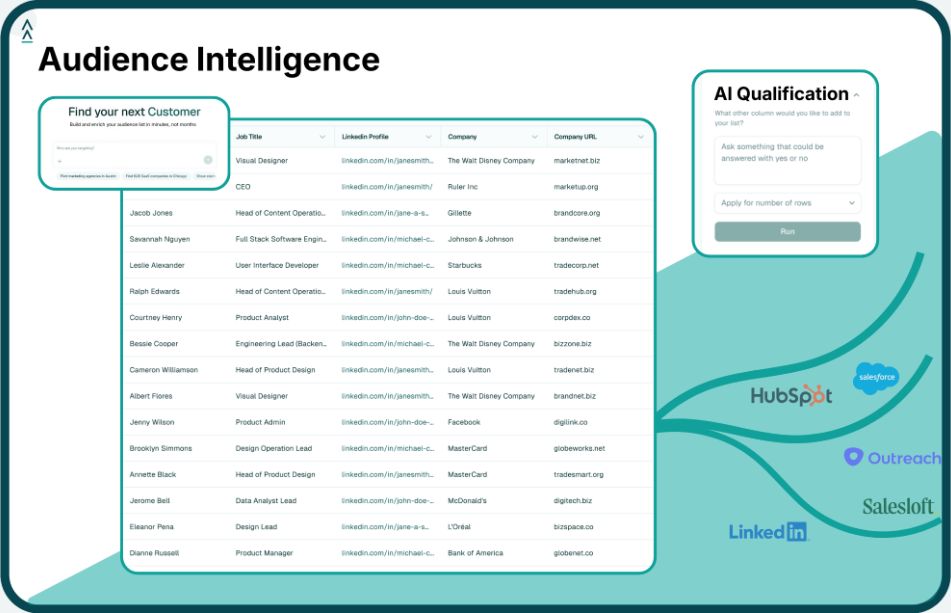
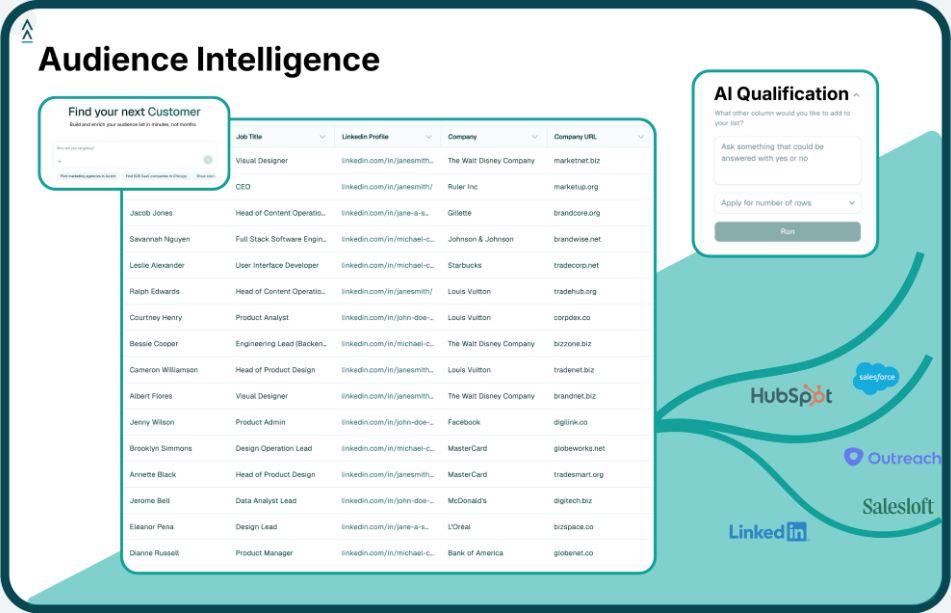
Landbase's Search Companies tool can build audiences using criteria such as industry, company size, revenue, location, technology, funding, headcount, and growth fields.
For an existing portfolio or account set, Analyze Patterns can surface shared industries, technologies, keywords, and company-size characteristics.
Funding can be evaluated alongside operating changes. Landbase provides dedicated data around funding events and headcount growth, including department- and region-level changes.
Combining several indicators can help distinguish a company that recently raised capital from one experiencing broader organizational expansion.
Some research questions require more than standard filters. The Advanced Dataset Creator can apply calculations, ratios, comparisons, and change-over-time logic to company datasets.
For example, a team could compare businesses by funding recency, engineering-team growth, revenue per employee, or combinations of several company characteristics.
The Landbase CLI provides programmatic access to GTM data and workflows from environments such as Claude Code and Codex.
GTM engineers and RevOps teams can use the CLI for search, matching, enrichment, dataset management, and structured outputs, turning recurring portfolio research into a workflow that can be rerun as company conditions change.
Tiger Global operates both public-equity and private-equity businesses. Its private strategy invests across early through late-stage companies pursuing innovative approaches in new and existing industries, while its public business invests in growth-oriented listed companies.
Growth can appear through revenue or ARR expansion, customer adoption, transaction volume, product usage, financing, valuation increases, geographic expansion, or other operating metrics. Private companies disclose different information, so several measures can provide a more useful picture than valuation alone.
AI is affecting multiple layers of technology simultaneously, including models, enterprise data, developer infrastructure, workflow software, voice systems, and autonomous machines. Tiger Global has invested across several of these layers rather than limiting its exposure to one AI category.
Recent funding, revenue growth, headcount expansion, hiring by department, executive appointments, new products, acquisitions, customer growth, technology changes, and geographic expansion can all add context. Combining multiple signals can provide a clearer view of how the organization is evolving.
Landbase can help teams define relevant company groups, compare funding and growth characteristics, analyze common patterns, enrich account and contact data, and build repeatable datasets. The same research can be extended into Landbase CLI workflows for Claude Code, Codex, scripts, dashboards, and other technical GTM environments.
Tool and strategies modern teams need to help their companies grow.