.png)
.png)

Daniel Saks
Chief Executive Officer


In the current AI boom, startups are reaching significant scale at unusually rapid rates. Accel describes AI as a technology supercycle that is compressing the time between an idea and a scaled business, while AI platforms and developer tools continue to reshape how software is built and deployed.
Accel, the venture capital firm known for early investments in companies such as Facebook, has continued backing businesses across AI, enterprise software, developer infrastructure, cybersecurity, and other technology markets. Its current portfolio includes fast-growing companies such as Anthropic, Lovable, Cyera, Vercel, and n8n.
For RevOps teams, GTM engineers, and technical operators, understanding which companies are scaling quickly can provide useful market intelligence. The broader investment environment reinforces the importance of AI: according to the OECD, AI companies accounted for 61% of global venture investment value in 2025.
The ten Accel-backed companies below show notable recent momentum across financing, valuation, revenue, customer adoption, and product growth.
Industry: Frontier AI / Foundation Models
CEO and Co-Founder: Dario Amodei
Latest Funding: $65 billion Series H, May 2026
Post-Money Valuation: $965 billion
Anthropic develops Claude, Claude Code, APIs, and enterprise AI products. Accel first invested in Anthropic in 2025 and has subsequently participated in additional financings.
Anthropic raised $65 billion in Series H financing in May 2026 at a $965 billion post-money valuation. That followed a $30 billion Series G only three months earlier at a $380 billion valuation.
The company said its run-rate revenue surpassed $47 billion in May as adoption continued expanding across enterprise customers and products including Claude Code.
Anthropic operates across frontier-model development, enterprise AI, APIs, and software-development tools. Claude Code has also positioned the company directly within the transition toward agent-assisted software engineering.
Its growth reflects increasing enterprise demand for models that can support both general knowledge work and more specialized technical workflows.
Industry: AI Software Engineering
Founded: 2024
CEO and Co-Founder: Scott Wu
Latest Funding: $2 billion Series E, September 2026
Valuation: $48 billion
Cognition develops Devin, an autonomous software-engineering agent, and operates Windsurf following its acquisition of the remaining Windsurf business in 2025.
Cognition raised $2 billion in Series E financing on September 8, 2026 at a $48 billion valuation. Accel and Andreessen Horowitz led the round.
The company reported that its run-rate revenue had increased from $492 million in May to nearly $900 million by September. Its valuation also increased from $26 billion in May to $48 billion four months later.
Cognition is part of the shift from AI-assisted code completion toward agents that can plan, write, test, and deploy software with greater autonomy.
The combination of Devin and Windsurf gives Cognition products across both autonomous engineering agents and AI-native development environments.
Industry: AI Software Creation
CEO and Co-Founder: Anton Osika
Co-Founder: Fabian Hedin
Latest Funding: $400 million Series C, August 2026
Valuation: $13.3 billion
Lovable enables users to create web applications and software through natural-language prompts. Accel led the company's $200 million Series A in 2025 and remains an investor.
Lovable raised $400 million in Series C financing in August 2026 at a $13.3 billion valuation. That followed a $6.6 billion valuation in December 2025.
The company reached approximately $500 million in annualized revenue by June 2026 after crossing $400 million earlier in the year.
Lovable also reported hosting approximately 60 million projects generating around 900 million monthly visitors.
Lovable illustrates how AI is reducing the technical barrier to building software. Application development can increasingly begin with natural-language instructions rather than conventional programming alone.
That shift broadens software creation beyond engineering teams while also changing how technical teams prototype and deliver applications.
Industry: Data and AI Security
CEO and Co-Founder: Yotam Segev
Co-Founder and CTO: Tamar Bar-Ilan
Latest Funding: $600 million Series G, June 2026
Valuation: $12 billion
Cyera provides data-security and AI-governance technology covering data discovery, classification, posture management, loss prevention, identity, and controls around enterprise AI usage.
Accel has partnered with Cyera since its Series A in 2022.
Cyera raised $600 million in Series G financing in June 2026 at a $12 billion valuation. The valuation had quadrupled over approximately 18 months.
Earlier in January 2026, Cyera had raised another $400 million at a $9 billion valuation.
The company also expanded its platform through the 2026 acquisition of Oasis Security, adding non-human identity management to its broader data and AI security capabilities.
Enterprise AI systems can create new questions around what data models and agents can access, how information moves between systems, and which human or machine identities have permissions.
Cyera's expansion reflects growing demand for security infrastructure designed around those changes.
Industry: AI Data, Evaluations, and Applications
Founded: 2016
CEO: Francis deSouza
Founder and Chairman: Alexandr Wang
Latest Major Investment: Meta strategic investment, June 2025
Valuation Following Transaction: More than $29 billion
Scale AI provides data infrastructure, model evaluations, and AI applications for frontier-model developers, enterprises, and governments. Accel first invested in Scale at Series A in 2016.
Scale described 2025 as its strongest financial year, reporting well over $1 billion in new business. Nearly half of new bookings arrived during the fourth quarter.
Its applications business more than doubled revenue during the second half of 2025, while its international public-sector business doubled revenue for the full year.
Scale appointed Francis deSouza CEO effective August 10, 2026. Alexandr Wang remains founder and chairman.
Scale has expanded beyond its original focus on training data into evaluations, enterprise applications, government AI deployments, robotics, and other production AI infrastructure.
Its development illustrates how AI infrastructure is broadening from model training into the full process of building, evaluating, and deploying AI systems.
Industry: AI Search and Research
Founded: 2022
CEO and Co-Founder: Aravind Srinivas
Latest Completed Financing: $200 million, September 2025
Valuation: $20 billion
Perplexity operates an AI-powered search and research platform that combines web retrieval with synthesized answers and cited sources. Accel lists the company as a portfolio investment beginning in 2025.
Perplexity's annualized revenue increased to more than $750 million by August 2026 from less than $250 million at the beginning of the year.
Part of that growth has come from Perplexity Computer, an AI-agent product designed to perform research and computer-based professional tasks.
Its most recently completed disclosed financing valued the company at approximately $20 billion in September 2025.
Perplexity demonstrates how AI is changing search from a process centered primarily on finding links toward one that also synthesizes information, conducts research, and performs multi-step tasks.
That model increasingly overlaps with enterprise research, market analysis, and professional knowledge workflows.
Industry: Developer Infrastructure / AI Cloud
Founded: 2015
CEO and Founder: Guillermo Rauch
Latest Funding: $300 million Series F, September 2025
Valuation: $9.3 billion
Vercel provides cloud infrastructure and developer tools for web applications and AI products. Its ecosystem includes Next.js, v0, AI SDK, deployment infrastructure, and agent-oriented development products.
Accel has partnered with Vercel across multiple financing rounds.
Vercel raised $300 million in Series F financing in September 2025 at a $9.3 billion valuation.
At the time, its AI SDK had surpassed three million weekly downloads. Next.js recorded more than 500 million downloads during the preceding 12 months, exceeding its cumulative downloads from 2016 through 2024.
Vercel has continued expanding its platform around AI agents, deployment infrastructure, workflow tooling, and open-source development.
Vercel operates where software creation, frontend infrastructure, AI application development, and deployment increasingly intersect.
As AI agents generate more software, infrastructure that helps teams build, test, deploy, and operate those applications becomes more important.
Industry: Generative Video and Creative AI
Founded: 2023
CEO and Co-Founder: Alex Mashrabov
Latest Funding: $400 million Series B, August 2026
Valuation: $5.4 billion
Higgsfield provides AI-powered image and video generation tools for creators, brands, agencies, and studios. Accel participated in the company's Series A financing and subsequent rounds.
Higgsfield raised $400 million in Series B financing in August 2026 at a $5.4 billion valuation, more than quadrupling its $1.3 billion valuation from January.
The company reported approximately $700 million in annualized revenue, compared with roughly $20 million a year earlier.
Higgsfield also reported more than 30 million users across 238 countries and territories and adoption by 390 Fortune 500 companies.
Generative video is moving from experimental content creation into advertising, marketing, media, and enterprise production workflows.
Higgsfield's rapid expansion reflects increasing commercial demand for AI systems that can automate larger portions of visual-content production.
Industry: Workflow Automation / AI Orchestration
Founded: 2019
CEO and Founder: Jan Oberhauser
Latest Funding: $180 million Series C, October 2025
Valuation: $2.5 billion
n8n provides workflow automation and AI-orchestration software that lets teams connect applications, models, APIs, and human approval steps in configurable workflows.
Accel led the company's Series C financing.
n8n raised $180 million in Series C financing in October 2025, bringing total funding to $240 million and valuing the company at $2.5 billion.
During the year leading into that round, n8n reported sixfold user growth and tenfold revenue growth.
The platform has increasingly expanded from conventional workflow automation toward orchestration for AI agents and business processes involving both automated and human steps.
Putting AI into production often requires more than selecting a model. Organizations also need to connect models with data, applications, approvals, triggers, and operational logic.
n8n operates within that orchestration layer, where conventional automation and agentic workflows increasingly overlap.
Industry: Product Development / Software Collaboration
CEO and Co-Founder: Karri Saarinen
Latest Liquidity Event: $99 million employee tender, August 2026
Valuation: $2.5 billion
Linear provides product-development software used by engineering, product, and design teams to plan work, manage issues, coordinate projects, and integrate AI agents into development workflows.
Accel has invested in Linear across three consecutive investment events.
Linear completed a $99 million employee tender in August 2026 at a $2.5 billion valuation, twice the valuation attached to its previous tender and Series C.
Earlier in 2026, the company crossed $100 million in annual recurring revenue. More than 40,000 companies were paying for Linear, with net revenue retention reaching 177%.
AI-agent adoption has also expanded quickly. Agents were installed across 95% of paid Linear workspaces by August, while their share of created work increased from approximately 3% a year earlier to 50%.
Product-development systems increasingly need to coordinate work performed by both people and software agents.
Linear's growth reflects the emergence of a development environment where planning, coding, issue management, and agent activity become more closely connected.
Several patterns connect these businesses despite their different products and markets.
Cognition, Lovable, Vercel, and Linear represent different parts of a changing development stack. AI can now generate applications, perform engineering tasks, deploy software, and participate directly in product-development workflows.
Anthropic operates at the model layer, while Scale supports data, evaluations, and production applications. n8n focuses on orchestration, Cyera on security and governance, and Perplexity on search and research.
The growing specialization illustrates how AI infrastructure is expanding into multiple distinct layers rather than converging on a single type of platform.
Higgsfield's rapid revenue growth and enterprise adoption show how generative video is moving into routine marketing and content-production processes.
The broader investment environment supports that trend. The OECD found that AI accounted for roughly 61% of global venture-capital investment value in 2025.
Funding and valuation provide one view of momentum. Revenue, customer expansion, retention, developer adoption, product usage, and hiring can show how that capital translates into operating growth.
That distinction is especially important when comparing companies ranging from frontier-model developers to infrastructure platforms and application-layer businesses.
An investor portfolio can provide a useful starting point for GTM research, but teams may need to narrow those companies by industry, stage, growth characteristics, technology, and the specific business changes relevant to their market.
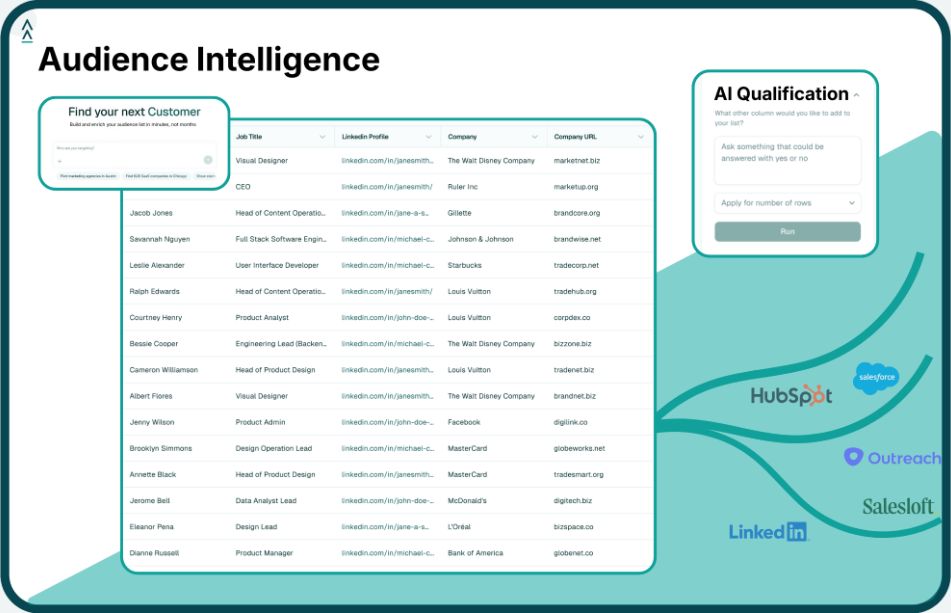
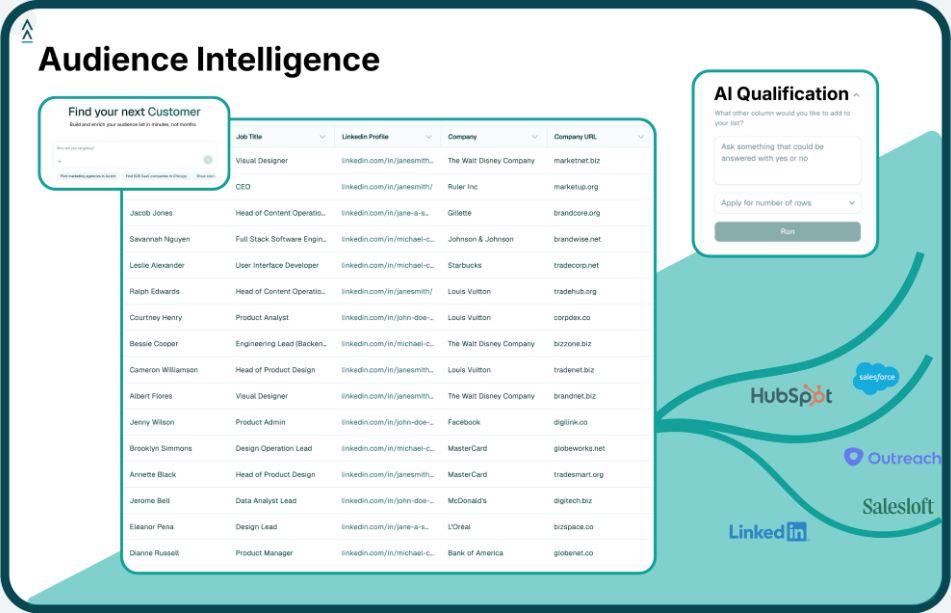
Landbase's Search Companies tool can define company sets using characteristics such as industry, size, revenue, location, technology, funding, headcount, and growth indicators.
For an existing portfolio list, Analyze Patterns can surface common industries, technologies, keywords, and company-size patterns.
Funding can be combined with operating changes rather than treated in isolation. Landbase's headcount growth signal tracks changes by department, seniority, and geography over different periods.
That can help distinguish companies expanding engineering, sales, marketing, or other functions even when their overall employee counts look similar.
Some market-research questions require calculations rather than standard filters. The Advanced Dataset Creator can work with ratios, calculated values, thresholds, and change-over-time conditions.
For example, GTM teams could compare companies by engineering headcount growth, revenue per employee, funding recency, or combinations of several characteristics.
Landbase's web environment and CLI operate as two connected interfaces to the same underlying system and data.
That allows teams to explore audiences interactively and move recurring searches, matching, enrichment, or dataset operations into Claude Code, Codex, scripts, and other programmatic workflows.
Growth can appear through revenue or ARR expansion, customer adoption, usage, financing, valuation increases, hiring, or geographic expansion. Because private companies disclose different metrics, several indicators can provide a more useful view of momentum than valuation alone.
Accel invests across early and later stages. In 2026, the firm announced $3.5 billion across four early-stage vehicles as well as $5 billion in late-stage capital, allowing it to invest in new companies and continue supporting existing portfolio businesses as they expand.
AI is creating opportunities across several layers of technology at once, including foundation models, software development, cybersecurity, workflow automation, search, creative software, and deployment infrastructure. This allows an investor to build exposure to AI without concentrating exclusively on model developers.
Funding, revenue growth, headcount expansion, hiring by department, customer growth, new executives, product launches, technology changes, and geographic expansion can all provide useful context. Combining several signals can provide a fuller picture of how a company is changing.
Landbase can help teams define company sets, compare growth characteristics, analyze common account patterns, add company and contact information, and build reusable datasets. Those workflows can also run through the Landbase CLI inside Claude Code, Codex, and other technical environments.
Tool and strategies modern teams need to help their companies grow.