.png)
.png)

Daniel Saks
Chief Executive Officer


Founded in 2009 by Marc Andreessen and Ben Horowitz, Andreessen Horowitz says it now has more than $100 billion under management across funds investing from seed through growth. Its focus areas include AI, enterprise technology, infrastructure, fintech, consumer technology, bio and health, crypto, games, and American Dynamism.
The firm has continued adding significant investment capacity. In January 2026, a16z announced more than $15 billion in new funds, followed in August by a new $1.1 billion Machine Age Fund focused on the physical infrastructure supporting AI.
AI accounts for much of the recent activity, but the companies showing strong growth span a wider range of markets. Revenue expansion, ARR, customer adoption, financing, and valuation growth provide different views of how these private companies are scaling.
CEO and Co-Founder: Sam Altman
Founded: 2015
Recent Funding: $122 billion in committed capital, March 2026
Post-Money Valuation: $852 billion
OpenAI develops frontier AI models and products including ChatGPT, its API platform, and Codex. Andreessen Horowitz has publicly identified itself as an investor in OpenAI.
OpenAI closed $122 billion in committed capital in March 2026 at an $852 billion post-money valuation. That followed a February announcement covering $110 billion of planned investment from SoftBank, NVIDIA, and Amazon.
Product adoption has also continued expanding. In February, OpenAI reported that weekly Codex users had more than tripled since the beginning of 2026 to 1.6 million.
OpenAI operates across consumer AI, enterprise AI, developer tools, and model infrastructure. Its scale means changes in its models, APIs, coding products, and infrastructure partnerships can influence large portions of the broader AI software market.
CEO and Co-Founder: Ali Ghodsi
Founded: 2013
Recent Funding: $5 billion, August 2026
Valuation: $190 billion
Databricks provides a data and AI platform used to ingest, manage, analyze, govern, and apply enterprise data to analytics and AI workloads. It is included in a16z's disclosed investment portfolio.
Databricks raised $5 billion in August 2026 at a $190 billion valuation, only months after a previous financing valued the company at approximately $134 billion.
At the time of the August round, Databricks reported more than $7 billion in annualized revenue run rate and more than 80% year-over-year revenue growth in the second quarter. Its Lakebase product had also surpassed a $100 million revenue run rate.
Databricks sits at the intersection of enterprise data infrastructure and AI development. Its expansion reflects the growing need to connect governed enterprise data with AI applications, agents, analytics, and model-development workflows.
CEO and Co-Founder: Scott Wu
Founded: 2023
Recent Funding: $2 billion Series E, September 2026
Valuation: $48 billion
Cognition develops AI software-engineering agents, including Devin, and also operates Windsurf following its 2025 acquisition of the remaining business.
On September 8, 2026, Cognition announced a $2 billion Series E at a $48 billion valuation. Andreessen Horowitz and Accel led the round, marking a direct current a16z investment in the company.
Cognition said its run-rate revenue had increased from $492 million in May to nearly $900 million by September. The latest valuation nearly doubled the $26 billion valuation attached to its May 2026 financing.
Cognition represents the shift from AI code completion toward agents that can plan and execute larger software-development tasks. The combination of Devin and Windsurf gives the company products spanning both autonomous agents and AI-assisted development environments.
CEO: Brian Schimpf
Founder: Palmer Luckey
Founded: 2017
Recent Funding: $5 billion Series H, May 2026
Valuation: $61 billion
Anduril develops defense technology combining autonomous systems, sensors, aircraft, drones, manufacturing, and its Lattice software platform. Andreessen Horowitz first invested in Anduril in 2019 and remains a major investor.
Anduril raised $5 billion in May 2026 at a $61 billion valuation, with Thrive Capital and Andreessen Horowitz leading the round.
The company said revenue more than doubled in 2025 to $2.2 billion while its workforce nearly doubled.
Anduril illustrates the expansion of venture-backed technology into markets historically dominated by large defense contractors. Its approach combines software, autonomy, manufacturing, and hardware development across military systems.
CEO and Co-Founder: Arthur Mensch
Founded: 2023
Recent Funding: €3 billion Series D, September 2026
Post-Money Valuation: More than €21 billion
Mistral develops frontier AI models, enterprise AI products, inference infrastructure, and tools designed for both cloud and sovereign deployments. The company appears in a16z's infrastructure and AI portfolio.
On September 8, 2026, Mistral announced a €3 billion Series D at a post-money valuation above €21 billion. Samsung Electronics led the round, with additional participation from new and existing investors.
Mistral also reported operations across 20 countries and more than 125 global enterprise customers using its technology for mission-critical AI initiatives.
Mistral gives European enterprises and public-sector organizations another option for frontier models, open-weight AI, localized infrastructure, and sovereign deployments. Its growth also reflects increasing investment in AI infrastructure outside the United States.
CEO and Co-Founder: Alex Bouaziz
Founded: 2019
Recent Funding: $300 million Series E, October 2025
Valuation: $17.3 billion
Deel provides global payroll, HR, compliance, benefits, mobility, and workforce-management technology for distributed organizations. Andreessen Horowitz is a long-time investor and co-led Deel's Series E.
Deel's $300 million Series E valued the company at $17.3 billion. Earlier in 2025, Deel surpassed $1 billion in annual recurring revenue, and by September it had recorded its first $100 million revenue month and three consecutive years of profitability.
At the time of the round, Deel reported more than 35,000 customers, 1.5 million workers served, and $22 billion in payroll processed annually.
Deel has expanded from international contractor management into a broader global workforce platform. Its growth reflects demand for infrastructure capable of supporting payroll, employment, compliance, and HR operations across multiple countries.
CEO and Co-Founder: Winston Weinberg
Co-Founder: Gabriel Pereyra
Founded: 2022
Recent Funding: $200 million growth round, March 2026
Valuation: $11 billion
Harvey builds domain-specific AI for legal and professional-services workflows, including research, document analysis, due diligence, drafting, compliance, and multi-step agents.
Harvey raised $200 million in March 2026 at an $11 billion valuation. Existing investors participating in the round included Andreessen Horowitz.
Adoption continued accelerating after the financing. Harvey currently reports more than 200,000 lawyers across 2,400+ organizations in 70 countries using the platform. In August 2026, the company also said its second quarter added more than $100 million in ARR.
Harvey demonstrates how domain-specific AI can move beyond general chat interfaces into workflows requiring professional context, specialized data, permissions, and repeatable processes.
CEO and Co-Founder: Mati Staniszewski
Founded: 2022
Recent Funding: $500 million Series D, February 2026
Valuation: $11 billion
ElevenLabs develops AI voice, speech, dubbing, audio-generation, and conversational-agent technology for developers, creators, enterprises, and public-sector organizations.
ElevenLabs raised $500 million in Series D funding in February 2026 at an $11 billion valuation. Andreessen Horowitz participated with significant follow-on investment.
The company ended 2025 with more than $330 million in ARR and had surpassed $500 million ARR within the first four months of 2026. ElevenLabs attributed much of that growth to enterprise deployment of voice agents across customer support, sales, recruiting, and marketing operations.
ElevenLabs has expanded synthetic speech from content generation into conversational AI and enterprise workflows. Voice is increasingly being used as an interface for automated customer interactions, sales workflows, accessibility, translation, and media production.
CEO and Co-Founder: Amjad Masad
Founded: 2016
Recent Funding: $400 million Series D, March 2026
Valuation: $9 billion
Replit provides an agentic software-creation environment that allows users to build and deploy applications with AI assistance. Andreessen Horowitz participated in both its 2025 and 2026 financing rounds.
Replit raised $400 million in March 2026 at a $9 billion valuation, tripling its valuation from $3 billion six months earlier.
As of September 2026, the company reports more than 60 million users worldwide and users at 85% of Fortune 500 companies. It also opened its first international office in London in September.
Replit reflects the broadening audience for AI-assisted software development. Its platform is designed for both traditional developers and people who want to create software through natural-language instructions without managing a conventional development environment.
CEO and Co-Founder: Jesse Zhang
Co-Founder: Ashwin Sreenivas
Recent Funding: $250 million Series D, January 2026
Valuation: $4.5 billion
Decagon develops AI agents for customer experience and support workflows. Andreessen Horowitz provided the company's first institutional investment and led its seed round.
Decagon raised $250 million in January 2026, tripling its valuation to $4.5 billion in less than six months.
The company said more than 100 new global enterprise customers joined during its preceding fiscal year, including organizations such as Avis Budget Group, Block, and Deutsche Telekom.
Decagon is part of a broader shift from scripted customer-service chatbots toward AI agents capable of handling longer, multi-step service interactions. Its growth shows enterprise demand for AI systems built around specific operational workflows rather than general-purpose conversation alone.
Several patterns connect these a16z-backed companies despite their different markets.
OpenAI and Mistral operate closer to the model layer, while Harvey, Decagon, ElevenLabs, Cognition, and Replit apply AI to specific categories of work. Databricks provides the data infrastructure that helps enterprises operationalize AI against their own information.
Cognition and Replit illustrate the shift from code completion toward systems that can plan, build, debug, and execute larger portions of software-development workflows.
Harvey's legal specialization and Decagon's customer-experience focus show how AI products can build around domain-specific workflows, data, permissions, and operational requirements rather than competing solely on model capability.
Anduril's revenue expansion and large 2026 financing show that venture-backed growth is also occurring in manufacturing, defense, autonomous systems, and physical infrastructure.
Capital can support compute, international expansion, research, manufacturing, acquisitions, and product development. The purpose and timing of a funding round therefore provide more useful context than the funding amount alone.
The companies in this list are scaling in different ways, from large funding rounds to revenue growth, hiring, customer expansion, and product development. For GTM teams researching the a16z ecosystem, Landbase can help organize those changes into structured company and contact research.
Landbase's Search Companies tool can define an account universe using criteria such as:
This allows teams to move beyond a static list of a16z-backed companies and identify businesses with similar growth characteristics.
Funding alone provides only part of the picture. The signal stacking workflow can combine developments such as:
Combining several signals can help identify companies undergoing broader operational expansion rather than relying on one financing event.
Fast-growing companies can change quickly between funding rounds. Landbase's Search the Web capability can help validate recent company developments, while its decision-maker research workflow can identify relevant stakeholders based on the business function being targeted.
That can be particularly useful across a diverse portfolio where the relevant buyer may sit in engineering, finance, HR, operations, security, or another department.
For more detailed analysis, the Advanced Dataset Creator can apply custom filters, comparisons, ratios, and ranking logic to company datasets.
GTM engineers and RevOps teams can then use the CLI-to-web workflow to move between programmatic research and interactive analysis as funding, hiring, and company conditions change.
This turns venture-backed-company research into a repeatable workflow rather than a static list tied to a single funding cycle.
Growth can appear through revenue or ARR increases, customer adoption, transaction volume, product usage, financing, geographic expansion, or valuation changes. Because private companies disclose different metrics, several indicators can provide a more useful picture of momentum than valuation alone.
Andreessen Horowitz says it has more than $100 billion under management across multiple funds. In January 2026, it announced more than $15 billion in new capital across strategies including growth, infrastructure, applications, American Dynamism, and bio and health.
AI is affecting multiple technology layers at once, including models, enterprise data, software development, professional services, voice, customer experience, and physical systems. That breadth allows AI investment to extend beyond model developers into companies applying the technology to specific operational problems.
Funding rounds, revenue or ARR growth, hiring activity, new executives, customer expansion, geographic growth, acquisitions, and product launches can all provide useful context. Combining several signals can create a fuller picture of how a company is changing.
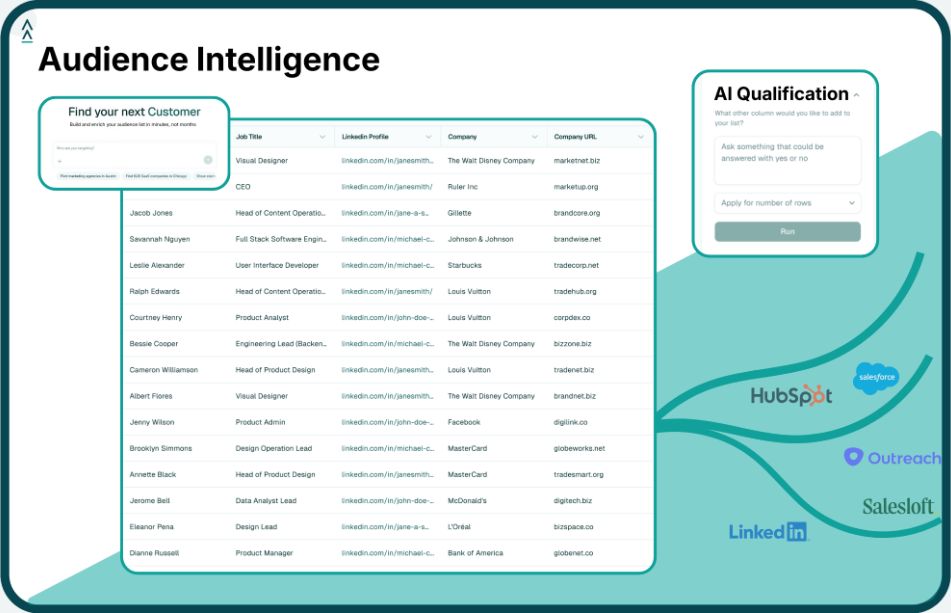
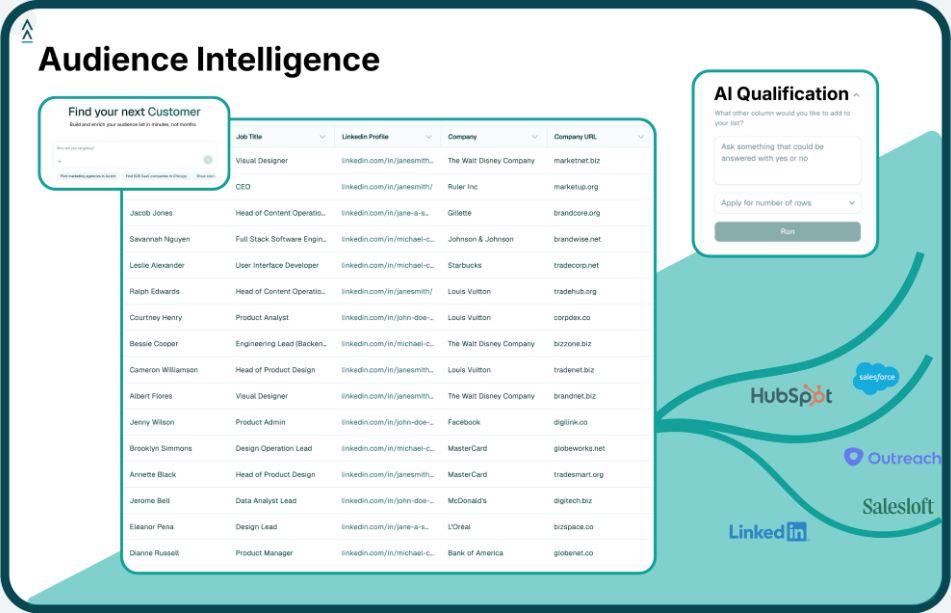
Landbase can help teams identify companies using structured company data, track relevant funding and business changes, research decision-makers, enrich existing datasets, and run repeatable workflows through its web interface or CLI. This allows venture-portfolio research to move from individual company lookups into structured account and market datasets.
Tool and strategies modern teams need to help their companies grow.