.png)
.png)

Daniel Saks
Chief Executive Officer


The additive manufacturing market in 2026 is moving well beyond desktop prototyping. Industrial metal platforms are scaling production for aerospace, defense, and advanced manufacturing, while other companies are expanding 3D printing into tissue therapeutics, construction, dentistry, consumer hardware, and high-performance polymer components.
Capital activity provides one view of that momentum. An additive manufacturing funding tracker maintained by AMPulse shows billions of dollars flowing into the category across hundreds of funding rounds since 2022. Recent financing also points toward increased investor interest in companies applying additive manufacturing to production-scale industrial problems.
Additive manufacturing now covers a broad range of technologies and business models. Some companies sell printers and materials, while others operate manufacturing networks, build digital factories, print biological tissue, or automate construction.
That diversity makes growth difficult to measure with a single number.
Revenue provides one useful metric when companies disclose it. Funding can indicate investor confidence and provide capital for expansion. Production capacity, new facilities, major customer programs, product commercialization, and geographic expansion provide additional evidence.
For GTM research, these indicators are similar to the broader hiring, funding, and tech signals that can help distinguish a static company profile from an organization undergoing meaningful change.
1. Divergent Technologies
CEO: Lukas Czinger
Headquarters: Torrance, California
Recent Funding: $290 million Series E in September 2025
Divergent raised $290 million in Series E financing to expand manufacturing capacity and develop new product capabilities. The company also reported more than 5x revenue growth in 2025 and introduced more than 200 aerospace and defense part numbers during the first half of the year.
Divergent's Adaptive Production System, or DAPS, combines AI-enabled design, metal additive manufacturing, and automated assembly. The platform supports production across aerospace, defense, and automotive programs.
Divergent shows how additive manufacturing can function as an integrated production system rather than a standalone printing process. Its recent growth also reflects increasing demand for digitally driven manufacturing in aerospace and defense.
CEO: Kevin Kassekert
Headquarters: Devens, Massachusetts
Recent Funding: $220 million in January 2026
VulcanForms raised $220 million in January 2026 to expand its U.S. manufacturing facilities, technology roadmap, and production capacity. The company is also developing additional integrated facilities as demand for production programs grows.
VulcanForms combines metal additive manufacturing, machining, automation, inspection, and proprietary software within integrated digital factories. Its production capabilities serve aerospace, defense, healthcare, consumer, and industrial markets.
VulcanForms represents a shift from standalone 3D printing toward vertically integrated digital manufacturing, where additive production is one step within a complete manufacturing workflow.
Founder and CEO: Tamer Mohamed
Headquarters: Vancouver, British Columbia
Recent Funding: $115 million Series B in January 2025
Aspect raised $115 million in Series B financing to advance its bioprinted tissue therapeutics. In April 2026, it also announced a separate $280 million multi-year project backed by a $79 million Government of Canada investment to expand development and biomanufacturing capabilities.
Aspect develops bioengineered cellular medicines using a platform that integrates AI-powered bioprinting, therapeutic cells, biomaterials, and computational design. Its pipeline focuses on metabolic and endocrine diseases.
Aspect extends additive manufacturing into regenerative medicine, where bioprinting becomes part of a broader platform for developing and manufacturing advanced cellular therapies.
CEO: Erik Palitsch
Headquarters: Hawthorne, California
Recent Funding: $67 million Series B in February 2026
Freeform raised $67 million in Series B financing in February 2026 as it expanded production capacity and its next-generation manufacturing platform. The company reported that customer demand was exceeding its existing capacity.
Freeform operates software-defined metal additive manufacturing factories that combine printing, robotics, sensing, simulation, machine learning, and real-time process control.
Freeform demonstrates how AI, computing, and additive manufacturing can operate as one production system, with the company focused on moving metal printing from prototyping into repeatable manufacturing.
Founder: Chris Hong
Headquarters: Shenzhen, China
Recent Funding: More than RMB 500 million in a 2026 B+ round
ELEGOO completed a B+ financing round worth more than RMB 500 million in 2026. Reported revenue reached approximately RMB 2.3 billion in 2025, up from RMB 1.6 billion in 2024, while the new capital is intended to support R\&D, hiring, supply-chain development, and international expansion.
ELEGOO develops resin and filament 3D printers alongside materials, accessories, and other maker and STEM products. The company sells its products across international consumer markets.
ELEGOO highlights the continued scale of consumer 3D printing, where product development, accessible hardware, and global distribution are expanding additive manufacturing beyond industrial users.
CEO: Philip DeSimone
Headquarters: Sunnyvale, California
Recent Funding: $60 million in November 2025
Carbon raised $60 million in November 2025 to increase capacity and support continued product development. The company cited rising production volumes and expanding customer relationships as it moved toward cash-flow-positive operations.
Carbon combines polymer 3D printers, proprietary materials, software, and design tools for prototyping and end-use production. Its technology is used across consumer, medical, dental, and industrial applications.
Carbon illustrates the transition of polymer 3D printing into scaled end-use production, particularly where manufacturers need integrated hardware, materials, and software.
CEO: Jason Ballard
Headquarters: Austin, Texas
Recent Funding: $56 million Series C first close in February 2025
ICON followed its 2025 financing with significant commercialization activity in 2026. It launched the Titan construction system for outside builders and received a $62.8 million U.S. Army production contract for additional 3D-printed barracks at Fort Bliss.
ICON develops large-scale construction robotics, printable building materials, software, and building systems. Its Titan program packages robotics, materials, software, training, and ongoing support for builders.
ICON is helping move construction-scale 3D printing from company-operated projects toward technology that other builders can deploy, broadening the potential commercial use of additive construction.
Founder and CEO: Daniel Chen
Headquarters: Shenzhen, China
Recent Funding: Series B financing in December 2025
Snapmaker raised tens of millions of U.S. dollars in Series B financing to support R\&D, talent acquisition, and ecosystem expansion. Its U1 printer also raised more than $20 million from over 20,000 Kickstarter backers in 2025.
Snapmaker develops desktop 3D printers and multifunctional fabrication systems spanning 3D printing, laser processing, and CNC carving. Its newer U1 platform focuses on multi-material and multicolor printing.
Snapmaker's financing and crowdfunding performance point to continued demand for more capable consumer and prosumer 3D printing systems, particularly around flexible multi-material workflows.
Founder and CEO: Liu Zhen
Headquarters: Suzhou, China
Recent Funding: Multi-million-dollar Pre-Series B in September 2025
RAYSHAPE completed a multi-million-dollar Pre-Series B round in September 2025 to fund R\&D, international distribution, and digital-dentistry expansion. The company also added manufacturing capacity for printers and dental resins in Suzhou.
RAYSHAPE develops integrated dental 3D printing systems spanning printers, software, materials, and chairside and laboratory workflows. Its products are distributed across more than 60 countries and regions.
RAYSHAPE reflects the growing specialization of additive manufacturing, with hardware, software, and materials developed around the specific requirements of digital dentistry.
Founder and CEO: Alessio Lorusso
Headquarters: Bari, Italy
Recent Funding: Undisclosed investment announced in March 2026
Roboze announced new investment led by Rule 1 Ventures in March 2026 to expand its distributed manufacturing infrastructure across the United States, Europe, and the Middle East. The company also opened a dedicated U.S. aerospace and defense headquarters in El Segundo in January 2026.
Roboze develops additive manufacturing systems for high-performance polymers and composites, combining proprietary hardware, materials, software, and process intelligence for aerospace, defense, energy, transportation, and other industrial applications.
Roboze shows how additive manufacturing can support localized production of high-performance components in industries where material performance, repeatability, and supply-chain resilience are important.
The harder challenge is not finding the ten companies already attracting attention. It is identifying the next wave as funding, hiring, technology, and expansion signals change.
Landbase gives revenue teams, RevOps operators, and GTM engineers a way to turn those changes into structured audiences that can be refined, enriched, and reused as the market evolves.
A team could start with a request such as:
"Find additive manufacturing companies in North America and Europe selling into aerospace, defense, medical, or industrial markets that recently raised funding or expanded production."
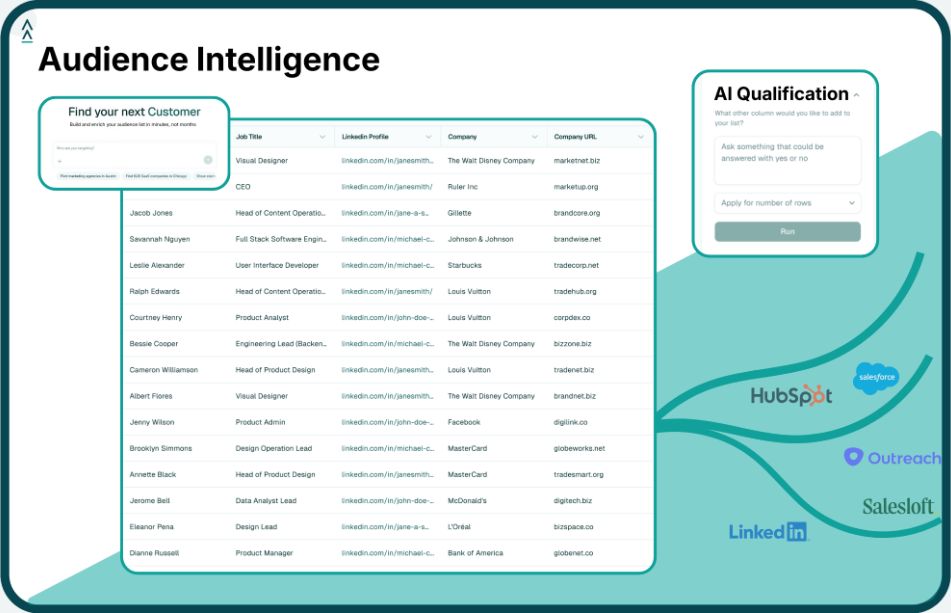
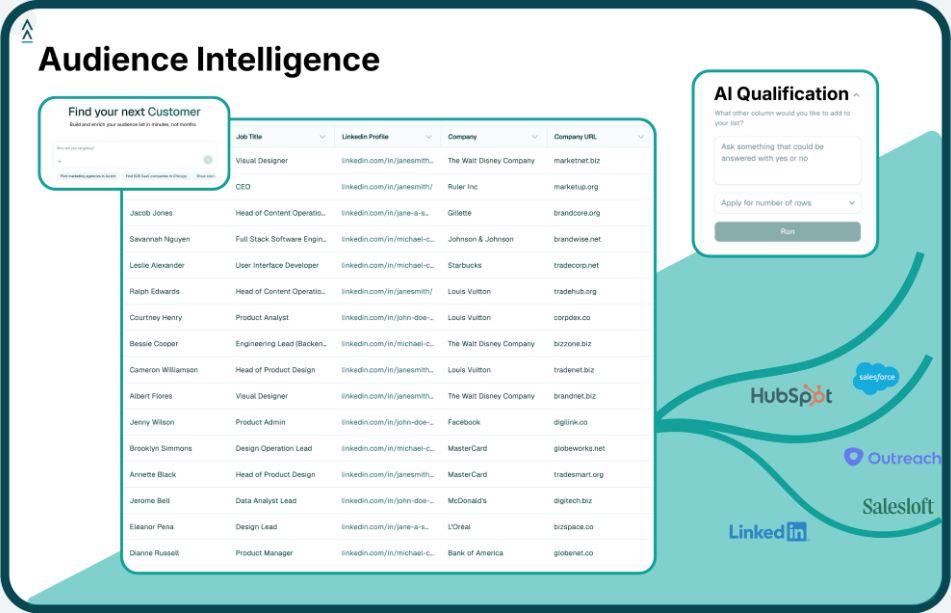
Landbase's natural language to filters workflow translates the request into structured targeting criteria. When a fixed database field cannot capture part of the request, Landbase can also apply AI-generated filters to evaluate the additional requirement.
That matters in additive manufacturing, where relevant companies may identify themselves as digital manufacturing, bioprinting, construction robotics, advanced materials, or industrial automation businesses.
Finding companies that fit the market is only the first step. Landbase can stack buying signals around events such as funding, hiring growth, executive changes, and technology adoption to add a current-state layer to the audience.
This makes it possible to separate companies that simply match the target profile from those undergoing meaningful change. In a fast-moving sector, that distinction can make an account list considerably more useful for prioritization.
Known companies such as Divergent, Freeform, or VulcanForms can become starting points for broader discovery.
Landbase's semantic search and lookalikes can identify companies with similar business characteristics, then combine that similarity with filters for geography, company size, funding stage, or other requirements.
This approach can uncover adjacent businesses that a conventional category search may overlook, particularly as additive manufacturing continues to converge with software, robotics, materials science, and specialized industrial applications.
A high-quality company list still needs the right contacts.
With finding contacts and decision-makers, teams can describe the decision they are targeting rather than guessing at one rigid job title. Landbase can then reason from that buying decision to relevant people within each company.
For additive manufacturing accounts, the appropriate stakeholder could sit in engineering, manufacturing, operations, supply chain, procurement, business development, or executive leadership depending on what is being sold.
Industry research rarely starts from zero. Teams may already have CRM records, conference lists, spreadsheets, or accounts gathered through previous research.
Landbase can enrich and match records from those existing sources by matching companies or people to Landbase data and filling in selected company and contact details. That allows an existing 3D printing market map to become part of the workflow instead of requiring the research to be rebuilt from scratch.
The strongest advantage emerges when the research needs to be repeated.
The Landbase CLI runs inside AI-assisted environments such as Claude Code and Codex, where searches, enrichment, matching, and connected workflow steps can be turned into repeatable commands. The CLI and web app share the same data, agent, account, and saved work, so technical workflows remain connected to the broader Landbase environment.
A GTM engineer could rerun an additive manufacturing market search, identify companies with new signals, enrich the resulting accounts and contacts, and pass the updated data into other connected workflows. Instead of rebuilding a static market list every few months, the research can become a repeatable process that evolves with the industry.
There is no single metric that defines a fast-growing additive manufacturing company. Revenue growth is valuable when available, but private companies often disclose limited financial information. Funding, manufacturing capacity, hiring, major customer programs, geographic expansion, and product commercialization can provide additional evidence. Evaluating multiple hiring, funding, and tech signals can provide a more complete view than relying on one financing announcement.
Funding alone is not enough to create a reliable growth ranking. A large financing round demonstrates access to capital and investor expectations, but it does not necessarily mean revenue or customer adoption is increasing at the same rate. Mature businesses may also expand rapidly without raising new venture capital. Funding is therefore more useful when evaluated alongside production, customer, hiring, and market-expansion signals.
Industrial metal additive manufacturing is receiving substantial investment, particularly for aerospace, defense, and advanced manufacturing applications. Consumer printing continues to develop through companies such as ELEGOO and Snapmaker, while bioprinting and construction printing are progressing through more specialized applications. Dental and high-performance polymer printing also remain active areas of commercialization. The market increasingly consists of multiple specialized categories rather than one uniform 3D printing segment.
GTM teams can monitor combinations of funding, hiring, leadership changes, facility expansion, new products, and technology adoption. Searching only for companies labeled "3D printing" can miss businesses that describe themselves as additive manufacturing, digital manufacturing, advanced manufacturing, bioprinting, or construction robotics companies. Landbase's semantic search and lookalikes workflow can help expand research beyond rigid industry labels and identify organizations with similar business or technology characteristics. That creates a more repeatable process than rebuilding company lists manually.
Landbase gives GTM teams access to company, contact, funding, hiring, technology, and other GTM data through its broader platform and CLI workflows. Teams can define an additive manufacturing market in plain language, incorporate growth signals, refine target companies, and identify relevant decision-makers. The power of the CLI also makes those workflows available inside AI-assisted environments such as Claude Code and Codex. This makes it possible to maintain an evolving additive manufacturing account universe instead of relying on a static one-time list.
Tool and strategies modern teams need to help their companies grow.