.png)
.png)

Daniel Saks
Chief Executive Officer


Coresignal provides public web data for developers, data teams, and organizations building custom applications, analytics products, and workforce intelligence systems. However, teams evaluating Coresignal alternatives may need more than bulk datasets or developer APIs. GTM engineers and revenue operations teams often need tools that can also create audiences, match incomplete records, enrich company and contact data, and prepare structured outputs for operational systems.
The rise of terminal-based AI workflows is also changing how technical teams interact with business data. Instead of relying solely on browser interfaces and manual exports, teams may need GTM data that can move directly into command-line tools, AI coding environments, scripts, dashboards, CRMs, and automated workflows.
Primary Use Case: Technical GTM teams and AI agents that need to search, match, enrich, process, and export B2B audience data from terminals and AI coding environments.
Landbase provides a command-line interface for working with GTM data inside terminals, scripts, Claude Code, Codex, notebooks, and other technical environments. Teams can use Landbase CLI to move from an audience request or uploaded file to matched, enriched, and downloadable datasets.
This makes Landbase particularly relevant when a team needs to operationalize B2B data instead of obtaining a raw dataset and building every subsequent workflow internally.
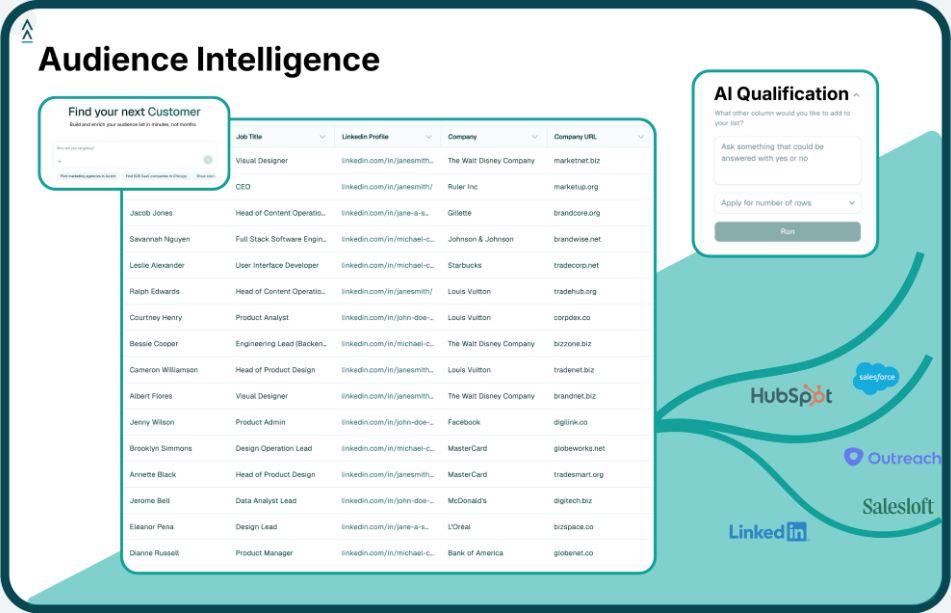
Landbase allows users to request an audience using plain English. A search can describe the required industry, location, company characteristics, technologies, roles, or other audience criteria without requiring the user to navigate a fixed series of filters.
The response includes identifiers for the run, session, and resulting dataset. These structured identifiers give technical operators and AI agents a clear way to continue processing the results through subsequent commands.
For more complicated requests, the advanced dataset creator supports logic that may be difficult to express through standard filters. This includes exact filtering, aggregations, custom SQL, ratios, rankings, and custom output columns. A two-step confirmation process allows the user or agent to review the proposed query before it runs.
Teams can upload existing CRM exports, prospect lists, or spreadsheets and process them through Landbase. Matching helps connect partial person or company information with Landbase records before enrichment begins.
The enrichment workflow can append firmographic information such as industry, company size, and location. Contact enrichment can add verified emails, phone numbers, LinkedIn URLs, and job titles where available.
This workflow is useful for operations such as:
Landbase also documents how to enrich an uploaded dataset from beginning to end. The workflow can include uploading, onboarding, matching, enrichment, publishing, and downloading the resulting dataset.
Landbase CLI is designed to return machine-readable results. The search returns structured JSON, which allows scripts and AI coding agents to identify the generated dataset and use it in later operations.
This architecture is relevant for teams building workflows in Claude Code or Codex because the data does not have to remain inside a browser interface. Results can be passed into scripts, transformed with command-line utilities, analyzed in notebooks, or prepared for downstream CRM and dashboard workflows.
Landbase also uses stable error codes to help technical workflows distinguish between authentication problems, validation errors, missing datasets, rate limits, and other conditions. This provides a clearer recovery path when an automated operation cannot finish as expected.
Landbase workflows operate on datasets, with each processing step producing a new output dataset. Because workflow commands transform datasets, technical teams can track how uploaded or generated data changes through onboarding, matching, enrichment, and publishing.
Completed results can be downloaded as JSONL, CSV, Parquet, or compressed JSONL files. The available formats support several operational needs:
This combination of search, matching, enrichment, workflow tracking, and export makes Landbase a strong Coresignal alternative when the goal is building an agent-ready GTM data workflow rather than accessing public web data alone.
Primary Use Case: Sales and marketing organizations that need a browser-based sales intelligence platform with company data, contact records, buyer signals, and CRM integrations.
ZoomInfo provides sales intelligence through a group of products for prospecting, marketing, operations, and talent-related workflows. Its platform helps revenue teams identify companies and contacts, review account information, monitor signals, and move records into established sales systems.
Unlike a raw data provider, ZoomInfo packages data within applications intended for day-to-day sales and marketing use. The platform is commonly considered by organizations that want account discovery, contact research, territory development, and CRM-connected workflows in one environment.
ZoomInfo focuses on sales intelligence and revenue-team workflows, while Coresignal emphasizes public web data delivered through datasets and APIs. ZoomInfo may fit teams that want representatives and marketers to work through a dedicated interface rather than build a data product internally.
Technical teams should assess export controls, integration requirements, data governance, and how records can move into their existing systems. Organizations needing terminal-native processing or agent-readable dataset workflows may require a different operational layer.
Primary Use Case: Sales teams that want prospecting data and outbound engagement capabilities in the same platform.
Apollo.io combines company and contact discovery with sales engagement tools. Users can search for prospects, organize lists, create sequences, send emails, manage tasks, and synchronize activity with supported CRM platforms.
This combination reduces the number of separate tools required when the primary objective is moving directly from prospect discovery to outbound activity. Apollo is oriented toward sales execution rather than custom public web datasets or data engineering projects.
Apollo packages data inside a prospecting and engagement workflow. Coresignal provides data infrastructure that developers can use to build their own applications, models, or analytics processes.
Apollo may suit teams that want sales representatives to discover and contact prospects in one browser-based environment. Teams building custom models or machine-operated GTM data pipelines should evaluate whether its exports and APIs provide the flexibility their technical workflows require.
Primary Use Case: B2B sales teams that need company and contact intelligence with an emphasis on phone data and compliance processes.
Cognism provides sales intelligence, contact information, prospecting tools, and data enrichment. Its platform includes phone-verified mobile data, account and contact search, CRM integrations, and compliance screening features.
The company also emphasizes global prospecting and processes related to privacy regulations and do-not-call requirements. Organizations should still assess how any data provider supports their specific jurisdictions, lawful-use requirements, and internal compliance policies.
Cognism is oriented toward sales prospecting and contact access, whereas Coresignal serves developers and data teams that need datasets or APIs. It can be considered when sales representatives need accessible contact information without building an internal data application.
Its workflow remains different from a CLI-first GTM data layer. Technical teams should compare how each platform supports batch processing, record matching, structured exports, and agent-assisted operations.
Primary Use Case: Developers and data teams that need APIs and datasets for identity resolution, enrichment, analytics, or custom applications.
People Data Labs provides person and company data infrastructure through APIs and licensed datasets. It is designed for organizations building products, internal tools, identity systems, analytics applications, or enrichment pipelines.
Among the alternatives in this list, People Data Labs is one of the closest to Coresignal in terms of its developer orientation. Both can support technical teams that want to obtain data and control the application or workflow built around it.
Both platforms provide data infrastructure rather than focusing solely on representative-facing sales applications. The appropriate option depends on the required data fields, sources, permitted use cases, refresh cadence, matching process, geographic coverage, and delivery format.
Teams should also separate data access from GTM operationalization. A developer API can supply records, but additional engineering may still be needed to create audiences, manage processing steps, enrich uploaded files, and prepare data for downstream revenue systems.
Primary Use Case: Sales professionals who need contact discovery and enrichment during browser-based prospecting.
Lusha provides company and professional contact information through its web application, browser extension, integrations, and enrichment products. Sales teams can use it to find business email addresses and phone numbers while reviewing prospects or company pages.
Its interface and extension make it accessible to sales representatives who want contact information during existing research workflows. Lusha also supports team administration and integrations with common sales platforms.
Lusha focuses on contact discovery and sales prospecting. Coresignal provides broader public web datasets that can support custom analytics, products, or data pipelines.
Lusha may be relevant when the main objective is helping sales representatives retrieve contact details quickly. It is less directly aligned with teams that want to license large datasets or build custom data infrastructure.
Primary Use Case: HubSpot users that need company intelligence, form enrichment, buyer-intent context, and CRM-connected data workflows.
Clearbit was acquired by HubSpot, and its technology has been incorporated into HubSpot’s data and intelligence products, including Breeze Intelligence. Buyers evaluating Clearbit should therefore review the capabilities currently available through HubSpot rather than assume that every historical standalone Clearbit product remains unchanged.
The current offering can help HubSpot customers enrich company and contact records, shorten forms, identify companies visiting a website, and use data within marketing and sales workflows.
Clearbit’s current role is closely connected to the HubSpot ecosystem. Coresignal remains oriented toward developers and data teams accessing public web data through APIs and datasets.
HubSpot users may prefer enrichment that works directly within their existing CRM and marketing processes. Teams operating across custom infrastructure, terminals, or multiple downstream systems should evaluate whether a CRM-centered approach provides sufficient portability.
Primary Use Case: Sales representatives and recruiters who need contact information while prospecting on LinkedIn.
Kaspr provides a browser extension and web application for finding business contact information associated with LinkedIn profiles. Users can access available phone numbers and email addresses, organize leads, and send information to supported sales tools.
Kaspr is part of Cognism but operates as a distinct product aimed primarily at individual contributors and smaller sales or recruiting workflows. Its lightweight prospecting experience differs from the data infrastructure approach offered by Coresignal.
Kaspr focuses on retrieving contact information during LinkedIn prospecting. Coresignal provides larger datasets and APIs that can support custom applications, research, modeling, and analytics.
Kaspr may be considered when individual users need a straightforward prospecting extension. It is not a direct replacement for a public web data infrastructure provider when the organization requires bulk datasets, custom schemas, or advanced data engineering control.
The right alternative depends on what the organization intends to do after obtaining the data. A platform built for sales representatives serves a different purpose from a developer API, a CRM enrichment product, or a terminal-native GTM data layer.
Consider the following questions:
Landbase is the strongest fit in this comparison when technical GTM teams want to connect audience creation, matching, enrichment, dataset processing, and export inside one command-line workflow. Coresignal and People Data Labs remain more closely associated with developer data infrastructure, while the other alternatives primarily support sales intelligence, prospecting, contact discovery, or CRM enrichment.
Teams should begin by identifying whether they need raw data infrastructure or an operational GTM workflow. Important evaluation areas include data coverage, permitted use cases, refresh frequency, matching accuracy, enrichment fields, delivery formats, and downstream integrations. Technical GTM teams should also assess whether scripts and AI agents can access the data without relying on browser-based exports. Landbase adds a CLI-based option for teams that need to search, process, and export B2B audience data within technical environments.
A public web dataset supplies records that developers can analyze or incorporate into custom products. A GTM data layer also helps teams turn audience criteria, partial records, or uploaded files into data prepared for revenue workflows. This can include search, matching, enrichment, dataset processing, and export. Landbase brings these steps into a command-line workflow designed for technical operators and AI agents.
AI agents can work with B2B data when the platform provides structured inputs, predictable commands, and machine-readable responses. JSON outputs and persistent dataset identifiers make it easier for an agent to run a search and continue processing the resulting data. Stable error codes also help automated workflows identify and respond to unsuccessful operations. Landbase CLI supports this pattern inside environments such as Claude Code and Codex.
Matching identifies which person or company an incomplete input record represents. Enrichment then adds selected fields to the matched record, such as firmographic information, job details, business emails, or telephone data. Keeping these steps separate can make the workflow easier to inspect and helps prevent enrichment from being applied to the wrong entity. Landbase supports both matching and enrichment for individual records and dataset-based workflows.
CSV is practical for spreadsheets, CRM imports, and handoffs to business users. JSONL works well for scripts, databases, command-line tools, and records containing nested fields. Parquet is useful for larger analytical workloads involving tools such as DuckDB, Pandas, or Spark. Landbase supports these formats so teams can choose an output suited to the next system in the workflow.

Tool and strategies modern teams need to help their companies grow.






