.png)
.png)

Daniel Saks
Chief Executive Officer


Lookalike expansion is one of the oldest patterns in B2B prospecting. An operator identifies a company or a seed set that fits the ICP and asks the tool to find more like them. The pattern underpins account-based marketing, outbound target lists and ad audience expansion. The hard part is defining what like them means.
The 2026 GTMBench included four lookalike prompts in the 26-prompt set. Landbase averaged 88.9% precision across the family, the highest family score of any vendor on any family in the benchmark. Clay averaged 64.2%. Apollo averaged 48.4%. ZoomInfo averaged 39.4%. Harvard Business Review coverage of B2B selling has documented how buyers describe their ICP through example companies more often than through attribute lists. McKinsey research on sales productivity notes the same pattern in enterprise motions. The full methodology lives on the GTMBench landing page.
Stripe is many things at once. By industry, Stripe is a payments company. By business model, Stripe is a developer-infrastructure API platform. By customer segment, Stripe serves both startups and enterprise. By go-to-market, Stripe runs a PLG motion that converts to enterprise sales. By geography, Stripe is US-HQ with global presence. By company stage, Stripe is a late-stage private.
Companies like Stripe depending on which dimension matters. For a payments-API operator, the answer is Checkout.com, Adyen, Braintree. For a developer-infrastructure operator, the answer is Twilio, Vercel, Supabase. For a PLG-enterprise operator, the answer is Twilio, Datadog, Snowflake. Each is a correct answer to a different operator intent.
Filter-based tools pick a dimension (usually industry and size) and expand on it. The result captures the dimension chosen and misses the operator's actual intent on the others. Agent reasoning can detect multiple dimensions of similarity and weight them against the full context of the prompt.
GTMBench's lookalike family included companies similar to stripe.com, companies similar to Ramp, Brex and Mercury, companies similar to Britaʼs retail / ecommerce sell-through pattern, and Microsoft-ecosystem consulting partner firms (which also carries lookalike characteristics). Each prompt required the system to decide which dimensions of the seed(s) mattered.
The multi-seed prompt (Ramp, Brex and Mercury) was harder than the single-seed prompt (Stripe). Multi-seed lookalikes constrain the similarity to the common pattern across the seeds. For Ramp, Brex and Mercury, the common pattern is fintech serving SMB and mid-market with corporate spend management as the core offering. A single-seed prompt leaves more interpretation room.
Landbase scored 100% on companies similar to Ramp, Brex and Mercury (the multi-seed prompt is easier to constrain). Landbase scored above 85% on the other three. Clay scored above 60% on two. Apollo and ZoomInfo scored under 50% on three of four.
Filter-based tools reach lookalike expansion by extracting the seed's stored attributes (industry, size, geography, technographic signals) and querying for more companies that match those attributes. The approximation works when the seed's position is defined by the stored attributes.
The approximation breaks when the seed's position depends on dimensions catalog systems do not store. Stripe's developer-infrastructure identity does not appear in a standard industry taxonomy. Mercury's business-bank identity does not sit in a standard financial-services vertical. The filter approximation returns rows that match on the stored dimensions and miss on the business-model dimensions.
Clay scored 64.2% on the lookalike family. Apollo scored 48.4%. The precision came from prompts where the seed's stored attributes carried enough signal (Britaʼs retail / ecommerce sell-through pattern decomposes into stored vertical and model axes). The gap came from prompts where the seed's identity sat partially outside the stored schema.
At list-build time, a reasoning agent reads the seed's underlying record and identifies multiple dimensions of similarity. For Stripe, the agent considers industry, business model, customer segment, go-to-market motion and company stage. The agent weights the dimensions against the prompt context.
Each candidate company is checked against each dimension. A company that matches on industry but misses on business model (a legacy payment processor compared to Stripe) is weighted down. A company that matches on business model but sits in a different industry (a developer-infrastructure company that is not in payments) is weighted up or down depending on the prompt context.
The verification pass runs on the pattern match, not on a stored attribute. Landbase scored 88.9% average on the lookalike family because the multi-dimensional similarity captured more of the operator's intent than a stored-attribute expansion did. Forrester research on B2B data readiness has documented how buyer definitions of lookalike have grown more model-dependent as GTM motions diversify.
The multi-seed prompt (Ramp, Brex and Mercury) is a cleaner test than a single-seed prompt. The common pattern across three seeds filters out the dimensions that only one seed carries. Ramp and Brex share corporate card plus spend management. Mercury adds business banking. All three share SMB and mid-market as the primary segment, US as the primary geography and venture-backed as the funding profile.
Landbase scored 100% on this prompt. The multi-seed structure made the dimensions of similarity explicit. Clay scored higher on the multi-seed prompt (above 70%) than on single-seed prompts because the stored-attribute approximation gets more signal when the seeds constrain the pattern.
Operators building lookalike lists benefit from using multiple seeds when the position has several defining dimensions. Three or four seeds narrow the similarity to the common pattern. One seed leaves the system to guess at which dimensions matter.
Lookalike expansion drives a substantial share of outbound target-list building, ABM campaign planning and ad audience design. The pattern appears in nearly every GTM playbook. Teams whose motion depends on lookalike accuracy face a vendor-selection question that catalog claims do not predict.
A tool with the deepest firmographic schema does not necessarily produce the best lookalike. The 25-point family gap between Landbase and Clay on the lookalike family suggests the dimension-recognition layer is the differentiator, not the schema layer. LinkedIn research on sales trends has documented how lookalike patterns have shifted toward business-model and go-to-market dimensions over the past five years.
For teams whose motion depends on lookalike targeting, the vendor evaluation shifts from how deep is the schema to how well does the system interpret seeds. See the concept prompts post for the related case where the criterion is a loose label, and the derived prompts post for the case where no stored attribute exists at all.
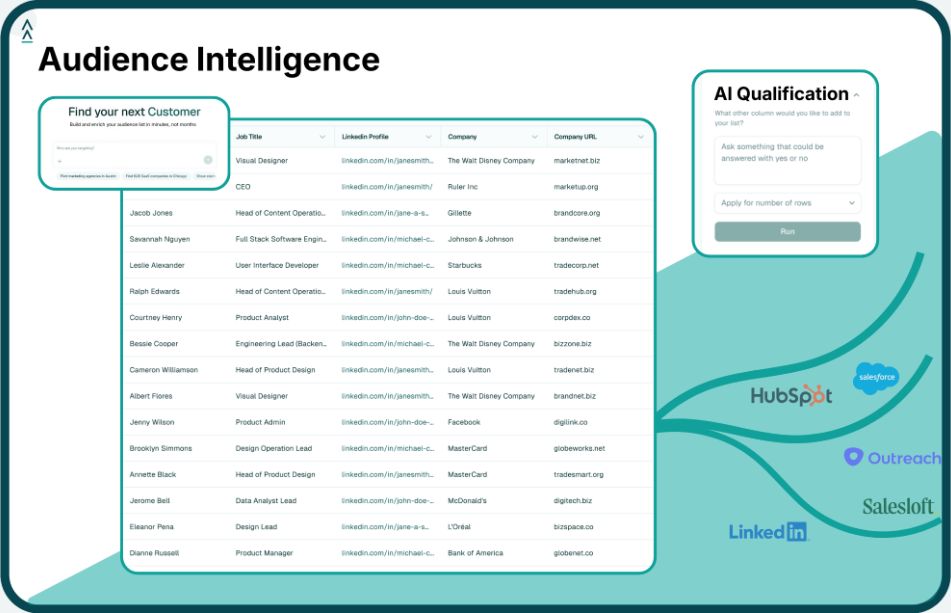
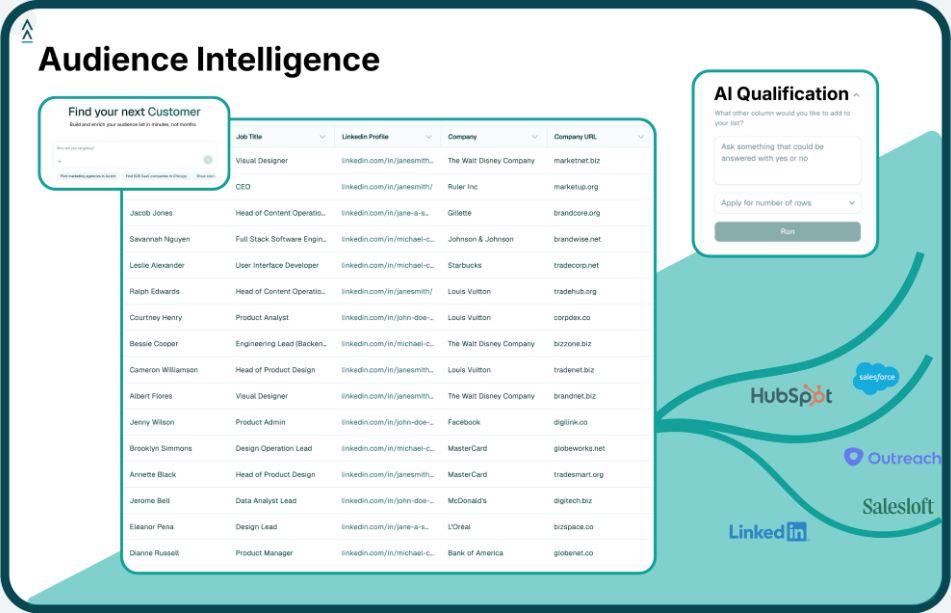
Landbase is an agent that reads a plain-language prompt, reasons across more than 1,500 enrichment fields per company, interprets lookalike seeds along multiple dimensions, verifies each row before returning it, and dial-tests the file before handoff. The platform runs inside Claude Code and Codex, and connects to Salesforce, HubSpot and CSV export. HubSpot sales statistics have documented how much of ABM pipeline depends on seed-based target-list design.
Across GTM teams from agencies to enterprise revenue organizations, customers have reported a 2 to 4x uplift in connect and meeting-booked rates. If your best-performing lists use lookalike seeds, send Landbase the seed set and the platform will expand and score it in one pass at no cost. Start a lookalike pass here. For the vendor-by-vendor view, read our Landbase vs Clay comparison.
Three to five is the sweet spot in the operator corpus. Fewer than three leaves too much interpretation room, which lets the system weight dimensions in ways that may not match the operator intent. More than five tends to narrow the pattern so aggressively that the returned universe is too small to work.
Yes, when the operator intent is to combine them. For example, a seed set of Ramp, Brex and Mercury expands into fintech-SMB. A seed set of Ramp, Brex, Mercury, Stripe and Vercel expands into developer-first business-infrastructure. The expansion follows the common pattern across the seeds, so mixed categories test the system's ability to detect multi-dimensional similarity.
The agent considers the most salient dimensions of similarity and weights them against the apparent operator intent (if the prompt is otherwise empty, Stripe's payments and developer-infrastructure positions dominate). The returned list typically covers both axes. Operators who want a specific axis should specify it in the prompt.
Yes. ABM target-list building is one of the most common use cases for lookalike expansion. The operator typically starts with a seed set of best-fit current customers or best-converting prospects, and the system returns more companies that match the pattern. The precision of the expansion determines the hit rate of the ABM motion.
The full report, with every prompt scored across all four vendors and the family-level averages, lives on the GTMBench page.
Tool and strategies modern teams need to help their companies grow.