.png)
.png)

Daniel Saks
Chief Executive Officer


Buyers evaluate prospecting tools on database size, filter counts and coverage claims. None of those numbers predict what reaches the sales floor. A 60,000-row pool at 23% precision delivers the same qualified contacts as a 1,300-row pool at 77%, and burns four times the rep hours getting there.
A bad list eats a week of SDR calendar on wrong accounts, which costs more than any database bill. Salesforce State of Sales research reports that sales reps spend only 28% of their week actually selling. Harvard Business Review coverage of B2B selling documents similar patterns across industries. The 2026 GTMBench tested whether the two popular approaches to automated prospecting, agent reasoning and workflow building, change those numbers in different ways. This post compares the agent approach Landbase uses with the workflow approach Clay uses, prompt by prompt.
Clay is a workflow builder. Operators compose multi-step pipelines across more than 200 data providers in Clay's marketplace, chain the output of one step into the next, and layer AI research steps where catalog data runs out. The company's own documentation describes the platform as infrastructure to get any data, run agentic workflows and launch GTM plays. Pricing on Clay's published tiers starts at $167 per month on the Launch plan and reaches $446 on Growth, with Enterprise beyond that. TechCrunch coverage reported a $100 million round at a $3.1 billion valuation in August 2025.
Landbase is an agent that reasons over the dataset. The operator writes a prompt in plain language. The agent decides which criteria apply, pulls the records, and verifies each company against every condition before returning a row. The operator describes the audience in plain language. The system handles the composition. The platform runs inside Claude Code and Codex, reasoning across more than 1,500 enrichment fields per company.
The two approaches test differently against different kinds of prompts, and the benchmark structure made the pattern visible.
The benchmark used 26 prompts drawn from a corpus of 50,000 natural-language queries that Landbase operators had run on the platform. Prompts covered four families: firmographic (facts a vendor already stores, like industry and headcount), derived (facts a vendor would have to compute from raw data), lookalike (a seed set plus find more like these) and concept (loose labels like sticky brands or creator economy startups). You can read the full GTMBench methodology for the per-prompt scoring rules.
Landbase scored 76.7% precision on average. Clay scored 47.9%. Precision is defined as the share of returned rows that met every stated criterion when a judge re-scraped the row from LinkedIn and scored it against the original prompt. On a 1,000-row list, Landbase delivered 767 qualifying rows. Clay delivered 479.
The first 100 rows mattered more than the full list for operator economics. Landbase scored 76.1% on the first 100. Clay scored 40.6%. Rep attention is the scarce resource; a top-of-list that is already noisy stays noisy however long the file runs. McKinsey research on sales productivity has quantified how much of a rep's week vanishes to list hygiene when the top of a file is unreliable.
Across 26 prompts, Landbase won 18 outright. Clay won 4. The remaining 4 were tied or close enough that neither cleared the other's precision band.
Three prompts in the set broke Clay entirely. The system has no attribute for the criterion the prompt asked for, so its builder returned an empty filter set and the prompt was scored 0.
The three were LinkedIn followers grew more than 20% last quarter, 90th-percentile engineering tenure under 18 months, and AE-to-SDR ratio between 1.5 and 3. Each is a derived measure. Each requires computing a statistic from underlying records. None of the measures corresponds to a field in Clay's schema, so no amount of filter composition could reach the answer.
Landbase scored 100%, 96.1% and 100% on the three. The agent read the raw LinkedIn signals, computed the derived measure per company, and returned only the companies where the computed value cleared the threshold.
The gap is structural. Forrester research on B2B data readiness has noted that enterprise buyers increasingly ask questions their vendor catalogs cannot answer, especially when the question involves a time trend or a ratio across people within a company. A catalog can only match what it already stores. For a deeper look at the three prompts, see our write-up on the derived criterion problem.
Clay led one prompt family in the benchmark. On firmographic prompts, where the criterion matches a stored attribute, Clay scored 72.7% precision against Landbase's 68.9%. A 4-point lead on these prompts.
The pattern makes sense. Commercial HVAC contractors in Ohio with 50 to 200 employees names the industry, geography and headcount band. All three sit in Clay's schema. A dropdown is sufficient to reach them. Agent reasoning adds latency without adding precision because the criterion is already a column.
Four of Clay's benchmark wins fell in this family. The other 22 prompts in the benchmark required computed or interpreted criteria, and the lead shifted to Landbase on those.
A buyer whose workflow is dominated by firmographic lookups, such as manufacturers in Iowa, credit unions in the Pacific Northwest, or software companies in the UK with 200 to 1,000 employees, would see Clay compete head to head, at a speed advantage. The honest question is how dominant that workflow actually is. If the sales team's best-performing lists use a derived criterion like hiring signals, team-mix ratios or growth-stage shifts, the firmographic win rate matters less to the final choice.
Landbase is slower. 134 seconds to finish a list on average, against Clay's 17 seconds. The agent writes its own criteria, fetches the records, and checks every company against every condition before returning a row.
The extra time is the mechanism behind the precision gap. Per-company reasoning is expensive in clock seconds. It also produces the first-100 accept rate of 76% that defines whether a rep works the file or hands it back.
Gartner research on sales technology adoption has argued that buyers trade latency for accuracy when the downstream cost of a bad list is high. A 2-minute wait is lower than the 2-week cost of chasing wrong accounts.
The trade is honest. A team that needs a list in the next 30 seconds to feed a webhook is better served by a filter dropdown. A team that is going to spend the next week dialing the file is better served by a reasoning pass that returns qualifying rows at a higher rate.
Clay publishes four tiers. Free covers 500 actions per month and 100 data credits. Launch at $167 per month lifts the ceiling to 15,000 actions and 3,000 credits. Growth at $446 per month covers 40,000 actions and 6,000 credits plus CRM auto-sync. Enterprise is custom. The pricing structure assigns a credit cost per data pull and an action cost per workflow step. A multi-step enrichment burns multiple credits and multiple actions per row.
Landbase prices per credit at a fixed per-contact and per-phone rate, with enrichment and verification wrapped in. A list that returns 767 qualifying rows out of 1,000 consumes credits only on verified rows, because the agent verifies before enrichment.
The buyer-facing question is cost per qualifying contact. Row count is a weaker proxy. On GTMBench's measured precision rates, a Clay list priced at the Growth tier returns 479 qualifying contacts per 1,000 credits consumed. The same credit budget on Landbase returns 767. Our pricing page carries the per-credit breakdown.
Clay is the right tool when the operator is a GTM engineer building a repeatable, multi-step pipeline across many data providers, when the criteria are already schema-mapped, and when the speed-to-webhook is the critical path. The 500,000-plus Clay customers include teams at Anthropic, Rippling and Intercom that fit this shape, per Clay's own customer page.
Landbase is the right tool when the list criterion is derived, lookalike or concept-level, when precision matters more than speed, and when the operator prefers to describe the audience in plain language. The 2 to 4x uplift in connect and meeting-booked rates that Landbase customers report comes from working lists where every top-100 row cleared verification.
Teams running both have reported sourcing the universe in Clay and running the output through Landbase as a precision pass before handoff. The two systems address different stages of the same workflow. For the vendor-by-vendor view, read our Landbase vs Apollo comparison and Landbase vs ZoomInfo comparison.
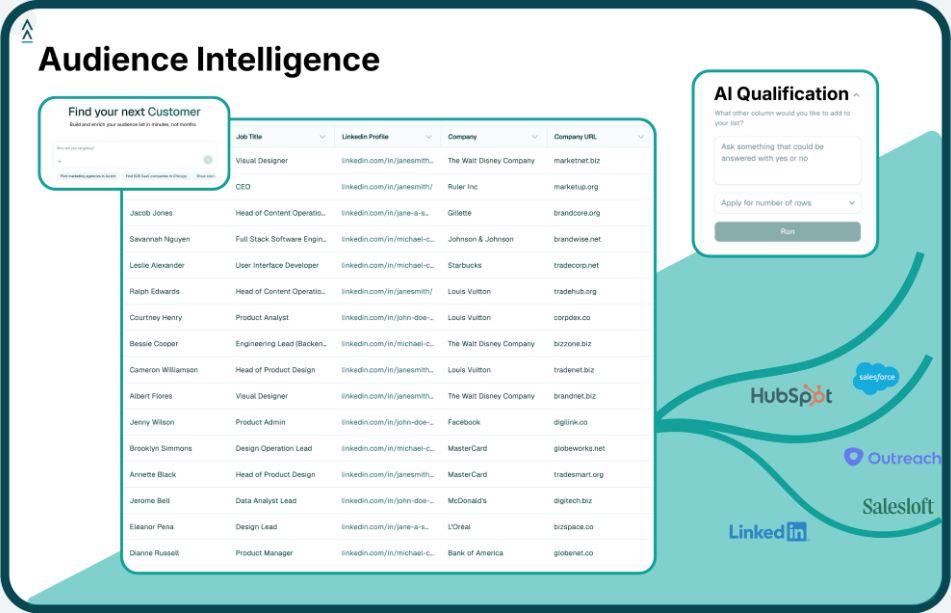
Landbase is an agent that reads a plain-language prompt, reasons across more than 1,500 enrichment fields per company, verifies each row before returning it, and dial-tests the file before handoff. The platform runs inside Claude Code and Codex, and connects to Salesforce, HubSpot and CSV export.
Across GTM teams from agencies to enterprise revenue organizations, customers have reported a 2 to 4x uplift in connect and meeting-booked rates against incumbent prospecting stacks. Send Landbase a list already pulled from Clay, ZoomInfo or Apollo, and the platform will qualify, expand and score it in one pass at no cost. Start a qualification pass here.
GTMBench is a prospecting benchmark that scores natural-language list-building prompts across Landbase, Clay, Apollo and ZoomInfo. The 2026 edition tested 26 prompts drawn from a corpus of 50,000 natural-language queries that Landbase operators had run on the platform. Each row every system returned was re-scraped from LinkedIn and judged row by row against the original prompt. The report was published by the Landbase AI Lab.
Clay led the firmographic family at 72.7%, and firmographic prompts were 8 of 26 in the benchmark. The remaining 18 prompts belonged to derived, lookalike and concept families, where Landbase led by 57, 25 and 16 percentage points respectively. The average across all 26 pulls the Clay number down because derived prompts are harder for any filter-based tool.
For the three prompts that broke Clay in the benchmark, no. Follower growth, tenure percentiles and AE-to-SDR ratio require computing a statistic from underlying LinkedIn records that are not in Clay's schema. A workflow can compose only against stored attributes. The three prompts returned empty filter sets.
It depends on the use case. If the list runs against a webhook or an inbound signal, 134 seconds is too long. If the list is going to be worked by SDRs over the next week, the latency buys 29 percentage points of first-100 precision that pays itself back in rep hours. HubSpot sales statistics have documented how much of an SDR week is spent on activities that depend on list quality.
Yes. Teams have reported pulling a broad list from Clay or ZoomInfo, then running that list through Landbase as a precision and derived-criteria pass before handoff. The two systems address different stages of the same workflow.

Tool and strategies modern teams need to help their companies grow.






