Daniel Saks
Chief Executive Officer


Buying signals are observable events that suggest a company has a reason to buy now: a new hire, a funding round, a tool added or dropped, a spike in website visits, a new executive, a new office. Most outbound lists sort by fit alone, so reps reach good accounts at the wrong moment. A signal adds the missing variable, which is timing.
This playbook covers the six buying signals worth prospecting on, how to rank them, how long each stays fresh and how to build each list in Landbase. Some signals are native search filters, some need a research query that quotes credits before it runs, and some come only from your own systems. For the tools that track them, see the roundup of buyer signal tracking tools.
A B2B buying signal is a change at an account that raises the odds it will evaluate a solution like yours in the next one to two quarters. The signal is not the purchase. It is evidence of a new budget, a new owner, a new problem or a new tool, and each of those tends to start a buying cycle. For the definition in more depth, see what buying signals mean in B2B sales.
Buyers do most of the work before a seller hears about it. Gartner research reports that B2B buyers spend about 17% of their buying time meeting potential suppliers, split across every vendor they consider, according to Gartner. The 2025 6sense Buyer Experience Report, a survey of nearly 4,000 B2B buyers, found that buyers first contacted sellers about 61% of the way through their process, that 79% of buyers initiated that first contact themselves, and that buying groups had filled four of five shortlist spots on day one, per a summary of the 6sense report. A signal is the earliest outside view of that hidden work, which is why reaching an account inside its window matters.
An event signal happened on a date: a round closed, a VP started, a job post went live. A state signal is a standing fact: the company uses Salesforce, it is a Series B company. Events carry timing; states carry fit. The strongest lists use one of each.
First-party signals come from your own properties (pricing page visits, demo requests, email replies). Third-party signals are public or purchased (job posts, funding announcements, technographics, topic intent). First-party signals are rarer and stronger because the account is researching you specifically.
A job post for a RevOps manager, a security engineer or a first VP of Sales means a budgeted seat and a problem the company has decided to staff. A first-time role is stronger than a backfill. The playbook for this signal is how to use hiring signals for prospecting.
New capital usually comes with a growth plan the board expects to see executed, which means new hires, new tools and new vendors. Stage matters: a Series A company buys its first systems, a Series C company replaces them. See the funding signals playbook.
A company that uses a competitor, a complement or an integration partner is a fit signal on its own. A change in that stack is a timing signal: a new install creates integration work, and a removal opens a replacement decision. See how to find companies using competitor tech.
Repeat visits from one account, pricing page views and docs views are the most direct evidence that a company is researching you. They are also the shortest-lived. The playbook is how to use website intent signals.
New executives tend to review the stack and the vendors they inherited. A new CRO, CMO or CIO is a short window to be part of that review. The base rate is high: the median wage and salary worker had been with their employer 4.1 years in January 2026, according to the Bureau of Labor Statistics, so leadership seats turn over constantly.
A new office, a new country, a new product line or a fast rise in headcount all create work that the current stack was not sized for. Expansion is a slower signal than hiring or website intent, but it often explains the others.
Each signal has a different source, and the honest answer decides how you build the list.
Rank signals on three questions: is it about you, is it recent, and is it independent of the other signals on the account.
Treat this order as a default and reorder it from your own closed-won data. Two independent signals on one account (for example, funding plus a RevOps job post) usually beat one strong signal, which is the core of how to stack buying signals.
The steps use one example ICP throughout: US B2B software companies with 50-500 employees, selling to VPs of Sales and heads of RevOps. Run them in the Landbase app or connect Landbase to Claude Code.
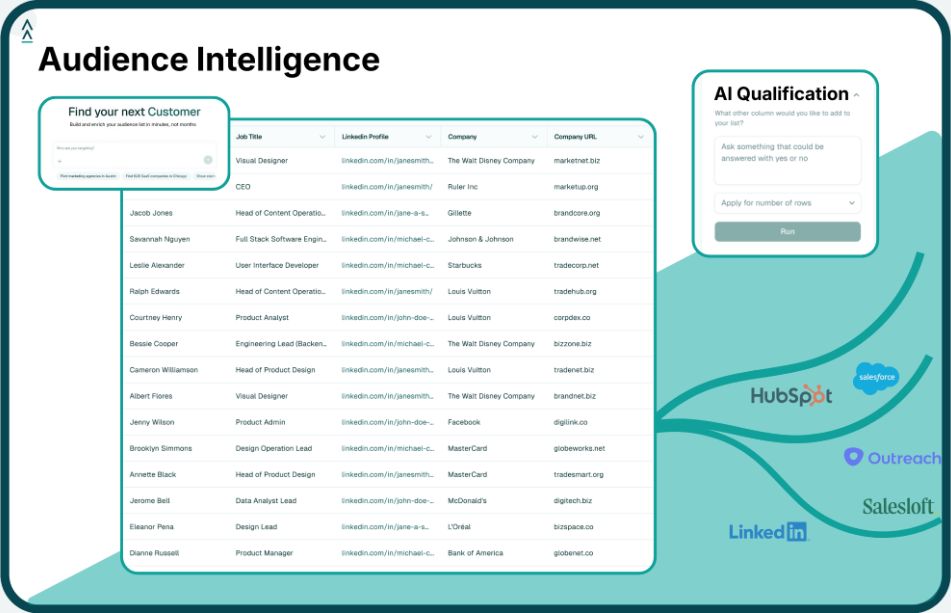
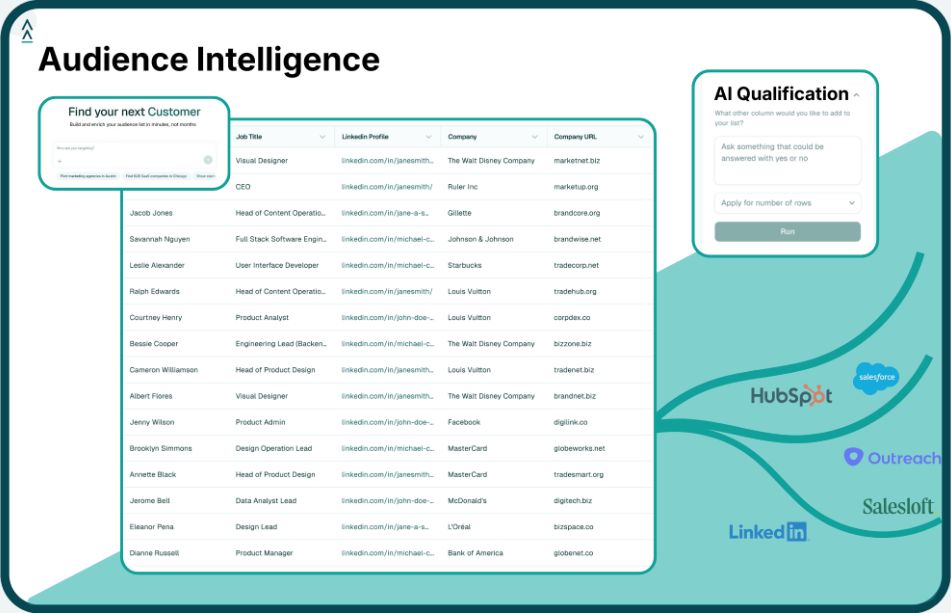
Ask how many US B2B software companies with 50-500 employees use Salesforce. Landbase returns a count before you build anything. A Landbase search run in November 2026 returned 11,742 US software companies with 50-500 employees, of which 6,471 had a detected Salesforce product. The agent labeled that a candidate count and recommended an AI qualification step to confirm which rows are B2B software companies; that step uses credits and quotes them first.
Ask for US B2B software companies with 50-500 employees whose latest round is Series A or B. The search applies headquarters country, employee count and latest funding round. A November 2026 run of this search returned 3,872 US companies with 50-500 employees whose latest round was a Series A or B, before any B2B software qualification. The searchable field is the latest round, so a company that has since raised a Series C drops out. For a date window such as "in the last 90 days", enrich the list with funding round history and keep only the recent rounds.
Ask for US B2B software companies with 50-500 employees that use HubSpot. The search filters on technologies used. Technographic detection is probabilistic, so confirm important rows. To catch churn, save this list, run the same search next month, and compare the two to find the companies that dropped out of the tech filter.
Ask for the same companies with open RevOps or sales operations job postings. This is a research query on job-posting data. It quotes a credit estimate before it runs, and nothing is spent until you approve. The same path covers headcount growth for expansion lists.
Ask the agent for recent CRO or VP of Sales appointments at companies on your list. It looks up announcements for accounts you already have. Treat the output as leads to verify, not a structured feed.
Export visiting accounts from your analytics or visitor-identification tool, then upload the file to Landbase. Landbase matches each visiting company to its record so you can filter it by fit and find the buyers.
Ask for VPs of Sales and heads of RevOps at the companies on a signal list, then download the contacts. The search pulls contacts only at the companies on that list. Repeat for each signal list.
For CRM exclusions, Landbase can apply a connected HubSpot or Salesforce directly, dropping people on your Do-not-contact rule and companies on your Customers rule. For a full method, see how to build exclusion layers.
Then tier the result. Tier 1 is fit plus a primary signal in window plus a corroborating signal, routed to an SDR for a personal first touch within 48 hours. Tier 2 is fit plus a primary signal in window, sent to a sequence. Tier 3 is fit only or a signal past its window, held in nurture until a new signal arrives.
Every signal decays. These windows are starting points to test against your own sales cycle, not fixed rules:
Act on day 0 to 2 for Tier 1. By day 7, every short-window signal should have had a touch. After the window, move the account to Tier 3 rather than off the list; it re-enters on the next signal. Longer enterprise cycles stretch every window. The detailed method is in how to apply signal decay windows.
Reference the likely consequence of the signal, not the signal itself.
Lines to avoid: "Congrats on the funding!" and "I noticed you visited our pricing page." The first is the same message every funded company gets that week; the second tells the buyer they were tracked without giving them a reason to reply.
Run each signal list against a control list with the same fit and no signal, and compare:
Drop or reweight any signal that does not beat the control after a few hundred accounts.
Buying signals are changes at an account that suggest it may evaluate a solution soon, such as hiring for a relevant role, raising a round, adding or dropping a tool, a new executive, expansion, or repeat visits to your website. They add timing to a fit-based list, so reps reach accounts while a project is forming rather than after a vendor shortlist is set.
First-party intent on a high-value page, such as pricing or a demo request, is usually strongest because the account is researching you. Among third-party signals, hiring for the role you sell to and a new leader in your buyer persona tend to rank highest. Two independent signals on the same account are usually more reliable than any single one, so test combinations against a control.
No. Landbase does not see your website traffic or your inbox. Export visiting accounts from your analytics or visitor-identification tool, and upload the file. Landbase then matches each company, filters it by fit and finds the buying committee. Funding stage and technologies used, by contrast, are native search filters.
It depends on the signal. Pricing page visits and demo requests go stale in about a week, website visits in about two weeks, job posts in 30 to 60 days and funding rounds in 60 to 90 days. Treat these as starting points and adjust them to your sales cycle. An account whose signal expires moves to nurture, not off the list.
The default search on native filters such as industry, headcount, location, funding stage and technologies used does not spend credits. Job postings, headcount growth and phrase matching run as research queries, which quote a credit estimate before they run. AI qualification and contact enrichment are separate steps that also quote credits first.
Signal tracking usually combines a company data platform for funding, technographics and hiring, a visitor-identification or analytics tool for website intent, a topic-intent provider for third-party research activity, and a CRM for exclusions. For a comparison of options, see the roundup of the best tools for buyer signal tracking.
Tool and strategies modern teams need to help their companies grow.